 Add to Chrome
 Add to Firefox
 Add to Edge
RIS-Aided ISAC in Cluttered Environments
Jul 18, 2026
In this paper, we analyze the performance of a communication-optimized reconfigurable intelligent surface (RIS)-assisted integrated sensing and communication (ISAC) system operating in a cluttered environment where multiple scatterers may interfere with the different types of reflected sensing signals. The RIS phases coherently combine the direct and reflected communication paths at the user equipment, whereas the corresponding radar returns remain generally misaligned. In addition, static scatterers near the radar act as environmental clutter that affects only the sensing function. For the communication link over small-scale fading, we derive an exact ergodic-capacity expression for the no-RIS baseline, a moment-matched Gamma approximation for the RIS-assisted link, and a Jensen upper bound, all of which are interpreted as upper bounds on the rate of the underlying binary phase-shift keying waveform. For sensing, our analysis focuses on the average signal-to-clutter-plus-noise ratio (SCNR) at the direct range-Doppler cell. Specifically, we derive the average powers of the direct, RIS-related, and scatterer returns, which scale as constant, linear, linear, quadratic, and constant, respectively, with the number of RIS elements. We then weigh them by the range and slow-time leakage responses to obtain the SCNR, thereby separating RIS-induced clutter from geometry-governed environmental clutter. Range and velocity estimation are evaluated using resolution-normalized metrics. Our Monte Carlo simulation results validate the analysis and show that zero-Doppler clutter leakage dominates the SCNR.

QoS-Aware Energy Optimization via Cell Switching in Heterogeneous Networks
Jan 19, 2026The growing demand for mobile data services in dense urban areas has intensified the need for energy-efficient radio access networks (RANs) in future 6G systems. In this context, one promising strategy is cell switching (CS), which dynamically deactivates underutilized small base stations (SBSs) to reduce power consumption. However, while previous research explored CS primarily based on traffic load, ensuring user quality of service (QoS) under realistic channel conditions remains a challenge. In this paper, we propose a novel optimization-driven CS framework that jointly minimizes network power consumption and guarantees user QoS by enforcing a minimum received power threshold as part of offloading decisions. In contrast to prior load-based or learning-based approaches, our method explicitly integrates channel-aware information into the CS process, thus ensuring reliable service quality for offloaded users. Furthermore, flexibility of the proposed framework enables operators to adapt system behavior between energy-saving and QoS-preserving modes by tuning a single design parameter. Simulation results demonstrate that the proposed approach achieves up to 30% power savings as compared to baseline methods while fully maintaining QoS under diverse network conditions. Scalability and robustness of the proposed method in realistic heterogeneous networks (HetNets) further highlight its potential as a practical solution for sustainable 6G deployments.
Beamforming for Massive MIMO Aerial Communications: A Robust and Scalable DRL Approach
Dec 29, 2025This paper presents a distributed beamforming framework for a constellation of airborne platform stations (APSs) in a massive Multiple-Input and Multiple-Output (MIMO) non-terrestrial network (NTN) that targets the downlink sum-rate maximization under imperfect local channel state information (CSI). We propose a novel entropy-based multi-agent deep reinforcement learning (DRL) approach where each non-terrestrial base station (NTBS) independently computes its beamforming vector using a Fourier Neural Operator (FNO) to capture long-range dependencies in the frequency domain. To ensure scalability and robustness, the proposed framework integrates transfer learning based on a conjugate prior mechanism and a low-rank decomposition (LRD) technique, thus enabling efficient support for large-scale user deployments and aerial layers. Our simulation results demonstrate the superiority of the proposed method over baseline schemes including WMMSE, ZF, MRT, CNN-based DRL, and the deep deterministic policy gradient (DDPG) method in terms of average sum rate, robustness to CSI imperfection, user mobility, and scalability across varying network sizes and user densities. Furthermore, we show that the proposed method achieves significant computational efficiency compared to CNN-based and WMMSE methods, while reducing communication overhead in comparison with shared-critic DRL approaches.
Beyond Diagonal RIS for ISAC Network: Statistical Analysis and Network Parameter Estimation
Feb 18, 2025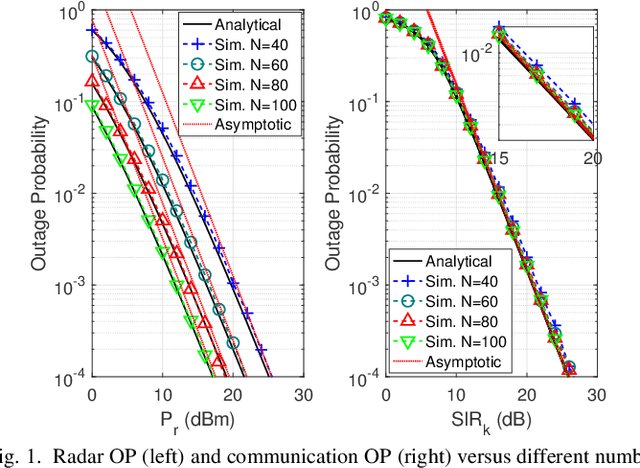
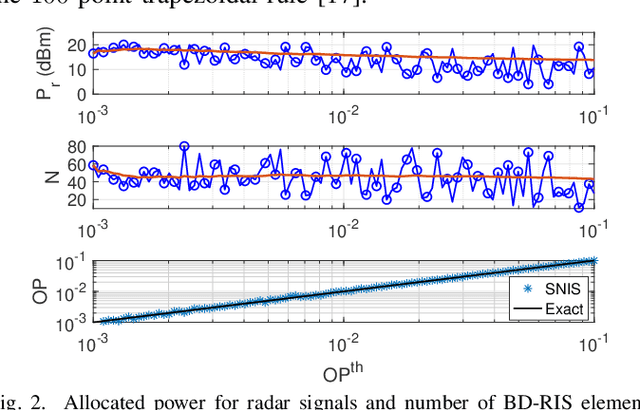
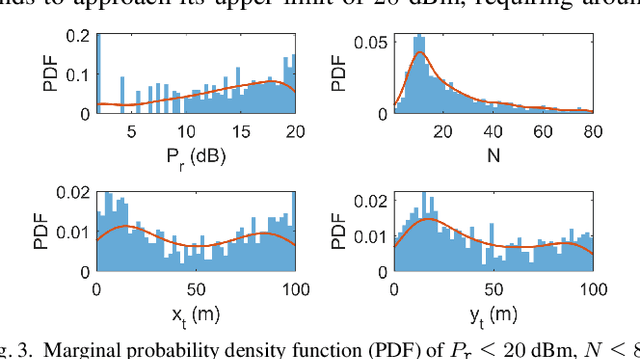
This paper investigates the use of beyond diagonal reconfigurable intelligent surface (BD-RIS) with $N$ elements to advance integrated sensing and communication (ISAC). We address a key gap in the statistical characterizations of the radar signal-to-noise ratio (SNR) and the communication signal-to-interference-plus-noise ratio (SINR) by deriving tractable closed-form cumulative distribution functions (CDFs) for these metrics. Our approach maximizes the radar SNR by jointly configuring radar beamforming and BD-RIS phase shifts. Subsequently, zero-forcing is adopted to mitigate user interference, enhancing the communication SINR. To meet ISAC outage requirements, we propose an analytically-driven successive non-inversion sampling (SNIS) algorithm for estimating network parameters satisfying network outage constraints. Numerical results illustrate the accuracy of the derived CDFs and demonstrate the effectiveness of the proposed SNIS algorithm.
Coordinated Half-Duplex/Full-Duplex Cooperative Rate-Splitting Multiple Access in Multi-Cell Networks
Sep 02, 2024This paper explores downlink Cooperative Rate-Splitting Multiple Access (C-RSMA) in a multi-cell wireless network with the assistance of Joint-Transmission Coordinated Multipoint (JT-CoMP). In this network, each cell consists of a base station (BS) equipped with multiple antennas, one or more cell-center users (CCU), and multiple cell-edge users (CEU) located at the edge of the cells. Through JT-CoMP, all the BSs collaborate to simultaneously transmit the data to all the users including the CCUs and CEUs. To enhance the signal quality for the CEUs, CCUs relay the common stream to the CEUs by operating in either half-duplex (HD) or full-duplex (FD) decode-and-forward (DF) relaying mode. In this setup, we aim to jointly optimize the beamforming vectors at the BS, the allocation of common stream rates, the transmit power at relaying users, i.e., CCUs, and the time slot fraction, aiming to maximize the minimum achievable data rate. However, the formulated optimization problem is non-convex and is challenging to solve directly. To address this challenge, we employ change-of-variables, first-order Taylor approximations, and a low-complexity algorithm based on Successive Convex Approximation (SCA). We demonstrate through simulation results the efficacy of the proposed scheme, in terms of average achievable data rate, and we compare its performance to that of four baseline schemes, including HD/FD cooperative non-orthogonal multiple access (C-NOMA), NOMA, and RSMA without user cooperation. The results show that the proposed FD C-RSMA can achieve 25% over FD C-NOMA and the proposed HD C-RSMA can achieve 19% over HD C-NOMA respectively, when the BS transmit power is 20 dBm.
Machine learning empowered Modulation detection for OFDM-based signals
Aug 15, 2024We propose a blind ML-based modulation detection for OFDM-based technologies. Unlike previous works that assume an ideal environment with precise knowledge of subcarrier count and cyclic prefix location, we consider blind modulation detection while accounting for realistic environmental parameters and imperfections. Our approach employs a ResNet network to simultaneously detect the modulation type and accurately locate the cyclic prefix. Specifically, after eliminating the environmental impact from the signal and accurately extracting the OFDM symbols, we convert these symbols into scatter plots. Due to their unique shapes, these scatter plots are then classified using ResNet. As a result, our proposed modulation classification method can be applied to any OFDM-based technology without prior knowledge of the transmitted signal. We evaluate its performance across various modulation schemes and subcarrier numbers. Simulation results show that our method achieves a modulation detection accuracy exceeding $80\%$ at an SNR of $10$ dB and $95\%$ at an SNR of $25$ dB.
Fluctuating Line-of-Sight Fading Distribution: Statistical Characterization and Applications
Aug 01, 2024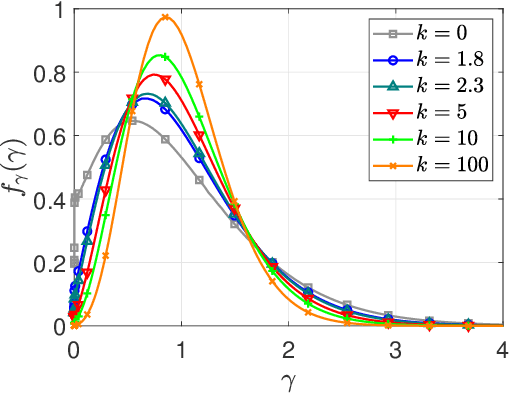
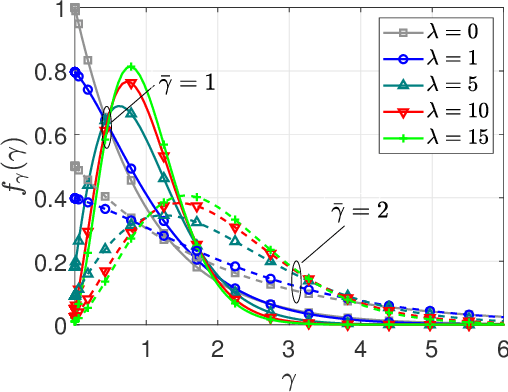
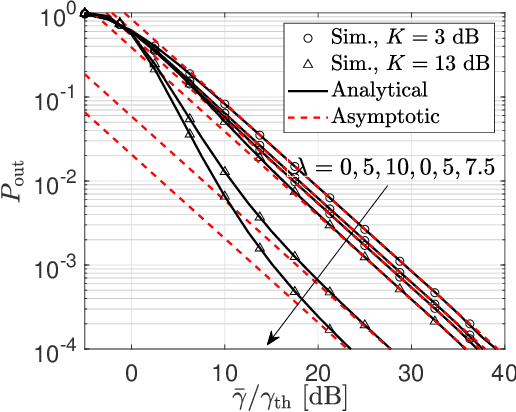
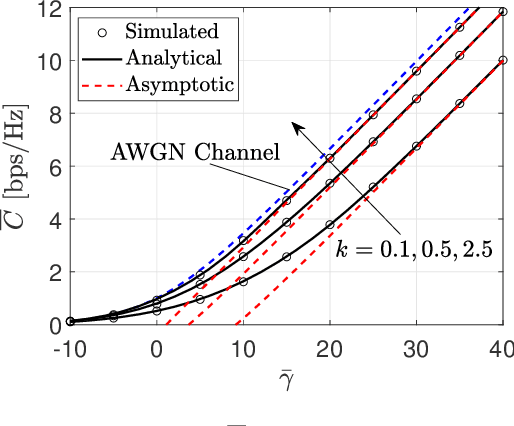
We introduce the fluctuating Line-of-Sight (fLoS) fading model, characterized by parameters $K$, $k$, $\lambda$, and $\Omega$. The fLoS fading distribution is expressed in terms of the multivariate confluent hypergeometric functions $\Psi_2$, $\Phi_3^{(n)}$, and $\Phi_3 = \Phi_3^{(2)}$ and encompasses well-known distributions, such as the Nakagami-$m$, Hoyt, Rice, and Rician shadowed fading distributions as special cases. An efficient method to numerically compute the fLoS fading distribution is also addressed. Notably, for a positive integer $k$, the fLoS fading distribution simplifies to a finite mixture of $\kappa$-$\mu$ distributions. Additionally, we analyze the outage probability and Ergodic capacity, presenting a tailored Prony's approximation method for the latter. Numerical results are presented to show the impact of the fading parameters and verify the accuracy of the proposed approximation. Moreover, we illustrate an application of the proposed fLoS fading distribution for characterizing wireless systems affected by channel aging.
Ground-to-UAV and RIS-assisted UAV-to-Ground Communication Under Channel Aging: Statistical Characterization and Outage Performance
Aug 01, 2024This paper studies the statistical characterization of ground-to-air (G2A) and reconfigurable intelligent surface (RIS)-assisted air-to-ground (A2G) communications in RIS-assisted UAV networks under the impact of channel aging. A comprehensive channel model is presented, which incorporates the time-varying fading, three-dimensional (3D) mobility, Doppler shifts, and the effects of channel aging on array antenna structures. We provide analytical expressions for the G2A signal-to-noise ratio (SNR) probability density function (PDF) and cumulative distribution function (CDF), demonstrating that the G2A SNR follows a mixture of noncentral $\chi^2$ distributions. The A2G communication is characterized under RIS arbitrary phase-shift configurations, showing that the A2G SNR can be represented as the product of two correlated noncentral $\chi^2$ random variables (RVs). Additionally, we present the PDF and the CDF of the product of two independently distributed noncentral $\chi^2$ RVs, which accurately characterize the A2G SNR's distribution. Our paper confirms the effectiveness of RISs in mitigating channel aging effects within the coherence time. Finally, we propose an adaptive spectral efficiency method that ensures consistent system performance and satisfactory outage levels when the UAV and the ground user equipments are in motion.
Aging-Resistant Wideband Precoding in 5G and Beyond Using 3D Convolutional Neural Networks
Jul 10, 2024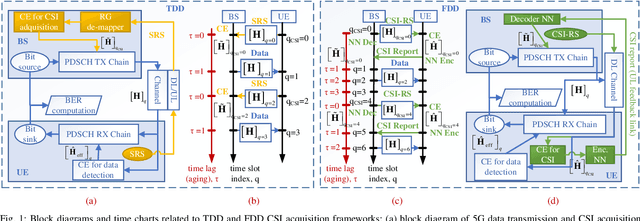
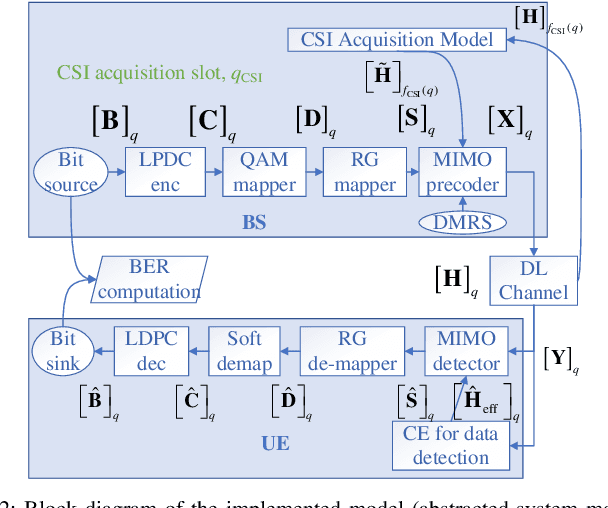
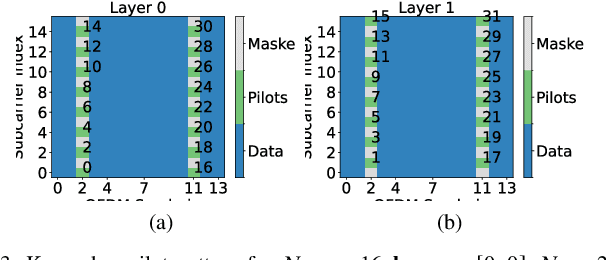
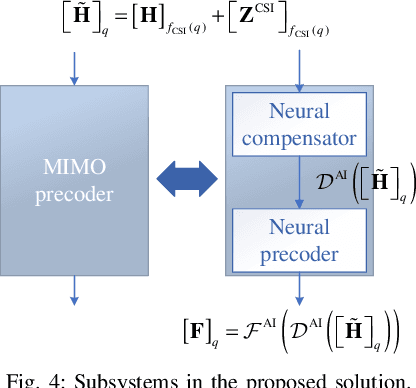
To meet the ever-increasing demand for higher data rates, 5G and 6G technologies are shifting transceivers to higher carrier frequencies, to support wider bandwidths and more antenna elements. Nevertheless, this solution poses several key challenges: i) increasing the carrier frequency and bandwidth leads to greater channel frequency selectivity in time and frequency domains, and ii) the greater the number of antennas the greater the the pilot overhead for channel estimation and the more prohibitively complex it becomes to determine the optimal precoding matrix. This paper presents two deep-learning frameworks to solve these issues. Firstly, we propose a 3D convolutional neural network (CNN) that is based on image super-resolution and captures the correlations between the transmitting and receiving antennas and the frequency domains to combat frequency selectivity. Secondly, we devise a deep learning-based framework to combat the time selectivity of the channel that treats channel aging as a distortion that can be mitigated through deep learning-based image restoration techniques. Simulation results show that combining both frameworks leads to a significant improvement in performance compared to existing techniques with little increase in complexity.
DRL-Based Dynamic Channel Access and SCLAR Maximization for Networks Under Jamming
Feb 02, 2024This paper investigates a deep reinforcement learning (DRL)-based approach for managing channel access in wireless networks. Specifically, we consider a scenario in which an intelligent user device (iUD) shares a time-varying uplink wireless channel with several fixed transmission schedule user devices (fUDs) and an unknown-schedule malicious jammer. The iUD aims to harmoniously coexist with the fUDs, avoid the jammer, and adaptively learn an optimal channel access strategy in the face of dynamic channel conditions, to maximize the network's sum cross-layer achievable rate (SCLAR). Through extensive simulations, we demonstrate that when we appropriately define the state space, action space, and rewards within the DRL framework, the iUD can effectively coexist with other UDs and optimize the network's SCLAR. We show that the proposed algorithm outperforms the tabular Q-learning and a fully connected deep neural network approach.