 Add to Chrome
 Add to Firefox
 Add to Edge
Have we built machines that think like people?
Nov 27, 2023
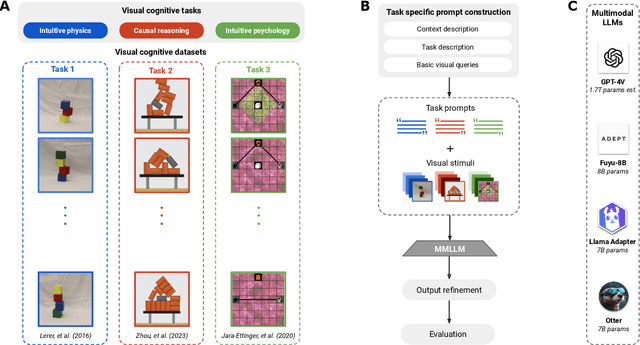
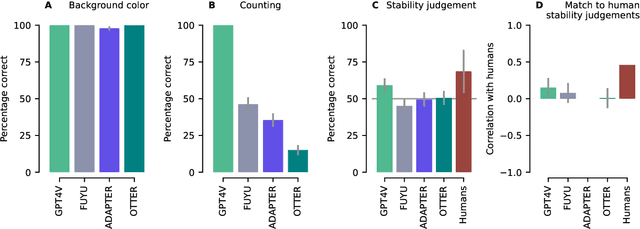
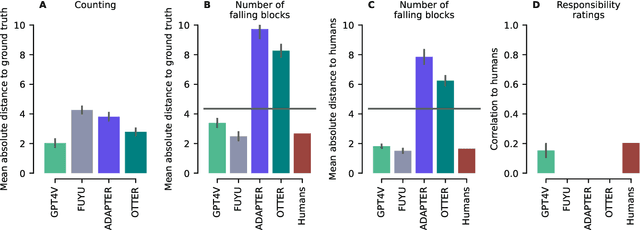
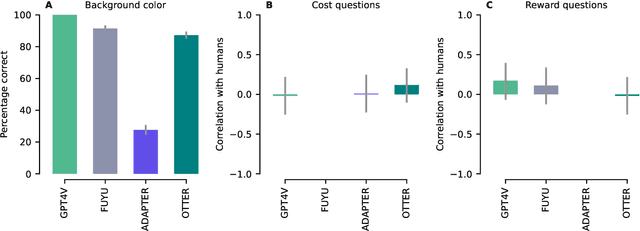
A chief goal of artificial intelligence is to build machines that think like people. Yet it has been argued that deep neural network architectures fail to accomplish this. Researchers have asserted these models' limitations in the domains of causal reasoning, intuitive physics, and intuitive psychology. Yet recent advancements, namely the rise of large language models, particularly those designed for visual processing, have rekindled interest in the potential to emulate human-like cognitive abilities. This paper evaluates the current state of vision-based large language models in the domains of intuitive physics, causal reasoning, and intuitive psychology. Through a series of controlled experiments, we investigate the extent to which these modern models grasp complex physical interactions, causal relationships, and intuitive understanding of others' preferences. Our findings reveal that, while these models demonstrate a notable proficiency in processing and interpreting visual data, they still fall short of human capabilities in these areas. The models exhibit a rudimentary understanding of physical laws and causal relationships, but their performance is hindered by a lack of deeper insights-a key aspect of human cognition. Furthermore, in tasks requiring an intuitive theory of mind, the models fail altogether. Our results emphasize the need for integrating more robust mechanisms for understanding causality, physical dynamics, and social cognition into modern-day, vision-based language models, and point out the importance of cognitively-inspired benchmarks.

Continual Learning: Applications and the Road Forward
Nov 21, 2023


Continual learning is a sub-field of machine learning, which aims to allow machine learning models to continuously learn on new data, by accumulating knowledge without forgetting what was learned in the past. In this work, we take a step back, and ask: "Why should one care about continual learning in the first place?". We set the stage by surveying recent continual learning papers published at three major machine learning conferences, and show that memory-constrained settings dominate the field. Then, we discuss five open problems in machine learning, and even though they seem unrelated to continual learning at first sight, we show that continual learning will inevitably be part of their solution. These problems are model-editing, personalization, on-device learning, faster (re-)training and reinforcement learning. Finally, by comparing the desiderata from these unsolved problems and the current assumptions in continual learning, we highlight and discuss four future directions for continual learning research. We hope that this work offers an interesting perspective on the future of continual learning, while displaying its potential value and the paths we have to pursue in order to make it successful. This work is the result of the many discussions the authors had at the Dagstuhl seminar on Deep Continual Learning, in March 2023.
Visual Data-Type Understanding does not emerge from Scaling Vision-Language Models
Oct 16, 2023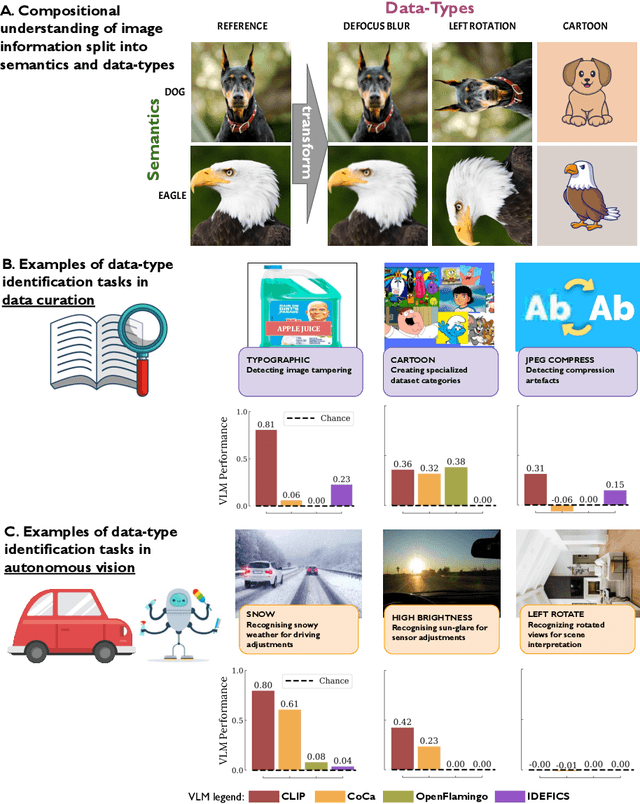
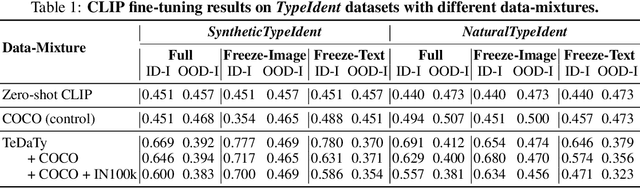
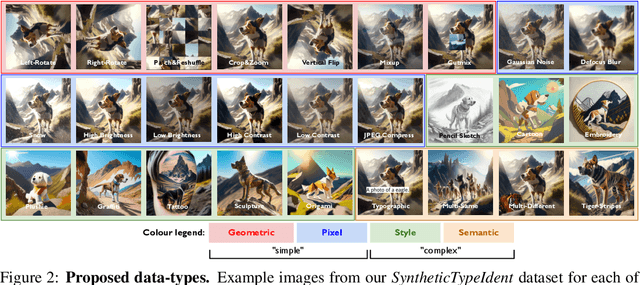
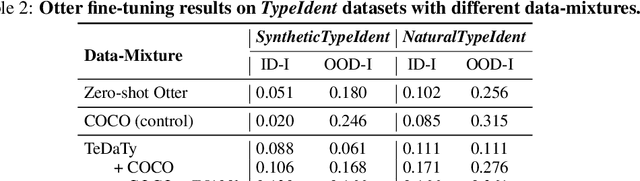
Recent advances in the development of vision-language models (VLMs) are yielding remarkable success in recognizing visual semantic content, including impressive instances of compositional image understanding. Here, we introduce the novel task of Visual Data-Type Identification, a basic perceptual skill with implications for data curation (e.g., noisy data-removal from large datasets, domain-specific retrieval) and autonomous vision (e.g., distinguishing changing weather conditions from camera lens staining). We develop two datasets consisting of animal images altered across a diverse set of 27 visual data-types, spanning four broad categories. An extensive zero-shot evaluation of 39 VLMs, ranging from 100M to 80B parameters, shows a nuanced performance landscape. While VLMs are reasonably good at identifying certain stylistic \textit{data-types}, such as cartoons and sketches, they struggle with simpler data-types arising from basic manipulations like image rotations or additive noise. Our findings reveal that (i) model scaling alone yields marginal gains for contrastively-trained models like CLIP, and (ii) there is a pronounced drop in performance for the largest auto-regressively trained VLMs like OpenFlamingo. This finding points to a blind spot in current frontier VLMs: they excel in recognizing semantic content but fail to acquire an understanding of visual data-types through scaling. By analyzing the pre-training distributions of these models and incorporating data-type information into the captions during fine-tuning, we achieve a significant enhancement in performance. By exploring this previously uncharted task, we aim to set the stage for further advancing VLMs to equip them with visual data-type understanding. Code and datasets are released at https://github.com/bethgelab/DataTypeIdentification.
Does CLIP's Generalization Performance Mainly Stem from High Train-Test Similarity?
Oct 14, 2023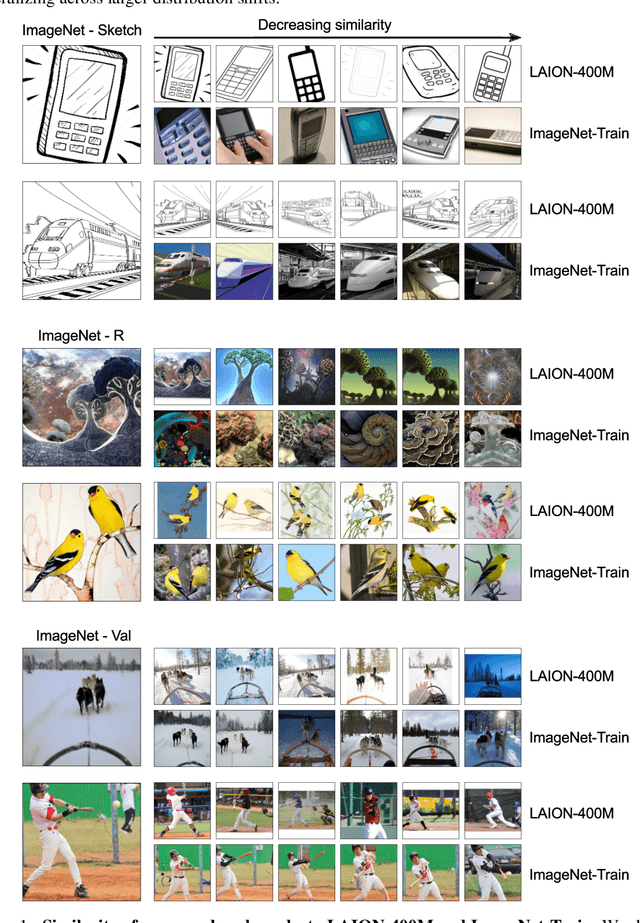
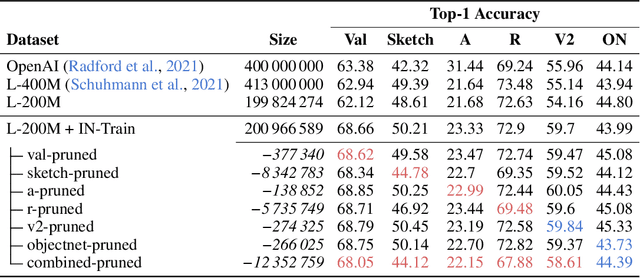
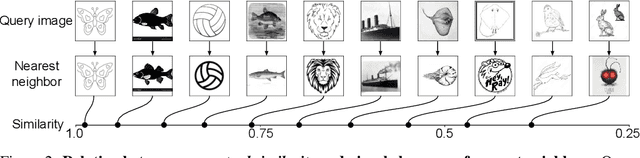
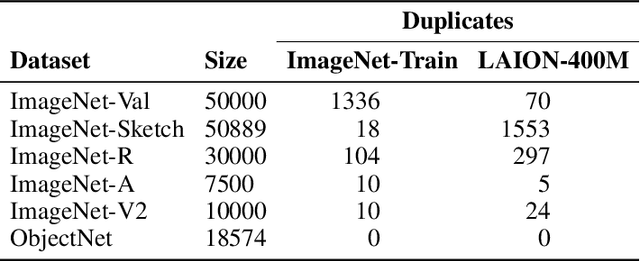
Foundation models like CLIP are trained on hundreds of millions of samples and effortlessly generalize to new tasks and inputs. Out of the box, CLIP shows stellar zero-shot and few-shot capabilities on a wide range of out-of-distribution (OOD) benchmarks, which prior works attribute mainly to today's large and comprehensive training dataset (like LAION). However, it is questionable how meaningful terms like out-of-distribution generalization are for CLIP as it seems likely that web-scale datasets like LAION simply contain many samples that are similar to common OOD benchmarks originally designed for ImageNet. To test this hypothesis, we retrain CLIP on pruned LAION splits that replicate ImageNet's train-test similarity with respect to common OOD benchmarks. While we observe a performance drop on some benchmarks, surprisingly, CLIP's overall performance remains high. This shows that high train-test similarity is insufficient to explain CLIP's OOD performance, and other properties of the training data must drive CLIP to learn more generalizable representations. Additionally, by pruning data points that are dissimilar to the OOD benchmarks, we uncover a 100M split of LAION ($\frac{1}{4}$th of its original size) on which CLIP can be trained to match its original OOD performance.
Provable Compositional Generalization for Object-Centric Learning
Oct 09, 2023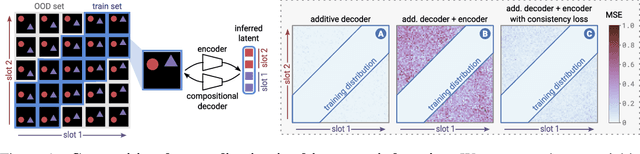
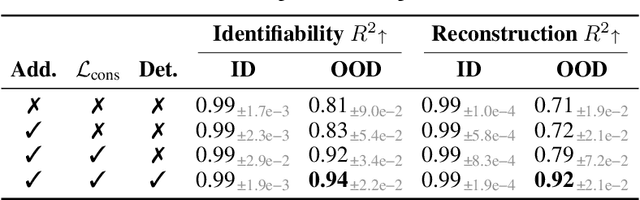
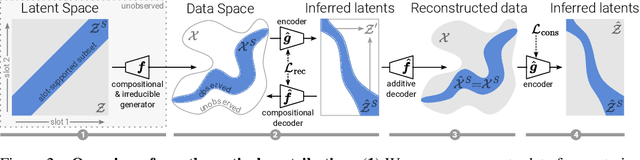
Learning representations that generalize to novel compositions of known concepts is crucial for bridging the gap between human and machine perception. One prominent effort is learning object-centric representations, which are widely conjectured to enable compositional generalization. Yet, it remains unclear when this conjecture will be true, as a principled theoretical or empirical understanding of compositional generalization is lacking. In this work, we investigate when compositional generalization is guaranteed for object-centric representations through the lens of identifiability theory. We show that autoencoders that satisfy structural assumptions on the decoder and enforce encoder-decoder consistency will learn object-centric representations that provably generalize compositionally. We validate our theoretical result and highlight the practical relevance of our assumptions through experiments on synthetic image data.
Compositional Generalization from First Principles
Jul 10, 2023Leveraging the compositional nature of our world to expedite learning and facilitate generalization is a hallmark of human perception. In machine learning, on the other hand, achieving compositional generalization has proven to be an elusive goal, even for models with explicit compositional priors. To get a better handle on compositional generalization, we here approach it from the bottom up: Inspired by identifiable representation learning, we investigate compositionality as a property of the data-generating process rather than the data itself. This reformulation enables us to derive mild conditions on only the support of the training distribution and the model architecture, which are sufficient for compositional generalization. We further demonstrate how our theoretical framework applies to real-world scenarios and validate our findings empirically. Our results set the stage for a principled theoretical study of compositional generalization.
RDumb: A simple approach that questions our progress in continual test-time adaptation
Jun 08, 2023Test-Time Adaptation (TTA) allows to update pretrained models to changing data distributions at deployment time. While early work tested these algorithms for individual fixed distribution shifts, recent work proposed and applied methods for continual adaptation over long timescales. To examine the reported progress in the field, we propose the Continuously Changing Corruptions (CCC) benchmark to measure asymptotic performance of TTA techniques. We find that eventually all but one state-of-the-art methods collapse and perform worse than a non-adapting model, including models specifically proposed to be robust to performance collapse. In addition, we introduce a simple baseline, "RDumb", that periodically resets the model to its pretrained state. RDumb performs better or on par with the previously proposed state-of-the-art in all considered benchmarks. Our results show that previous TTA approaches are neither effective at regularizing adaptation to avoid collapse nor able to outperform a simplistic resetting strategy.
Playing repeated games with Large Language Models
May 26, 2023Large Language Models (LLMs) are transforming society and permeating into diverse applications. As a result, LLMs will frequently interact with us and other agents. It is, therefore, of great societal value to understand how LLMs behave in interactive social settings. Here, we propose to use behavioral game theory to study LLM's cooperation and coordination behavior. To do so, we let different LLMs (GPT-3, GPT-3.5, and GPT-4) play finitely repeated games with each other and with other, human-like strategies. Our results show that LLMs generally perform well in such tasks and also uncover persistent behavioral signatures. In a large set of two players-two strategies games, we find that LLMs are particularly good at games where valuing their own self-interest pays off, like the iterated Prisoner's Dilemma family. However, they behave sub-optimally in games that require coordination. We, therefore, further focus on two games from these distinct families. In the canonical iterated Prisoner's Dilemma, we find that GPT-4 acts particularly unforgivingly, always defecting after another agent has defected only once. In the Battle of the Sexes, we find that GPT-4 cannot match the behavior of the simple convention to alternate between options. We verify that these behavioral signatures are stable across robustness checks. Finally, we show how GPT-4's behavior can be modified by providing further information about the other player as well as by asking it to predict the other player's actions before making a choice. These results enrich our understanding of LLM's social behavior and pave the way for a behavioral game theory for machines.
Invariant Neural Ordinary Differential Equations
Feb 26, 2023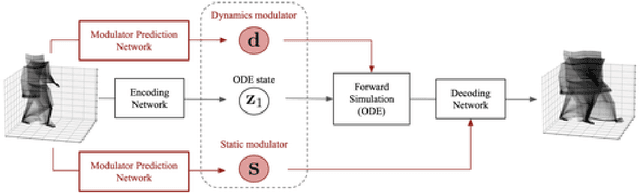
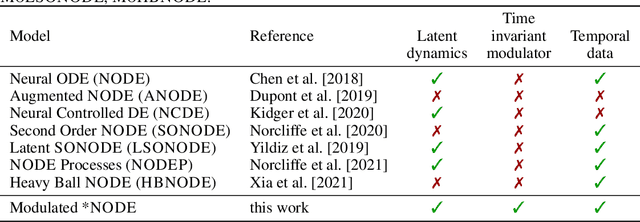
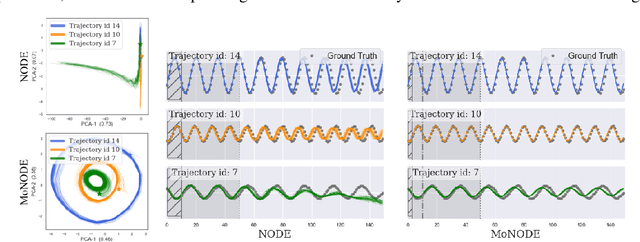
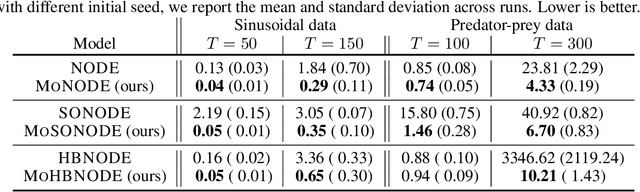
Latent neural ordinary differential equations have been proven useful for learning non-linear dynamics of arbitrary sequences. In contrast with their mechanistic counterparts, the predictive accuracy of neural ODEs decreases over longer prediction horizons (Rubanova et al., 2019). To mitigate this issue, we propose disentangling dynamic states from time-invariant variables in a completely data-driven way, enabling robust neural ODE models that can generalize across different settings. We show that such variables can control the latent differential function and/or parameterize the mapping from latent variables to observations. By explicitly modeling the time-invariant variables, our framework enables the use of recent advances in representation learning. We demonstrate this by introducing a straightforward self-supervised objective that enhances the learning of these variables. The experiments on low-dimensional oscillating systems and video sequences reveal that our disentangled model achieves improved long-term predictions, when the training data involve sequence-specific factors of variation such as different rotational speeds, calligraphic styles, and friction constants.
Disentanglement and Generalization Under Correlation Shifts
Dec 29, 2021
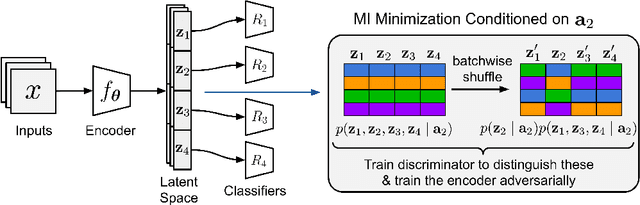
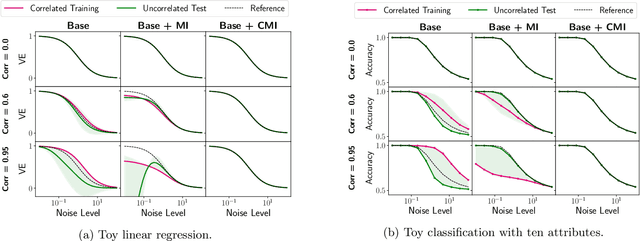
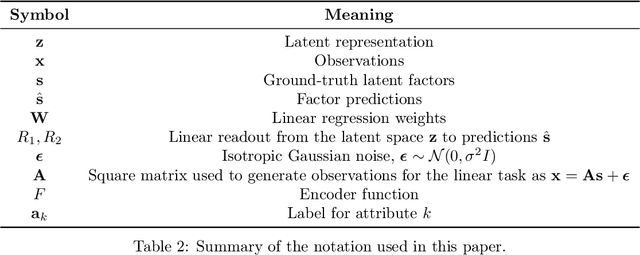
Correlations between factors of variation are prevalent in real-world data. Machine learning algorithms may benefit from exploiting such correlations, as they can increase predictive performance on noisy data. However, often such correlations are not robust (e.g., they may change between domains, datasets, or applications) and we wish to avoid exploiting them. Disentanglement methods aim to learn representations which capture different factors of variation in latent subspaces. A common approach involves minimizing the mutual information between latent subspaces, such that each encodes a single underlying attribute. However, this fails when attributes are correlated. We solve this problem by enforcing independence between subspaces conditioned on the available attributes, which allows us to remove only dependencies that are not due to the correlation structure present in the training data. We achieve this via an adversarial approach to minimize the conditional mutual information (CMI) between subspaces with respect to categorical variables. We first show theoretically that CMI minimization is a good objective for robust disentanglement on linear problems with Gaussian data. We then apply our method on real-world datasets based on MNIST and CelebA, and show that it yields models that are disentangled and robust under correlation shift, including in weakly supervised settings.