 Add to Chrome
 Add to Firefox
 Add to Edge
Sparse Delta Memory: Scaling the State of Linear RNNs through Sparsity
Jul 08, 2026
Linear attention models allow a fixed state size and a fixed amount of compute per token. However, due to their limited state size, linear attention models fall behind in long-context recall compared to softmax-attention-based transformer architectures. Increasing the state size of linear attention improves recall performance but at the cost of higher FLOPs. In this work, we introduce Sparse Delta Memory (SDM), an architecture that scales the hidden state of gated linear RNNs to orders of magnitude higher capacity using a sparse addressing scheme. SDM extends the Gated DeltaNet architecture by replacing the dense key-value outer product with sparse reads and writes to a large explicit memory. We show that, under an isoFLOP constraint and with an identical number of parameters, a higher state memory capacity significantly improves performance on in-context learning and long-context retrieval tasks. Moreover, by learning the initial state of the SDM memory and therefore using it as a parametric memory, we show that the model further improves on a wide range of common-knowledge and reasoning tasks.

QVal: Cheaply Evaluating Dense Supervision Signals for Long-Horizon LLM Agents
Jun 30, 2026LLM agents increasingly act over long horizons, where a single trajectory can contain hundreds or thousands of actions. In these settings, outcome-only rewards provide too sparse guidance, failing to inform the model about the goodness of intermediate actions. Dense supervision methods aim to solve this problem by scoring intermediate steps, from intrinsic confidence to self-distillation and embedding similarities. However, it is common practice to evaluate them by measuring the downstream performance of a training pipeline that integrates them. This is expensive, conflates supervision quality with training engineering confounders, and renders different methodological families requiring distinct training setups incomparable. As a result, dense supervision methods are rarely benchmarked on common ground. We introduce QVal, a training-free testbed for directly evaluating dense supervision signals. Given a state-action pair, QVal measures how well a method's score is Q-aligned: whether it orders actions according to the Q-values of a strong reference-policy. This lets us compare signals before any training run and separate signal quality from other engineering choices. We instantiate QVal as QVal-v1.0, benchmarking 21 dense supervision methods across four diverse environments and seven methodological families, with over 1.2K evaluation experiments across six open-weight model backbones. We find that simple prompting baselines consistently outperform recent dense supervision methods from the literature, and that performance clusters strongly by family. These findings hold across model sizes, environments, and observation modalities. QVal is designed to be easily extensible to new environments and methods, enabling researchers to iterate on dense supervision methods before any training run.
Intrinsic Credit Assignment for Long Horizon Interaction
Feb 12, 2026How can we train agents to navigate uncertainty over long horizons? In this work, we propose ΔBelief-RL, which leverages a language model's own intrinsic beliefs to reward intermediate progress. Our method utilizes the change in the probability an agent assigns to the target solution for credit assignment. By training on synthetic interaction data, ΔBelief-RL teaches information-seeking capabilities that consistently outperform purely outcome-based rewards for Reinforcement Learning, with improvements generalizing to out-of-distribution applications ranging from customer service to personalization. Notably, the performance continues to improve as we scale test-time interactions beyond the training horizon, with interaction-efficiency increasing even on Pass@k metrics. Overall, our work introduces a scalable training strategy for navigating uncertainty over a long-horizon, by enabling credit assignment to intermediate actions via intrinsic ΔBelief rewards.
Great Models Think Alike and this Undermines AI Oversight
Feb 06, 2025As Language Model (LM) capabilities advance, evaluating and supervising them at scale is getting harder for humans. There is hope that other language models can automate both these tasks, which we refer to as "AI Oversight". We study how model similarity affects both aspects of AI oversight by proposing a probabilistic metric for LM similarity based on overlap in model mistakes. Using this metric, we first show that LLM-as-a-judge scores favor models similar to the judge, generalizing recent self-preference results. Then, we study training on LM annotations, and find complementary knowledge between the weak supervisor and strong student model plays a crucial role in gains from "weak-to-strong generalization". As model capabilities increase, it becomes harder to find their mistakes, and we might defer more to AI oversight. However, we observe a concerning trend -- model mistakes are becoming more similar with increasing capabilities, pointing to risks from correlated failures. Our work underscores the importance of reporting and correcting for model similarity, especially in the emerging paradigm of AI oversight.
Invariant Neural Ordinary Differential Equations
Feb 26, 2023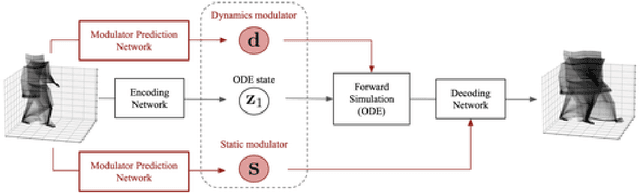
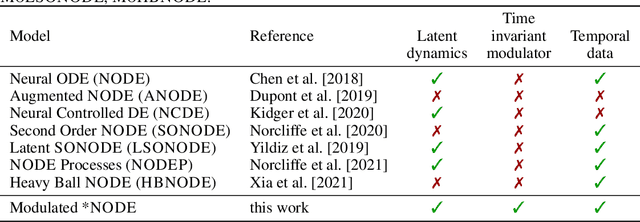
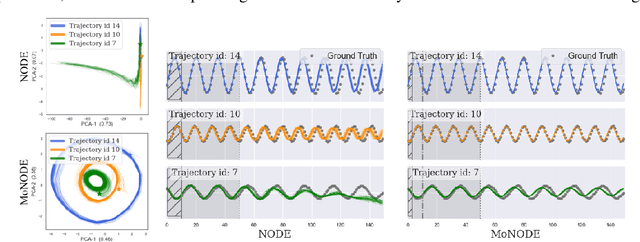
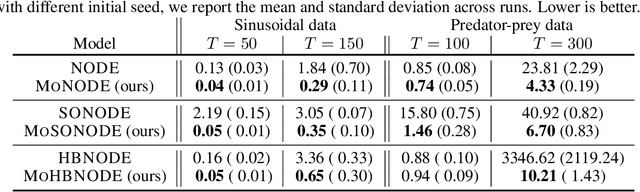
Latent neural ordinary differential equations have been proven useful for learning non-linear dynamics of arbitrary sequences. In contrast with their mechanistic counterparts, the predictive accuracy of neural ODEs decreases over longer prediction horizons (Rubanova et al., 2019). To mitigate this issue, we propose disentangling dynamic states from time-invariant variables in a completely data-driven way, enabling robust neural ODE models that can generalize across different settings. We show that such variables can control the latent differential function and/or parameterize the mapping from latent variables to observations. By explicitly modeling the time-invariant variables, our framework enables the use of recent advances in representation learning. We demonstrate this by introducing a straightforward self-supervised objective that enhances the learning of these variables. The experiments on low-dimensional oscillating systems and video sequences reveal that our disentangled model achieves improved long-term predictions, when the training data involve sequence-specific factors of variation such as different rotational speeds, calligraphic styles, and friction constants.
ABC-Di: Approximate Bayesian Computation for Discrete Data
Oct 19, 2020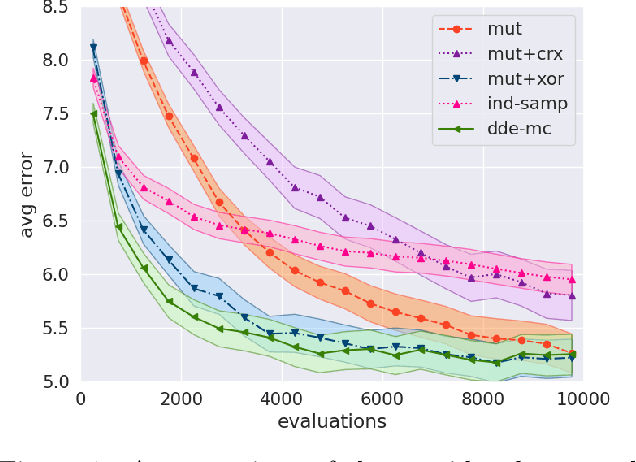
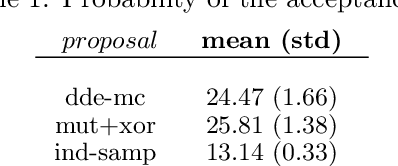
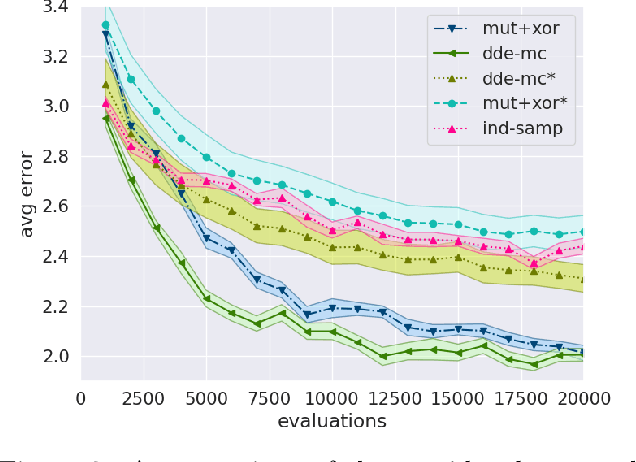

Many real-life problems are represented as a black-box, i.e., the internal workings are inaccessible or a closed-form mathematical expression of the likelihood function cannot be defined. For continuous random variables likelihood-free inference problems can be solved by a group of methods under the name of Approximate Bayesian Computation (ABC). However, a similar approach for discrete random variables is yet to be formulated. Here, we aim to fill this research gap. We propose to use a population-based MCMC ABC framework. Further, we present a valid Markov kernel, and propose a new kernel that is inspired by Differential Evolution. We assess the proposed approach on a problem with the known likelihood function, namely, discovering the underlying diseases based on a QMR-DT Network, and three likelihood-free inference problems: (i) the QMR-DT Network with the unknown likelihood function, (ii) learning binary neural network, and (iii) Neural Architecture Search. The obtained results indicate the high potential of the proposed framework and the superiority of the new Markov kernel.