 Add to Chrome
 Add to Firefox
 Add to Edge
From AGI to ASI
Jun 10, 2026
Over the last decade, building human-level artificial general intelligence has moved from far-fetched speculation to being a concrete next-decade target for many of the largest AI organisations. Achieving this goal would have profound and far-reaching impacts on human society, which raises many complex questions for the decade ahead. This report investigates how AI itself might continue to develop in a post-AGI world along the continuum of machine intelligence. The endpoint of this continuum, Universal AI, is theoretically well understood, which provides some formal grounding for the main focus of this report: the transition from human-level AGI to artificial general superintelligence, which, intuitively, can be understood as a system that is more intelligent and cognitively capable than large organisations of humans. After characterizing ASI, the report discusses four potential pathways from AGI to ASI: scaling AGI, AI paradigm shifts, recursive improvement, and ASI emerging from large-scale multi-agent collectives. The report then discusses possible frictions and bottlenecks along these pathways. Determining whether the impact of these frictions will be negligible or substantial raises a number of concrete open research questions. Due to large uncertainties for predicting ASI progress, it cannot be ruled out that AI progress might continue to accelerate over the next years. This could imply that the image of a single transformative step change, caused by the introduction of human-level AGI into our society, could be inaccurate. More apt might be the prospect of a series of transformative societal changes caused by AI-enabled progress and breakthroughs across many areas of science and technology. Preparing for this prospect requires a massively interdisciplinary endeavour of global scope and interest.

Positive Alignment: Artificial Intelligence for Human Flourishing
May 11, 2026Existing alignment research is dominated by concerns about safety and preventing harm: safeguards, controllability, and compliance. This paradigm of alignment parallels early psychology's focus on mental illness: necessary but incomplete. What we call Positive Alignment is the development of AI systems that (i) actively support human and ecological flourishing in a pluralistic, polycentric, context-sensitive, and user-authored way while (ii) remaining safe and cooperative. It is a distinct and necessary agenda within AI alignment research. We argue that several existing failures of alignment (e.g., engagement hacking, loss of human autonomy, failures in truth-seeking, low epistemic humility, error correction, lack of diverse viewpoints, and being primarily reactive rather than proactive) may be better addressed through positive alignment, including cultivating virtues and maximizing human flourishing. We highlight a range of challenges, open questions, and technical directions (e.g., data filtering and upsampling, pre- and post-training, evaluations, collaborative value collection) for different phases of the LLM and agents lifecycle. We end with design principles for promoting disagreement and decentralization through contextual grounding, community customization, continual adaptation, and polycentric governance; that is, many legitimate centers of oversight rather than one institutional or moral chokepoint.
Architecting Trust in Artificial Epistemic Agents
Mar 03, 2026Large language models increasingly function as epistemic agents -- entities that can 1) autonomously pursue epistemic goals and 2) actively shape our shared knowledge environment. They curate the information we receive, often supplanting traditional search-based methods, and are frequently used to generate both personal and deeply specialized advice. How they perform these functions, including whether they are reliable and properly calibrated to both individual and collective epistemic norms, is therefore highly consequential for the choices we make. We argue that the potential impact of epistemic AI agents on practices of knowledge creation, curation and synthesis, particularly in the context of complex multi-agent interactions, creates new informational interdependencies that necessitate a fundamental shift in evaluation and governance of AI. While a well-calibrated ecosystem could augment human judgment and collective decision-making, poorly aligned agents risk causing cognitive deskilling and epistemic drift, making the calibration of these models to human norms a high-stakes necessity. To ensure a beneficial human-AI knowledge ecosystem, we propose a framework centered on building and cultivating the trustworthiness of epistemic AI agents; aligning AI these agents with human epistemic goals; and reinforcing the surrounding socio-epistemic infrastructure. In this context, trustworthy AI agents must demonstrate epistemic competence, robust falsifiability, and epistemically virtuous behaviors, supported by technical provenance systems and "knowledge sanctuaries" designed to protect human resilience. This normative roadmap provides a path toward ensuring that future AI systems act as reliable partners in a robust and inclusive knowledge ecosystem.
Intelligent AI Delegation
Feb 12, 2026AI agents are able to tackle increasingly complex tasks. To achieve more ambitious goals, AI agents need to be able to meaningfully decompose problems into manageable sub-components, and safely delegate their completion across to other AI agents and humans alike. Yet, existing task decomposition and delegation methods rely on simple heuristics, and are not able to dynamically adapt to environmental changes and robustly handle unexpected failures. Here we propose an adaptive framework for intelligent AI delegation - a sequence of decisions involving task allocation, that also incorporates transfer of authority, responsibility, accountability, clear specifications regarding roles and boundaries, clarity of intent, and mechanisms for establishing trust between the two (or more) parties. The proposed framework is applicable to both human and AI delegators and delegatees in complex delegation networks, aiming to inform the development of protocols in the emerging agentic web.
Distributional AGI Safety
Dec 18, 2025AI safety and alignment research has predominantly been focused on methods for safeguarding individual AI systems, resting on the assumption of an eventual emergence of a monolithic Artificial General Intelligence (AGI). The alternative AGI emergence hypothesis, where general capability levels are first manifested through coordination in groups of sub-AGI individual agents with complementary skills and affordances, has received far less attention. Here we argue that this patchwork AGI hypothesis needs to be given serious consideration, and should inform the development of corresponding safeguards and mitigations. The rapid deployment of advanced AI agents with tool-use capabilities and the ability to communicate and coordinate makes this an urgent safety consideration. We therefore propose a framework for distributional AGI safety that moves beyond evaluating and aligning individual agents. This framework centers on the design and implementation of virtual agentic sandbox economies (impermeable or semi-permeable), where agent-to-agent transactions are governed by robust market mechanisms, coupled with appropriate auditability, reputation management, and oversight to mitigate collective risks.
Multi-Agent Risks from Advanced AI
Feb 19, 2025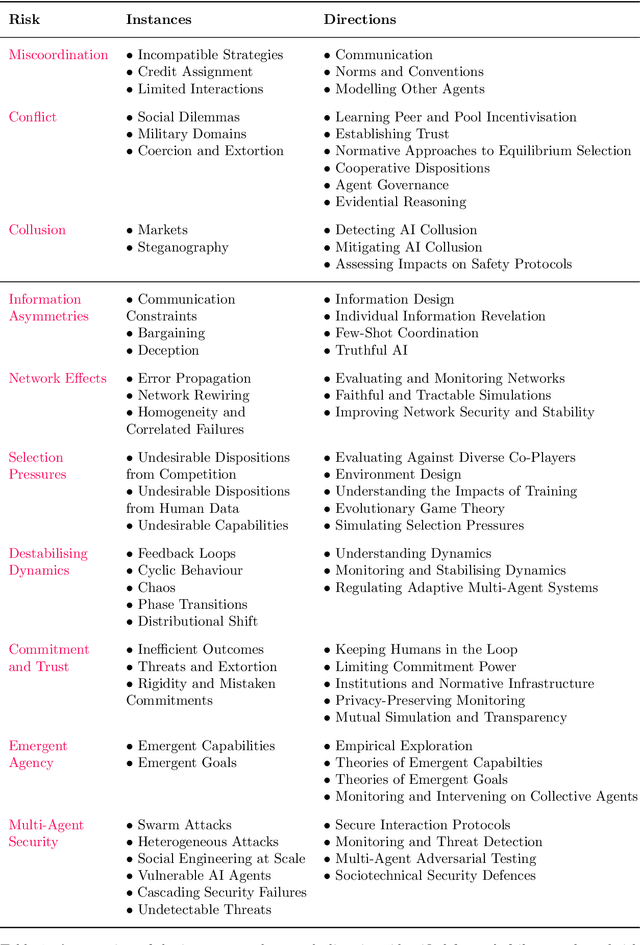
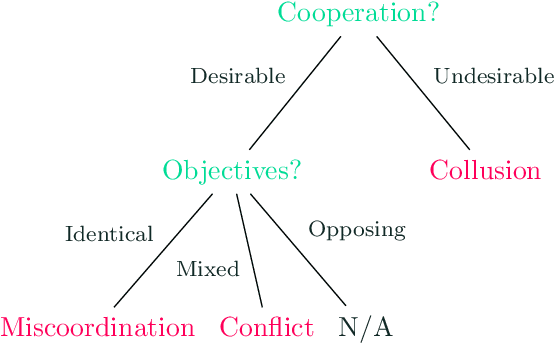
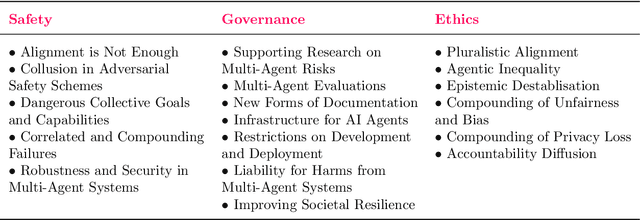

The rapid development of advanced AI agents and the imminent deployment of many instances of these agents will give rise to multi-agent systems of unprecedented complexity. These systems pose novel and under-explored risks. In this report, we provide a structured taxonomy of these risks by identifying three key failure modes (miscoordination, conflict, and collusion) based on agents' incentives, as well as seven key risk factors (information asymmetries, network effects, selection pressures, destabilising dynamics, commitment problems, emergent agency, and multi-agent security) that can underpin them. We highlight several important instances of each risk, as well as promising directions to help mitigate them. By anchoring our analysis in a range of real-world examples and experimental evidence, we illustrate the distinct challenges posed by multi-agent systems and their implications for the safety, governance, and ethics of advanced AI.
Model-Free RL Agents Demonstrate System 1-Like Intentionality
Jan 30, 2025This paper argues that model-free reinforcement learning (RL) agents, while lacking explicit planning mechanisms, exhibit behaviours that can be analogised to System 1 ("thinking fast") processes in human cognition. Unlike model-based RL agents, which operate akin to System 2 ("thinking slow") reasoning by leveraging internal representations for planning, model-free agents react to environmental stimuli without anticipatory modelling. We propose a novel framework linking the dichotomy of System 1 and System 2 to the distinction between model-free and model-based RL. This framing challenges the prevailing assumption that intentionality and purposeful behaviour require planning, suggesting instead that intentionality can manifest in the structured, reactive behaviours of model-free agents. By drawing on interdisciplinary insights from cognitive psychology, legal theory, and experimental jurisprudence, we explore the implications of this perspective for attributing responsibility and ensuring AI safety. These insights advocate for a broader, contextually informed interpretation of intentionality in RL systems, with implications for their ethical deployment and regulation.
AI Governance through Markets
Jan 29, 2025This paper argues that market governance mechanisms should be considered a key approach in the governance of artificial intelligence (AI), alongside traditional regulatory frameworks. While current governance approaches have predominantly focused on regulation, we contend that market-based mechanisms offer effective incentives for responsible AI development. We examine four emerging vectors of market governance: insurance, auditing, procurement, and due diligence, demonstrating how these mechanisms can affirm the relationship between AI risk and financial risk while addressing capital allocation inefficiencies. While we do not claim that market forces alone can adequately protect societal interests, we maintain that standardised AI disclosures and market mechanisms can create powerful incentives for safe and responsible AI development. This paper urges regulators, economists, and machine learning researchers to investigate and implement market-based approaches to AI governance.
LMUnit: Fine-grained Evaluation with Natural Language Unit Tests
Dec 17, 2024As language models become integral to critical workflows, assessing their behavior remains a fundamental challenge -- human evaluation is costly and noisy, while automated metrics provide only coarse, difficult-to-interpret signals. We introduce natural language unit tests, a paradigm that decomposes response quality into explicit, testable criteria, along with a unified scoring model, LMUnit, which combines multi-objective training across preferences, direct ratings, and natural language rationales. Through controlled human studies, we show this paradigm significantly improves inter-annotator agreement and enables more effective LLM development workflows. LMUnit achieves state-of-the-art performance on evaluation benchmarks (FLASK, BigGenBench) and competitive results on RewardBench. These results validate both our proposed paradigm and scoring model, suggesting a promising path forward for language model evaluation and development.
Beyond Preferences in AI Alignment
Aug 30, 2024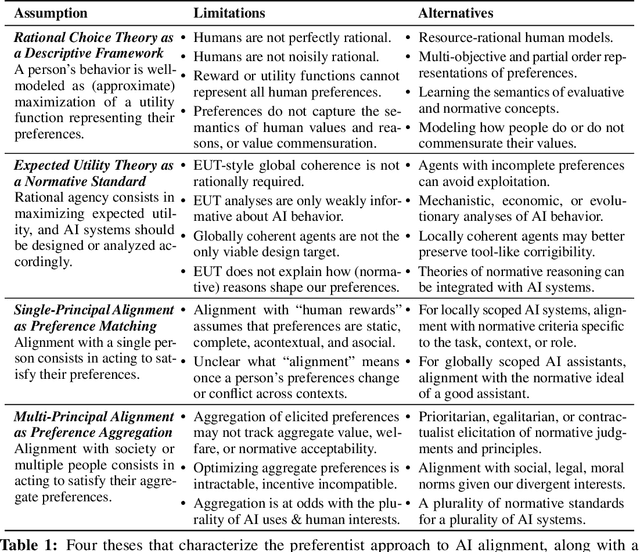

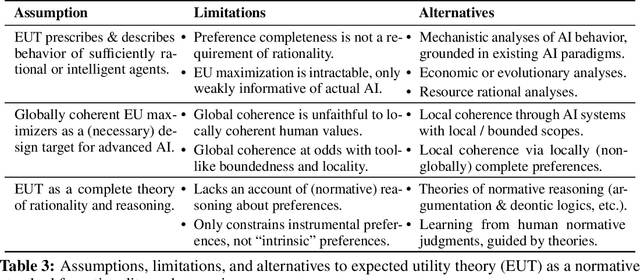

The dominant practice of AI alignment assumes (1) that preferences are an adequate representation of human values, (2) that human rationality can be understood in terms of maximizing the satisfaction of preferences, and (3) that AI systems should be aligned with the preferences of one or more humans to ensure that they behave safely and in accordance with our values. Whether implicitly followed or explicitly endorsed, these commitments constitute what we term a preferentist approach to AI alignment. In this paper, we characterize and challenge the preferentist approach, describing conceptual and technical alternatives that are ripe for further research. We first survey the limits of rational choice theory as a descriptive model, explaining how preferences fail to capture the thick semantic content of human values, and how utility representations neglect the possible incommensurability of those values. We then critique the normativity of expected utility theory (EUT) for humans and AI, drawing upon arguments showing how rational agents need not comply with EUT, while highlighting how EUT is silent on which preferences are normatively acceptable. Finally, we argue that these limitations motivate a reframing of the targets of AI alignment: Instead of alignment with the preferences of a human user, developer, or humanity-writ-large, AI systems should be aligned with normative standards appropriate to their social roles, such as the role of a general-purpose assistant. Furthermore, these standards should be negotiated and agreed upon by all relevant stakeholders. On this alternative conception of alignment, a multiplicity of AI systems will be able to serve diverse ends, aligned with normative standards that promote mutual benefit and limit harm despite our plural and divergent values.