 Add to Chrome
 Add to Firefox
 Add to Edge
Robust Hybrid Beamforming with Liquid Crystal Antennas and Liquid Neural Networks
Apr 08, 2026
Sub-terahertz (sub-THz) multi-user multiple-input multiple-output (MU-MIMO) systems unlock immense bandwidth for 6G wireless communications. However, practical deployment of wireless systems in sub-THz bands faces critical challenges such as increased atmospheric absorption, reduced channel coherence time due to increased Doppler spread at higher carrier frequencies, and hardware bottlenecks as low-loss sub-THz phase shifters are difficult to realize. To overcome the hardware and channel estimation challenges of sub-THz systems, this paper proposes a hybrid beamforming (BF) framework that integrates reconfigurable liquid crystal (LC) antennas with a liquid neural network (LNN) for transmitter. Specifically, we employ an LC antenna as the analog BF stage of a hybrid BF architecture, exploiting its voltage-driven permittivity tunability to achieve high-gain beam steering without the need for lossy phase shifters. For digital BF, we utilize an ordinary differential equations-defined LNN to learn temporal channel dynamics, and use a manifold optimization technique to compress the search space. We validated the proposed method on simulated site-specific 108 GHz ray-tracing channels in an urban scenario using NYURay, a ray-tracing simulator validated against 142 GHz propagation measurements. The 108 GHz carrier frequency matches the operating band of the LC antenna hardware. The proposed method achieves an 88.6\% spectral efficiency (SE) gain and higher robustness to imperfect channel estimation compared to the learning-aided gradient descent and gated recurrent unit machine learning baselines, and 1.9 times higher SE than the 3GPP TR~38.901 standard antenna model, highlighting the potential of LC-based hardware for sub-THz communications.

NYUSIM: A Roadmap to AI-Enabled Statistical Channel Modeling and Simulation
Feb 17, 2026Integrating artificial intelligence (AI) into wireless channel modeling requires large, accurate, and physically consistent datasets derived from real measurements. Such datasets are essential for training and validating models that learn spatio-temporal channel behavior across frequencies and environments. NYUSIM, introduced by NYU WIRELESS in 2016, generates realistic spatio-temporal channel data using extensive outdoor and indoor measurements between 28 and 142 GHz. To improve scalability and support 6G research, we migrated the complete NYUSIM framework from MATLAB to Python, and are incorporating new statistical model generation capabilities from extensive field measurements in the new 6G upper mid-band spectrum at 6.75 GHz (FR1(C)) and 16.95 GHz (FR3) [1]. The NYUSIM Python also incorporates a 3D antenna data format, referred to as Ant3D, which is a standardized, full-sphere format for defining canonical, commercial, or measured antenna patterns for any statistical or site-specific ray tracing modeling tool. Migration from MATLAB to Python was rigorously validated through Kolmogorov-Smirnov (K-S) tests, moment analysis, and end-to-end testing with unified randomness control, confirming statistical consistency and reproduction of spatio-temporal channel statistics, including spatial consistency with the open-source MATLAB NYUSIM v4.0 implementation. The NYUSIM Python version is designed to integrate with modern AI workflows and enable large-scale parallel data generation, establishing a robust, verified, and extensible foundation for future AI-enabled channel modeling.
HoRAMA: Holistic Reconstruction with Automated Material Assignment for Ray Tracing using NYURay
Feb 13, 2026Next-generation wireless networks at upper mid-band and millimeter-wave frequencies require accurate site-specific deterministic channel propagation prediction. Wireless ray tracing (RT) provides site-specific predictions but demands high-fidelity three-dimensional (3D) environment models with material properties. Manual 3D model reconstruction achieves high accuracy but requires weeks of expert effort, creating scalability bottlenecks for large environment reconstruction. Traditional vision-based 3D reconstruction methods lack RT compatibility due to geometrically defective meshes and missing material properties. This paper presents Holistic Reconstruction with Automated Material Assignment (HoRAMA) for wireless propagation prediction using NYURay. HoRAMA generates RT-compatible 3D models from RGB video readily captured using a smartphone or low-cost portable camera, by integrating MASt3R-SLAM dense point cloud generation with vision language model-assisted material assignment. The HoRAMA 3D reconstruction method is verified by comparing NYURay RT predictions, using both manually created and HoRAMA-generated 3D models, against field measurements at 6.75 GHz and 16.95 GHz across 12 TX-RX locations in a 700 square meter factory. HoRAMA ray tracing predictions achieve a 2.28 dB RMSE for matched multipath component (MPC) power predictions, comparable to the manually created 3D model baseline (2.18 dB), while reducing 3D reconstruction time from two months to 16 hours. HoRAMA enables scalable wireless digital twin creation for RT network planning, infrastructure deployment, and beam management in 5G/6G systems, as well as eventual real-time implementation at the edge.
Distributed Uplink Anti-Jamming in LEO Mega-Constellations via Game-Theoretic Beamforming
Jan 22, 2026Low-Earth-Orbit (LEO) satellite constellations have become vital in emerging commercial and defense Non-Terrestrial Networks (NTNs). However, their predictable orbital dynamics and exposed geometries make them highly susceptible to ground-based jamming. Traditional single-satellite interference mitigation techniques struggle to spatially separate desired uplink signals from nearby jammers, even with large antenna arrays. This paper explores a distributed multi-satellite anti-jamming strategy leveraging the dense connectivity and high-speed inter-satellite links of modern LEO mega-constellations. We model the uplink interference scenario as a convex-concave game between a desired terrestrial transmitter and a jammer, each optimizing their spatial covariance matrices to maximize or minimize achievable rate. We propose an efficient min-max solver combining alternating best-response updates with projected gradient descent, achieving fast convergence of the beamforming strategy to the Nash equilibrium. Using realistic Starlink orbital geometries and Sionna ray-tracing simulations, we demonstrate that while close-proximity jammers can cripple single-satellite links, distributed satellite cooperation significantly enhances resilience, shifting the capacity distribution upward under strong interference.
Site-Specific Location Calibration and Validation of Ray-Tracing Simulator NYURay at Upper Mid-Band Frequencies
Jul 29, 2025Ray-tracing (RT) simulators are essential for wireless digital twins, enabling accurate site-specific radio channel prediction for next-generation wireless systems. Yet, RT simulation accuracy is often limited by insufficient measurement data and a lack of systematic validation. This paper presents site-specific location calibration and validation of NYURay, NYU's in-house ray tracer, at upper mid-band frequencies (6.75 GHz and 16.95 GHz). We propose a location calibration algorithm that corrects GPS-induced position errors by optimizing transmitter-receiver (TX-RX) locations to align simulated and measured power delay profiles, improving TX-RX location accuracy by 42.3% for line-of-sight (LOS) and 13.5% for non-line-of-sight (NLOS) scenarios. Validation across 18 TX-RX locations shows excellent RT accuracy in path loss prediction, with path loss exponent (PLE) deviations under 0.14. While RT underestimates delay spread and angular spreads, their cumulative distributions remain statistically similar. The validated NYURay advances RT validation and provides reliable channel statistics for 6G deployment.
Statistical and Deterministic RCS Characterization for ISAC Channel Modeling
Feb 17, 2025In this study, we perform a statistical analysis of the radar cross section (RCS) for various test targets in an indoor factory at \(25\)-\(28\) GHz, with the goal of formulating parameters that may be used for target identification and other sensing applications for future wireless systems. The analysis is conducted based on measurements in monostatic and bistatic configurations for bistatic angles of \(20^\circ\), \(40^\circ\), and \(60^\circ\), which are functions of transmitter-receiver (T-R) and target positions, via accurate \(3\)dB beamwidth of \(10^\circ\) in both azimuth and elevation planes. The test targets include unmanned aerial vehicles, an autonomous mobile robot, and a robotic arm. We utilize parametric statistical distributions to fit the measured RCS data. The analysis reveals that the \textit{lognormal and gamma distributions} are effective in modeling the RCS of the test targets over different reflecting points of the target itself, i.e. when target is in motion. Additionally, we provide a framework for evaluating the deterministic bistatic RCS of a rectangular sheet of laminated wood, due to its widespread use in indoor hotspot environments. Novel deterministic and statistical RCS models are evaluated, incorporating dependencies on the bistatic angle, T-R distance (\(2\)m -\(10\)m) and the target. The results demonstrate that some proposed RCS models accurately fit the measured data, highlighting their applicability in bistatic configurations.
Upper Mid-Band Channel Measurements and Characterization at 6.75 GHz FR1(C) and 16.95 GHz FR3 in an Indoor Factory Scenario
Nov 06, 2024

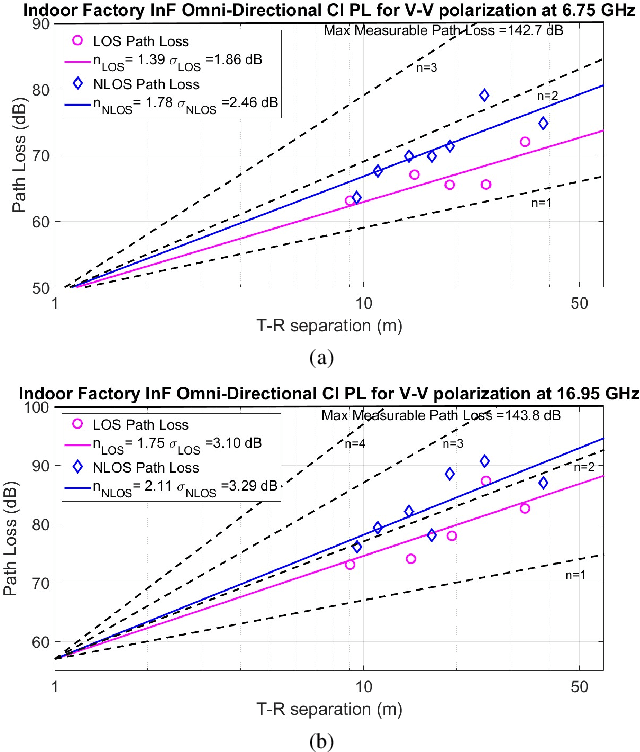

This paper presents detailed radio propagation measurements for an indoor factory (InF) environment at 6.75 GHz and 16.95 GHz using a 1 GHz bandwidth channel sounder. Conducted at the NYU MakerSpace in the NYU Tandon School of Engineering campus in Brooklyn, NY, USA, our measurement campaign characterizes a representative small factory with diverse machinery and open workspaces across 12 locations, comprising 5 line-of-sight (LOS) and 7 non-line-of-sight (NLOS) scenarios. Analysis using the close-in (CI) path loss model with a 1 m reference distance reveals path loss exponents (PLE) below 2 in LOS at 6.75 GHz and 16.95 GHz, while in NLOS PLE is similar to free-space propagation. The RMS delay spread (DS) decreases at higher frequencies with a clear frequency dependence. Similarly, RMS angular spread (AS) measurements show wider spreads in NLOS compared to LOS at both frequency bands, with a decreasing trend as frequency increases. These observations in a dense-scatterer environment demonstrate frequency-dependent behavior that deviate from existing industry-standard models. Our findings provide crucial insights into complex propagation mechanisms in factory environments, essential for designing robust industrial wireless networks at upper mid-band frequencies.
Urban Outdoor Propagation Measurements and Channel Models at 6.75 GHz FR1(C) and 16.95 GHz FR3 Upper Mid-Band Spectrum for 5G and 6G
Oct 24, 2024Global allocations in the upper mid-band spectrum (4-24 GHz) necessitate a comprehensive exploration of the propagation behavior to meet the promise of coverage and capacity. This paper presents an extensive Urban Microcell (UMi) outdoor propagation measurement campaign at 6.75 GHz and 16.95 GHz conducted in Downtown Brooklyn, USA, using a 1 GHz bandwidth sliding correlation channel sounder over 40-880 m propagation distance, encompassing 6 Line of Sight (LOS) and 14 Non-Line of Sight (NLOS) locations. Analysis of the path loss (PL) reveals lower directional and omnidirectional PL exponents compared to mmWave and sub-THz frequencies in the UMi environment, using the close-in PL model with a 1 m reference distance. Additionally, a decreasing trend in root mean square (RMS) delay spread (DS) and angular spread (AS) with increasing frequency was observed. The NLOS RMS DS and RMS AS mean values are obtained consistently lower compared to 3GPP model predictions. Point data for all measured statistics at each TX-RX location are provided to supplement the models and results. The spatio-temporal statistics evaluated here offer valuable insights for the design of next-generation wireless systems and networks.
Point Data for Site-Specific Mid-band Radio Propagation Channel Statistics in the Indoor Hotspot (InH) Environment for 3GPP and Next Generation Alliance (NGA) Channel Modeling
Sep 30, 2024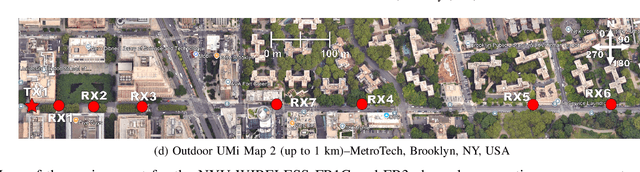
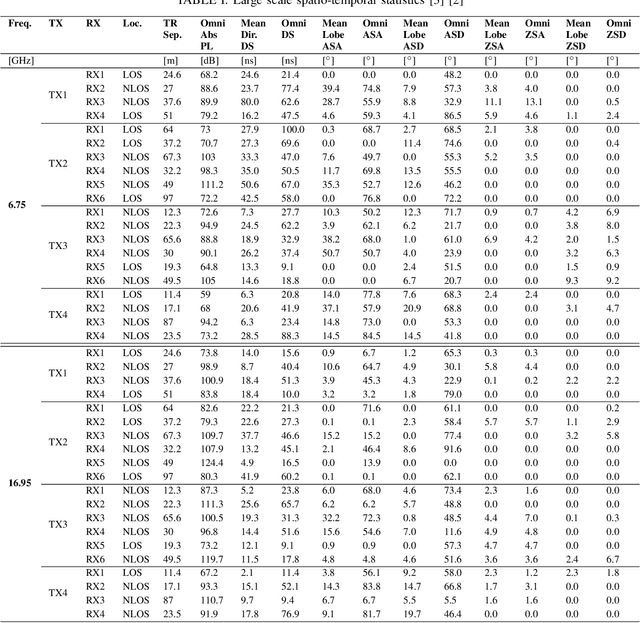
Extensive work has been carried out in the past year by various organizations in an effort to determine standardized statistical channel impulse response (CIR) parameters for the newly-released mid-band spectrum (7.25 GHz -- 24.25 GHz) [1]--[5]. In this work, we show that the wireless community currently lacks a unified method for presenting key parameters required for transparency and utilization by several constituencies when presenting propagation data for use by standard bodies or third parties to create statistical CIR models. This paper aims to solve the existing problem by offering a standard method for providing key propagation parameters such as bandwidth, antenna beamwidth, noise-threshold level, and coarseness in point form, for use in creating standards or comparing parameters, rather than providing commonly-used cumulative distribution function (CDF) plots, which hide the observed key statistics on a location-by-location, point-by-point basis. The method for presenting propagation data, proposed here, may be used for statistical channel modeling of pooled datasets from many contributors, additionally also holding promise for exploring ray-tracing (e.g. site-specific) channel modeling. The indoor hotspot (InH) data collected in Spring2024 at 6.75 GHz and 16.95 GHZ by NYU WIRELESS [1]--[3] is provided for the first time in point form, to augment statistical models previously presented solely as CDFs, to demonstrate how a standardized approach to measurement data could allow others to utilize the site-specific locations and key channel parameters observed at each location, to better understand, vet, and build upon statistical or site-specific CIRs from the contributions of many different data sources.
Angular Spread Statistics for 6.75 GHz FR1(C) and 16.95 GHz FR3 Mid-Band Frequencies in an Indoor Hotspot Environment
Sep 04, 2024We present detailed multipath propagation spatial statistics for next-generation wireless systems operating at lower and upper mid-band frequencies spanning 6--24 GHz. The large-scale spatial characteristics of the wireless channel include Azimuth angular Spread of Departure (ASD) and Zenith angular Spread of Departure (ZSD) of multipath components (MPC) from a transmitter and the Azimuth angular Spread of Arrival (ASA) and Zenith angular Spread of Arrival (ZSA) at a receiver. The angular statistics calculated from measurements were compared with industry-standard 3GPP models, and ASD and ASA values were found to be in close agreement at both 6.75 GHz and 16.95 GHz. Measured LOS ASD was found larger than 3GPP ASD indicating more diverse MPC departure directions in the azimuth. ZSA and ZSD were observed smaller than the 3GPP modeling results as most multipath arrivals and departures during measurements were recorded at the boresight antenna elevation. The wide angular spreads indicate a multipath-rich spatial propagation at 6.75 GHz and 16.95 GHz, showing greater promise for the implementation of MIMO beamforming systems in the mid-band spectrum.