 Add to Chrome
 Add to Firefox
 Add to Edge
Noncoherent Detection and Interference Nulling for Terrestrial-Satellite Downlinz Coexistence in the Upper Mid-Band
Jul 23, 2026
Terrestrial--satellite coexistence in the upper mid-band is challenging when a terrestrial base station has limited prior information about non-terrestrial receivers and their uplink transmissions. This paper studies noncoherent victim sensing and interference nulling, where uplink sensing snapshots are observed while the transmitted waveform is treated as unknown. For a single victim, we show that the generalized likelihood-ratio test reduces to a principal-eigenvector estimator of the sample covariance. For multiple victims, we combine MDL-based model-order selection with MUSIC to recover anonymous direction and power information that is sufficient for beam design without pilot knowledge or user identities. These estimates are then used in a nulling beamformer that preserves the intended terrestrial link while reducing leakage toward detected victims. We further analyze the single-victim estimator in the large-matrix regime and show that estimation accuracy improves with sensing SNR, which reveals the observed interplay between path loss and estimation quality. Site-specific ray-tracing results show significant reduction of NTN INR with only modest degradation of TN SINR.

Near Field Multi-Band Localization: CRB, Efficient Estimator, and Threshold SNR
Jun 10, 2026This paper presents a theoretical framework for multi-band localization for a single-path single-input multiple-output (SIMO) system. We derive closed-form Cramer-Rao bounds (CRBs) for angle-of-arrival (AoA) and distance for uniform linear arrays (ULAs), and an intermediate matrix-form formulation for arbitrary array shapes. We also develop benchmark single- and multi-band maximum-likelihood (ML) estimators for AoA-Distance, leveraging a structured Levenberg-Marquardt (LM) refinement procedure. A key contribution is an analytical characterization of the threshold SNR (TSNR) for the proposed estimators. This is the SNR threshold at which the estimator transitions from "off the chart" to CRB-approaching performance, for both TDoA and distance estimation. Numerical simulations confirm that the proposed single- and multi-band estimators achieve the CRB at SNRs above the predicted TSNR, and that multi-band processing simultaneously improves estimation accuracy and reduces SNR requirements. The resulting framework provides a rigorous foundation for next-generation multi-band localization and can be readily extended to elevation estimation, distributed arrays, and multi-path environments.
A Preliminary Assessment of Midhaul Links at 140 GHz using Ray-Tracing
May 26, 2026The ever-growing demand for mobile data necessitates a transport network architecture that can withstand the 5G-and-beyond multi-Gbps traffic requirements. To cater for such unprecedented demand, studies are being conducted to incorporate TeraHertz (THz) communications in future mobile networks. In this paper, we consider an urban environment and evaluate the feasibility of THz wireless midhaul links for the transport networks between the Central Units (CU) and Distributed Units (DU) in a disaggregated 5G network architecture with functional splits. Our goal is to study the feasibility of midhaul links at 140 GHz by minimizing the number of required CUs to serve all the DUs. To this end, we define several policies for selecting CU and DU nodes in order to determine the peak data rate that can be supported over each link between a CU and DU. Our numerical results based on ray-tracing suggest that wireless links at 140 GHz with 3GPP option 2 as High Layer Split (HLS) represents a promising technology for midhaul transport networks.
Low-rank Preconditioning in Beamspace Domain For Massive MU-MIMO Long-Term Beamforming
May 04, 2026Long-term beamforming substantially reduces the channel estimation and inversion overhead of conventional massive MU-MIMO receivers; yet, its construction still hinges on the inversion of a large Hermitian matrix, whose condition number deteriorates with the per-user SNR dynamic range. When this inversion is approximated in hardware via the conjugate gradient (CG) algorithm, the deterioration directly inflates the iteration count and, consequently, the energy and latency budget. We propose a hardware-friendly low-rank preconditioning framework that targets exactly this bottleneck. The preconditioner is constructed from the top eigenpairs of the long-term covariance matrix through a randomized complex eigenvalue decomposition (RC-EVD), whose inner QR factorizations are realized via a Cholesky-based scheme (QRC), confining the dominant cost to generalized matrix multiplication (GEMM) and small triangular solves that map naturally onto systolic arrays. We further show that performing the preconditioned CG inversion in the beamspace domain induces sparsification of the system matrix and provides additional convergence acceleration at negligible transformation cost. Ray-tracing simulations confirm that the joint scheme reduces the required CG iteration count by two to three while matching the post-equalization SINR of the exact inversion.
Interference Suppression for Massive MU-MIMO Long-Term Beamforming with Matrix Inversion Approximation
Apr 07, 2026Long-term beamforming (LTBF) is a widely-used scalable alternative to instantaneous multi-user MIMO processing that leverages slowly varying spatial channel statistics. VLSI implementations require matrix inversion that become computationally challenging for massive MIMO systems with large number of antennas. In this work, we show that dominant interferers significantly degrade the numerical conditioning of the LTBF covariance matrix, leading to severe performance loss in finite-precision implementations of polynomial and conjugate gradient (CG) based inversion methods. To address this issue, we propose a subspace nulling approach that operates solely on long-term channel statistics and acts as an implicit preconditioning step for LTBF. By projecting the received signal onto the orthogonal complement of the dominant interference subspace, the proposed method reduces the eigenvalue spread of the covariance matrix and improves numerical stability. Through ray-tracing simulations in a realistic 5G scenario, we demonstrate that the proposed method substantially reduces the number of CG iterations required to achieve near-optimal performance across floating-point and fixed-point implementations while preserving the low-overhead nature of LTBF.
Interpolation Techniques for Fast Channel Estimation in Ray Tracing
Jan 30, 2026Ray tracing is increasingly utilized in wireless system simulations to estimate channel paths. In large-scale simulations with complex environments, ray tracing at high resolution can be computationally demanding. To reduce the computation, this paper presents a novel method for conducting ray tracing at a coarse set of reference points and interpolating the channels at other locations. The key insight is to interpolate the images of reflected points. In addition to the computational savings, the method directly captures the spherical nature of each wavefront enabling fast and accurate computation of channels using line-of-sight MIMO and other wide aperture techniques. Through empirical validation and comparison with exhaustive ray tracing, we demonstrate the efficacy and practicality of our approach in achieving high-fidelity channel predictions with reduced computational resources.
* This is the authors accepted version of a paper published in the Proceedings of the 2024 58th Asilomar Conference on Signals, Systems, and Computers
Distributed Uplink Anti-Jamming in LEO Mega-Constellations via Game-Theoretic Beamforming
Jan 22, 2026Low-Earth-Orbit (LEO) satellite constellations have become vital in emerging commercial and defense Non-Terrestrial Networks (NTNs). However, their predictable orbital dynamics and exposed geometries make them highly susceptible to ground-based jamming. Traditional single-satellite interference mitigation techniques struggle to spatially separate desired uplink signals from nearby jammers, even with large antenna arrays. This paper explores a distributed multi-satellite anti-jamming strategy leveraging the dense connectivity and high-speed inter-satellite links of modern LEO mega-constellations. We model the uplink interference scenario as a convex-concave game between a desired terrestrial transmitter and a jammer, each optimizing their spatial covariance matrices to maximize or minimize achievable rate. We propose an efficient min-max solver combining alternating best-response updates with projected gradient descent, achieving fast convergence of the beamforming strategy to the Nash equilibrium. Using realistic Starlink orbital geometries and Sionna ray-tracing simulations, we demonstrate that while close-proximity jammers can cripple single-satellite links, distributed satellite cooperation significantly enhances resilience, shifting the capacity distribution upward under strong interference.
Scalable Long-Term Beamforming for Massive Multi-User MIMO
Nov 12, 2025Fully digital massive MIMO systems with large numbers (1000+) of antennas offer dramatically increased capacity gains from spatial multiplexing and beamforming. Designing digital receivers that can scale to these array dimensions presents significant challenges regarding both channel estimation overhead and digital computation. This paper presents a computationally efficient and low-overhead receiver design based on long-term beamforming. The method combines finding a low-rank projection from the spatial covariance estimate with a fast polynomial matrix inverse. Ray tracing simulations show minimal loss relative to complete instantaneous beamforming while offering significant overhead and computational gains.
Upper Mid-Band Spectrum for 6G: Vision, Opportunity and Challenges
Feb 25, 2025Driven by the pursuit of gigabit-per-second data speeds for future 6G mobile networks, in addition to the support of sensing and artificial intelligence applications, the industry is expanding beyond crowded sub-6 GHz bands with innovative new spectrum allocations. In this paper, we chart a compelling vision for 6G within the frequency range 3 (FR3) spectrum, i.e. $7.125$-$24.25$ $\GHz$, by delving into its key enablers and addressing the multifaceted challenges that lie ahead for these new frequency bands. Here we highlight the physical properties of this \textcolor{black}{never-before} used spectrum by reviewing recent channel measurements for outdoor and indoor environments, including path loss, delay and angular spreads, and material penetration loss, all which offer insights that underpin future 5G/6G wireless communication designs. Building on the fundamental knowledge of the channel properties, we explore FR3 spectrum agility strategies that balance coverage and capacity (e.g. data rate) tradeoffs, while also examining coexistence with incumbent systems, such as satellites, radio astronomy, and earth exploration. Moreover, we discuss the potential of massive multiple-input multiple-output, compact and digital architectures, and evaluate the potential of multiband sensing for FR3 integrated sensing and communications. Finally, we outline 6G standardization features that are likely to emerge from 3GPP radio frame innovations and open radio access network developments.
Near-Field Measurement System for the Upper Mid-Band
Dec 03, 2024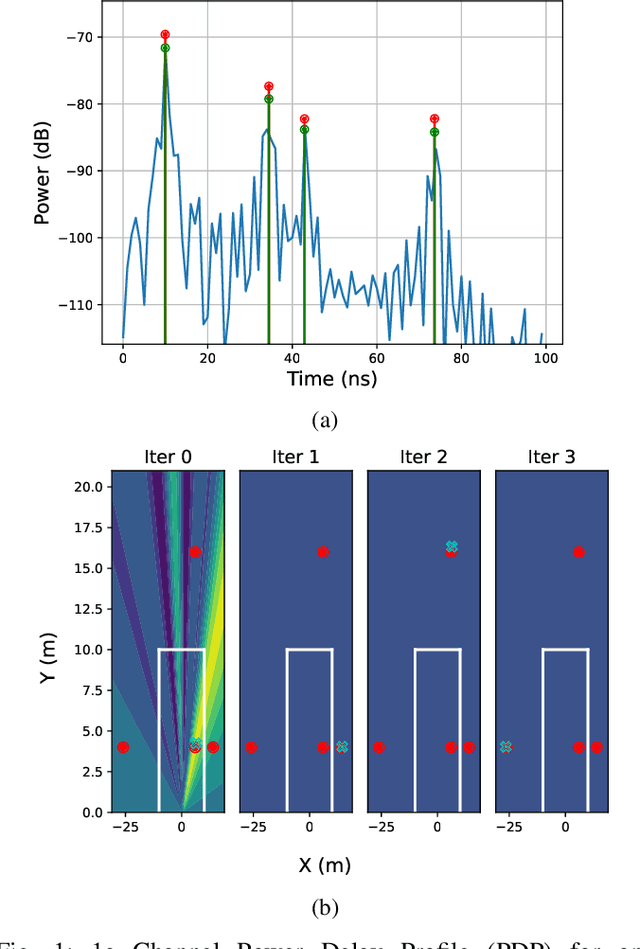
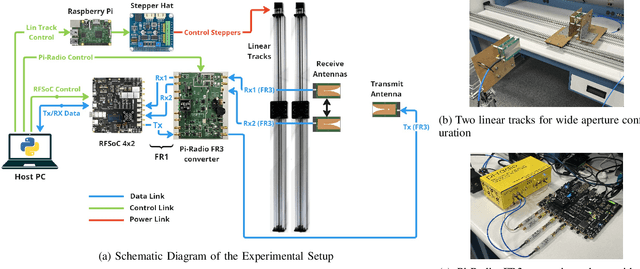
The upper mid-band (or FR3, spanning 6-24 GHz) is a crucial frequency range for next-generation mobile networks, offering a favorable balance between coverage and spectrum efficiency. From another perspective, the systems operating in the near-field in both indoor environment and outdoor environments can support line-of-sight multiple input multiple output (MIMO) communications and be beneficial from the FR3 bands. In this paper, a novel method is proposed to measure the near-field parameters leveraging a recently developed reflection model where the near-field paths can be described by their image points. We show that these image points can be accurately estimated via triangulation from multiple measurements with a small number of antennas in each measurement, thus affording a low-cost procedure for near-field multi-path parameter extraction. A preliminary experimental apparatus is presented comprising 2 transmit and 2 receive antennas mounted on a linear track to measure the 2x2 MIMO channel at various displacements. The system uses a recently-developed wideband radio frequency (RF) transceiver board with fast frequency switching, an FPGA for fast baseband processing, and a new parameter extraction method to recover paths and spherical characteristics from the multiple 2x2 measurements.