 Add to Chrome
 Add to Firefox
 Add to Edge
Data Augmentation for L2 English Speaking Assessment using TTS
Jul 12, 2026
Automated assessment of second language (L2) speaking proficiency relies on large-scale annotated speech data, which remains scarce compared to widely available written learner corpora. A promising direction for addressing this imbalance is to use text-to-speech (TTS) and voice cloning to convert written L2 production into synthetic speech. However, written and spoken L2 differ fundamentally: spontaneous speech includes disfluencies and discourse markers, while writing is more planned and complex. This raises the question of what is required to generate synthetic L2 speech suitable for assessment. We address this through a systematic analysis of speaker-text relationships using COREFL, a publicly available corpus containing paired spoken and written responses from the same L2 learners to the same questions across modalities. In our proposed framework, we first address the structural differences between written and spoken language by transforming written responses into spoken-style transcripts ("speechification") using a large language model. These transcripts are then converted into speech using a TTS/voice-cloning model. To assign a voice to each synthetic response, we investigate different speaker-text pairing strategies based on shared learner attributes (proficiency level, first language, both, or neither). We evaluate our data augmentation techniques on the language assessment task, with improvements shown in both wav2vec2 (audio-based) and ModernBERT (text-based) scoring systems. Results show that matching speakers and texts by proficiency level yields the most robust synthetic speech. Moreover, raw written text leads to a strong mismatch with spoken language, while speechification substantially reduces this gap and improves grading performance.

Exploiting the English Grammar Profile for L2 grammatical analysis with LLMs
Mar 17, 2026Evaluating the grammatical competence of second language (L2) learners is essential both for providing targeted feedback and for assessing proficiency. To achieve this, we propose a novel framework leveraging the English Grammar Profile (EGP), a taxonomy of grammatical constructs mapped to the proficiency levels of the Common European Framework of Reference (CEFR), to detect learners' attempts at grammatical constructs and classify them as successful or unsuccessful. This detection can then be used to provide fine-grained feedback. Moreover, the grammatical constructs are used as predictors of proficiency assessment by using automatically detected attempts as predictors of holistic CEFR proficiency. For the selection of grammatical constructs derived from the EGP, rule-based and LLM-based classifiers are compared. We show that LLMs outperform rule-based methods on semantically and pragmatically nuanced constructs, while rule-based approaches remain competitive for constructs that rely purely on morphological or syntactic features and do not require semantic interpretation. For proficiency assessment, we evaluate both rule-based and hybrid pipelines and show that a hybrid approach combining a rule-based pre-filter with an LLM consistently yields the strongest performance. Since our framework operates on pairs of original learner sentences and their corrected counterparts, we also evaluate a fully automated pipeline using automatic grammatical error correction. This pipeline closely approaches the performance of semi-automated systems based on manual corrections, particularly for the detection of successful attempts at grammatical constructs. Overall, our framework emphasises learners' successful attempts in addition to unsuccessful ones, enabling positive, formative feedback and providing actionable insights into grammatical development.
Speak & Improve Challenge 2025: Tasks and Baseline Systems
Dec 17, 2024
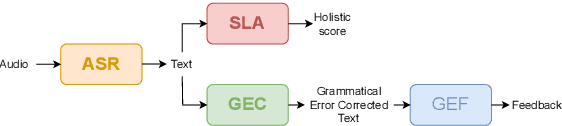
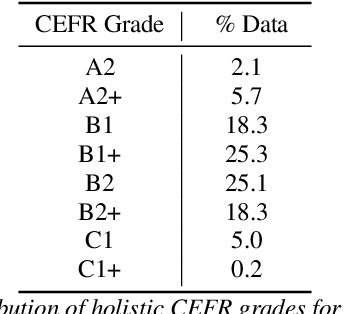
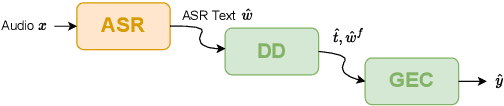
This paper presents the "Speak & Improve Challenge 2025: Spoken Language Assessment and Feedback" -- a challenge associated with the ISCA SLaTE 2025 Workshop. The goal of the challenge is to advance research on spoken language assessment and feedback, with tasks associated with both the underlying technology and language learning feedback. Linked with the challenge, the Speak & Improve (S&I) Corpus 2025 is being pre-released, a dataset of L2 learner English data with holistic scores and language error annotation, collected from open (spontaneous) speaking tests on the Speak & Improve learning platform. The corpus consists of approximately 315 hours of audio data from second language English learners with holistic scores, and a 55-hour subset with manual transcriptions and error labels. The Challenge has four shared tasks: Automatic Speech Recognition (ASR), Spoken Language Assessment (SLA), Spoken Grammatical Error Correction (SGEC), and Spoken Grammatical Error Correction Feedback (SGECF). Each of these tasks has a closed track where a predetermined set of models and data sources are allowed to be used, and an open track where any public resource may be used. Challenge participants may do one or more of the tasks. This paper describes the challenge, the S&I Corpus 2025, and the baseline systems released for the Challenge.
A Comparative Analysis of Pretrained Language Models for Text-to-Speech
Sep 04, 2023State-of-the-art text-to-speech (TTS) systems have utilized pretrained language models (PLMs) to enhance prosody and create more natural-sounding speech. However, while PLMs have been extensively researched for natural language understanding (NLU), their impact on TTS has been overlooked. In this study, we aim to address this gap by conducting a comparative analysis of different PLMs for two TTS tasks: prosody prediction and pause prediction. Firstly, we trained a prosody prediction model using 15 different PLMs. Our findings revealed a logarithmic relationship between model size and quality, as well as significant performance differences between neutral and expressive prosody. Secondly, we employed PLMs for pause prediction and found that the task was less sensitive to small models. We also identified a strong correlation between our empirical results and the GLUE scores obtained for these language models. To the best of our knowledge, this is the first study of its kind to investigate the impact of different PLMs on TTS.
Controllable Emphasis with zero data for text-to-speech
Jul 13, 2023We present a scalable method to produce high quality emphasis for text-to-speech (TTS) that does not require recordings or annotations. Many TTS models include a phoneme duration model. A simple but effective method to achieve emphasized speech consists in increasing the predicted duration of the emphasised word. We show that this is significantly better than spectrogram modification techniques improving naturalness by $7.3\%$ and correct testers' identification of the emphasized word in a sentence by $40\%$ on a reference female en-US voice. We show that this technique significantly closes the gap to methods that require explicit recordings. The method proved to be scalable and preferred in all four languages tested (English, Spanish, Italian, German), for different voices and multiple speaking styles.
eCat: An End-to-End Model for Multi-Speaker TTS & Many-to-Many Fine-Grained Prosody Transfer
Jun 20, 2023We present eCat, a novel end-to-end multispeaker model capable of: a) generating long-context speech with expressive and contextually appropriate prosody, and b) performing fine-grained prosody transfer between any pair of seen speakers. eCat is trained using a two-stage training approach. In Stage I, the model learns speaker-independent word-level prosody representations in an end-to-end fashion from speech. In Stage II, we learn to predict the prosody representations using the contextual information available in text. We compare eCat to CopyCat2, a model capable of both fine-grained prosody transfer (FPT) and multi-speaker TTS. We show that eCat statistically significantly reduces the gap in naturalness between CopyCat2 and human recordings by an average of 46.7% across 2 languages, 3 locales, and 7 speakers, along with better target-speaker similarity in FPT. We also compare eCat to VITS, and show a statistically significant preference.
Simple and Effective Multi-sentence TTS with Expressive and Coherent Prosody
Jun 29, 2022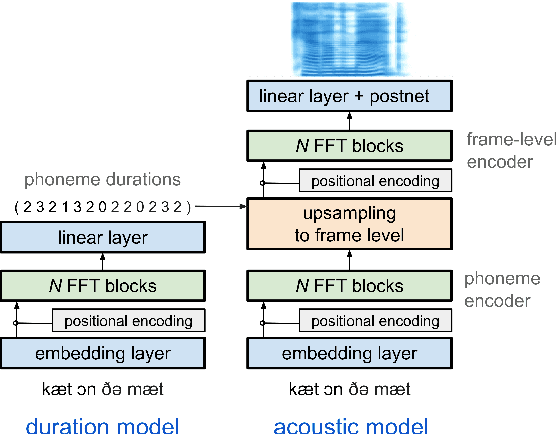
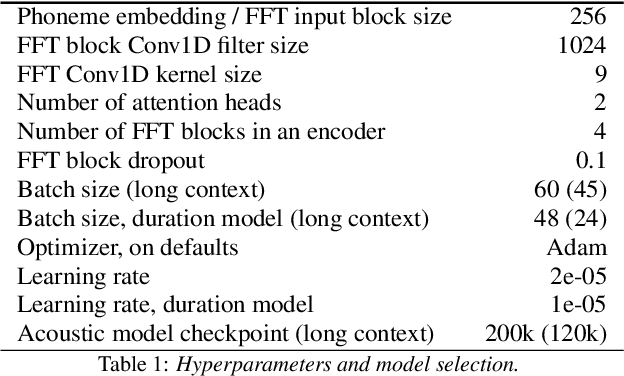
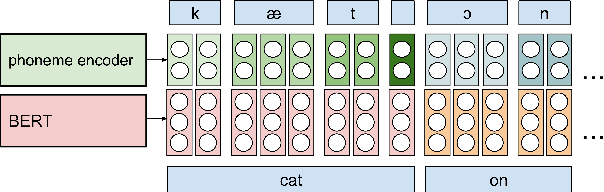
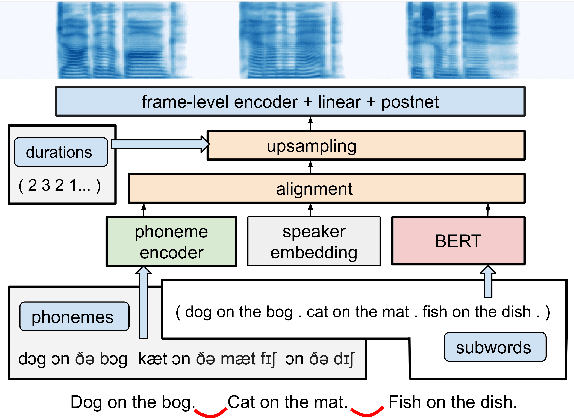
Generating expressive and contextually appropriate prosody remains a challenge for modern text-to-speech (TTS) systems. This is particularly evident for long, multi-sentence inputs. In this paper, we examine simple extensions to a Transformer-based FastSpeech-like system, with the goal of improving prosody for multi-sentence TTS. We find that long context, powerful text features, and training on multi-speaker data all improve prosody. More interestingly, they result in synergies. Long context disambiguates prosody, improves coherence, and plays to the strengths of Transformers. Fine-tuning word-level features from a powerful language model, such as BERT, appears to profit from more training data, readily available in a multi-speaker setting. We look into objective metrics on pausing and pacing and perform thorough subjective evaluations for speech naturalness. Our main system, which incorporates all the extensions, achieves consistently strong results, including statistically significant improvements in speech naturalness over all its competitors.
CopyCat2: A Single Model for Multi-Speaker TTS and Many-to-Many Fine-Grained Prosody Transfer
Jun 27, 2022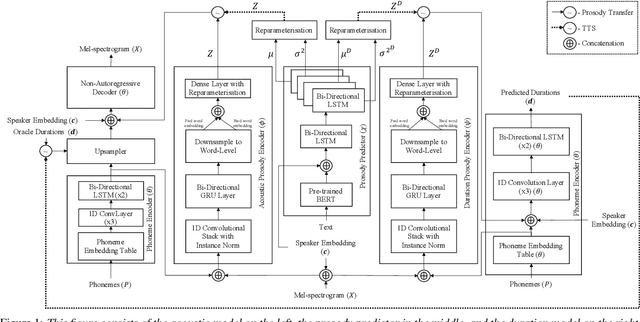
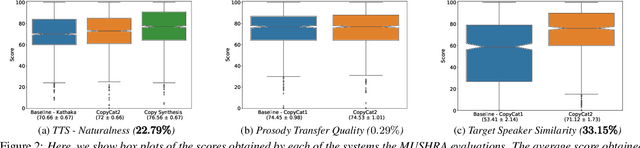
In this paper, we present CopyCat2 (CC2), a novel model capable of: a) synthesizing speech with different speaker identities, b) generating speech with expressive and contextually appropriate prosody, and c) transferring prosody at fine-grained level between any pair of seen speakers. We do this by activating distinct parts of the network for different tasks. We train our model using a novel approach to two-stage training. In Stage I, the model learns speaker-independent word-level prosody representations from speech which it uses for many-to-many fine-grained prosody transfer. In Stage II, we learn to predict these prosody representations using the contextual information available in text, thereby, enabling multi-speaker TTS with contextually appropriate prosody. We compare CC2 to two strong baselines, one in TTS with contextually appropriate prosody, and one in fine-grained prosody transfer. CC2 reduces the gap in naturalness between our baseline and copy-synthesised speech by $22.79\%$. In fine-grained prosody transfer evaluations, it obtains a relative improvement of $33.15\%$ in target speaker similarity.
Multi-Scale Spectrogram Modelling for Neural Text-to-Speech
Jun 29, 2021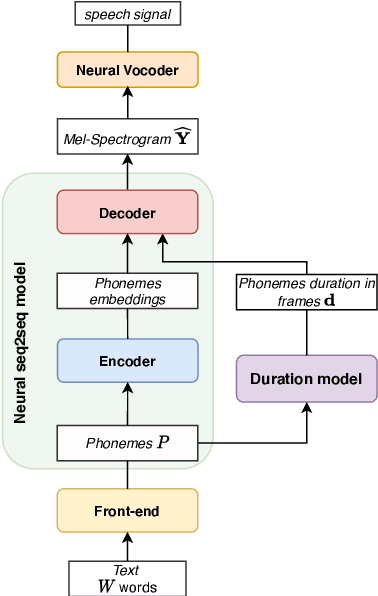
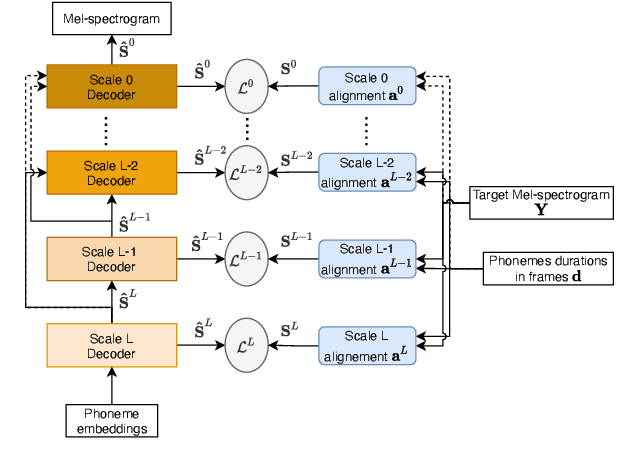
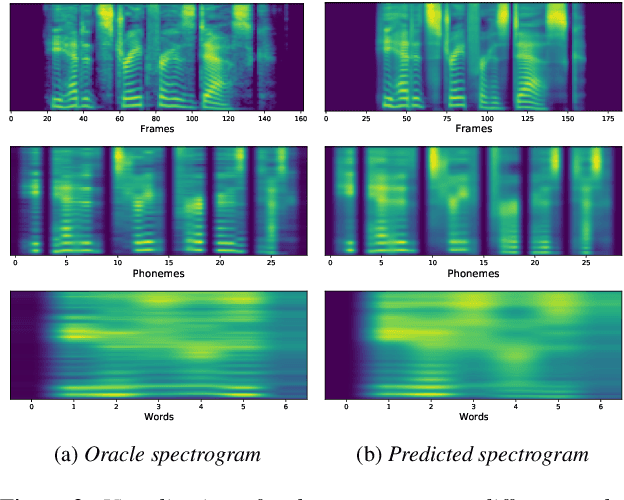
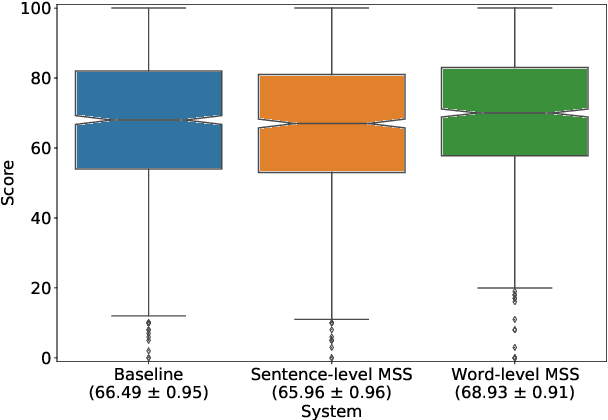
We propose a novel Multi-Scale Spectrogram (MSS) modelling approach to synthesise speech with an improved coarse and fine-grained prosody. We present a generic multi-scale spectrogram prediction mechanism where the system first predicts coarser scale mel-spectrograms that capture the suprasegmental information in speech, and later uses these coarser scale mel-spectrograms to predict finer scale mel-spectrograms capturing fine-grained prosody. We present details for two specific versions of MSS called Word-level MSS and Sentence-level MSS where the scales in our system are motivated by the linguistic units. The Word-level MSS models word, phoneme, and frame-level spectrograms while Sentence-level MSS models sentence-level spectrogram in addition. Subjective evaluations show that Word-level MSS performs statistically significantly better compared to the baseline on two voices.
A learned conditional prior for the VAE acoustic space of a TTS system
Jun 14, 2021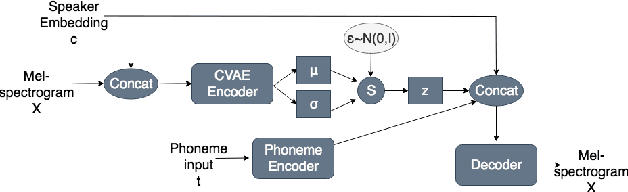
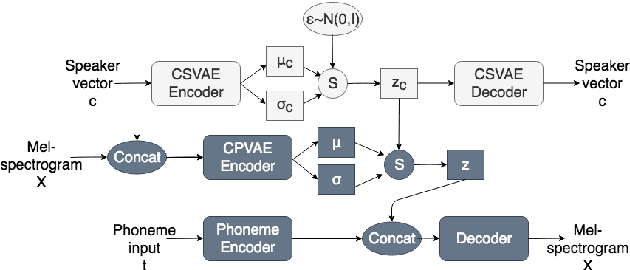
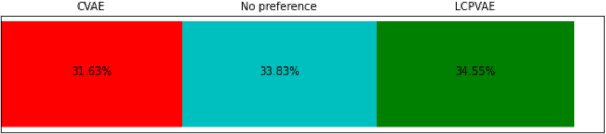
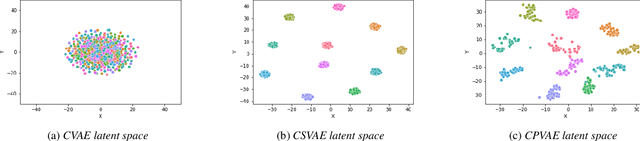
Many factors influence speech yielding different renditions of a given sentence. Generative models, such as variational autoencoders (VAEs), capture this variability and allow multiple renditions of the same sentence via sampling. The degree of prosodic variability depends heavily on the prior that is used when sampling. In this paper, we propose a novel method to compute an informative prior for the VAE latent space of a neural text-to-speech (TTS) system. By doing so, we aim to sample with more prosodic variability, while gaining controllability over the latent space's structure. By using as prior the posterior distribution of a secondary VAE, which we condition on a speaker vector, we can sample from the primary VAE taking explicitly the conditioning into account and resulting in samples from a specific region of the latent space for each condition (i.e. speaker). A formal preference test demonstrates significant preference of the proposed approach over standard Conditional VAE. We also provide visualisations of the latent space where well-separated condition-specific clusters appear, as well as ablation studies to better understand the behaviour of the system.