 Add to Chrome
 Add to Firefox
 Add to Edge
TASTE: A Designer-Annotated Multi-Dimensional Preference Dataset for AI-Generated Graphic Design
May 20, 2026
Text-to-image models produce graphic design at production scale, but their supervision comes from photo-style preference data with a single overall verdict per comparison. Designers evaluate along several distinct axes, including typography, visual hierarchy, color harmony, layout, and brief fidelity, and a single label collapses them. We release TASTE (Typography, Aesthetics, Spatial, Tone, Etc.): ten professional designers ranked outputs from four current text-to-image models on nine criteria across two disjoint cohorts, yielding 1,600 ratings per criterion plus per-image hallucination flags on the holistic-preference cohorts. We pair the dataset with three contributions. First, a criterion-agnostic signal test framework, using Kendall's tau, majority probability, and Condorcet cycles against exact iid-uniform nulls at p = 4 and R = 5, places designer agreement on graphic design between food and movie preferences and photo-style image quality, with every TASTE criterion rejecting the random-rater null. Second, no pre-trained system in our benchmark, including six open-weight VLM judges from 3B to 33B parameters and three dedicated T2I scorers, HPSv2.1, PickScore-v1, and LAION-Aesthetic-V2, exceeds 0.55 macro agreement with the 5-designer majority; VLM judges trade off position bias against content sensitivity, so scaling moves along this frontier without improving accuracy. Third, a small pairwise-difference head trained on TASTE reaches 0.611, closing roughly half the gap to the 0.741 single-rater ceiling.

Structural Evaluation Metrics for SVG Generation via Leave-One-Out Analysis
Apr 09, 2026Scalable Vector Graphics (SVG) represent visual content as structured, editable code. Each element (path, shape, or text node) can be individually inspected, transformed, or removed. This structural editability is a main motivation for SVG generation, yet prevailing evaluation protocols primarily reduce the output to a single similarity score against a reference image or input texts, measuring how faithfully the result reproduces an image or follows the instructions, but not how well it preserves the structural properties that make SVG valuable. In particular, existing metrics cannot determine which generated elements contribute positively to overall visual quality, how visual concepts map to specific parts of the code, or whether the generated output supports meaningful downstream editing. We introduce element-level leave-one-out (LOO) analysis, inspired by the classic jackknife estimator. The procedure renders the SVG with and without each element, measures the resulting visual change, and derives a suite of structural quality metrics. Despite its simplicity, the jackknife's capacity to decompose an aggregate statistic into per-sample contributions translates directly to this setting. From a single mechanism, we obtain: (1) quality scores per element through LOO scoring that enable zero-shot artifact detection; (2) concept-element attribution that maps each element to the visual concept it serves; and (3) four structural metrics, purity, coverage, compactness, and locality, that quantify SVG modularity from complementary perspectives. We validate these metrics on over 19,000 edits (5 types) across 5 generation systems and 3 complexity tiers.
Graphic-Design-Bench: A Comprehensive Benchmark for Evaluating AI on Graphic Design Tasks
Apr 07, 2026We introduce GraphicDesignBench (GDB), the first comprehensive benchmark suite designed specifically to evaluate AI models on the full breadth of professional graphic design tasks. Unlike existing benchmarks that focus on natural-image understanding or generic text-to-image synthesis, GDB targets the unique challenges of professional design work: translating communicative intent into structured layouts, rendering typographically faithful text, manipulating layered compositions, producing valid vector graphics, and reasoning about animation. The suite comprises 50 tasks organized along five axes: layout, typography, infographics, template & design semantics and animation, each evaluated under both understanding and generation settings, and grounded in real-world design templates drawn from the LICA layered-composition dataset. We evaluate a set of frontier closed-source models using a standardized metric taxonomy covering spatial accuracy, perceptual quality, text fidelity, semantic alignment, and structural validity. Our results reveal that current models fall short on the core challenges of professional design: spatial reasoning over complex layouts, faithful vector code generation, fine-grained typographic perception, and temporal decomposition of animations remain largely unsolved. While high-level semantic understanding is within reach, the gap widens sharply as tasks demand precision, structure, and compositional awareness. GDB provides a rigorous, reproducible testbed for tracking progress toward AI systems that can function as capable design collaborators. The full evaluation framework is publicly available.
LICA: Layered Image Composition Annotations for Graphic Design Research
Mar 17, 2026We introduce LICA (Layered Image Composition Annotations), a large-scale dataset of 1,550,244 multi-layer graphic design compositions designed to advance structured understanding and generation of graphic layouts1. In addition to ren- dered PNG images, LICA represents each design as a hierarchical composition of typed components including text, image, vector, and group elements, each paired with rich per-element metadata such as spatial geometry, typographic attributes, opacity, and visibility. The dataset spans 20 design categories and 971,850 unique templates, providing broad coverage of real-world design structures. We further introduce graphic design video as a new and largely unexplored challenge for current vision-language models through 27,261 animated layouts annotated with per-component keyframes and motion parameters. Beyond scale, LICA establishes a new paradigm of research tasks for graphic design, enabling structured investiga- tions into problems such as layer-aware inpainting, structured layout generation, controlled design editing, and temporally-aware generative modeling. By repre- senting design as a system of compositional layers and relationships, the dataset supports research on models that operate directly on design structure rather than pixels alone.
Interpretable Tensor Fusion
May 07, 2024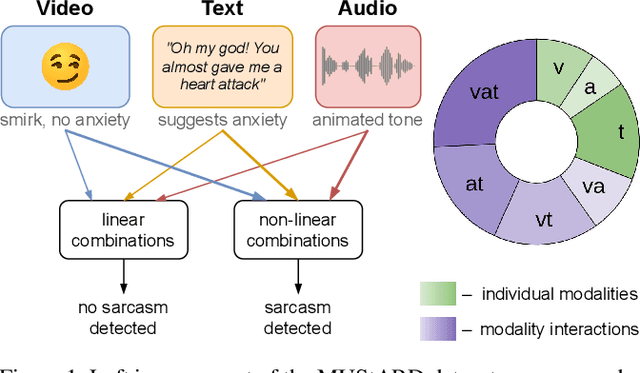
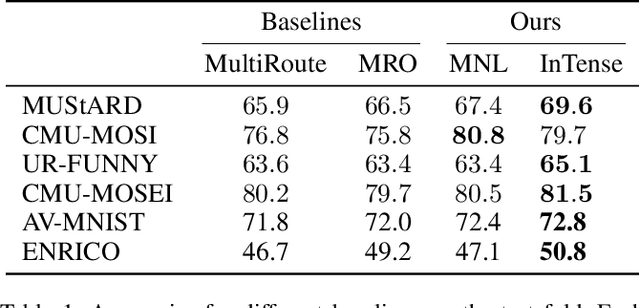
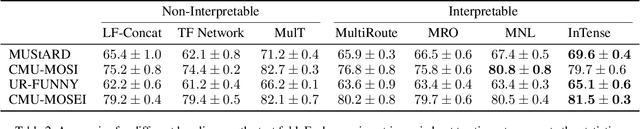
Conventional machine learning methods are predominantly designed to predict outcomes based on a single data type. However, practical applications may encompass data of diverse types, such as text, images, and audio. We introduce interpretable tensor fusion (InTense), a multimodal learning method for training neural networks to simultaneously learn multimodal data representations and their interpretable fusion. InTense can separately capture both linear combinations and multiplicative interactions of diverse data types, thereby disentangling higher-order interactions from the individual effects of each modality. InTense provides interpretability out of the box by assigning relevance scores to modalities and their associations. The approach is theoretically grounded and yields meaningful relevance scores on multiple synthetic and real-world datasets. Experiments on six real-world datasets show that InTense outperforms existing state-of-the-art multimodal interpretable approaches in terms of accuracy and interpretability.
HetTree: Heterogeneous Tree Graph Neural Network
Feb 21, 2024
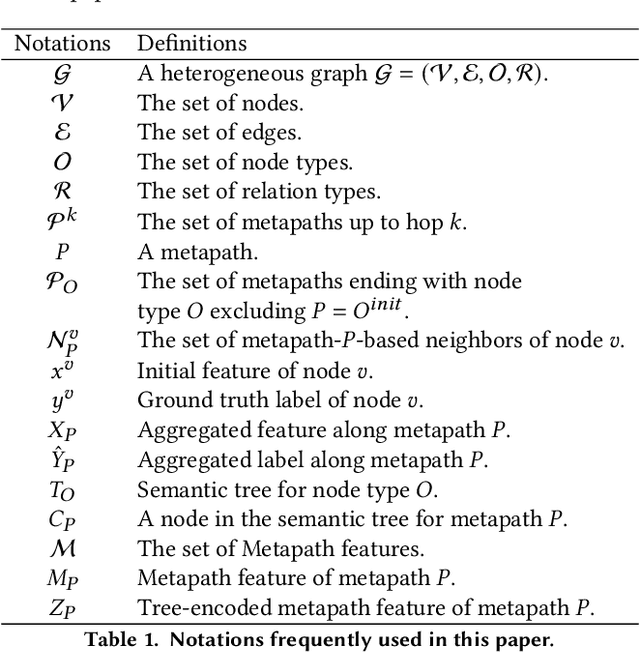

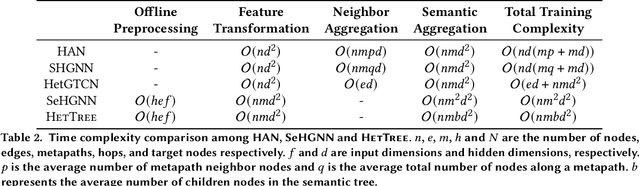
The recent past has seen an increasing interest in Heterogeneous Graph Neural Networks (HGNNs) since many real-world graphs are heterogeneous in nature, from citation graphs to email graphs. However, existing methods ignore a tree hierarchy among metapaths, which is naturally constituted by different node types and relation types. In this paper, we present HetTree, a novel heterogeneous tree graph neural network that models both the graph structure and heterogeneous aspects in a scalable and effective manner. Specifically, HetTree builds a semantic tree data structure to capture the hierarchy among metapaths. Existing tree encoding techniques aggregate children nodes by weighting the contribution of children nodes based on similarity to the parent node. However, we find that this tree encoding fails to capture the entire parent-children hierarchy by only considering the parent node. Hence, HetTree uses a novel subtree attention mechanism to emphasize metapaths that are more helpful in encoding parent-children relationships. Moreover, instead of separating feature learning from label learning or treating features and labels equally by projecting them to the same latent space, HetTree proposes to match them carefully based on corresponding metapaths, which provides more accurate and richer information between node features and labels. Our evaluation of HetTree on a variety of real-world datasets demonstrates that it outperforms all existing baselines on open benchmarks and efficiently scales to large real-world graphs with millions of nodes and edges.
EvoKG: Jointly Modeling Event Time and Network Structure for Reasoning over Temporal Knowledge Graphs
Feb 16, 2022How can we perform knowledge reasoning over temporal knowledge graphs (TKGs)? TKGs represent facts about entities and their relations, where each fact is associated with a timestamp. Reasoning over TKGs, i.e., inferring new facts from time-evolving KGs, is crucial for many applications to provide intelligent services. However, despite the prevalence of real-world data that can be represented as TKGs, most methods focus on reasoning over static knowledge graphs, or cannot predict future events. In this paper, we present a problem formulation that unifies the two major problems that need to be addressed for an effective reasoning over TKGs, namely, modeling the event time and the evolving network structure. Our proposed method EvoKG jointly models both tasks in an effective framework, which captures the ever-changing structural and temporal dynamics in TKGs via recurrent event modeling, and models the interactions between entities based on the temporal neighborhood aggregation framework. Further, EvoKG achieves an accurate modeling of event time, using flexible and efficient mechanisms based on neural density estimation. Experiments show that EvoKG outperforms existing methods in terms of effectiveness (up to 77% and 116% more accurate time and link prediction) and efficiency.