 Add to Chrome
 Add to Firefox
 Add to Edge
Skipping the Zeros in Diffusion Models for Sparse Data Generation
May 03, 2026
Diffusion models (DMs) excel on dense continuous data, but are not designed for sparse continuous data. They do not model exact zeros that represent the deliberate absence of a signal. As a result, they erase sparsity patterns and perform unnecessary computation on mostly zero entries. With Sparsity-Exploiting Diffusion (SED), we model only non-zero values, preserving sparsity. SED delivers computational savings while maintaining or improving generation quality by skipping zeros during training and inference. Across physics and biology benchmarks, SED matches or surpasses conventional DMs and domain-specific baselines, while vision experiments provide intuitive insights into the limitations of dense DMs and the benefits of SED.

Interpretable Tensor Fusion
May 07, 2024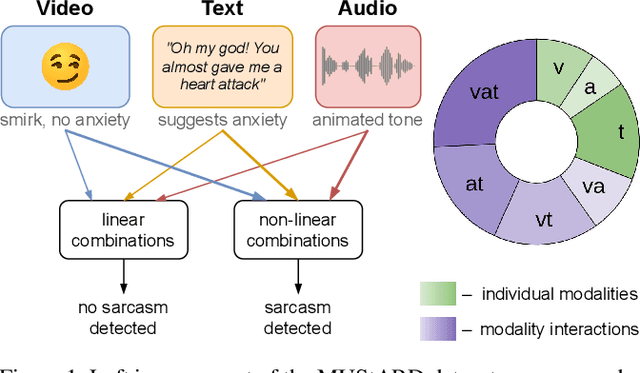
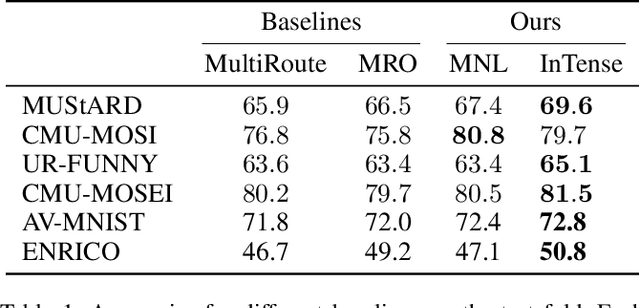
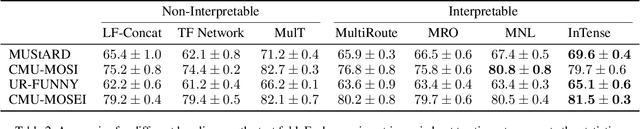
Conventional machine learning methods are predominantly designed to predict outcomes based on a single data type. However, practical applications may encompass data of diverse types, such as text, images, and audio. We introduce interpretable tensor fusion (InTense), a multimodal learning method for training neural networks to simultaneously learn multimodal data representations and their interpretable fusion. InTense can separately capture both linear combinations and multiplicative interactions of diverse data types, thereby disentangling higher-order interactions from the individual effects of each modality. InTense provides interpretability out of the box by assigning relevance scores to modalities and their associations. The approach is theoretically grounded and yields meaningful relevance scores on multiple synthetic and real-world datasets. Experiments on six real-world datasets show that InTense outperforms existing state-of-the-art multimodal interpretable approaches in terms of accuracy and interpretability.