 Add to Chrome
 Add to Firefox
 Add to Edge
Multilingual and Domain-Agnostic Tip-of-the-Tongue Query Generation for Simulated Evaluation
Apr 22, 2026
Tip-of-the-Tongue (ToT) retrieval benchmarks have largely focused on English, limiting their applicability to multilingual information access. In this work, we construct multilingual ToT test collections for Chinese, Japanese, Korean, and English, using an LLM-based query simulation framework. We systematically study how prompt language and source document language affect the fidelity of simulated ToT queries, validating synthetic queries through system rank correlation against real user queries. Our results show that effective ToT simulation requires language-aware design choices: non-English language sources are generally important, while English Wikipedia can be beneficial when non-English sources provide insufficient information for query generation. Based on these findings, we release four ToT test collections with 5,000 queries per language across multiple domains. This work provides the first large-scale multilingual ToT benchmark and offers practical guidance for constructing realistic ToT datasets beyond English.

Formalized Information Needs Improve Large-Language-Model Relevance Judgments
Apr 05, 2026Cranfield-style retrieval evaluations with too few or too many relevant documents or with low inter-assessor agreement on relevance can reduce the reliability of observations. In evaluations with human assessors, information needs are often formalized as retrieval topics to avoid an excessive number of relevant documents while maintaining good agreement. However, emerging evaluation setups that use Large Language Models (LLMs) as relevance assessors often use only queries, potentially decreasing the reliability. To study whether LLM relevance assessors benefit from formalized information needs, we synthetically formalize information needs with LLMs into topics that follow the established structure from previous human relevance assessments (i.e., descriptions and narratives). We compare assessors using synthetically formalized topics against the LLM-default query-only assessor on Robust04 and the 2019/2020 editions of TREC Deep Learning. We find that assessors without formalization judge many more documents relevant and have a lower agreement, leading to reduced reliability in retrieval evaluations. Furthermore, we show that the formalized topics improve agreement between human and LLM relevance judgments, even when the topics are not highly similar to their human counterparts. Our findings indicate that LLM relevance assessors should use formalized information needs, as is standard for human assessment, and synthetically formalize topics when no human formalization exists to improve evaluation reliability.
Overview of PAN 2026: Voight-Kampff Generative AI Detection, Text Watermarking, Multi-Author Writing Style Analysis, Generative Plagiarism Detection, and Reasoning Trajectory Detection
Feb 09, 2026The goal of the PAN workshop is to advance computational stylometry and text forensics via objective and reproducible evaluation. In 2026, we run the following five tasks: (1) Voight-Kampff Generative AI Detection, particularly in mixed and obfuscated authorship scenarios, (2) Text Watermarking, a new task that aims to find new and benchmark the robustness of existing text watermarking schemes, (3) Multi-author Writing Style Analysis, a continued task that aims to find positions of authorship change, (4) Generative Plagiarism Detection, a continued task that targets source retrieval and text alignment between generated text and source documents, and (5) Reasoning Trajectory Detection, a new task that deals with source detection and safety detection of LLM-generated or human-written reasoning trajectories. As in previous years, PAN invites software submissions as easy-to-reproduce Docker containers for most of the tasks. Since PAN 2012, more than 1,100 submissions have been made this way via the TIRA experimentation platform.
The Viability of Crowdsourcing for RAG Evaluation
Apr 22, 2025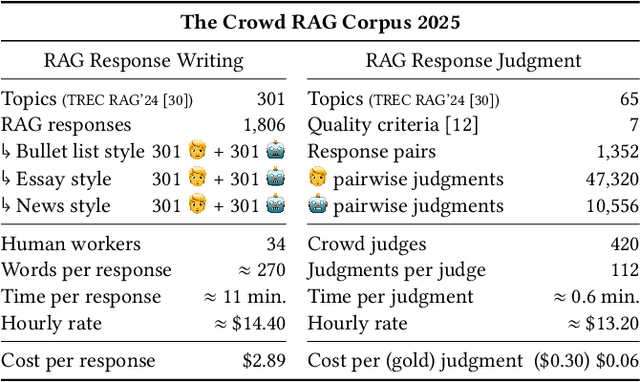
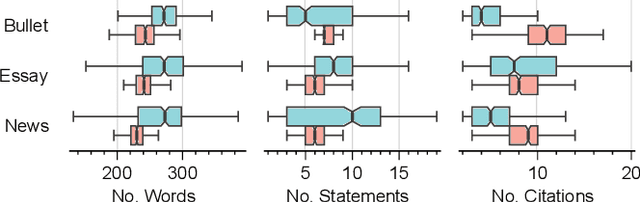
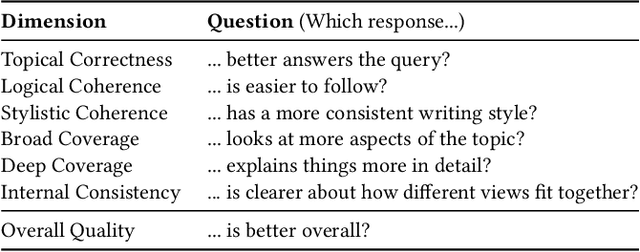
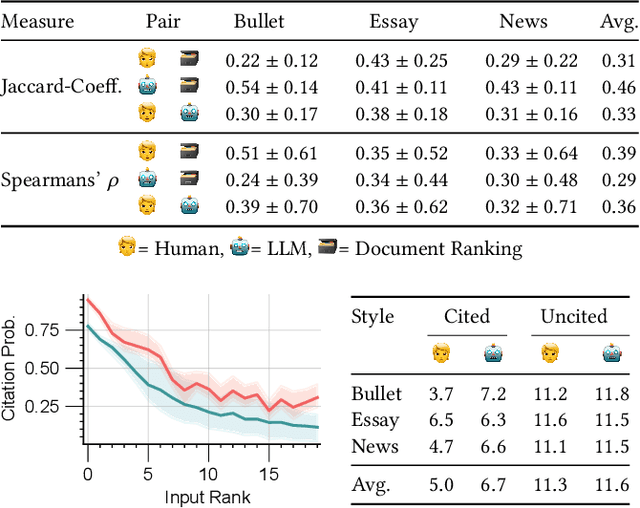
How good are humans at writing and judging responses in retrieval-augmented generation (RAG) scenarios? To answer this question, we investigate the efficacy of crowdsourcing for RAG through two complementary studies: response writing and response utility judgment. We present the Crowd RAG Corpus 2025 (CrowdRAG-25), which consists of 903 human-written and 903 LLM-generated responses for the 301 topics of the TREC RAG'24 track, across the three discourse styles 'bulleted list', 'essay', and 'news'. For a selection of 65 topics, the corpus further contains 47,320 pairwise human judgments and 10,556 pairwise LLM judgments across seven utility dimensions (e.g., coverage and coherence). Our analyses give insights into human writing behavior for RAG and the viability of crowdsourcing for RAG evaluation. Human pairwise judgments provide reliable and cost-effective results compared to LLM-based pairwise or human/LLM-based pointwise judgments, as well as automated comparisons with human-written reference responses. All our data and tools are freely available.
Variations in Relevance Judgments and the Shelf Life of Test Collections
Feb 28, 2025The fundamental property of Cranfield-style evaluations, that system rankings are stable even when assessors disagree on individual relevance decisions, was validated on traditional test collections. However, the paradigm shift towards neural retrieval models affected the characteristics of modern test collections, e.g., documents are short, judged with four grades of relevance, and information needs have no descriptions or narratives. Under these changes, it is unclear whether assessor disagreement remains negligible for system comparisons. We investigate this aspect under the additional condition that the few modern test collections are heavily re-used. Given more possible query interpretations due to less formalized information needs, an ''expiration date'' for test collections might be needed if top-effectiveness requires overfitting to a single interpretation of relevance. We run a reproducibility study and re-annotate the relevance judgments of the 2019 TREC Deep Learning track. We can reproduce prior work in the neural retrieval setting, showing that assessor disagreement does not affect system rankings. However, we observe that some models substantially degrade with our new relevance judgments, and some have already reached the effectiveness of humans as rankers, providing evidence that test collections can expire.
Counterfactual Query Rewriting to Use Historical Relevance Feedback
Feb 06, 2025When a retrieval system receives a query it has encountered before, previous relevance feedback, such as clicks or explicit judgments can help to improve retrieval results. However, the content of a previously relevant document may have changed, or the document might not be available anymore. Despite this evolved corpus, we counterfactually use these previously relevant documents as relevance signals. In this paper we proposed approaches to rewrite user queries and compare them against a system that directly uses the previous qrels for the ranking. We expand queries with terms extracted from the previously relevant documents or derive so-called keyqueries that rank the previously relevant documents to the top of the current corpus. Our evaluation in the CLEF LongEval scenario shows that rewriting queries with historical relevance feedback improves the retrieval effectiveness and even outperforms computationally expensive transformer-based approaches.
Lightning IR: Straightforward Fine-tuning and Inference of Transformer-based Language Models for Information Retrieval
Nov 07, 2024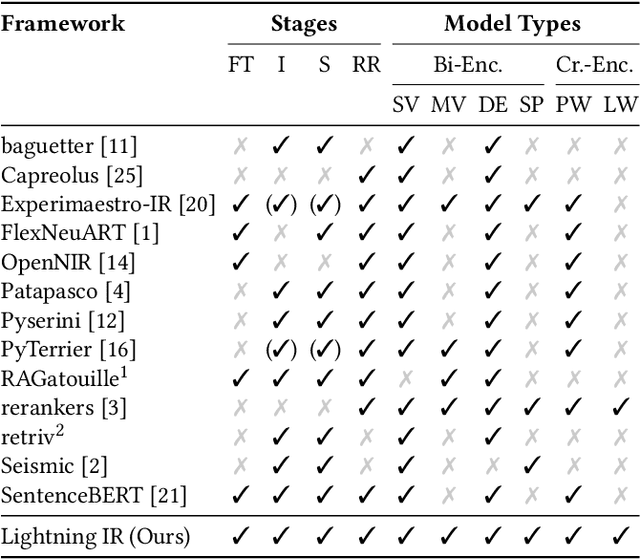
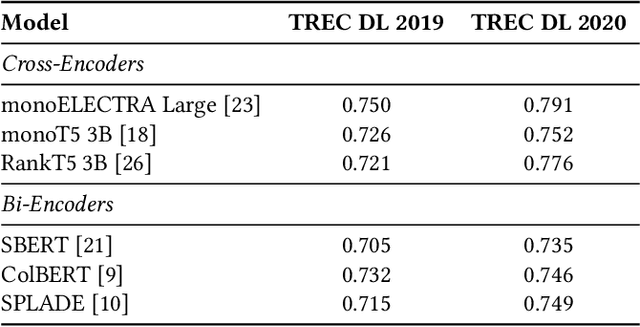
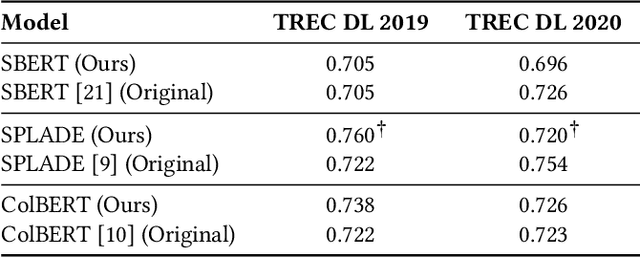
A wide range of transformer-based language models have been proposed for information retrieval tasks. However, fine-tuning and inference of these models is often complex and requires substantial engineering effort. This paper introduces Lightning IR, a PyTorch Lightning-based framework for fine-tuning and inference of transformer-based language models for information retrieval. Lightning IR provides a modular and extensible architecture that supports all stages of an information retrieval pipeline: from fine-tuning and indexing to searching and re-ranking. It is designed to be straightforward to use, scalable, and reproducible. Lightning IR is available as open-source: https://github.com/webis-de/lightning-ir.
Systematic Evaluation of Neural Retrieval Models on the Touché 2020 Argument Retrieval Subset of BEIR
Jul 10, 2024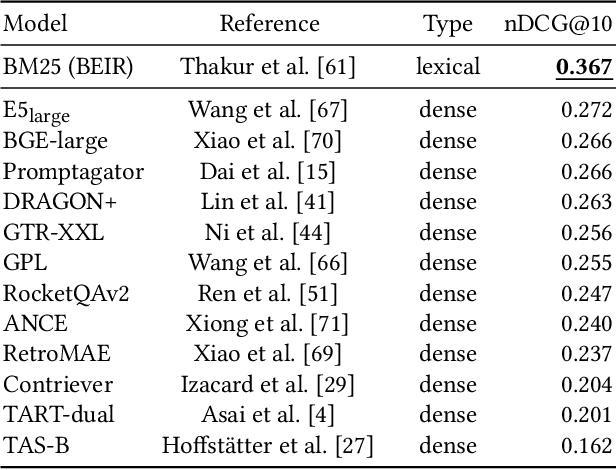

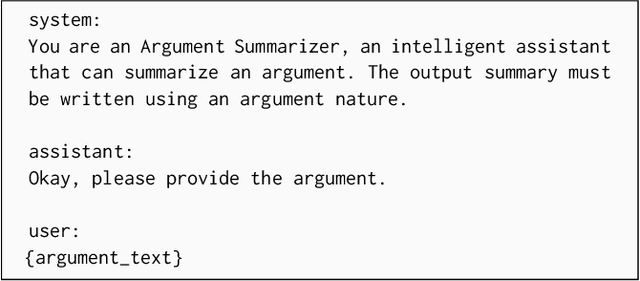

The zero-shot effectiveness of neural retrieval models is often evaluated on the BEIR benchmark -- a combination of different IR evaluation datasets. Interestingly, previous studies found that particularly on the BEIR subset Touch\'e 2020, an argument retrieval task, neural retrieval models are considerably less effective than BM25. Still, so far, no further investigation has been conducted on what makes argument retrieval so "special". To more deeply analyze the respective potential limits of neural retrieval models, we run a reproducibility study on the Touch\'e 2020 data. In our study, we focus on two experiments: (i) a black-box evaluation (i.e., no model retraining), incorporating a theoretical exploration using retrieval axioms, and (ii) a data denoising evaluation involving post-hoc relevance judgments. Our black-box evaluation reveals an inherent bias of neural models towards retrieving short passages from the Touch\'e 2020 data, and we also find that quite a few of the neural models' results are unjudged in the Touch\'e 2020 data. As many of the short Touch\'e passages are not argumentative and thus non-relevant per se, and as the missing judgments complicate fair comparison, we denoise the Touch\'e 2020 data by excluding very short passages (less than 20 words) and by augmenting the unjudged data with post-hoc judgments following the Touch\'e guidelines. On the denoised data, the effectiveness of the neural models improves by up to 0.52 in nDCG@10, but BM25 is still more effective. Our code and the augmented Touch\'e 2020 dataset are available at \url{https://github.com/castorini/touche-error-analysis}.
A Systematic Investigation of Distilling Large Language Models into Cross-Encoders for Passage Re-ranking
May 13, 2024
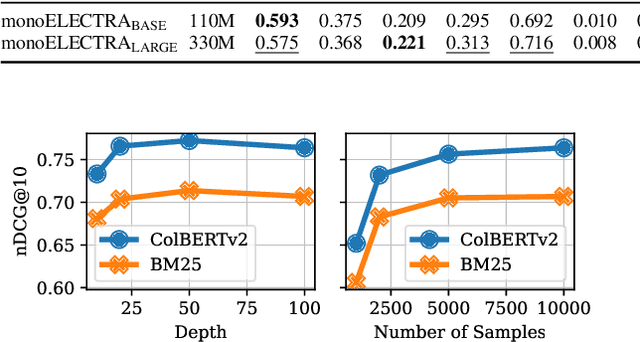
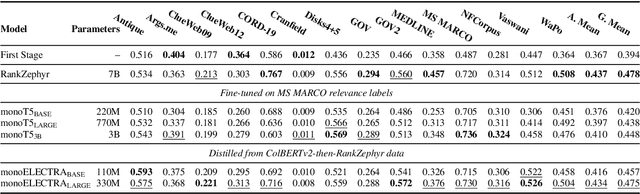
Cross-encoders distilled from large language models are more effective re-rankers than cross-encoders fine-tuned using manually labeled data. However, the distilled models do not reach the language model's effectiveness. We construct and release a new distillation dataset, named Rank-DistiLLM, to investigate whether insights from fine-tuning cross-encoders on manually labeled data -- hard-negative sampling, deep sampling, and listwise loss functions -- are transferable to large language model ranker distillation. Our dataset can be used to train cross-encoders that reach the effectiveness of large language models while being orders of magnitude more efficient. Code and data is available at: https://github.com/webis-de/msmarco-llm-distillation
Set-Encoder: Permutation-Invariant Inter-Passage Attention for Listwise Passage Re-Ranking with Cross-Encoders
Apr 11, 2024Cross-encoders are effective passage re-rankers. But when re-ranking multiple passages at once, existing cross-encoders inefficiently optimize the output ranking over several input permutations, as their passage interactions are not permutation-invariant. Moreover, their high memory footprint constrains the number of passages during listwise training. To tackle these issues, we propose the Set-Encoder, a new cross-encoder architecture that (1) introduces inter-passage attention with parallel passage processing to ensure permutation invariance between input passages, and that (2) uses fused-attention kernels to enable training with more passages at a time. In experiments on TREC Deep Learning and TIREx, the Set-Encoder is more effective than previous cross-encoders with a similar number of parameters. Compared to larger models, the Set-Encoder is more efficient and either on par or even more effective.