 Add to Chrome
 Add to Firefox
 Add to Edge
Neuromorphic Optical Flow and Real-time Implementation with Event Cameras
Apr 14, 2023
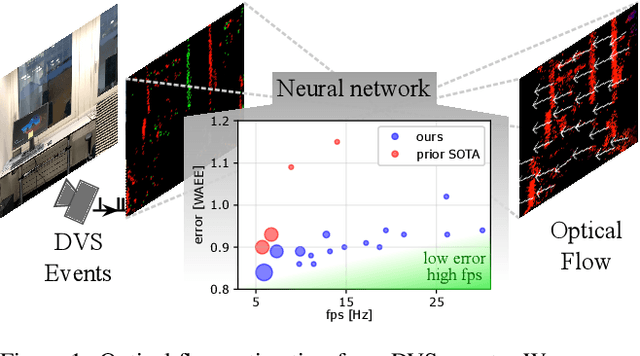
Optical flow provides information on relative motion that is an important component in many computer vision pipelines. Neural networks provide high accuracy optical flow, yet their complexity is often prohibitive for application at the edge or in robots, where efficiency and latency play crucial role. To address this challenge, we build on the latest developments in event-based vision and spiking neural networks. We propose a new network architecture, inspired by Timelens, that improves the state-of-the-art self-supervised optical flow accuracy when operated both in spiking and non-spiking mode. To implement a real-time pipeline with a physical event camera, we propose a methodology for principled model simplification based on activity and latency analysis. We demonstrate high speed optical flow prediction with almost two orders of magnitude reduced complexity while maintaining the accuracy, opening the path for real-time deployments.

Factorizers for Distributed Sparse Block Codes
Mar 24, 2023Distributed sparse block codes (SBCs) exhibit compact representations for encoding and manipulating symbolic data structures using fixed-with vectors. One major challenge however is to disentangle, or factorize, such data structures into their constituent elements without having to search through all possible combinations. This factorization becomes more challenging when queried by noisy SBCs wherein symbol representations are relaxed due to perceptual uncertainty and approximations made when modern neural networks are used to generate the query vectors. To address these challenges, we first propose a fast and highly accurate method for factorizing a more flexible and hence generalized form of SBCs, dubbed GSBCs. Our iterative factorizer introduces a threshold-based nonlinear activation, a conditional random sampling, and an $\ell_\infty$-based similarity metric. Its random sampling mechanism in combination with the search in superposition allows to analytically determine the expected number of decoding iterations, which matches the empirical observations up to the GSBC's bundling capacity. Secondly, the proposed factorizer maintains its high accuracy when queried by noisy product vectors generated using deep convolutional neural networks (CNNs). This facilitates its application in replacing the large fully connected layer (FCL) in CNNs, whereby C trainable class vectors, or attribute combinations, can be implicitly represented by our factorizer having F-factor codebooks, each with $\sqrt[\leftroot{-2}\uproot{2}F]{C}$ fixed codevectors. We provide a methodology to flexibly integrate our factorizer in the classification layer of CNNs with a novel loss function. We demonstrate the feasibility of our method on four deep CNN architectures over CIFAR-100, ImageNet-1K, and RAVEN datasets. In all use cases, the number of parameters and operations are significantly reduced compared to the FCL.
Deep Neural Network Architecture Search for Accurate Visual Pose Estimation aboard Nano-UAVs
Mar 03, 2023
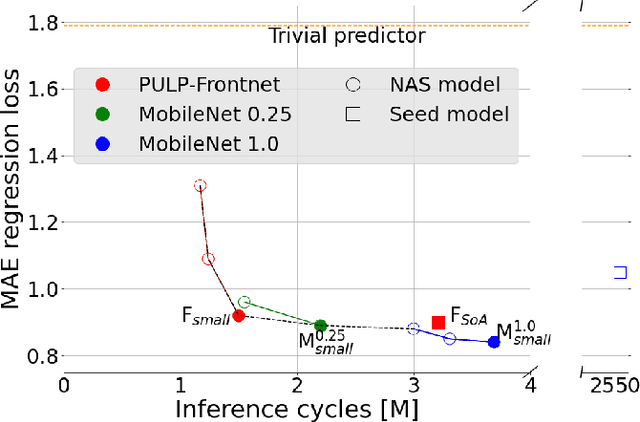
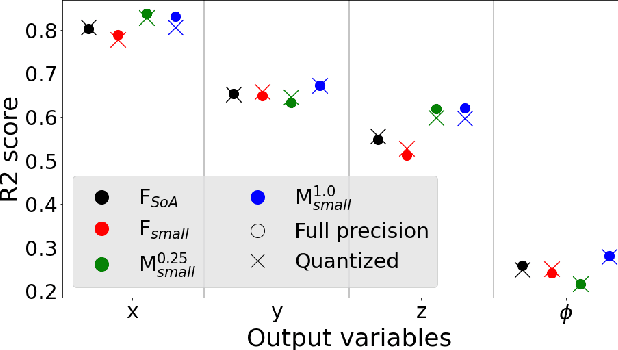
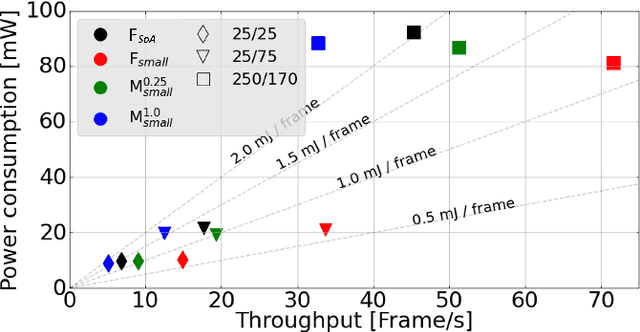
Miniaturized autonomous unmanned aerial vehicles (UAVs) are an emerging and trending topic. With their form factor as big as the palm of one hand, they can reach spots otherwise inaccessible to bigger robots and safely operate in human surroundings. The simple electronics aboard such robots (sub-100mW) make them particularly cheap and attractive but pose significant challenges in enabling onboard sophisticated intelligence. In this work, we leverage a novel neural architecture search (NAS) technique to automatically identify several Pareto-optimal convolutional neural networks (CNNs) for a visual pose estimation task. Our work demonstrates how real-life and field-tested robotics applications can concretely leverage NAS technologies to automatically and efficiently optimize CNNs for the specific hardware constraints of small UAVs. We deploy several NAS-optimized CNNs and run them in closed-loop aboard a 27-g Crazyflie nano-UAV equipped with a parallel ultra-low power System-on-Chip. Our results improve the State-of-the-Art by reducing the in-field control error of 32% while achieving a real-time onboard inference-rate of ~10Hz@10mW and ~50Hz@90mW.
Experimenting with Emerging ARM and RISC-V Systems for Decentralised Machine Learning
Feb 15, 2023

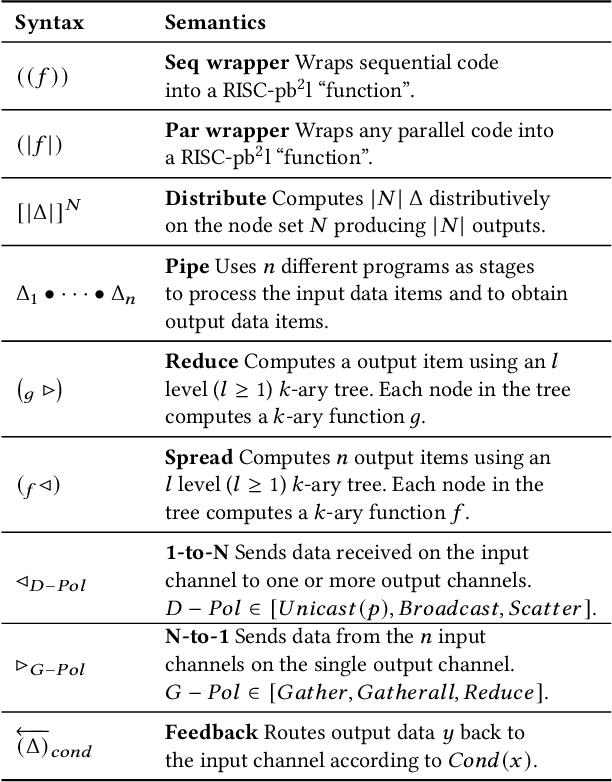

Decentralised Machine Learning (DML) enables collaborative machine learning without centralised input data. Federated Learning (FL) and Edge Inference are examples of DML. While tools for DML (especially FL) are starting to flourish, many are not flexible and portable enough to experiment with novel systems (e.g., RISC-V), non-fully connected topologies, and asynchronous collaboration schemes. We overcome these limitations via a domain-specific language allowing to map DML schemes to an underlying middleware, i.e. the \ff parallel programming library. We experiment with it by generating different working DML schemes on two emerging architectures (ARM-v8, RISC-V) and the x86-64 platform. We characterise the performance and energy efficiency of the presented schemes and systems. As a byproduct, we introduce a RISC-V porting of the PyTorch framework, the first publicly available to our knowledge.
Bio-inspired Autonomous Exploration Policies with CNN-based Object Detection on Nano-drones
Feb 01, 2023Nano-sized drones, with palm-sized form factor, are gaining relevance in the Internet-of-Things ecosystem. Achieving a high degree of autonomy for complex multi-objective missions (e.g., safe flight, exploration, object detection) is extremely challenging for the onboard chip-set due to tight size, payload (<10g), and power envelope constraints, which strictly limit both memory and computation. Our work addresses this complex problem by combining bio-inspired navigation policies, which rely on time-of-flight distance sensor data, with a vision-based convolutional neural network (CNN) for object detection. Our field-proven nano-drone is equipped with two microcontroller units (MCUs), a single-core ARM Cortex-M4 (STM32) for safe navigation and exploration policies, and a parallel ultra-low power octa-core RISC-V (GAP8) for onboard CNN inference, with a power envelope of just 134mW, including image sensors and external memories. The object detection task achieves a mean average precision of 50% (at 1.6 frame/s) on an in-field collected dataset. We compare four bio-inspired exploration policies and identify a pseudo-random policy to achieve the highest coverage area of 83% in a ~36m^2 unknown room in a 3 minutes flight. By combining the detection CNN and the exploration policy, we show an average detection rate of 90% on six target objects in a never-seen-before environment.
Lightweight Neural Architecture Search for Temporal Convolutional Networks at the Edge
Jan 24, 2023Neural Architecture Search (NAS) is quickly becoming the go-to approach to optimize the structure of Deep Learning (DL) models for complex tasks such as Image Classification or Object Detection. However, many other relevant applications of DL, especially at the edge, are based on time-series processing and require models with unique features, for which NAS is less explored. This work focuses in particular on Temporal Convolutional Networks (TCNs), a convolutional model for time-series processing that has recently emerged as a promising alternative to more complex recurrent architectures. We propose the first NAS tool that explicitly targets the optimization of the most peculiar architectural parameters of TCNs, namely dilation, receptive-field and number of features in each layer. The proposed approach searches for networks that offer good trade-offs between accuracy and number of parameters/operations, enabling an efficient deployment on embedded platforms. We test the proposed NAS on four real-world, edge-relevant tasks, involving audio and bio-signals. Results show that, starting from a single seed network, our method is capable of obtaining a rich collection of Pareto optimal architectures, among which we obtain models with the same accuracy as the seed, and 15.9-152x fewer parameters. Compared to three state-of-the-art NAS tools, ProxylessNAS, MorphNet and FBNetV2, our method explores a larger search space for TCNs (up to 10^12x) and obtains superior solutions, while requiring low GPU memory and search time. We deploy our NAS outputs on two distinct edge devices, the multicore GreenWaves Technology GAP8 IoT processor and the single-core STMicroelectronics STM32H7 microcontroller. With respect to the state-of-the-art hand-tuned models, we reduce latency and energy of up to 5.5x and 3.8x on the two targets respectively, without any accuracy loss.
RedMule: A Mixed-Precision Matrix-Matrix Operation Engine for Flexible and Energy-Efficient On-Chip Linear Algebra and TinyML Training Acceleration
Jan 10, 2023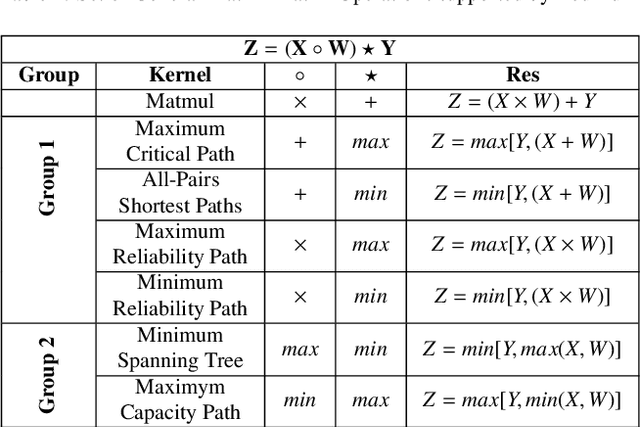
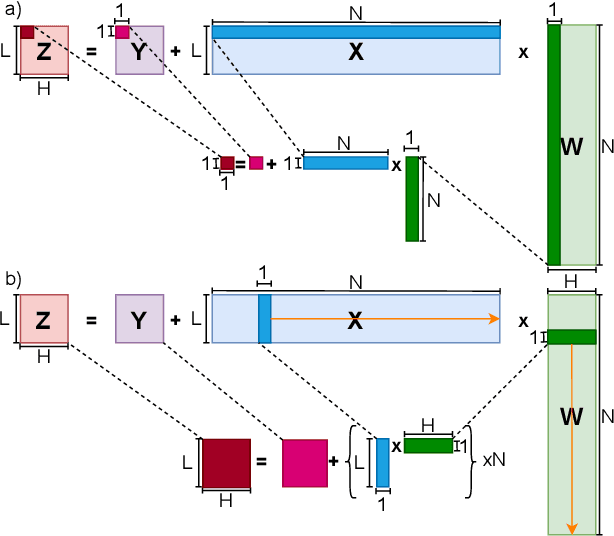
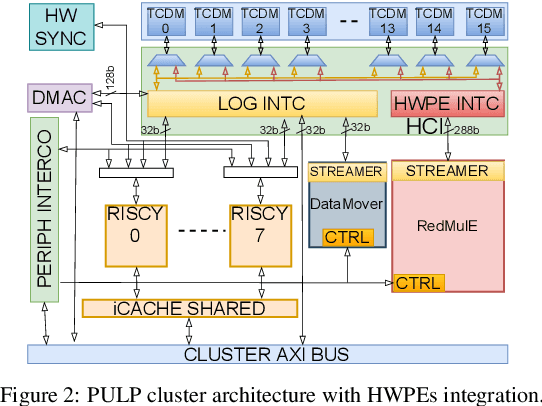
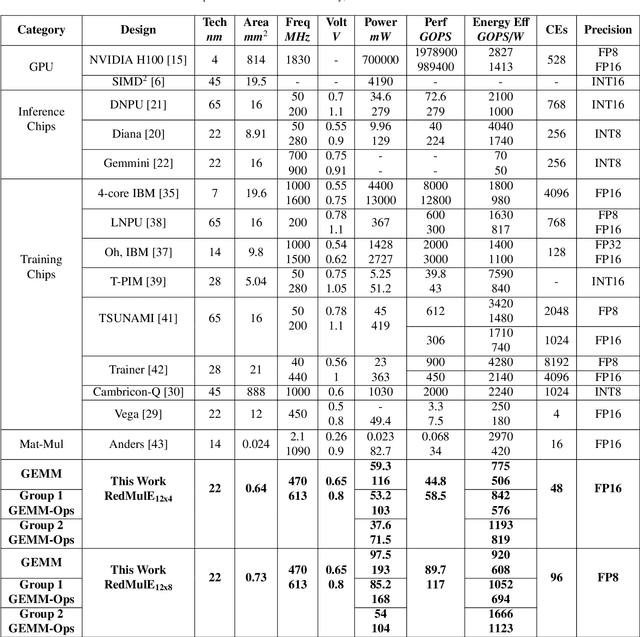
The increasing interest in TinyML, i.e., near-sensor machine learning on power budgets of a few tens of mW, is currently pushing toward enabling TinyML-class training as opposed to inference only. Current training algorithms, based on various forms of error and gradient backpropagation, rely on floating-point matrix operations to meet the precision and dynamic range requirements. So far, the energy and power cost of these operations has been considered too high for TinyML scenarios. This paper addresses the open challenge of near-sensor training on a few mW power budget and presents RedMulE - Reduced-Precision Matrix Multiplication Engine, a low-power specialized accelerator conceived for multi-precision floating-point General Matrix-Matrix Operations (GEMM-Ops) acceleration, supporting FP16, as well as hybrid FP8 formats, with {sign, exponent, mantissa}=({1,4,3}, {1,5,2}). We integrate RedMule into a Parallel Ultra-Low-Power (PULP) cluster containing eight energy-efficient RISC-V cores sharing a tightly-coupled data memory and implement the resulting system in a 22 nm technology. At its best efficiency point (@ 470 MHz, 0.65 V), the RedMulE-augmented PULP cluster achieves 755 GFLOPS/W and 920 GFLOPS/W during regular General Matrix-Matrix Multiplication (GEMM), and up to 1.19 TFLOPS/W and 1.67 TFLOPS/W when executing GEMM-Ops, respectively, for FP16 and FP8 input/output tensors. In its best performance point (@ 613 MHz, 0.8 V), RedMulE achieves up to 58.5 GFLOPS and 117 GFLOPS for FP16 and FP8, respectively, with 99.4% utilization of the array of Computing Elements and consuming less than 60 mW on average, thus enabling on-device training of deep learning models in TinyML application scenarios while retaining the flexibility to tackle other classes of common linear algebra problems efficiently.
Self-sustaining Ultra-wideband Positioning System for Event-driven Indoor Localization
Dec 09, 2022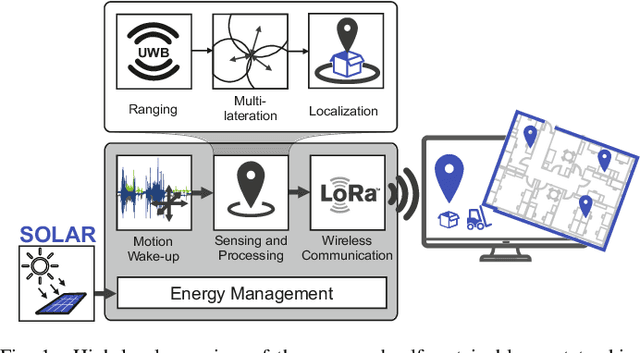
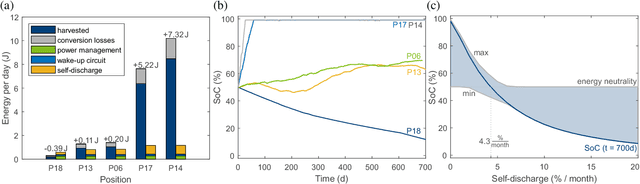
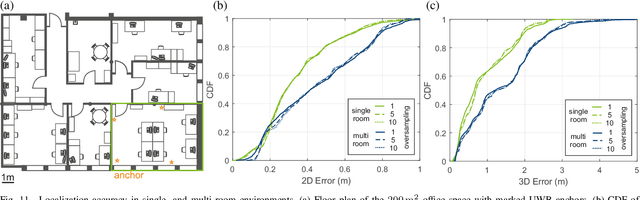
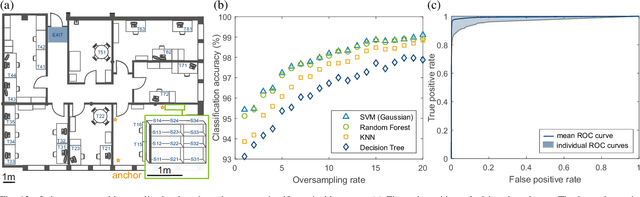
Smart and unobtrusive mobile sensor nodes that accurately track their own position have the potential to augment data collection with location-based functions. To attain this vision of unobtrusiveness, the sensor nodes must have a compact form factor and operate over long periods without battery recharging or replacement. This paper presents a self-sustaining and accurate ultra-wideband-based indoor location system with conservative infrastructure overhead. An event-driven sensing approach allows for balancing the limited energy harvested in indoor conditions with the power consumption of ultra-wideband transceivers. The presented tag-centralized concept, which combines heterogeneous system design with embedded processing, minimizes idle consumption without sacrificing functionality. Despite modest infrastructure requirements, high localization accuracy is achieved with error-correcting double-sided two-way ranging and embedded optimal multilateration. Experimental results demonstrate the benefits of the proposed system: the node achieves a quiescent current of $47~nA$ and operates at $1.2~\mu A$ while performing energy harvesting and motion detection. The energy consumption for position updates, with an accuracy of $40~cm$ (2D) in realistic non-line-of-sight conditions, is $10.84~mJ$. In an asset tracking case study within a $200~m^2$ multi-room office space, the achieved accuracy level allows for identifying 36 different desk and storage locations with an accuracy of over $95~{\%}$. The system`s long-time self-sustainability has been analyzed over $700~days$ in multiple indoor lighting situations.
Fully On-board Low-Power Localization with Multizone Time-of-Flight Sensors on Nano-UAVs
Nov 25, 2022Nano-size unmanned aerial vehicles (UAVs) hold enormous potential to perform autonomous operations in complex environments, such as inspection, monitoring or data collection. Moreover, their small size allows safe operation close to humans and agile flight. An important part of autonomous flight is localization, which is a computationally intensive task especially on a nano-UAV that usually has strong constraints in sensing, processing and memory. This work presents a real-time localization approach with low element-count multizone range sensors for resource-constrained nano-UAVs. The proposed approach is based on a novel miniature 64-zone time-of-flight sensor from ST Microelectronics and a RISC-V-based parallel ultra low-power processor, to enable accurate and low latency Monte Carlo Localization on-board. Experimental evaluation using a nano-UAV open platform demonstrated that the proposed solution is capable of localizing on a 31.2m$\boldsymbol{^2}$ map with 0.15m accuracy and an above 95% success rate. The achieved accuracy is sufficient for localization in common indoor environments. We analyze tradeoffs in using full and half-precision floating point numbers as well as a quantized map and evaluate the accuracy and memory footprint across the design space. Experimental evaluation shows that parallelizing the execution for 8 RISC-V cores brings a 7x speedup and allows us to execute the algorithm on-board in real-time with a latency of 0.2-30ms (depending on the number of particles), while only increasing the overall drone power consumption by 3-7%. Finally, we provide an open-source implementation of our approach.
In-memory factorization of holographic perceptual representations
Nov 09, 2022Disentanglement of constituent factors of a sensory signal is central to perception and cognition and hence is a critical task for future artificial intelligence systems. In this paper, we present a compute engine capable of efficiently factorizing holographic perceptual representations by exploiting the computation-in-superposition capability of brain-inspired hyperdimensional computing and the intrinsic stochasticity associated with analog in-memory computing based on nanoscale memristive devices. Such an iterative in-memory factorizer is shown to solve at least five orders of magnitude larger problems that cannot be solved otherwise, while also significantly lowering the computational time and space complexity. We present a large-scale experimental demonstration of the factorizer by employing two in-memory compute chips based on phase-change memristive devices. The dominant matrix-vector multiply operations are executed at O(1) thus reducing the computational time complexity to merely the number of iterations. Moreover, we experimentally demonstrate the ability to factorize visual perceptual representations reliably and efficiently.