 Add to Chrome
 Add to Firefox
 Add to Edge
Thinking Fast, Thinking Slow: Adaptive Multimodal Transformer-based Sensor Fusion for Depth Estimation on Ultra-low-power MCUs
Jul 21, 2026
Artificial intelligence (AI)-based multimodal sensor fusion is a relevant topic gaining ever more traction across ultra-low-power (ULP) embedded and cyber-physical systems, as it improves reliability, accuracy, and robustness under real-world constraints. However, adding more and more sensors to ultra-constrained sub-100 mW platforms requires balancing energy consumption against prediction accuracy. To achieve this ambitious goal, we present a novel adaptive AI methodology that combines multimodal sensor fusion (camera, ultrasound, and Time-of-Flight sensors) with a lightweight recurrent Transformer-based architecture (688 k parameters). We address the depth map estimation task with a mechanism that combines token propagation across iterations with incremental sensor utilization. At each iteration, a confidence-based gating mechanism dynamically decides whether to continue the computation by adding progressively richer but more power-demanding sensors as input. Token propagation ensures temporal consistency by forwarding context features across time. To deploy our algorithm and test a first real-world prototype, we design a novel printed circuit board featuring all three sensors, coupled with an ULP GWT GAP9 multicore System-on-Chip. When comparing our adaptive system against the same pipeline using all sensors and iterations on the NYUv2 dataset, we lose only 4.8% of the δ1 accuracy in exchange for 90% energy saving (2.44 mJ/frame). Finally, our adaptive method marks only 5.6% lower δ1 accuracy than MobileDepth despite using 9x fewer parameters. Compared with a state-of-the-art model also running on GAP9, our method improves δ1 accuracy by 31.8% thanks to our adaptive sensor fusion while operating within the same average power budget (~400 mW).

Improving Autonomous Nano-drones Performance via Automated End-to-End Optimization and Deployment of DNNs
Jul 14, 2026The evolution of energy-efficient ultra-low-power (ULP) parallel processors and the diffusion of convolutional neural networks (CNNs) are fueling the advent of autonomous driving nano-sized unmanned aerial vehicles (UAVs). These sub-10 cm robotic platforms are envisioned as next-generation ubiquitous smart-sensors and unobtrusive robotic-helpers. However, the limited computational/memory resources available aboard nano-UAVs introduce the challenge of minimizing and optimizing vision-based CNNs -- which to date require error-prone, labor-intensive iterative development flows. This work explores methodologies and software tools to streamline and automate all the deployment of vision-based CNN navigation on a ULP multicore system-on-chip acting as a mission computer on a Crazyflie 2.1 nano-UAV. We focus on the deployment of PULP-Dronet, a state-of-the-art CNN for autonomous navigation of nano-UAVs, from the initial training to the final closed-loop evaluation. Compared to the original hand-crafted CNN, our results show a 2x reduction of memory footprint and a speedup of 1.6x in inference time while guaranteeing the same prediction accuracy and significantly improving the behavior in the field, achieving: i) obstacle avoidance with a peak braking-speed of 1.65 m/s and improving the speed/braking-space ratio of the baseline, ii) free flight in a familiar environment up to 1.96 m/s (0.5 m/s for the baseline), and iii) lane following on a path featuring a 90 deg turn -- all while using for computation less than 1.6% of the drone's power budget. To foster new applications and future research, we open-source all the software design in a ready-to-run project compatible with the Crazyflie 2.1
Low-Power License Plate Detection and Recognition on a RISC-V Multi-Core MCU-Based Vision System
Jul 07, 2026In this paper, we present the first (to the best of our knowledge) demonstration of a low-power MCU-based edge device for Automatic License Plate Recognition (ALPR). The design leverages on a 9-core RISC-V processor, GAP8, coupled with a QVGA ultra-low-power greyscale imager. The proposed visual processing pipeline uses a multi-model inference approach based on SSDlite-MobilenetV2 for license plate detection and LPRNet for optical character recognition, reaching a 38.9% mAP score for the first task and a recognition rate of >99.13% for the latter on public datasets. On real-world data, the pipeline recognizes registration numbers when the size of LP crops is as small as 30x5 pixels. Thanks to the applied compression and optimization strategies, the multi-model inference (687 MMAC) achieves a throughput of 1.09 FPS at a power cost of 117 mW when running on GAP8. Our solution is the first MCU-class device embedding such a level of network complexity, resulting to be 73x more energy-efficient w.r.t. precedent mobile-class ALPR system featuring a Raspberry Pi3. The proposed design does not resort to any hardwired acceleration engines, thus retaining full flexibility for future algorithmic improvements.
TinyDEVO: Deep Event-based Visual Odometry on Ultra-low-power Multi-core Microcontrollers
Apr 09, 2026A key task in embedded vision is visual odometry (VO), which estimates camera motion from visual sensors, and it is a core component in many embedded power-constrained systems, from autonomous robots to augmented and virtual reality wearable devices. The newest class of VO systems combines deep learning models with bio-inspired event-based cameras, which are robust to motion blur and lighting conditions. However, state-of-the-art (SoA) event-based VO algorithms require significant memory and computation. For example, the leading approach DEVO requires 733 MB of memory and 155 billion multiply-accumulate (MAC) operations per frame. We present TinyDEVO, an event-based VO deep learning model designed for resource-constrained microcontroller units (MCUs). We deploy TinyDEVO on an ultra-low-power (ULP) 9-core RISC-V-based MCU, achieving a throughput of approximately 1.2 frames per second with an average power consumption of only 86 mW. Thanks to our neural network architectural optimizations and hyperparameter tuning, TinyDEVO reduces the memory footprint by 11.5x (to 63.8 MB) and the number of operations per frame by 29.7x (to 5.2 billion MACs per frame) compared to DEVO, while maintaining an average trajectory error of 27 cm, i.e., only 19 cm higher than DEVO, on three state-of-the-art datasets. Our work demonstrates, for the first time, the feasibility of an event-based VO pipeline on ultra-low-power devices.
Tiny-DroNeRF: Tiny Neural Radiance Fields aboard Federated Learning-enabled Nano-drones
Mar 02, 2026Sub-30g nano-sized aerial robots can leverage their agility and form factor to autonomously explore cluttered and narrow environments, like in industrial inspection and search and rescue missions. However, the price for their tiny size is a strong limit in their resources, i.e., sub-100 mW microcontroller units (MCUs) delivering $\sim$100 GOps/s at best, and memory budgets well below 100 MB. Despite these strict constraints, we aim to enable complex vision-based tasks aboard nano-drones, such as dense 3D scene reconstruction: a key robotic task underlying fundamental capabilities like spatial awareness and motion planning. Top-performing 3D reconstruction methods leverage neural radiance fields (NeRF) models, which require GBs of memory and massive computation, usually delivered by high-end GPUs consuming 100s of Watts. Our work introduces Tiny-DroNeRF, a lightweight NeRF model, based on Instant-NGP, and optimized for running on a GAP9 ultra-low-power (ULP) MCU aboard our nano-drones. Then, we further empower our Tiny-DroNeRF by leveraging a collaborative federated learning scheme, which distributes the model training among multiple nano-drones. Our experimental results show a 96% reduction in Tiny-DroNeRF's memory footprint compared to Instant-NGP, with only a 5.7 dB drop in reconstruction accuracy. Finally, our federated learning scheme allows Tiny-DroNeRF to train with an amount of data otherwise impossible to keep in a single drone's memory, increasing the overall reconstruction accuracy. Ultimately, our work combines, for the first time, NeRF training on an ULP MCU with federated learning on nano-drones.
Distilling Tiny and Ultra-fast Deep Neural Networks for Autonomous Navigation on Nano-UAVs
Jul 17, 2024Nano-sized unmanned aerial vehicles (UAVs) are ideal candidates for flying Internet-of-Things smart sensors to collect information in narrow spaces. This requires ultra-fast navigation under very tight memory/computation constraints. The PULP-Dronet convolutional neural network (CNN) enables autonomous navigation running aboard a nano-UAV at 19 frame/s, at the cost of a large memory footprint of 320 kB -- and with drone control in complex scenarios hindered by the disjoint training of collision avoidance and steering capabilities. In this work, we distill a novel family of CNNs with better capabilities than PULP-Dronet, but memory footprint reduced by up to 168x (down to 2.9 kB), achieving an inference rate of up to 139 frame/s; we collect a new open-source unified collision/steering 66 k images dataset for more robust navigation; and we perform a thorough in-field analysis of both PULP-Dronet and our tiny CNNs running on a commercially available nano-UAV. Our tiniest CNN, called Tiny-PULP-Dronet v3, navigates with a 100% success rate a challenging and never-seen-before path, composed of a narrow obstacle-populated corridor and a 180{\deg} turn, at a maximum target speed of 0.5 m/s. In the same scenario, the SoA PULP-Dronet consistently fails despite having 168x more parameters.
Tiny-PULP-Dronets: Squeezing Neural Networks for Faster and Lighter Inference on Multi-Tasking Autonomous Nano-Drones
Jul 02, 2024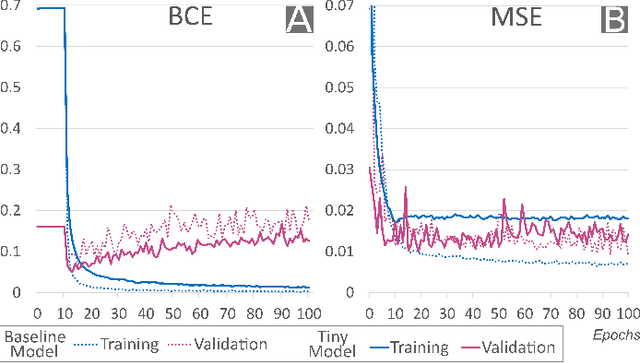
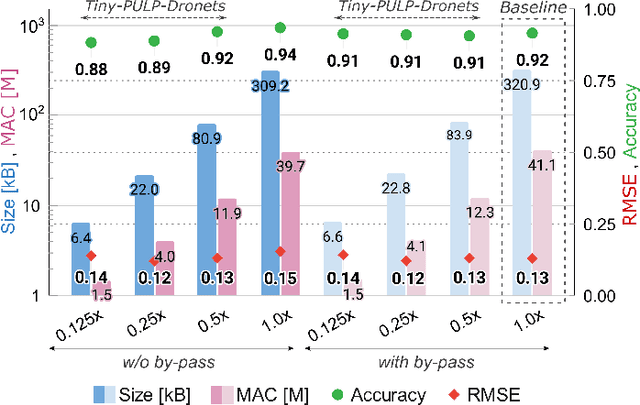
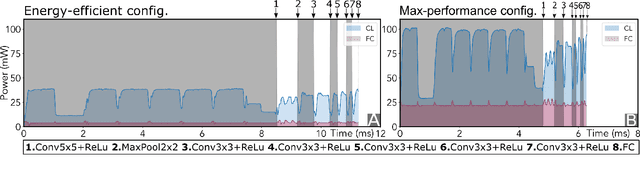

Pocket-sized autonomous nano-drones can revolutionize many robotic use cases, such as visual inspection in narrow, constrained spaces, and ensure safer human-robot interaction due to their tiny form factor and weight -- i.e., tens of grams. This compelling vision is challenged by the high level of intelligence needed aboard, which clashes against the limited computational and storage resources available on PULP (parallel-ultra-low-power) MCU class navigation and mission controllers that can be hosted aboard. This work moves from PULP-Dronet, a State-of-the-Art convolutional neural network for autonomous navigation on nano-drones. We introduce Tiny-PULP-Dronet: a novel methodology to squeeze by more than one order of magnitude model size (50x fewer parameters), and number of operations (27x less multiply-and-accumulate) required to run inference with similar flight performance as PULP-Dronet. This massive reduction paves the way towards affordable multi-tasking on nano-drones, a fundamental requirement for achieving high-level intelligence.
Combining Local and Global Perception for Autonomous Navigation on Nano-UAVs
Mar 18, 2024
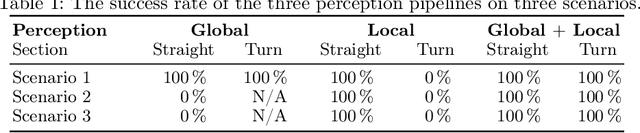

A critical challenge in deploying unmanned aerial vehicles (UAVs) for autonomous tasks is their ability to navigate in an unknown environment. This paper introduces a novel vision-depth fusion approach for autonomous navigation on nano-UAVs. We combine the visual-based PULP-Dronet convolutional neural network for semantic information extraction, i.e., serving as the global perception, with 8x8px depth maps for close-proximity maneuvers, i.e., the local perception. When tested in-field, our integration strategy highlights the complementary strengths of both visual and depth sensory information. We achieve a 100% success rate over 15 flights in a complex navigation scenario, encompassing straight pathways, static obstacle avoidance, and 90{\deg} turns.
Multi-sensory Anti-collision Design for Autonomous Nano-swarm Exploration
Dec 20, 2023This work presents a multi-sensory anti-collision system design to achieve robust autonomous exploration capabilities for a swarm of 10 cm-side nano-drones operating on object detection missions. We combine lightweight single-beam laser ranging to avoid proximity collisions with a long-range vision-based obstacle avoidance deep learning model (i.e., PULP-Dronet) and an ultra-wide-band (UWB) based ranging module to prevent intra-swarm collisions. An in-field study shows that our multisensory approach can prevent collisions with static obstacles, improving the mission success rate from 20% to 80% in cluttered environments w.r.t. a State-of-the-Art (SoA) baseline. At the same time, the UWB-based sub-system shows a 92.8% success rate in preventing collisions between drones of a four-agent fleet within a safety distance of 65 cm. On a SoA robotic platform extended by a GAP8 multi-core processor, the PULP-Dronet runs interleaved with an objected detection task, which constraints its execution at 1.6 frame/s. This throughput is sufficient for avoiding obstacles with a probability of about 40% but shows a need for more capable processors for the next-generation nano-drone swarms.
A Sim-to-Real Deep Learning-based Framework for Autonomous Nano-drone Racing
Dec 14, 2023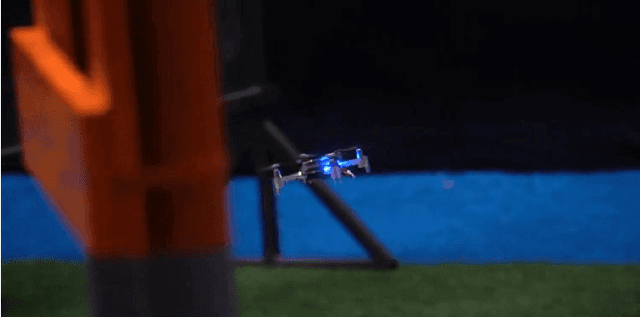
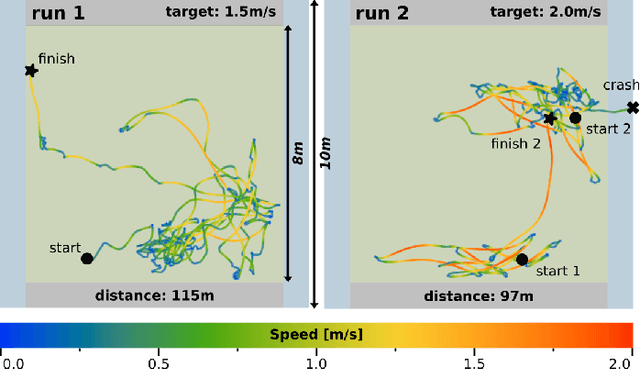
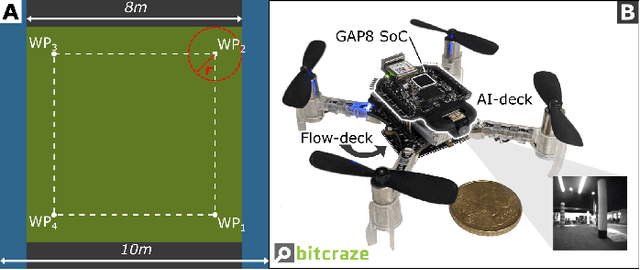
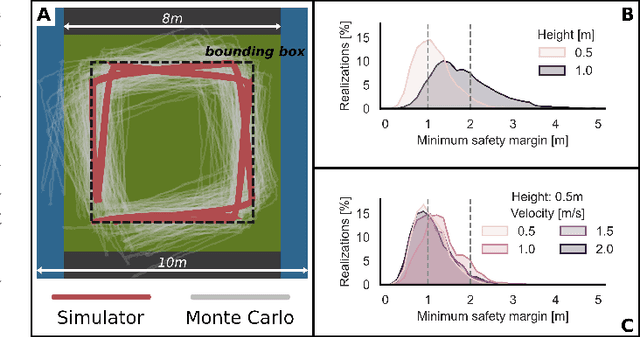
Autonomous drone racing competitions are a proxy to improve unmanned aerial vehicles' perception, planning, and control skills. The recent emergence of autonomous nano-sized drone racing imposes new challenges, as their ~10cm form factor heavily restricts the resources available onboard, including memory, computation, and sensors. This paper describes the methodology and technical implementation of the system winning the first autonomous nano-drone racing international competition: the IMAV 2022 Nanocopter AI Challenge. We developed a fully onboard deep learning approach for visual navigation trained only on simulation images to achieve this goal. Our approach includes a convolutional neural network for obstacle avoidance, a sim-to-real dataset collection procedure, and a navigation policy that we selected, characterized, and adapted through simulation and actual in-field experiments. Our system ranked 1st among seven competing teams at the competition. In our best attempt, we scored 115m of traveled distance in the allotted 5-minute flight, never crashing while dodging static and dynamic obstacles. Sharing our knowledge with the research community, we aim to provide a solid groundwork to foster future development in this field.