 Add to Chrome
 Add to Firefox
 Add to Edge
MAUPITI: On-Device Prototype-Based Learning on a Smart Infrared Sensor
Aug 07, 2026
Low-resolution infrared (IR) array sensors represent an interesting solution for privacy-preserving human sensing in embedded systems. In this letter, we describe a smart multi-pixel IR sensor integrating a 16$\times$16 thermal MOSFET (TMOS) array and a RISC-V microcontroller extended with low-precision SIMD instructions, capable of on-device learning and continual adaptation for pose and gesture recognition tasks under tight memory and power constraints ($<$32kB on-chip memory, $\approx$1.5mW). To avoid the memory overheads of backpropagation and replay buffers, we adopt a prototype-based Nearest Class Mean (NCM) classifier in which a simple Convolutional Neural Network (CNN) encoder is trained and quantized offline, while class prototypes are stored and updated on the device in streaming mode. With experiments on two datasets, we show that this approach yields accuracy on par with a conventional classifier, with negligible latency overheads in both the classification and the prototype update ($<$0.29% considering both phases), effectively enabling online adaptation of the perception framework.

End-to-end Automated Deep Neural Network Optimization for PPG-based Blood Pressure Estimation on Wearables
Apr 11, 2026Photoplethysmography (PPG)-based blood pressure (BP) estimation is a challenging task, particularly on resource-constrained wearable devices. However, fully on-board processing is desirable to ensure user data confidentiality. Recent deep neural networks (DNNs) have achieved high BP estimation accuracy by reconstructing BP waveforms or directly regressing BP values, but their large memory, computation, and energy requirements hinder deployment on wearables. This work introduces a fully automated DNN design pipeline that combines hardware-aware neural architecture search (NAS), pruning, and mixed-precision search (MPS) to generate accurate yet compact BP prediction models optimized for ultra-low-power multicore systems-on-chip (SoCs). Starting from state-of-the-art baseline models on four public datasets, our optimized networks achieve up to 7.99% lower error with a 7.5x parameter reduction, or up to 83x fewer parameters with negligible accuracy loss. All models fit within 512 kB of memory on our target SoC (GreenWaves' GAP8), requiring less than 55 kB and achieving an average inference latency of 142 ms and energy consumption of 7.25 mJ. Patient-specific fine-tuning further improves accuracy by up to 64%, enabling fully autonomous, low-cost BP monitoring on wearables.
BlankSkip: Early-exit Object Detection onboard Nano-drones
Mar 30, 2026Deploying tiny computer vision Deep Neural Networks (DNNs) on-board nano-sized drones is key for achieving autonomy, but is complicated by the extremely tight constraints of their computational platforms (approximately 10 MiB memory, 1 W power budget). Early-exit adaptive DNNs that dial down the computational effort for "easy-to-process" input frames represent a promising way to reduce the average inference latency. However, while this approach is extensively studied for classification, its application to dense tasks like object detection (OD) is not straightforward. In this paper, we propose BlankSkip, an adaptive network for on-device OD that leverages a simple auxiliary classification task for early exit, i.e., identifying frames with no objects of interest. With experiments using a real-world nano-drone platform, the Bitcraze Crazyflie 2.1, we achieve up to 24% average throughput improvement with a limited 0.015 mean Average Precision (mAP) drop compared to a static MobileNet-SSD detector, on a state-of-the-art nano-drones OD dataset.
MEbots: Integrating a RISC-V Virtual Platform with a Robotic Simulator for Energy-aware Design
May 22, 2025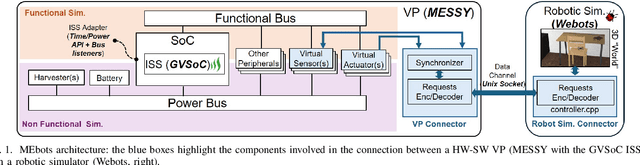
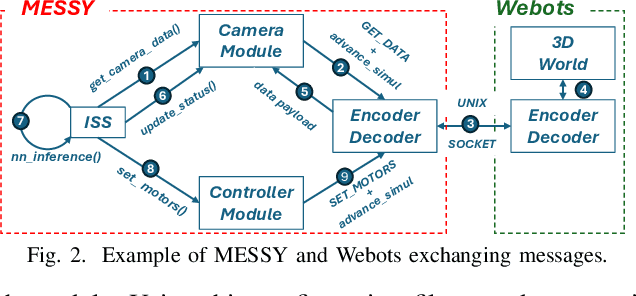
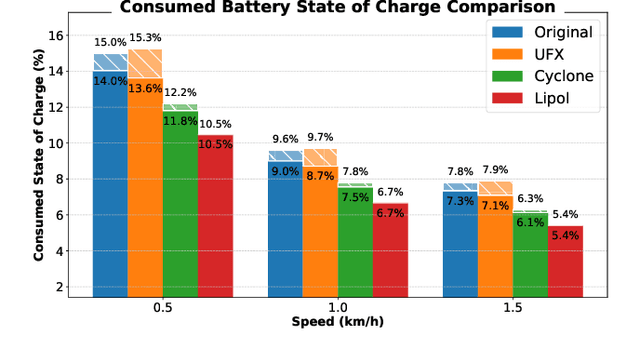
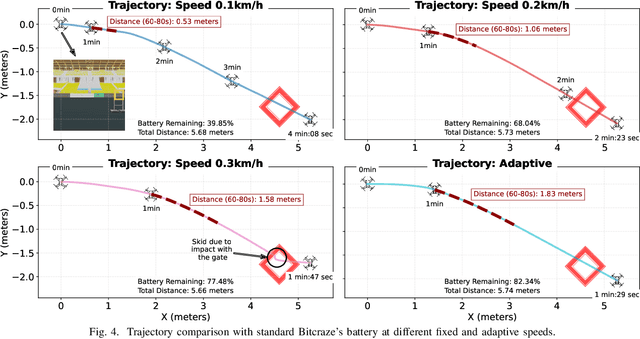
Virtual Platforms (VPs) enable early software validation of autonomous systems' electronics, reducing costs and time-to-market. While many VPs support both functional and non-functional simulation (e.g., timing, power), they lack the capability of simulating the environment in which the system operates. In contrast, robotics simulators lack accurate timing and power features. This twofold shortcoming limits the effectiveness of the design flow, as the designer can not fully evaluate the features of the solution under development. This paper presents a novel, fully open-source framework bridging this gap by integrating a robotics simulator (Webots) with a VP for RISC-V-based systems (MESSY). The framework enables a holistic, mission-level, energy-aware co-simulation of electronics in their surrounding environment, streamlining the exploration of design configurations and advanced power management policies.
Lightweight Software Kernels and Hardware Extensions for Efficient Sparse Deep Neural Networks on Microcontrollers
Mar 08, 2025The acceleration of pruned Deep Neural Networks (DNNs) on edge devices such as Microcontrollers (MCUs) is a challenging task, given the tight area- and power-constraints of these devices. In this work, we propose a three-fold contribution to address this problem. First, we design a set of optimized software kernels for N:M pruned layers, targeting ultra-low-power, multicore RISC-V MCUs, which are up to 2.1x and 3.4x faster than their dense counterparts at 1:8 and 1:16 sparsity, respectively. Then, we implement a lightweight Instruction-Set Architecture (ISA) extension to accelerate the indirect load and non-zero indices decompression operations required by our kernels, obtaining up to 1.9x extra speedup, at the cost of a 5% area overhead. Lastly, we extend an open-source DNN compiler to utilize our sparse kernels for complete networks, showing speedups of 3.21x and 1.81x on a ResNet18 and a Vision Transformer (ViT), with less than 1.5% accuracy drop compared to a dense baseline.
Coupling Neural Networks and Physics Equations For Li-Ion Battery State-of-Charge Prediction
Dec 21, 2024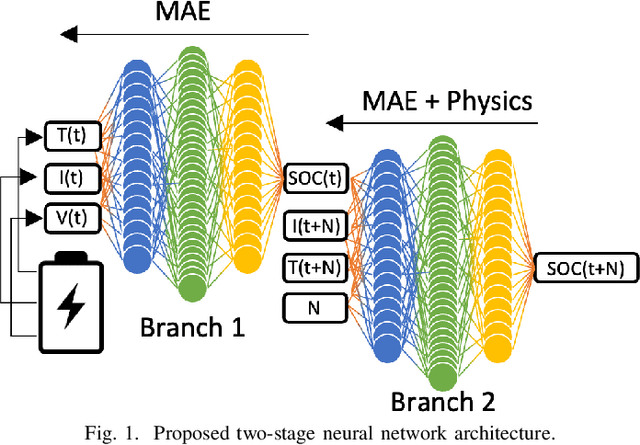
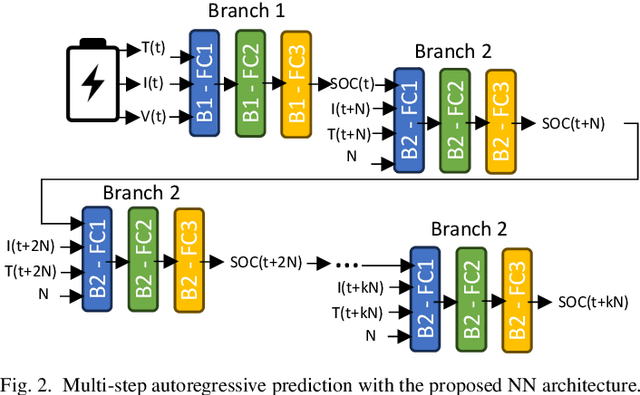
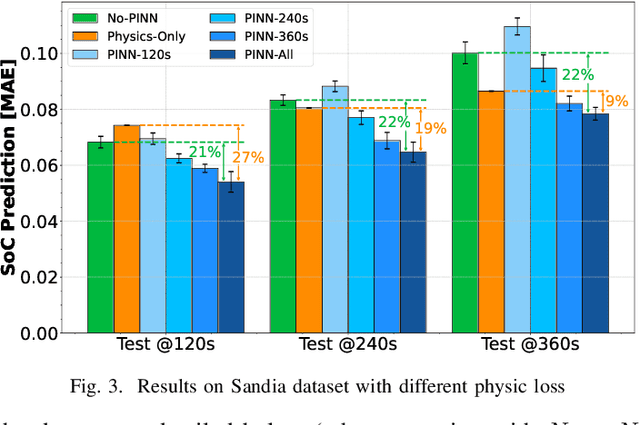
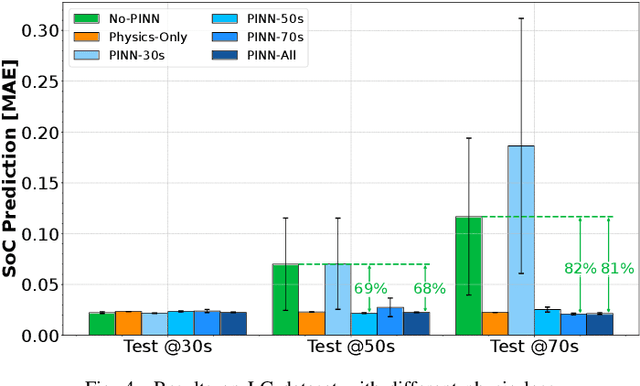
Estimating the evolution of the battery's State of Charge (SoC) in response to its usage is critical for implementing effective power management policies and for ultimately improving the system's lifetime. Most existing estimation methods are either physics-based digital twins of the battery or data-driven models such as Neural Networks (NNs). In this work, we propose two new contributions in this domain. First, we introduce a novel NN architecture formed by two cascaded branches: one to predict the current SoC based on sensor readings, and one to estimate the SoC at a future time as a function of the load behavior. Second, we integrate battery dynamics equations into the training of our NN, merging the physics-based and data-driven approaches, to improve the models' generalization over variable prediction horizons. We validate our approach on two publicly accessible datasets, showing that our Physics-Informed Neural Networks (PINNs) outperform purely data-driven ones while also obtaining superior prediction accuracy with a smaller architecture with respect to the state-of-the-art.
EnhancePPG: Improving PPG-based Heart Rate Estimation with Self-Supervision and Augmentation
Dec 20, 2024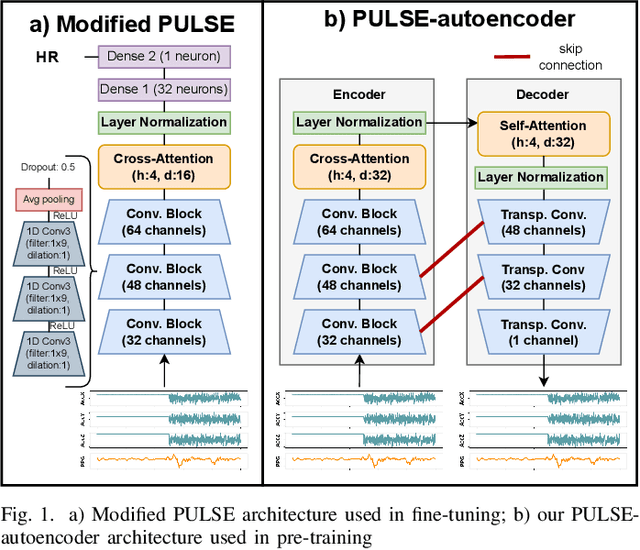
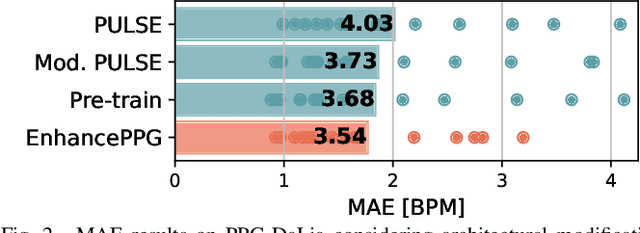


Heart rate (HR) estimation from photoplethysmography (PPG) signals is a key feature of modern wearable devices for health and wellness monitoring. While deep learning models show promise, their performance relies on the availability of large datasets. We present EnhancePPG, a method that enhances state-of-the-art models by integrating self-supervised learning with data augmentation (DA). Our approach combines self-supervised pre-training with DA, allowing the model to learn more generalizable features, without needing more labelled data. Inspired by a U-Net-like autoencoder architecture, we utilize unsupervised PPG signal reconstruction, taking advantage of large amounts of unlabeled data during the pre-training phase combined with data augmentation, to improve state-of-the-art models' performance. Thanks to our approach and minimal modification to the state-of-the-art model, we improve the best HR estimation by 12.2%, lowering from 4.03 Beats-Per-Minute (BPM) to 3.54 BPM the error on PPG-DaLiA. Importantly, our EnhancePPG approach focuses exclusively on the training of the selected deep learning model, without significantly increasing its inference latency
Building Damage Assessment in Conflict Zones: A Deep Learning Approach Using Geospatial Sub-Meter Resolution Data
Oct 07, 2024
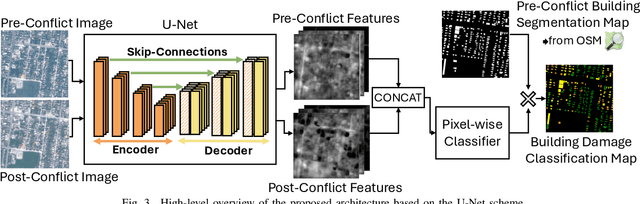


Very High Resolution (VHR) geospatial image analysis is crucial for humanitarian assistance in both natural and anthropogenic crises, as it allows to rapidly identify the most critical areas that need support. Nonetheless, manually inspecting large areas is time-consuming and requires domain expertise. Thanks to their accuracy, generalization capabilities, and highly parallelizable workload, Deep Neural Networks (DNNs) provide an excellent way to automate this task. Nevertheless, there is a scarcity of VHR data pertaining to conflict situations, and consequently, of studies on the effectiveness of DNNs in those scenarios. Motivated by this, our work extensively studies the applicability of a collection of state-of-the-art Convolutional Neural Networks (CNNs) originally developed for natural disasters damage assessment in a war scenario. To this end, we build an annotated dataset with pre- and post-conflict images of the Ukrainian city of Mariupol. We then explore the transferability of the CNN models in both zero-shot and learning scenarios, demonstrating their potential and limitations. To the best of our knowledge, this is the first study to use sub-meter resolution imagery to assess building damage in combat zones.
Joint Pruning and Channel-wise Mixed-Precision Quantization for Efficient Deep Neural Networks
Jul 01, 2024The resource requirements of deep neural networks (DNNs) pose significant challenges to their deployment on edge devices. Common approaches to address this issue are pruning and mixed-precision quantization, which lead to latency and memory occupation improvements. These optimization techniques are usually applied independently. We propose a novel methodology to apply them jointly via a lightweight gradient-based search, and in a hardware-aware manner, greatly reducing the time required to generate Pareto-optimal DNNs in terms of accuracy versus cost (i.e., latency or memory). We test our approach on three edge-relevant benchmarks, namely CIFAR-10, Google Speech Commands, and Tiny ImageNet. When targeting the optimization of the memory footprint, we are able to achieve a size reduction of 47.50% and 69.54% at iso-accuracy with the baseline networks with all weights quantized at 8 and 2-bit, respectively. Our method surpasses a previous state-of-the-art approach with up to 56.17% size reduction at iso-accuracy. With respect to the sequential application of state-of-the-art pruning and mixed-precision optimizations, we obtain comparable or superior results, but with a significantly lowered training time. In addition, we show how well-tailored cost models can improve the cost versus accuracy trade-offs when targeting specific hardware for deployment.
Accelerating Depthwise Separable Convolutions on Ultra-Low-Power Devices
Jun 18, 2024Depthwise separable convolutions are a fundamental component in efficient Deep Neural Networks, as they reduce the number of parameters and operations compared to traditional convolutions while maintaining comparable accuracy. However, their low data reuse opportunities make deploying them notoriously difficult. In this work, we perform an extensive exploration of alternatives to fuse the depthwise and pointwise kernels that constitute the separable convolutional block. Our approach aims to minimize time-consuming memory transfers by combining different data layouts. When targeting a commercial ultra-low-power device with a three-level memory hierarchy, the GreenWaves GAP8 SoC, we reduce the latency of end-to-end network execution by up to 11.40%. Furthermore, our kernels reduce activation data movements between L2 and L1 memories by up to 52.97%.