 Add to Chrome
 Add to Firefox
 Add to Edge
End-to-end Automated Deep Neural Network Optimization for PPG-based Blood Pressure Estimation on Wearables
Apr 11, 2026
Photoplethysmography (PPG)-based blood pressure (BP) estimation is a challenging task, particularly on resource-constrained wearable devices. However, fully on-board processing is desirable to ensure user data confidentiality. Recent deep neural networks (DNNs) have achieved high BP estimation accuracy by reconstructing BP waveforms or directly regressing BP values, but their large memory, computation, and energy requirements hinder deployment on wearables. This work introduces a fully automated DNN design pipeline that combines hardware-aware neural architecture search (NAS), pruning, and mixed-precision search (MPS) to generate accurate yet compact BP prediction models optimized for ultra-low-power multicore systems-on-chip (SoCs). Starting from state-of-the-art baseline models on four public datasets, our optimized networks achieve up to 7.99% lower error with a 7.5x parameter reduction, or up to 83x fewer parameters with negligible accuracy loss. All models fit within 512 kB of memory on our target SoC (GreenWaves' GAP8), requiring less than 55 kB and achieving an average inference latency of 142 ms and energy consumption of 7.25 mJ. Patient-specific fine-tuning further improves accuracy by up to 64%, enabling fully autonomous, low-cost BP monitoring on wearables.

MATCHA: Efficient Deployment of Deep Neural Networks on Multi-Accelerator Heterogeneous Edge SoCs
Apr 10, 2026Deploying DNNs on System-on-Chips (SoC) with multiple heterogeneous acceleration engines is challenging, and the majority of deployment frameworks cannot fully exploit heterogeneity. We present MATCHA, a unified DNN deployment framework that generates highly concurrent schedules for parallel, heterogeneous accelerators and uses constraint programming to optimize L3/L2 memory allocation and scheduling. Using pattern matching, tiling, and mapping across individual HW units enables parallel execution and high accelerator utilization. On the MLPerf Tiny benchmark, using a SoC with two heterogeneous accelerators, MATCHA improves accelerator utilization and reduces inference latency by up to 35% with respect to the the state-of-the-art MATCH compiler.
BlankSkip: Early-exit Object Detection onboard Nano-drones
Mar 30, 2026Deploying tiny computer vision Deep Neural Networks (DNNs) on-board nano-sized drones is key for achieving autonomy, but is complicated by the extremely tight constraints of their computational platforms (approximately 10 MiB memory, 1 W power budget). Early-exit adaptive DNNs that dial down the computational effort for "easy-to-process" input frames represent a promising way to reduce the average inference latency. However, while this approach is extensively studied for classification, its application to dense tasks like object detection (OD) is not straightforward. In this paper, we propose BlankSkip, an adaptive network for on-device OD that leverages a simple auxiliary classification task for early exit, i.e., identifying frames with no objects of interest. With experiments using a real-world nano-drone platform, the Bitcraze Crazyflie 2.1, we achieve up to 24% average throughput improvement with a limited 0.015 mean Average Precision (mAP) drop compared to a static MobileNet-SSD detector, on a state-of-the-art nano-drones OD dataset.
Improving Continual Learning for Gaussian Splatting based Environments Reconstruction on Commercial Off-the-Shelf Edge Devices
Mar 09, 2026Novel view synthesis (NVS) is increasingly relevant for edge robotics, where compact and incrementally updatable 3D scene models are needed for SLAM, navigation, and inspection under tight memory and latency budgets. Variational Bayesian Gaussian Splatting (VBGS) enables replay-free continual updates for the 3DGS algorithm by maintaining a probabilistic scene model, but its high-precision computations and large intermediate tensors make on-device training impractical. We present a precision-adaptive optimization framework that enables VBGS training on resource-constrained hardware without altering its variational formulation. We (i) profile VBGS to identify memory/latency hotspots, (ii) fuse memory-dominant kernels to reduce materialized intermediate tensors, and (iii) automatically assign operation-level precisions via a mixed-precision search with bounded relative error. Across the Blender, Habitat, and Replica datasets, our optimised pipeline reduces peak memory from 9.44 GB to 1.11 GB and training time from ~234 min to ~61 min on an A5000 GPU, while preserving (and in some cases improving) reconstruction quality of the state-of-the-art VBGS baseline. We also enable for the first time NVS training on a commercial embedded platform, the Jetson Orin Nano, reducing per-frame latency by 19x compared to 3DGS.
SilentWear: an Ultra-Low Power Wearable System for EMG-based Silent Speech Recognition
Mar 04, 2026Detecting speech from biosignals is gaining increasing attention due to the potential to develop human-computer interfaces that are noise-robust, privacy-preserving, and scalable for both clinical applications and daily use. However, most existing approaches remain limited by insufficient wearability and the lack of edge-processing capabilities, which are essential for minimally obtrusive, responsive, and private assistive technologies. In this work, we present SilentWear, a fully wearable, textile-based neck interface for EMG signal acquisition and processing. Powered by BioGAP-Ultra, the system enables end-to-end data acquisition from 14 differential channels and on-device speech recognition. SilentWear is coupled with SpeechNet, a lightweight 15k-parameter CNN architecture specifically tailored for EMG-based speech decoding, achieving an average cross-validated accuracy of 84.8$\pm$4.6% and 77.5$\pm$6.6% for vocalized and silent speech, respectively, over eight representative human-machine interaction commands collected over multiple days. We evaluate robustness to repositioning induced by multi-day use. In an inter-session setting, the system achieves average accuracies of 71.1$\pm$8.3% and 59.3\pm2.2% for vocalized and silent speech, respectively. To mitigate performance degradation due to repositioning, we propose an incremental fine-tuning strategy, demonstrating more than 10% accuracy recovery with less than 10 minutes of additional user data. Finally, we demonstrate end-to-end real-time on-device speech recognition on a commercial multi-core microcontroller unit (MCU), achieving an energy consumption of 63.9$μ$J per inference with a latency of 2.47 ms. With a total power consumption of 20.5mW for acquisition, inference, and wireless transmission of results, SilentWear enables continuous operation for more than 27 hours.
Don't be so Stief! Learning KV Cache low-rank approximation over the Stiefel manifold
Jan 29, 2026Key--value (KV) caching enables fast autoregressive decoding but at long contexts becomes a dominant bottleneck in High Bandwidth Memory (HBM) capacity and bandwidth. A common mitigation is to compress cached keys and values by projecting per-head matrixes to a lower rank, storing only the projections in the HBM. However, existing post-training approaches typically fit these projections using SVD-style proxy objectives, which may poorly reflect end-to-end reconstruction after softmax, value mixing, and subsequent decoder-layer transformations. For these reasons, we introduce StiefAttention, a post-training KV-cache compression method that learns \emph{orthonormal} projection bases by directly minimizing \emph{decoder-layer output reconstruction error}. StiefAttention additionally precomputes, for each layer, an error-rank profile over candidate ranks, enabling flexible layer-wise rank allocation under a user-specified error budget. Noteworthy, on Llama3-8B under the same conditions, StiefAttention outperforms EigenAttention by $11.9$ points on C4 perplexity and $5.4\%$ on 0-shot MMLU accuracy at iso-compression, yielding lower relative error and higher cosine similarity with respect to the original decoder-layer outputs.
Automatic integration of SystemC in the FMI standard for Software-defined Vehicle design
Aug 27, 2025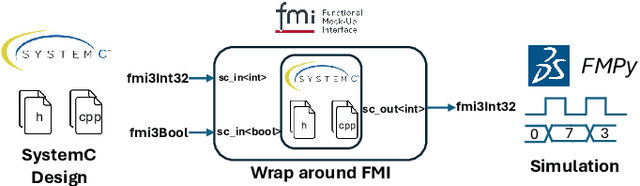
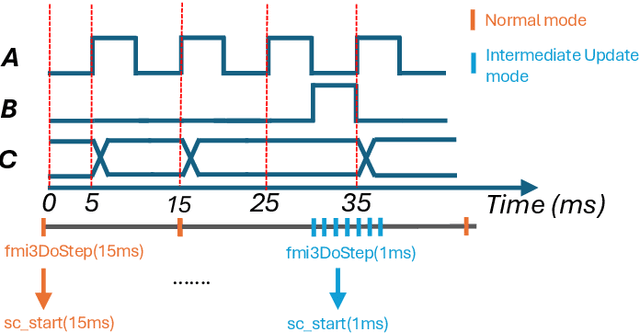
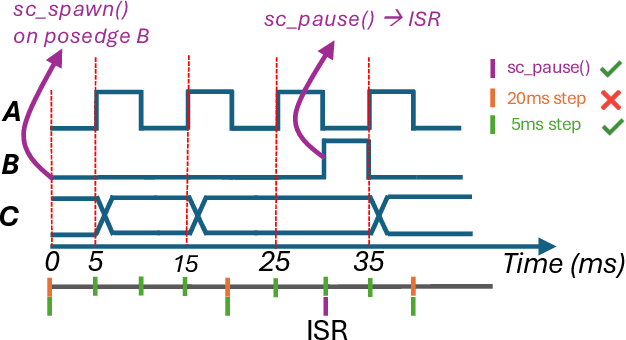
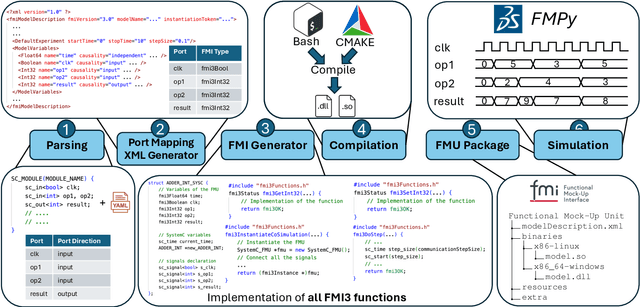
The recent advancements of the automotive sector demand robust co-simulation methodologies that enable early validation and seamless integration across hardware and software domains. However, the lack of standardized interfaces and the dominance of proprietary simulation platforms pose significant challenges to collaboration, scalability, and IP protection. To address these limitations, this paper presents an approach for automatically wrapping SystemC models by using the Functional Mock-up Interface (FMI) standard. This method combines the modeling accuracy and fast time-to-market of SystemC with the interoperability and encapsulation benefits of FMI, enabling secure and portable integration of embedded components into co-simulation workflows. We validate the proposed methodology on real-world case studies, demonstrating its effectiveness with complex designs.
Deep Recommender Models Inference: Automatic Asymmetric Data Flow Optimization
Jul 02, 2025Deep Recommender Models (DLRMs) inference is a fundamental AI workload accounting for more than 79% of the total AI workload in Meta's data centers. DLRMs' performance bottleneck is found in the embedding layers, which perform many random memory accesses to retrieve small embedding vectors from tables of various sizes. We propose the design of tailored data flows to speedup embedding look-ups. Namely, we propose four strategies to look up an embedding table effectively on one core, and a framework to automatically map the tables asymmetrically to the multiple cores of a SoC. We assess the effectiveness of our method using the Huawei Ascend AI accelerators, comparing it with the default Ascend compiler, and we perform high-level comparisons with Nvidia A100. Results show a speed-up varying from 1.5x up to 6.5x for real workload distributions, and more than 20x for extremely unbalanced distributions. Furthermore, the method proves to be much more independent of the query distribution than the baseline.
* 5 pages, 4 figures, conference: IEEE ICCD24
MEbots: Integrating a RISC-V Virtual Platform with a Robotic Simulator for Energy-aware Design
May 22, 2025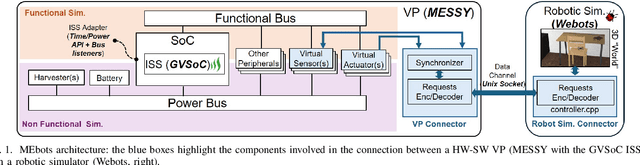
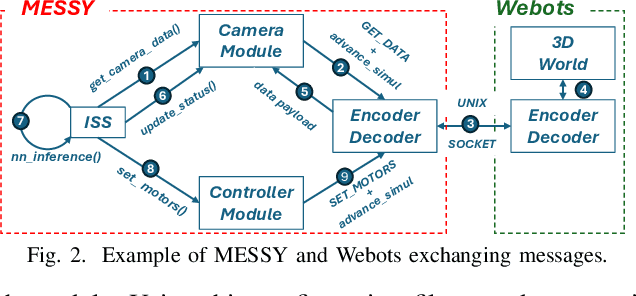
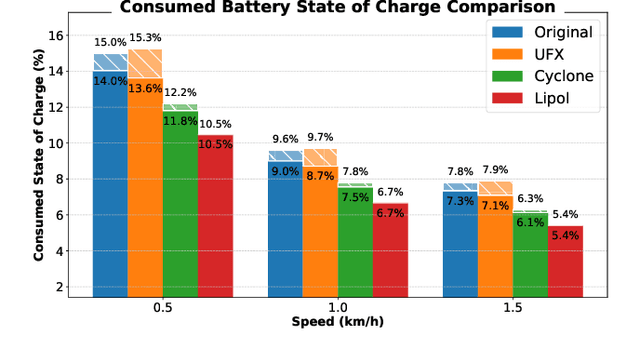
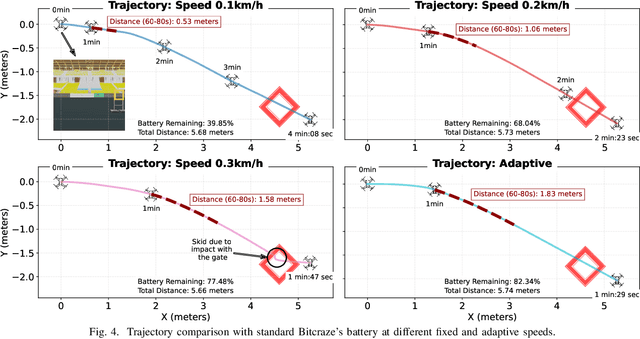
Virtual Platforms (VPs) enable early software validation of autonomous systems' electronics, reducing costs and time-to-market. While many VPs support both functional and non-functional simulation (e.g., timing, power), they lack the capability of simulating the environment in which the system operates. In contrast, robotics simulators lack accurate timing and power features. This twofold shortcoming limits the effectiveness of the design flow, as the designer can not fully evaluate the features of the solution under development. This paper presents a novel, fully open-source framework bridging this gap by integrating a robotics simulator (Webots) with a VP for RISC-V-based systems (MESSY). The framework enables a holistic, mission-level, energy-aware co-simulation of electronics in their surrounding environment, streamlining the exploration of design configurations and advanced power management policies.
Lightweight Software Kernels and Hardware Extensions for Efficient Sparse Deep Neural Networks on Microcontrollers
Mar 08, 2025The acceleration of pruned Deep Neural Networks (DNNs) on edge devices such as Microcontrollers (MCUs) is a challenging task, given the tight area- and power-constraints of these devices. In this work, we propose a three-fold contribution to address this problem. First, we design a set of optimized software kernels for N:M pruned layers, targeting ultra-low-power, multicore RISC-V MCUs, which are up to 2.1x and 3.4x faster than their dense counterparts at 1:8 and 1:16 sparsity, respectively. Then, we implement a lightweight Instruction-Set Architecture (ISA) extension to accelerate the indirect load and non-zero indices decompression operations required by our kernels, obtaining up to 1.9x extra speedup, at the cost of a 5% area overhead. Lastly, we extend an open-source DNN compiler to utilize our sparse kernels for complete networks, showing speedups of 3.21x and 1.81x on a ResNet18 and a Vision Transformer (ViT), with less than 1.5% accuracy drop compared to a dense baseline.