 Add to Chrome
 Add to Firefox
 Add to Edge
Pair-In, Pair-Out: Latent Multi-Token Prediction for Efficient LLMs
May 26, 2026
Long chain-of-thought reasoning has made autoregressive decoding the dominant inference cost of modern large language models. Existing methods target either the input side (latent compression) or the output side (speculative decoding and multi-token prediction, MTP), but the two lines of work have been pursued independently. Moreover, output-side methods must incur an expensive verifier pass to validate the unreliable draft tokens predicted by MTP. To address these issues, we propose \textbf{Pair-In, Pair-Out (PIPO)}, which unifies both sides by viewing a latent compressor and an MTP head as mirror-image operations: the compressor folds two input tokens into one latent representation, while the MTP head unfolds one hidden state into one additional output token. To remove the verifier cost without sacrificing reliability, PIPO trains a lightweight confidence head that decides whether draft tokens should be accepted. We observe that On-Policy Distillation (OPD) naturally matches the rejection-sampling criterion of speculative decoding, so the confidence head can be trained alongside OPD with negligible extra cost. Experiments on AIME 2025, GPQA-Diamond, LiveCodeBench v6, and LongBench v2 with Qwen3.5-4B and 9B backbones show that PIPO improves pass@4 over regular decoding by up to $+7.15$ points, while delivering up to $2.64\times$ first-token-latency and $2.07\times$ per-token-latency speedups.

Relax: An Asynchronous Reinforcement Learning Engine for Omni-Modal Post-Training at Scale
Apr 14, 2026Reinforcement learning (RL) post-training has proven effective at unlocking reasoning, self-reflection, and tool-use capabilities in large language models. As models extend to omni-modal inputs and agentic multi-turn workflows, RL training systems face three interdependent challenges: heterogeneous data flows, operational robustness at scale, and the staleness -- throughput tradeoff. We present \textbf{Relax} (Reinforcement Engine Leveraging Agentic X-modality), an open-source RL training engine that addresses these challenges through three co-designed architectural layers. First, an \emph{omni-native architecture} builds multimodal support into the full stack -- from data preprocessing and modality-aware parallelism to inference generation -- rather than retrofitting it onto a text-centric pipeline. Second, each RL role runs as an independent, fault-isolated service that can be scaled, recovered, and upgraded without global coordination. Third, service-level decoupling enables asynchronous training via the TransferQueue data bus, where a single staleness parameter smoothly interpolates among on-policy, near-on-policy, and fully asynchronous execution. Relax achieves a 1.20$\times$ end-to-end speedup over veRL on Qwen3-4B on-policy training. Its fully async mode delivers a 1.76$\times$ speedup over colocate on Qwen3-4B and a 2.00$\times$ speedup on Qwen3-Omni-30B, while all modes converge to the same reward level. Relax supports R3 (Rollout Routing Replay)~\cite{ma2025r3} for MoE models with only 1.9\% overhead, compared to 32\% degradation in veRL under the same configuration. It further demonstrates stable omni-modal RL convergence on Qwen3-Omni across image, text, and audio, sustaining over 2{,}000 steps on video without degradation. Relax is available at https://github.com/rednote-ai/Relax.
Towards Large-scale Generative Ranking
May 08, 2025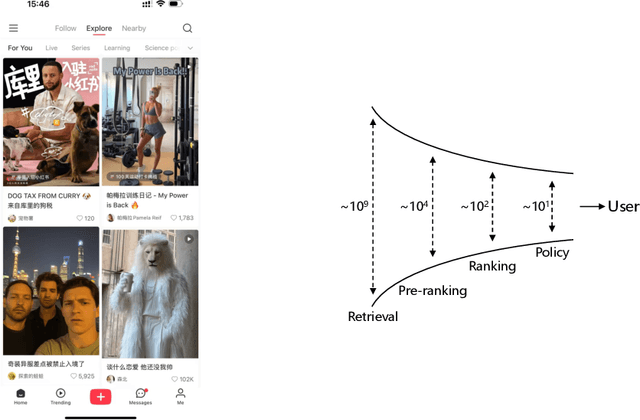
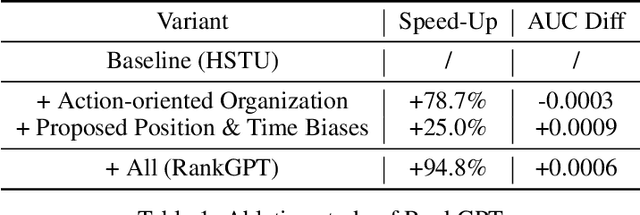
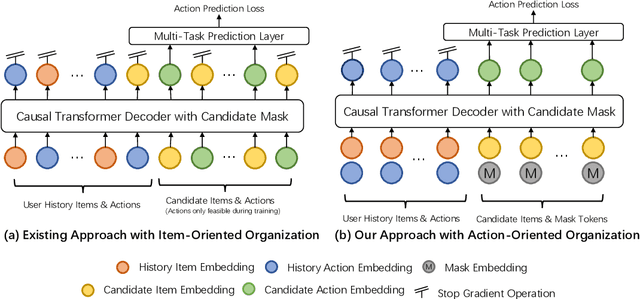

Generative recommendation has recently emerged as a promising paradigm in information retrieval. However, generative ranking systems are still understudied, particularly with respect to their effectiveness and feasibility in large-scale industrial settings. This paper investigates this topic at the ranking stage of Xiaohongshu's Explore Feed, a recommender system that serves hundreds of millions of users. Specifically, we first examine how generative ranking outperforms current industrial recommenders. Through theoretical and empirical analyses, we find that the primary improvement in effectiveness stems from the generative architecture, rather than the training paradigm. To facilitate efficient deployment of generative ranking, we introduce GenRank, a novel generative architecture for ranking. We validate the effectiveness and efficiency of our solution through online A/B experiments. The results show that GenRank achieves significant improvements in user satisfaction with nearly equivalent computational resources compared to the existing production system.