 Add to Chrome
 Add to Firefox
 Add to Edge
CIVIC: End-to-End Sequence Compactness for Efficient Vision-Language Models
May 27, 2026
Vision-Language Models (VLMs) face severe memory and latency bottlenecks due to high-resolution visual tokens. While current token reduction methods theoretically save FLOPs, post-hoc pruning introduces structural overhead, failing to yield proportional wall-clock acceleration. However, enforcing a contiguous compact pathway risks geometric disorientation and loss of fine-grained localization. To overcome these barriers, this paper introduces CIVIC, a path-consistent compact visual inference framework. By maintaining compact sequence representations seamlessly across the vision encoder, projection layer, LLM prefill, and KV-cache, CIVIC avoids non-contiguous memory access and localized unmerging overheads. Evaluated on the Qwen3-VL architecture, CIVIC successfully translates sequence reductions into genuine physical hardware efficiency, shrinking KV-cache memory to approximately one-third of the baseline and reducing end-to-end inference latency. Enabled by text-aligned KL distillation and an adaptive spatial retention floor, CIVIC achieves these efficiency milestones without degrading accuracy across rigorous multimodal reasoning and visual grounding benchmarks.

Locatability-Guided Adaptive Reasoning for Image Geo-Localization with Vision-Language Models
Mar 13, 2026The emergence of Vision-Language Models (VLMs) has introduced new paradigms for global image geo-localization through retrieval-augmented generation (RAG) and reasoning-driven inference. However, RAG methods are constrained by retrieval database quality, while reasoning-driven approaches fail to internalize image locatability, relying on inefficient, fixed-depth reasoning paths that increase hallucinations and degrade accuracy. To overcome these limitations, we introduce an Optimized Locatability Score that quantifies an image's suitability for deep reasoning in geo-localization. Using this metric, we curate Geo-ADAPT-51K, a locatability-stratified reasoning dataset enriched with augmented reasoning trajectories for complex visual scenes. Building on this foundation, we propose a two-stage Group Relative Policy Optimization (GRPO) curriculum with customized reward functions that regulate adaptive reasoning depth, visual grounding, and hierarchical geographical accuracy. Our framework, Geo-ADAPT, learns an adaptive reasoning policy, achieves state-of-the-art performance across multiple geo-localization benchmarks, and substantially reduces hallucinations by reasoning both adaptively and efficiently.
KnowDiffuser: A Knowledge-Guided Diffusion Planner with LM Reasoning and Prior-Informed Trajectory Initialization
Mar 11, 2026Recent advancements in Language Models (LMs) have demonstrated strong semantic reasoning capabilities, enabling their application in high-level decision-making for autonomous driving (AD). However, LMs operate over discrete token spaces and lack the ability to generate continuous, physically feasible trajectories required for motion planning. Meanwhile, diffusion models have proven effective at generating reliable and dynamically consistent trajectories, but often lack semantic interpretability and alignment with scene-level understanding. To address these limitations, we propose \textbf{KnowDiffuser}, a knowledge-guided motion planning framework that tightly integrates the semantic understanding of language models with the generative power of diffusion models. The framework employs a language model to infer context-aware meta-actions from structured scene representations, which are then mapped to prior trajectories that anchor the subsequent denoising process. A two-stage truncated denoising mechanism refines these trajectories efficiently, preserving both semantic alignment and physical feasibility. Experiments on the nuPlan benchmark demonstrate that KnowDiffuser significantly outperforms existing planners in both open-loop and closed-loop evaluations, establishing a robust and interpretable framework that effectively bridges the semantic-to-physical gap in AD systems.
Independent Mobility GPT (IDM-GPT): A Self-Supervised Multi-Agent Large Language Model Framework for Customized Traffic Mobility Analysis Using Machine Learning Models
Feb 25, 2025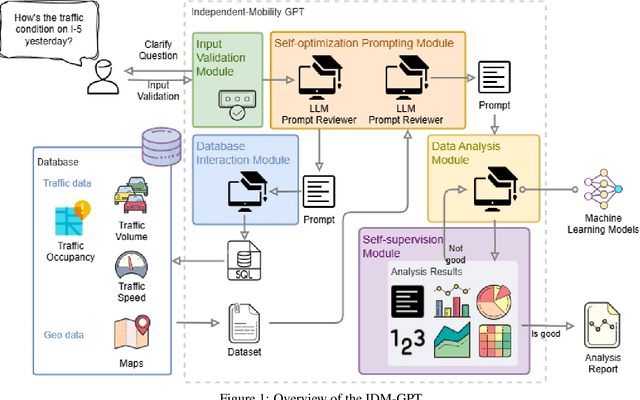
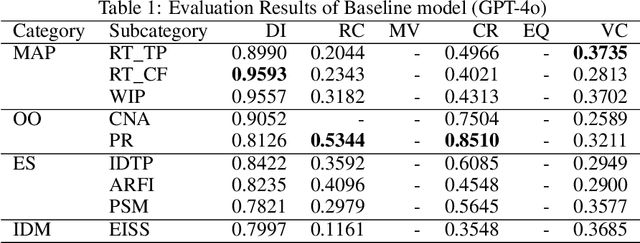
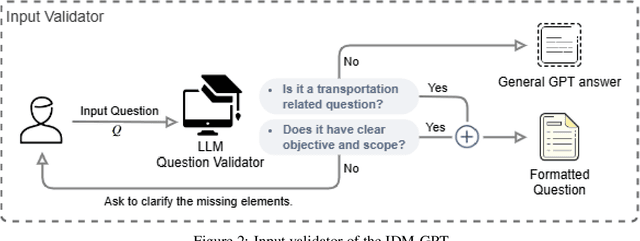
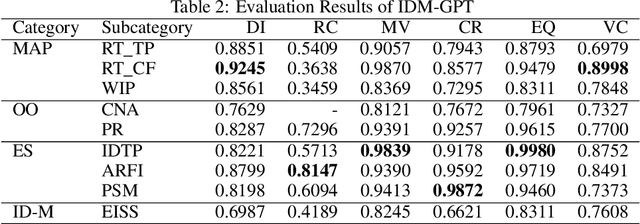
With the urbanization process, an increasing number of sensors are being deployed in transportation systems, leading to an explosion of big data. To harness the power of this vast transportation data, various machine learning (ML) and artificial intelligence (AI) methods have been introduced to address numerous transportation challenges. However, these methods often require significant investment in data collection, processing, storage, and the employment of professionals with expertise in transportation and ML. Additionally, privacy issues are a major concern when processing data for real-world traffic control and management. To address these challenges, the research team proposes an innovative Multi-agent framework named Independent Mobility GPT (IDM-GPT) based on large language models (LLMs) for customized traffic analysis, management suggestions, and privacy preservation. IDM-GPT efficiently connects users, transportation databases, and ML models economically. IDM-GPT trains, customizes, and applies various LLM-based AI agents for multiple functions, including user query comprehension, prompts optimization, data analysis, model selection, and performance evaluation and enhancement. With IDM-GPT, users without any background in transportation or ML can efficiently and intuitively obtain data analysis and customized suggestions in near real-time based on their questions. Experimental results demonstrate that IDM-GPT delivers satisfactory performance across multiple traffic-related tasks, providing comprehensive and actionable insights that support effective traffic management and urban mobility improvement.
SenseRAG: Constructing Environmental Knowledge Bases with Proactive Querying for LLM-Based Autonomous Driving
Jan 08, 2025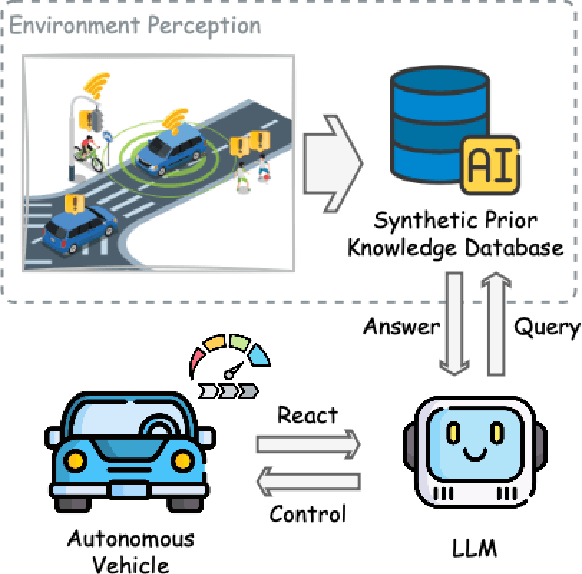
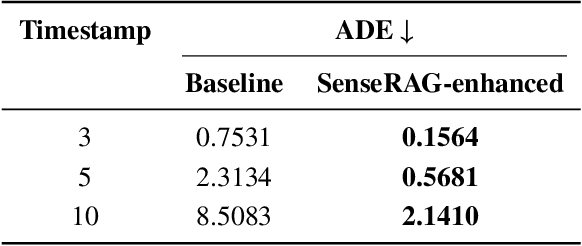
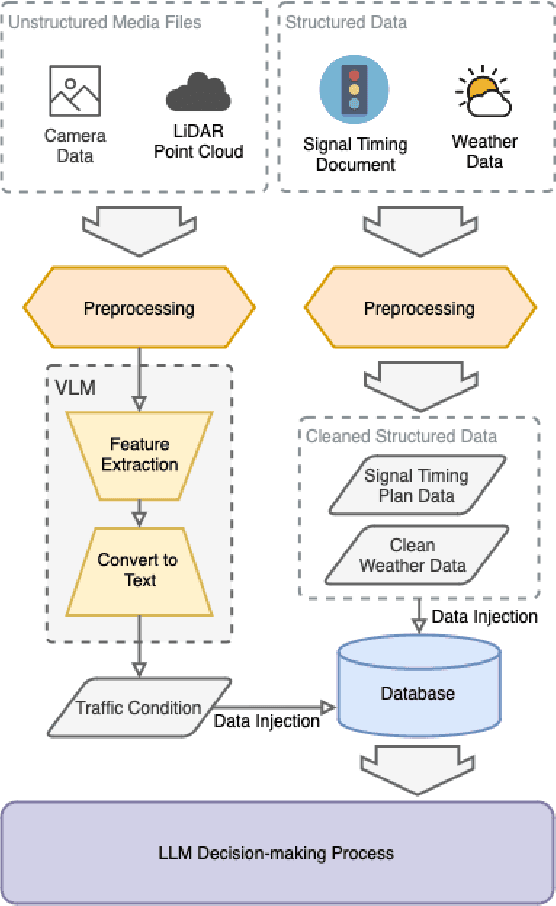
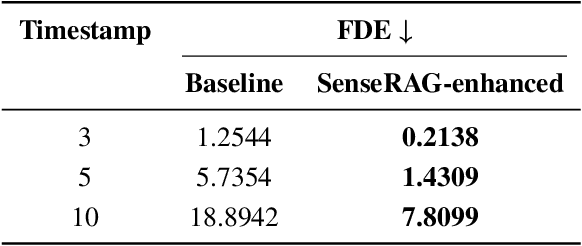
This study addresses the critical need for enhanced situational awareness in autonomous driving (AD) by leveraging the contextual reasoning capabilities of large language models (LLMs). Unlike traditional perception systems that rely on rigid, label-based annotations, it integrates real-time, multimodal sensor data into a unified, LLMs-readable knowledge base, enabling LLMs to dynamically understand and respond to complex driving environments. To overcome the inherent latency and modality limitations of LLMs, a proactive Retrieval-Augmented Generation (RAG) is designed for AD, combined with a chain-of-thought prompting mechanism, ensuring rapid and context-rich understanding. Experimental results using real-world Vehicle-to-everything (V2X) datasets demonstrate significant improvements in perception and prediction performance, highlighting the potential of this framework to enhance safety, adaptability, and decision-making in next-generation AD systems.