 Add to Chrome
 Add to Firefox
 Add to Edge
SlimPer: Make Personalization Model Slim and Smart
Jul 14, 2026
Transformer-style architectures are increasingly adopted for industrial recommendation systems, yet they inherit a design premise misaligned with the task: generative models rely on per-token autoregressive prediction, which justifies maintaining large intermediate tensors that scale with sequence length. In contrast, recommendation systems produce a single set of relevance scores for each <user, item> pair without token-level supervision. Leveraging this observation, we propose SlimPer, which reformulates personalized ranking as iterative refinement of a compact, unified <user, item> knowledge base. At each layer, the model selectively queries raw multi-modal user-side tokens, computes explicit relevance matching scores, and refines the knowledge base, all in O(N) per-layer cost with a fixed-size intermediate representation. As a result, model depth is decoupled from user history length, enabling deeper relevance understanding without proportional growth in compute or memory; request-only optimization further trims memory by sharing a single copy of user-side tokens across all candidate items. SlimPer unifies sparse, dense, and sequence features within a single backbone and provides inherent interpretability through its attention mechanism. Deployed on Instagram Reels and Feed, SlimPer yields measurable improvements in user engagement while streamlining the overall system and enabling effective modeling of 10k+ fine-grained user history events.

Versioned Late Materialization for Ultra-Long Sequence Training in Recommendation Systems at Scale
Apr 27, 2026Modern Deep Learning Recommendation Models (DLRMs) follow scaling laws with sequence length, driving the frontier toward ultra-long User Interaction History (UIH). However, the industry-standard "Fat Row" paradigm, which pre-materializes these sequences into every training example, creates a storage and I/O wall where data infrastructure usage exceeds GPU training capacity due to data redundancy that is amplified in multi-tenant environments where models with vastly different sequence length requirements share a union dataset. We present a \emph{versioned late materialization} paradigm that eliminates this redundancy by storing UIH once in a normalized, immutable tier and reconstructing sequences just-in-time during training via lightweight versioned pointers. The system ensures Online-to-Offline (O2O) consistency through a bifurcated protocol that prevents future leakage across both streaming and batch training, while a read-optimized immutable storage layer provides multi-dimensional projection pushdown for heterogeneous model tenants. Disaggregated data preprocessing with pipelined I/O prefetching and data-affinity optimizations masks the latency of training-time sequence reconstruction, keeping training throughput compute-bound by GPUs. Deployed on production DLRMs, the system reduces training data infrastructure resource usage while enabling aggressive sequence length scaling that delivers significant model quality gains, serving as the foundational data infrastructure for modern recommendation model architectures, including HSTU and ULTRA-HSTU.
GAF: Gaussian Action Field as a Dvnamic World Model for Robotic Mlanipulation
Jun 17, 2025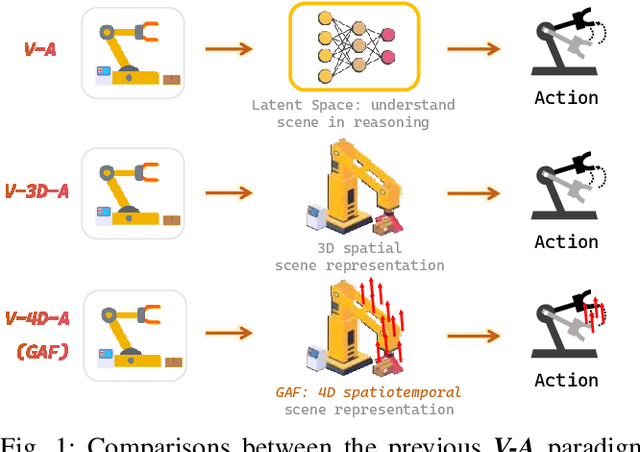
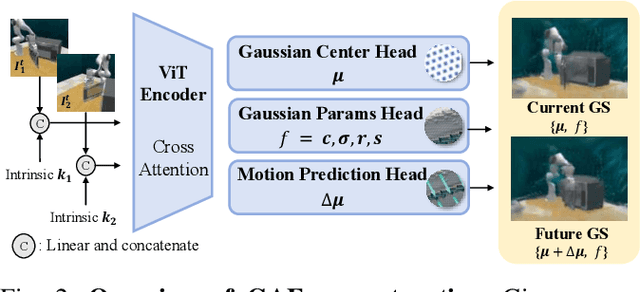
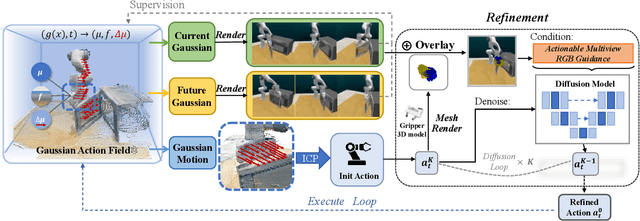
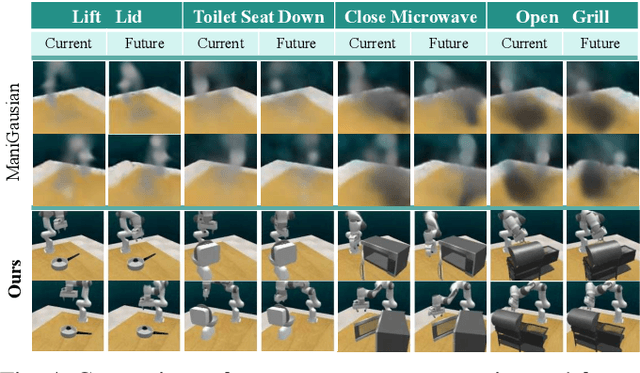
Accurate action inference is critical for vision-based robotic manipulation. Existing approaches typically follow either a Vision-to-Action (V-A) paradigm, predicting actions directly from visual inputs, or a Vision-to-3D-to-Action (V-3D-A) paradigm, leveraging intermediate 3D representations. However, these methods often struggle with action inaccuracies due to the complexity and dynamic nature of manipulation scenes. In this paper, we propose a V-4D-A framework that enables direct action reasoning from motion-aware 4D representations via a Gaussian Action Field (GAF). GAF extends 3D Gaussian Splatting (3DGS) by incorporating learnable motion attributes, allowing simultaneous modeling of dynamic scenes and manipulation actions. To learn time-varying scene geometry and action-aware robot motion, GAF supports three key query types: reconstruction of the current scene, prediction of future frames, and estimation of initial action via robot motion. Furthermore, the high-quality current and future frames generated by GAF facilitate manipulation action refinement through a GAF-guided diffusion model. Extensive experiments demonstrate significant improvements, with GAF achieving +11.5385 dB PSNR and -0.5574 LPIPS improvements in reconstruction quality, while boosting the average success rate in robotic manipulation tasks by 10.33% over state-of-the-art methods. Project page: http://chaiying1.github.io/GAF.github.io/project_page/