 Add to Chrome
 Add to Firefox
 Add to Edge
SynAgent: Generalizable Cooperative Humanoid Manipulation via Solo-to-Cooperative Agent Synergy
Apr 20, 2026
Controllable cooperative humanoid manipulation is a fundamental yet challenging problem for embodied intelligence, due to severe data scarcity, complexities in multi-agent coordination, and limited generalization across objects. In this paper, we present SynAgent, a unified framework that enables scalable and physically plausible cooperative manipulation by leveraging Solo-to-Cooperative Agent Synergy to transfer skills from single-agent human-object interaction to multi-agent human-object-human scenarios. To maintain semantic integrity during motion transfer, we introduce an interaction-preserving retargeting method based on an Interact Mesh constructed via Delaunay tetrahedralization, which faithfully maintains spatial relationships among humans and objects. Building upon this refined data, we propose a single-agent pretraining and adaptation paradigm that bootstraps synergistic collaborative behaviors from abundant single-human data through decentralized training and multi-agent PPO. Finally, we develop a trajectory-conditioned generative policy using a conditional VAE, trained via multi-teacher distillation from motion imitation priors to achieve stable and controllable object-level trajectory execution. Extensive experiments demonstrate that SynAgent significantly outperforms existing baselines in both cooperative imitation and trajectory-conditioned control, while generalizing across diverse object geometries. Codes and data will be available after publication. Project Page: http://yw0208.github.io/synagent

GAF: Gaussian Action Field as a Dvnamic World Model for Robotic Mlanipulation
Jun 17, 2025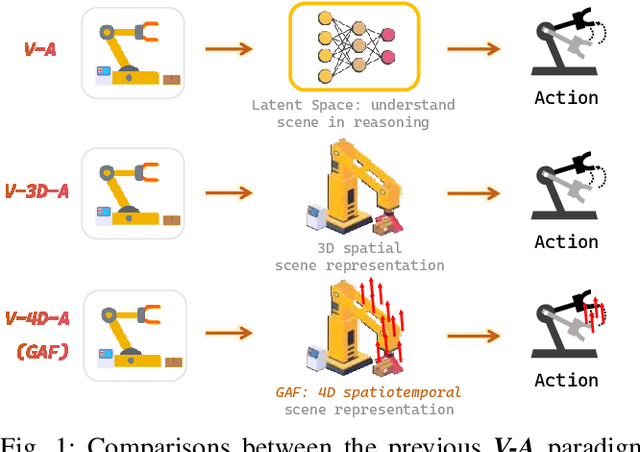
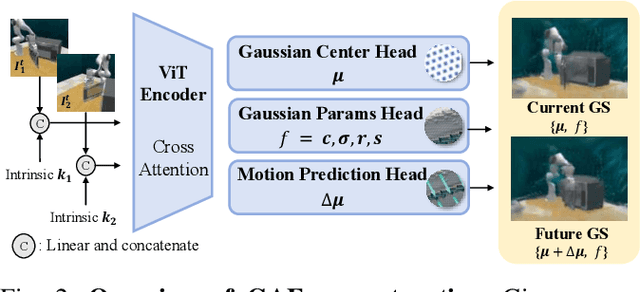
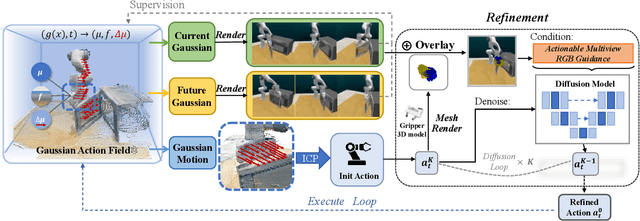
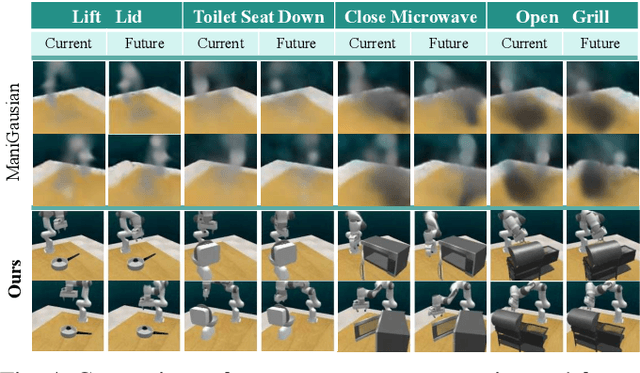
Accurate action inference is critical for vision-based robotic manipulation. Existing approaches typically follow either a Vision-to-Action (V-A) paradigm, predicting actions directly from visual inputs, or a Vision-to-3D-to-Action (V-3D-A) paradigm, leveraging intermediate 3D representations. However, these methods often struggle with action inaccuracies due to the complexity and dynamic nature of manipulation scenes. In this paper, we propose a V-4D-A framework that enables direct action reasoning from motion-aware 4D representations via a Gaussian Action Field (GAF). GAF extends 3D Gaussian Splatting (3DGS) by incorporating learnable motion attributes, allowing simultaneous modeling of dynamic scenes and manipulation actions. To learn time-varying scene geometry and action-aware robot motion, GAF supports three key query types: reconstruction of the current scene, prediction of future frames, and estimation of initial action via robot motion. Furthermore, the high-quality current and future frames generated by GAF facilitate manipulation action refinement through a GAF-guided diffusion model. Extensive experiments demonstrate significant improvements, with GAF achieving +11.5385 dB PSNR and -0.5574 LPIPS improvements in reconstruction quality, while boosting the average success rate in robotic manipulation tasks by 10.33% over state-of-the-art methods. Project page: http://chaiying1.github.io/GAF.github.io/project_page/