 Add to Chrome
 Add to Firefox
 Add to Edge
Exploring Bottlenecks in VLM-LLM Navigation: How 3D Scene Understanding Capability Impacts Zero-Shot VLN
May 14, 2026
Zero-shot vision-and-language navigation (VLN) has gained significant attention due to its minimal data collection costs and inherent generalization. This paradigm is typically driven by the integration of pre-trained Vision-Language Models (VLMs) and Large Language Models (LLMs), where VLMs construct 3D scene graphs while LLMs handle high-level reasoning and decision-making. However, a critical bottleneck exists in this system: current 3D perception models prioritize pixel-level accuracy, directly conflicting with the strict computational limits and real-time efficiency demanded by embodied navigation. To address this gap, this paper quantifies the actual impact of 3D scene understanding capability on VLN performance. Based on typical VLM-LLM frameworks, we propose statistical success rate (SR) upper bounds for two core subsystems: 1) the slow LLM planner, which relies on topological mapping semantics, and 2) the fast reactive navigator, which utilizes spatial coordinates and bounding boxes to execute LLM decisions. Evaluations using state-of-the-art 3D scene understanding models validate our proposed bounds and reveal a perception saturation phenomenon, indicating that improvements in perception accuracy beyond a certain threshold yield diminishing returns in navigation success. Our findings suggest that 3D scene understanding for VLN should pivot away from strict pixel-level precision, prioritizing instead navigation-relevant core vocabularies and accurate bounding box proportions.

SFCo-Nav: Efficient Zero-Shot Visual Language Navigation via Collaboration of Slow LLM and Fast Attributed Graph Alignment
Mar 02, 2026Recent advances in large vision-language models (VLMs) and large language models (LLMs) have enabled zero-shot approaches to visual language navigation (VLN), where an agent follows natural language instructions using only ego perception and reasoning. However, existing zero-shot methods typically construct a naive observation graph and perform per-step VLM-LLM inference on it, resulting in high latency and computation costs that limit real-time deployment. To address this, we present SFCo-Nav, an efficient zero-shot VLN framework inspired by the principle of slow-fast cognitive collaboration. SFCo-Nav integrates three key modules: 1) a slow LLM-based planner that produces a strategic chain of subgoals, each linked to an imagined object graph; 2) a fast reactive navigator for real-time object graph construction and subgoal execution; and 3) a lightweight asynchronous slow-fast bridge aligns advanced structured, attributed imagined and perceived graphs to estimate navigation confidence, triggering the slow LLM planner only when necessary. To the best of our knowledge, SFCo-Nav is the first slow-fast collaboration zero-shot VLN system supporting asynchronous LLM triggering according to the internal confidence. Evaluated on the public R2R and REVERIE benchmarks, SFCo-Nav matches or exceeds prior state-of-the-art zero-shot VLN success rates while cutting total token consumption per trajectory by over 50% and running more than 3.5 times faster. Finally, we demonstrate SFCo-Nav on a legged robot in a hotel suite, showcasing its efficiency and practicality in indoor environments.
exUMI: Extensible Robot Teaching System with Action-aware Task-agnostic Tactile Representation
Sep 18, 2025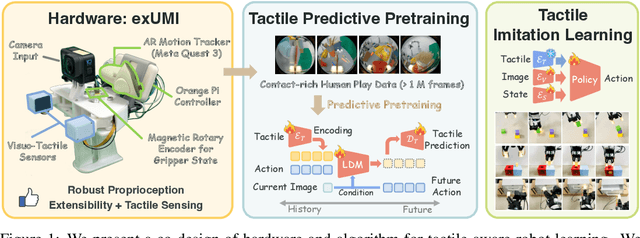
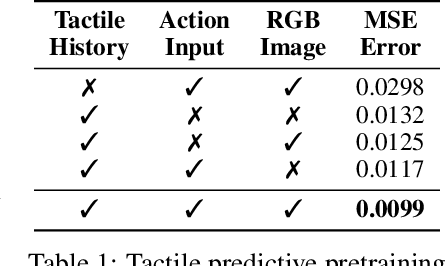
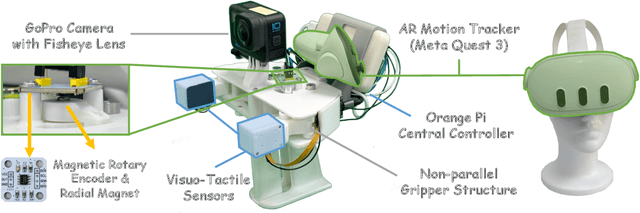
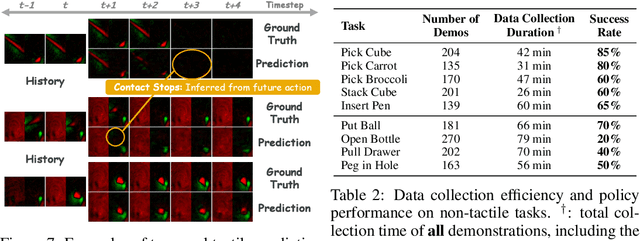
Tactile-aware robot learning faces critical challenges in data collection and representation due to data scarcity and sparsity, and the absence of force feedback in existing systems. To address these limitations, we introduce a tactile robot learning system with both hardware and algorithm innovations. We present exUMI, an extensible data collection device that enhances the vanilla UMI with robust proprioception (via AR MoCap and rotary encoder), modular visuo-tactile sensing, and automated calibration, achieving 100% data usability. Building on an efficient collection of over 1 M tactile frames, we propose Tactile Prediction Pretraining (TPP), a representation learning framework through action-aware temporal tactile prediction, capturing contact dynamics and mitigating tactile sparsity. Real-world experiments show that TPP outperforms traditional tactile imitation learning. Our work bridges the gap between human tactile intuition and robot learning through co-designed hardware and algorithms, offering open-source resources to advance contact-rich manipulation research. Project page: https://silicx.github.io/exUMI.
THE-SEAN: A Heart Rate Variation-Inspired Temporally High-Order Event-Based Visual Odometry with Self-Supervised Spiking Event Accumulation Networks
Mar 07, 2025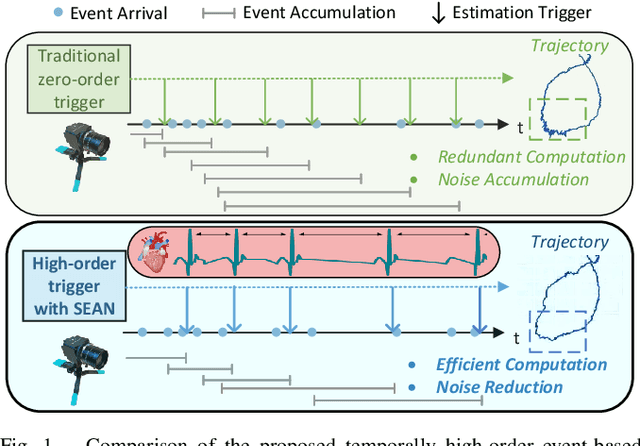
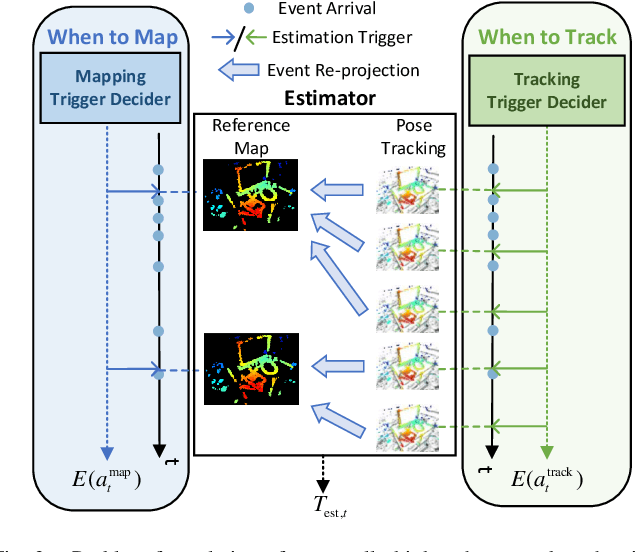
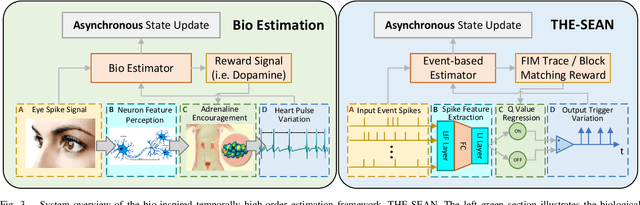
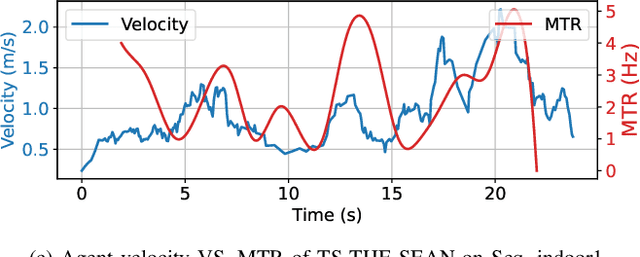
Event-based visual odometry has recently gained attention for its high accuracy and real-time performance in fast-motion systems. Unlike traditional synchronous estimators that rely on constant-frequency (zero-order) triggers, event-based visual odometry can actively accumulate information to generate temporally high-order estimation triggers. However, existing methods primarily focus on adaptive event representation after estimation triggers, neglecting the decision-making process for efficient temporal triggering itself. This oversight leads to the computational redundancy and noise accumulation. In this paper, we introduce a temporally high-order event-based visual odometry with spiking event accumulation networks (THE-SEAN). To the best of our knowledge, it is the first event-based visual odometry capable of dynamically adjusting its estimation trigger decision in response to motion and environmental changes. Inspired by biological systems that regulate hormone secretion to modulate heart rate, a self-supervised spiking neural network is designed to generate estimation triggers. This spiking network extracts temporal features to produce triggers, with rewards based on block matching points and Fisher information matrix (FIM) trace acquired from the estimator itself. Finally, THE-SEAN is evaluated across several open datasets, thereby demonstrating average improvements of 13\% in estimation accuracy, 9\% in smoothness, and 38\% in triggering efficiency compared to the state-of-the-art methods.