 Add to Chrome
 Add to Firefox
 Add to Edge
VICBench: A Multi-Language Benchmark for Code Vulnerability Detection
Aug 12, 2026
Evaluating security vulnerability detection tools requires benchmark datasets with vulnerability-inducing commits (VICs) - the commits that first introduce vulnerabilities into codebases. VICs are essential for determining the full range of vulnerable software versions. Existing vulnerability datasets suffer from limited programming language coverage, restricted patch complexity, and narrow project scope. Through our dual annotation by human experts and an agentic workflow, we create a benchmark - VICBench - of 100 verified VICs for 100 CVEs across 88 projects in Python, Java, and C++, covering 48 CWE types. VICBench features complex real-world vulnerability fixes averaging 38.6 lines and corresponding VICs of 252.5 lines - significantly larger than prior work. Our evaluation shows that state-of-the-art algorithms V-SZZ and LLM4SZZ achieve only 33.3%-40.1% F1, confirming that using existing approaches still entails significant manual effort. VICBench enables robust evaluation of vulnerability detection approaches.

Learning Context-Free Grammars for Grammar-Constrained Decoding via Declarative Agentic Programming with Guarantees
Aug 06, 2026Language models (LMs) are increasingly used to interact with external services via programs written in domain-specific languages (DSLs). Unfortunately, since DSLs are often low-resource and esoteric, LMs frequently produce syntactically invalid programs in these languages. Grammar-constrained decoding can eliminate such failures, but requires syntactic constraints. These are usually in the form of a context-free grammar for the target language, an artifact that is hard to come by for third-party DSLs. In this work, we define an agent, called Autogrammar, that automatically learns context-free grammars from documentation and execution data. Autogrammar is formalized as a Kripke structure whose nondeterministic choices are resolved by a language model, enabling declarative control of agent behavior via linear temporal logic constraints. We evaluate four versions of Autogrammar on three DSLs (i.e., Amazon CloudWatch Logs Insights, Dynatrace Query Language, and Datadog Search Syntax) and find that it generates grammars that achieve near perfect precision on unseen data; that temporal restrictions reduce execution time by 3.8x without incurring statistically-significant loss in precision; that execution data is crucial while documentation is dispensable; and that grammar-constrained decoding using Autogrammar-generated grammars significantly improves end-to-end LM performance on eight out of ten real tasks, matching or exceeding the performance of a professionally-maintained grammar. In comparison, the context-free grammars generated by existing LM baselines and a state-of-the-art formal technique perform significantly worse over the same evaluation.
An Empirical Study of LLM-Generated Specifications for VeriFast
Jun 25, 2026Static verification tools can assure industrial scale software, but require significant human labor to write specifications. This is particularly true of static verifiers based on separation logic (SL verifiers), which excel at verifying heapmanipulating programs, but require many complex auxiliary specifications to reason about heap structure. Recent work applies large language models (LLMs) to generate code, tests, and proofs, including specifications for verifiers, but mostly targeting non-SL verifiers. To address this gap, this paper thoroughly evaluates how well LLMs perform when prompted to generate specifications for verifying 303 C functions with the SL verifier VeriFast. We explored eight prompting approaches, ten LLMs, and three input types in two stages. Quantitative and qualitative analyses are used to assess the LLM-generated code and specifications for functional behavior, verifiability and errors. The results show that LLMs preserve functional behavior in source code and specifications (both over 91%), but achieve modest verification success (31.4%). Using Gemini 2.5 Pro and providing formal contracts lead to higher success rates in our setting. Moreover, most errors (94%) come from LLMs' mistakes in the domainspecific knowledge of SL verifiers such as VeriFast. These findings provide guidance for optimizing LLM-generated specifications for SL verifiers.
Towards Resiliency in Large Language Model Serving with KevlarFlow
Jan 30, 2026Large Language Model (LLM) serving systems remain fundamentally fragile, where frequent hardware faults in hyperscale clusters trigger disproportionate service outages in the software stack. Current recovery mechanisms are prohibitively slow, often requiring up to 10 minutes to reinitialize resources and reload massive model weights. We introduce KevlarFlow, a fault tolerant serving architecture designed to bridge the gap between hardware unreliability and service availability. KevlarFlow leverages 1) decoupled model parallelism initialization, 2) dynamic traffic rerouting, and 3) background KV cache replication to maintain high throughput during partial failures. Our evaluation demonstrates that KevlarFlow reduces mean-time-to-recovery (MTTR) by 20x and, under failure conditions, improves average latency by 3.1x, 99th percentile (p99) latency by 2.8x, average time-to-first-token (TTFT) by 378.9x, and p99 TTFT by 574.6x with negligible runtime overhead in comparison to state-of-the-art LLM serving systems.
Unified Software Engineering agent as AI Software Engineer
Jun 17, 2025The growth of Large Language Model (LLM) technology has raised expectations for automated coding. However, software engineering is more than coding and is concerned with activities including maintenance and evolution of a project. In this context, the concept of LLM agents has gained traction, which utilize LLMs as reasoning engines to invoke external tools autonomously. But is an LLM agent the same as an AI software engineer? In this paper, we seek to understand this question by developing a Unified Software Engineering agent or USEagent. Unlike existing work which builds specialized agents for specific software tasks such as testing, debugging, and repair, our goal is to build a unified agent which can orchestrate and handle multiple capabilities. This gives the agent the promise of handling complex scenarios in software development such as fixing an incomplete patch, adding new features, or taking over code written by others. We envision USEagent as the first draft of a future AI Software Engineer which can be a team member in future software development teams involving both AI and humans. To evaluate the efficacy of USEagent, we build a Unified Software Engineering bench (USEbench) comprising of myriad tasks such as coding, testing, and patching. USEbench is a judicious mixture of tasks from existing benchmarks such as SWE-bench, SWT-bench, and REPOCOD. In an evaluation on USEbench consisting of 1,271 repository-level software engineering tasks, USEagent shows improved efficacy compared to existing general agents such as OpenHands CodeActAgent. There exist gaps in the capabilities of USEagent for certain coding tasks, which provides hints on further developing the AI Software Engineer of the future.
Leveraging Interview-Informed LLMs to Model Survey Responses: Comparative Insights from AI-Generated and Human Data
May 28, 2025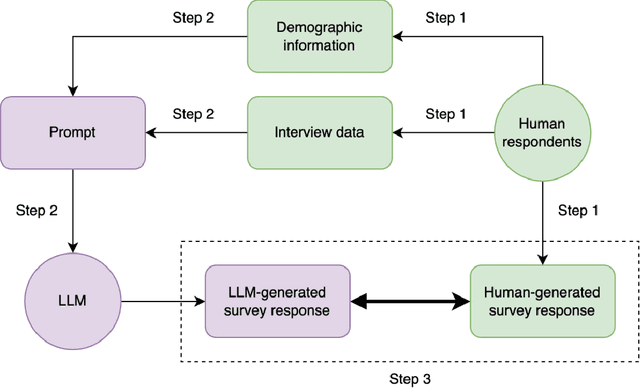
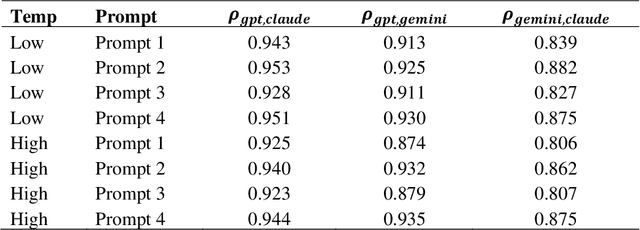
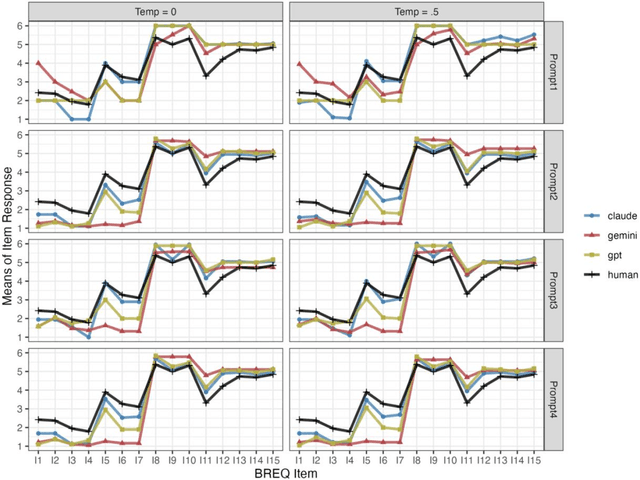
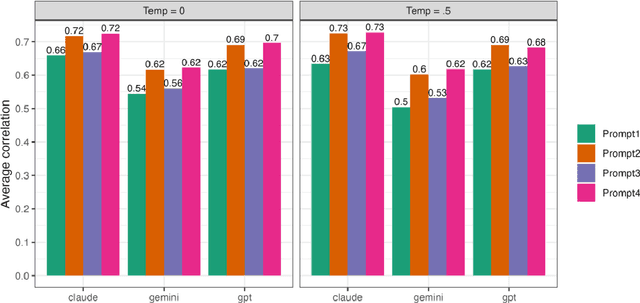
Mixed methods research integrates quantitative and qualitative data but faces challenges in aligning their distinct structures, particularly in examining measurement characteristics and individual response patterns. Advances in large language models (LLMs) offer promising solutions by generating synthetic survey responses informed by qualitative data. This study investigates whether LLMs, guided by personal interviews, can reliably predict human survey responses, using the Behavioral Regulations in Exercise Questionnaire (BREQ) and interviews from after-school program staff as a case study. Results indicate that LLMs capture overall response patterns but exhibit lower variability than humans. Incorporating interview data improves response diversity for some models (e.g., Claude, GPT), while well-crafted prompts and low-temperature settings enhance alignment between LLM and human responses. Demographic information had less impact than interview content on alignment accuracy. These findings underscore the potential of interview-informed LLMs to bridge qualitative and quantitative methodologies while revealing limitations in response variability, emotional interpretation, and psychometric fidelity. Future research should refine prompt design, explore bias mitigation, and optimize model settings to enhance the validity of LLM-generated survey data in social science research.
Can Language Models Replace Programmers? REPOCOD Says 'Not Yet'
Oct 29, 2024Large language models (LLMs) have shown remarkable ability in code generation with more than 90 pass@1 in solving Python coding problems in HumanEval and MBPP. Such high accuracy leads to the question: can LLMs replace human programmers? Existing manual crafted, simple, or single-line code generation benchmarks cannot answer this question due to their gap with real-world software development. To answer this question, we propose REPOCOD, a code generation benchmark with 980 problems collected from 11 popular real-world projects, with more than 58% of them requiring file-level or repository-level context information. In addition, REPOCOD has the longest average canonical solution length (331.6 tokens) and the highest average cyclomatic complexity (9.00) compared to existing benchmarks. In our evaluations on ten LLMs, none of the models can achieve more than 30 pass@1 on REPOCOD, disclosing the necessity of building stronger LLMs that can help developers in real-world software development.
WAFFLE: Multi-Modal Model for Automated Front-End Development
Oct 24, 2024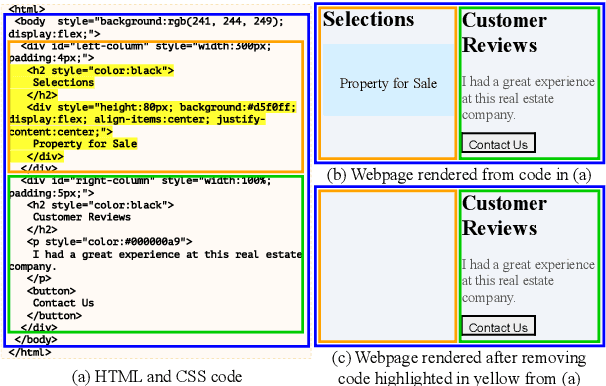
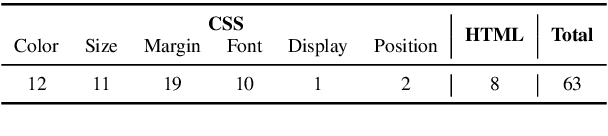
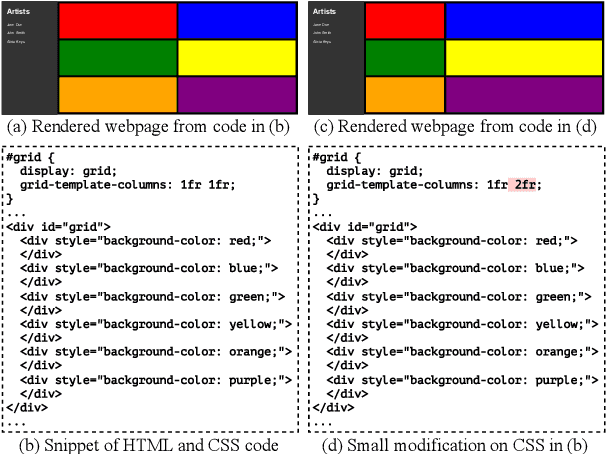
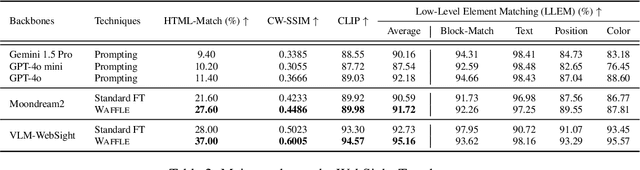
Web development involves turning UI designs into functional webpages, which can be difficult for both beginners and experienced developers due to the complexity of HTML's hierarchical structures and styles. While Large Language Models (LLMs) have shown promise in generating source code, two major challenges persist in UI-to-HTML code generation: (1) effectively representing HTML's hierarchical structure for LLMs, and (2) bridging the gap between the visual nature of UI designs and the text-based format of HTML code. To tackle these challenges, we introduce Waffle, a new fine-tuning strategy that uses a structure-aware attention mechanism to improve LLMs' understanding of HTML's structure and a contrastive fine-tuning approach to align LLMs' understanding of UI images and HTML code. Models fine-tuned with Waffle show up to 9.00 pp (percentage point) higher HTML match, 0.0982 higher CW-SSIM, 32.99 higher CLIP, and 27.12 pp higher LLEM on our new benchmark WebSight-Test and an existing benchmark Design2Code, outperforming current fine-tuning methods.
Collu-Bench: A Benchmark for Predicting Language Model Hallucinations in Code
Oct 13, 2024



Despite their success, large language models (LLMs) face the critical challenge of hallucinations, generating plausible but incorrect content. While much research has focused on hallucinations in multiple modalities including images and natural language text, less attention has been given to hallucinations in source code, which leads to incorrect and vulnerable code that causes significant financial loss. To pave the way for research in LLMs' hallucinations in code, we introduce Collu-Bench, a benchmark for predicting code hallucinations of LLMs across code generation (CG) and automated program repair (APR) tasks. Collu-Bench includes 13,234 code hallucination instances collected from five datasets and 11 diverse LLMs, ranging from open-source models to commercial ones. To better understand and predict code hallucinations, Collu-Bench provides detailed features such as the per-step log probabilities of LLMs' output, token types, and the execution feedback of LLMs' generated code for in-depth analysis. In addition, we conduct experiments to predict hallucination on Collu-Bench, using both traditional machine learning techniques and neural networks, which achieves 22.03 -- 33.15% accuracy. Our experiments draw insightful findings of code hallucination patterns, reveal the challenge of accurately localizing LLMs' hallucinations, and highlight the need for more sophisticated techniques.
SELP: Generating Safe and Efficient Task Plans for Robot Agents with Large Language Models
Sep 28, 2024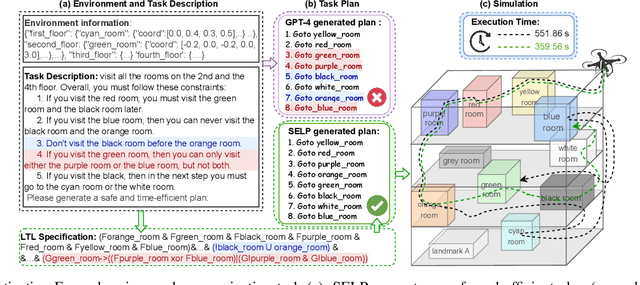
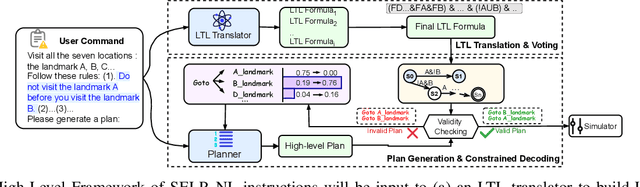
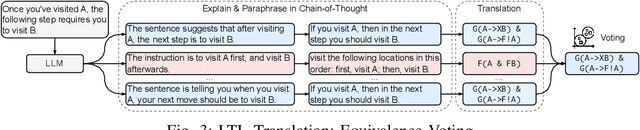

Despite significant advancements in large language models (LLMs) that enhance robot agents' understanding and execution of natural language (NL) commands, ensuring the agents adhere to user-specified constraints remains challenging, particularly for complex commands and long-horizon tasks. To address this challenge, we present three key insights, equivalence voting, constrained decoding, and domain-specific fine-tuning, which significantly enhance LLM planners' capability in handling complex tasks. Equivalence voting ensures consistency by generating and sampling multiple Linear Temporal Logic (LTL) formulas from NL commands, grouping equivalent LTL formulas, and selecting the majority group of formulas as the final LTL formula. Constrained decoding then uses the generated LTL formula to enforce the autoregressive inference of plans, ensuring the generated plans conform to the LTL. Domain-specific fine-tuning customizes LLMs to produce safe and efficient plans within specific task domains. Our approach, Safe Efficient LLM Planner (SELP), combines these insights to create LLM planners to generate plans adhering to user commands with high confidence. We demonstrate the effectiveness and generalizability of SELP across different robot agents and tasks, including drone navigation and robot manipulation. For drone navigation tasks, SELP outperforms state-of-the-art planners by 10.8% in safety rate (i.e., finishing tasks conforming to NL commands) and by 19.8% in plan efficiency. For robot manipulation tasks, SELP achieves 20.4% improvement in safety rate. Our datasets for evaluating NL-to-LTL and robot task planning will be released in github.com/lt-asset/selp.