 Add to Chrome
 Add to Firefox
 Add to Edge
MeDocVL: A Visual Language Model for Medical Document Understanding and Parsing
Feb 06, 2026
Medical document OCR is challenging due to complex layouts, domain-specific terminology, and noisy annotations, while requiring strict field-level exact matching. Existing OCR systems and general-purpose vision-language models often fail to reliably parse such documents. We propose MeDocVL, a post-trained vision-language model for query-driven medical document parsing. Our framework combines Training-driven Label Refinement to construct high-quality supervision from noisy annotations, with a Noise-aware Hybrid Post-training strategy that integrates reinforcement learning and supervised fine-tuning to achieve robust and precise extraction. Experiments on medical invoice benchmarks show that MeDocVL consistently outperforms conventional OCR systems and strong VLM baselines, achieving state-of-the-art performance under noisy supervision.

ReLE: A Scalable System and Structured Benchmark for Diagnosing Capability Anisotropy in Chinese LLMs
Jan 24, 2026Large Language Models (LLMs) have achieved rapid progress in Chinese language understanding, yet accurately evaluating their capabilities remains challenged by benchmark saturation and prohibitive computational costs. While static leaderboards provide snapshot rankings, they often mask the structural trade-offs between capabilities. In this work, we present ReLE (Robust Efficient Live Evaluation), a scalable system designed to diagnose Capability Anisotropy, the non-uniformity of model performance across domains. Using ReLE, we evaluate 304 models (189 commercial, 115 open-source) across a Domain $\times$ Capability orthogonal matrix comprising 207,843 samples. We introduce two methodological contributions to address current evaluation pitfalls: (1) A Symbolic-Grounded Hybrid Scoring Mechanism that eliminates embedding-based false positives in reasoning tasks; (2) A Dynamic Variance-Aware Scheduler based on Neyman allocation with noise correction, which reduces compute costs by 70\% compared to full-pass evaluations while maintaining a ranking correlation of $ρ=0.96$. Our analysis reveals that aggregate rankings are highly sensitive to weighting schemes: models exhibit a Rank Stability Amplitude (RSA) of 11.4 in ReLE versus $\sim$5.0 in traditional benchmarks, confirming that modern models are highly specialized rather than generally superior. We position ReLE not as a replacement for comprehensive static benchmarks, but as a high-frequency diagnostic monitor for the evolving model landscape.
CCAD: Compressed Global Feature Conditioned Anomaly Detection
Dec 25, 2025Anomaly detection holds considerable industrial significance, especially in scenarios with limited anomalous data. Currently, reconstruction-based and unsupervised representation-based approaches are the primary focus. However, unsupervised representation-based methods struggle to extract robust features under domain shift, whereas reconstruction-based methods often suffer from low training efficiency and performance degradation due to insufficient constraints. To address these challenges, we propose a novel method named Compressed Global Feature Conditioned Anomaly Detection (CCAD). CCAD synergizes the strengths of both paradigms by adapting global features as a new modality condition for the reconstruction model. Furthermore, we design an adaptive compression mechanism to enhance both generalization and training efficiency. Extensive experiments demonstrate that CCAD consistently outperforms state-of-the-art methods in terms of AUC while achieving faster convergence. In addition, we contribute a reorganized and re-annotated version of the DAGM 2007 dataset with new annotations to further validate our method's effectiveness. The code for reproducing main results is available at https://github.com/chloeqxq/CCAD.
ChineseFoodNet: A large-scale Image Dataset for Chinese Food Recognition
Oct 15, 2017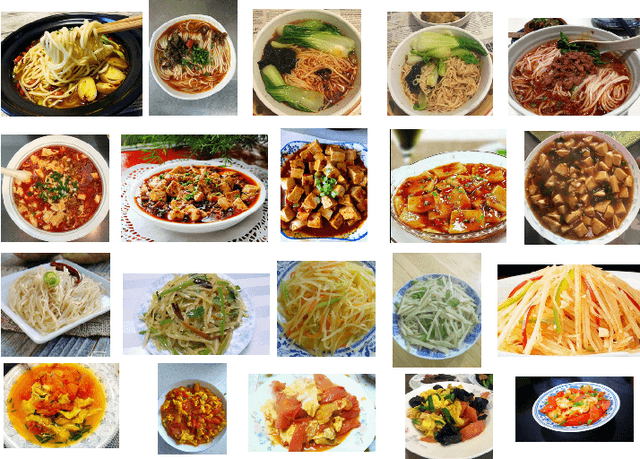
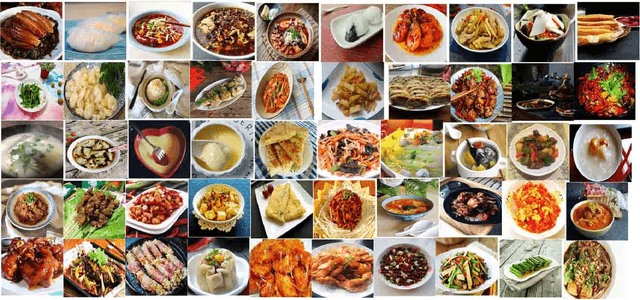
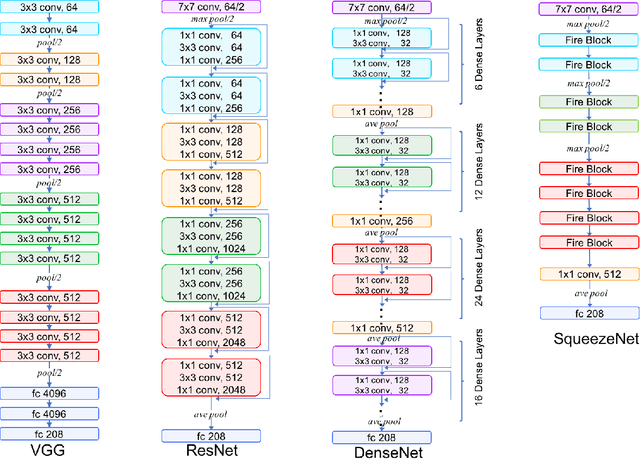
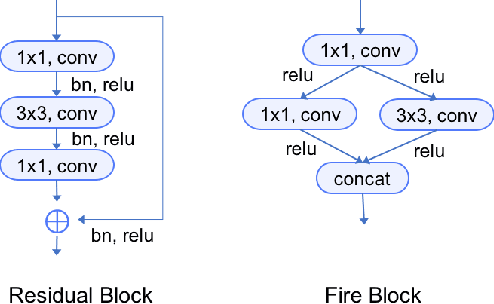
In this paper, we introduce a new and challenging large-scale food image dataset called "ChineseFoodNet", which aims to automatically recognizing pictured Chinese dishes. Most of the existing food image datasets collected food images either from recipe pictures or selfie. In our dataset, images of each food category of our dataset consists of not only web recipe and menu pictures but photos taken from real dishes, recipe and menu as well. ChineseFoodNet contains over 180,000 food photos of 208 categories, with each category covering a large variations in presentations of same Chinese food. We present our efforts to build this large-scale image dataset, including food category selection, data collection, and data clean and label, in particular how to use machine learning methods to reduce manual labeling work that is an expensive process. We share a detailed benchmark of several state-of-the-art deep convolutional neural networks (CNNs) on ChineseFoodNet. We further propose a novel two-step data fusion approach referred as "TastyNet", which combines prediction results from different CNNs with voting method. Our proposed approach achieves top-1 accuracies of 81.43% on the validation set and 81.55% on the test set, respectively. The latest dataset is public available for research and can be achieved at https://sites.google.com/view/chinesefoodnet.