 Add to Chrome
 Add to Firefox
 Add to Edge
FlowMaps: Modeling Long-Term Multimodal Object Dynamics with Flow Matching
Jun 18, 2026
Joint spatial and temporal understanding of 3D scenes is a crucial requirement for robots deployed in everyday household environments. Such agents must not only comprehend and navigate spatial layouts, but also reason about how these spaces evolve over time. In particular, humans interact with objects daily, causing them to change position throughout the environment and making it difficult for robots to reliably associate current observations with previously seen objects. However, these interactions are not random: human habits and routines induce spatio-temporally consistent patterns in object locations, which robotic agents can potentially learn and then exploit for downstream tasks such as navigation. To this end, we introduce FlowMaps, a latent flow matching model for estimating multimodal distributions over the future locations of dynamic objects in a continuous 3D space. By learning the implicit dependencies among objects and their temporal evolution, FlowMaps predicts likely changes in object locations conditioned on past human interactions, while supporting generalization across previously unseen environments that share similar object routines. To demonstrate the utility of this method, we deploy FlowMaps in a downstream dynamic Object Navigation task in both simulated and real-world environments. Across more than 600 episodes, FlowMaps outperforms state-of-the-art approaches, showing that modeling object dynamics through continuous, multimodal spatio-temporal distributions improves robotic search and navigation in changing household environments. Code and additional material is available at https://fra-tsuna.github.io/flowmaps/.

PerceptTwin: Semantic Scene Reconstruction for Iterative LLM Planning and Verification
Jun 02, 2026Simulation environments are useful for both robot policy learning and planning verification and validation. Traditionally, the process of creating a simulation was onerous. Creating a bespoke simulation environment for each individual environment that a robot would operate in was simply infeasible. In this work, we introduce PerceptTwin, a fully automatic pipeline that constructs interactive simulations directly from semantic scene representations produced by a robot's perception stack. PerceptTwin combines open-vocabulary object maps with 3D asset generation, affordance prediction, and commonsense condition checking. These interactive simulations can be used to validate and refine plans before they are executed on the robot hardware. Borrowing from the AI alignment literature, we also introduce an LLM judge that verifies plan correctness and alignment with human preferences. Experiments show that PerceptTwin feedback allows LLM planners to refine plans, enhance safety, and resist harmful black-box prompting attacks. In our suite of tasks, PerceptTwin improves plan success by an average of approximately 39% for GPT5, GPT5Mini, and GPT5Nano planners. Additionally, PerceptTwin also improves human plan verification by up to 18% on average for plans that fail due to unfilled skill preconditions. Our results demonstrate the potential of open-vocabulary scene simulation from robot perception as a foundation for safer, more reliable robot planning.
Safety Representations for Safer Policy Learning
Feb 27, 2025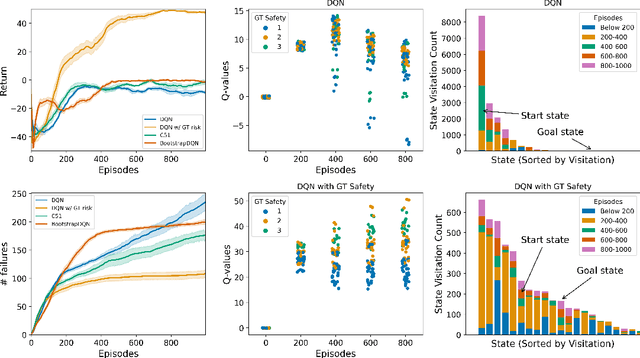

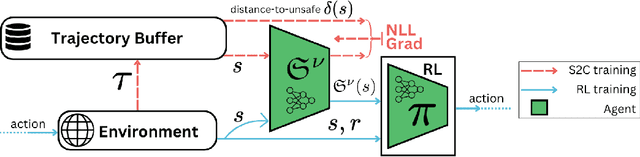

Reinforcement learning algorithms typically necessitate extensive exploration of the state space to find optimal policies. However, in safety-critical applications, the risks associated with such exploration can lead to catastrophic consequences. Existing safe exploration methods attempt to mitigate this by imposing constraints, which often result in overly conservative behaviours and inefficient learning. Heavy penalties for early constraint violations can trap agents in local optima, deterring exploration of risky yet high-reward regions of the state space. To address this, we introduce a method that explicitly learns state-conditioned safety representations. By augmenting the state features with these safety representations, our approach naturally encourages safer exploration without being excessively cautious, resulting in more efficient and safer policy learning in safety-critical scenarios. Empirical evaluations across diverse environments show that our method significantly improves task performance while reducing constraint violations during training, underscoring its effectiveness in balancing exploration with safety.