 Add to Chrome
 Add to Firefox
 Add to Edge
Scaling Self-Play for End-to-End Driving
Jun 17, 2026
End-to-end autonomous driving models are typically trained on offline human-demonstration datasets that provide limited state coverage and often no closed-loop feedback, making them prone to compounding errors when deployed in closed-loop and brittle to long-tail agent interactions. To overcome these limitations, we propose an alternative strategy for training end-to-end driving models: large-scale self-play directly from pixels in simulation. While prior self-play approaches have shown promising transfer to real-world driving, they typically assume vectorized Bird's-Eye-View (BEV) observations that are incompatible with end-to-end policies operating directly on sensor observations. To this end, we introduce Gigapixel, a high-throughput batched driving simulator with perspective rendering, enabling scalable self-play directly from pixel observations. Rather than targeting compute-costly photorealistic sensor simulation, Gigapixel renders a simplified bounding-box world that preserves essential scene structure while achieving throughput at 50k agent steps per second. Since direct pixel-space self-play RL is prohibitively sample-inefficient at end-to-end model scale, we propose self-play DAgger training: we train pixel-based policies in self-play via on-policy distillation from a privileged RL teacher. To bridge the sim-to-real gap, we subsequently transfer the self-play trained policies to real-world sensor data through lightweight perception adaptation. Policies trained in Gigapixel and adapted to real-world sensor data achieve competitive performance on the HUGSIM and NAVSIM-v2 benchmarks without human trajectory supervision. Moreover, scaling self-play training yields proportional gains in policy performance, establishing self-play as a practical and scalable strategy for training end-to-end models.

Constrained Group Relative Policy Optimization
Feb 05, 2026While Group Relative Policy Optimization (GRPO) has emerged as a scalable framework for critic-free policy learning, extending it to settings with explicit behavioral constraints remains underexplored. We introduce Constrained GRPO, a Lagrangian-based extension of GRPO for constrained policy optimization. Constraints are specified via indicator cost functions, enabling direct optimization of violation rates through a Lagrangian relaxation. We show that a naive multi-component treatment in advantage estimation can break constrained learning: mismatched component-wise standard deviations distort the relative importance of the different objective terms, which in turn corrupts the Lagrangian signal and prevents meaningful constraint enforcement. We formally derive this effect to motivate our scalarized advantage construction that preserves the intended trade-off between reward and constraint terms. Experiments in a toy gridworld confirm the predicted optimization pathology and demonstrate that scalarizing advantages restores stable constraint control. In addition, we evaluate Constrained GRPO on robotics tasks, where it improves constraint satisfaction while increasing task success, establishing a simple and effective recipe for constrained policy optimization in embodied AI domains that increasingly rely on large multimodal foundation models.
Poutine: Vision-Language-Trajectory Pre-Training and Reinforcement Learning Post-Training Enable Robust End-to-End Autonomous Driving
Jun 12, 2025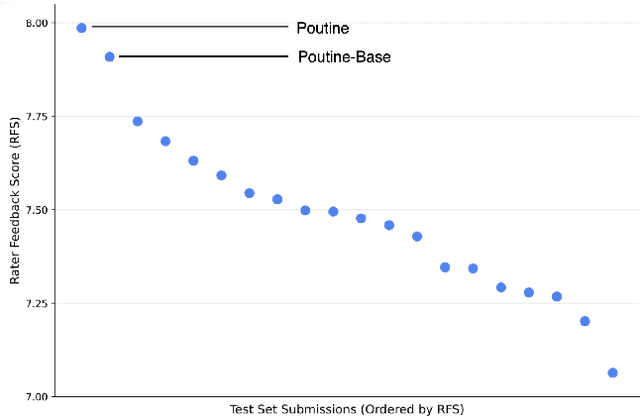
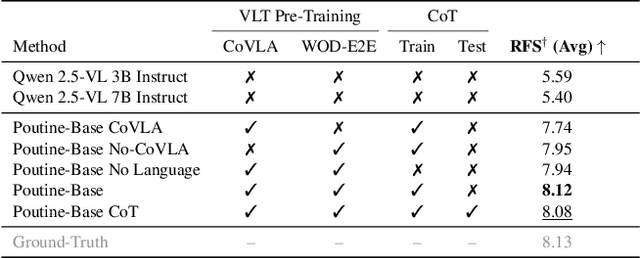

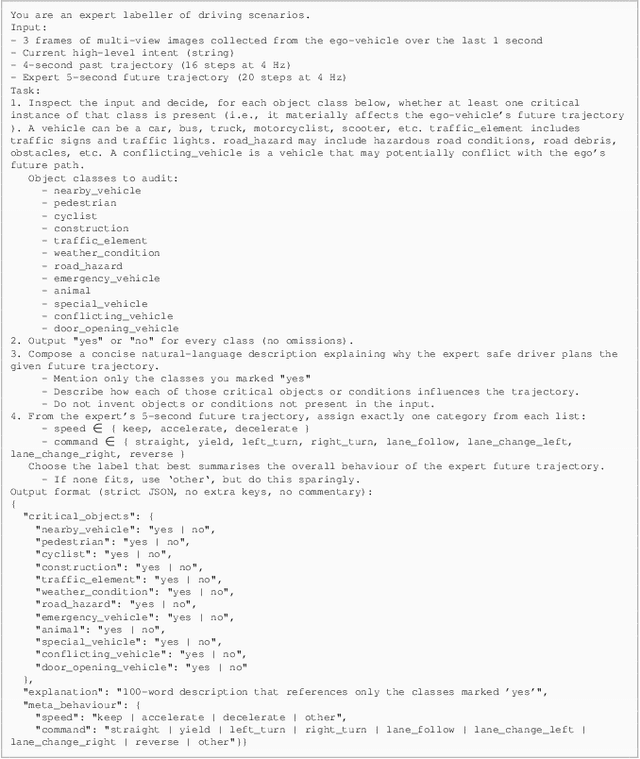
We present Poutine, a 3B-parameter vision-language model (VLM) tailored for end-to-end autonomous driving in long-tail driving scenarios. Poutine is trained in two stages. To obtain strong base driving capabilities, we train Poutine-Base in a self-supervised vision-language-trajectory (VLT) next-token prediction fashion on 83 hours of CoVLA nominal driving and 11 hours of Waymo long-tail driving. Accompanying language annotations are auto-generated with a 72B-parameter VLM. Poutine is obtained by fine-tuning Poutine-Base with Group Relative Policy Optimization (GRPO) using less than 500 preference-labeled frames from the Waymo validation set. We show that both VLT pretraining and RL fine-tuning are critical to attain strong driving performance in the long-tail. Poutine-Base achieves a rater-feedback score (RFS) of 8.12 on the validation set, nearly matching Waymo's expert ground-truth RFS. The final Poutine model achieves an RFS of 7.99 on the official Waymo test set, placing 1st in the 2025 Waymo Vision-Based End-to-End Driving Challenge by a significant margin. These results highlight the promise of scalable VLT pre-training and lightweight RL fine-tuning to enable robust and generalizable autonomy.
AUTO-IceNav: A Local Navigation Strategy for Autonomous Surface Ships in Broken Ice Fields
Nov 26, 2024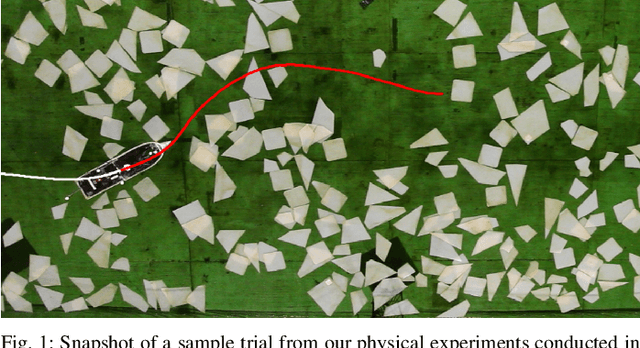
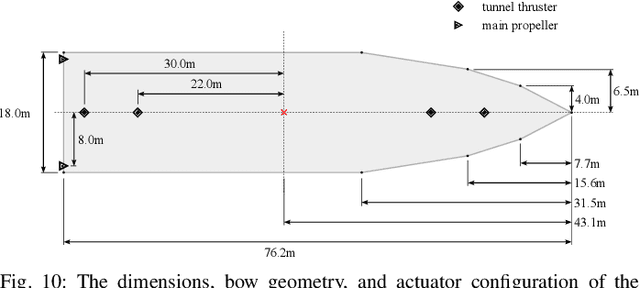
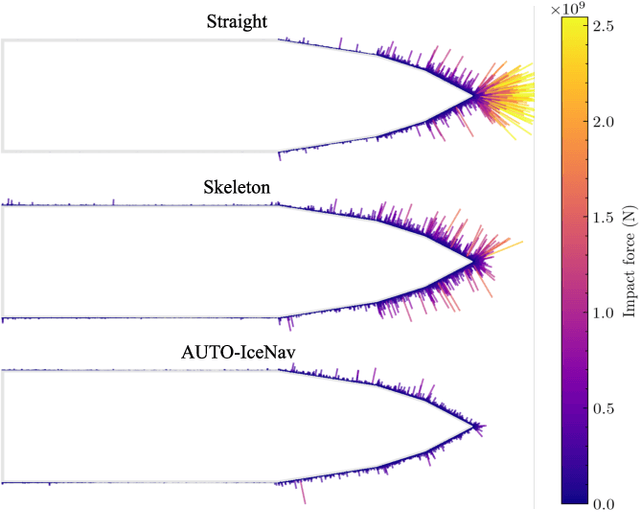
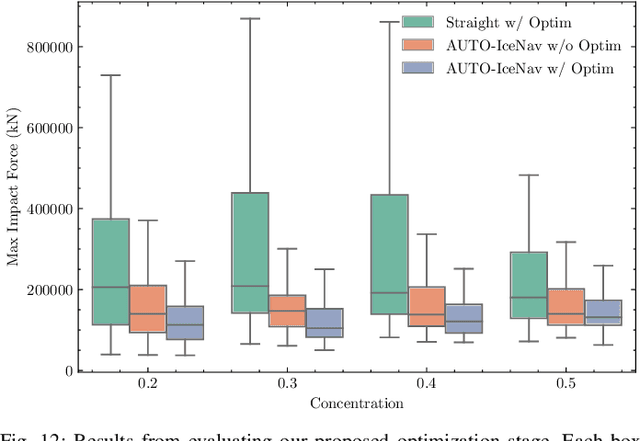
Ice conditions often require ships to reduce speed and deviate from their main course to avoid damage to the ship. In addition, broken ice fields are becoming the dominant ice conditions encountered in the Arctic, where the effects of collisions with ice are highly dependent on where contact occurs and on the particular features of the ice floes. In this paper, we present AUTO-IceNav, a framework for the autonomous navigation of ships operating in ice floe fields. Trajectories are computed in a receding-horizon manner, where we frequently replan given updated ice field data. During a planning step, we assume a nominal speed that is safe with respect to the current ice conditions, and compute a reference path. We formulate a novel cost function that minimizes the kinetic energy loss of the ship from ship-ice collisions and incorporate this cost as part of our lattice-based path planner. The solution computed by the lattice planning stage is then used as an initial guess in our proposed optimization-based improvement step, producing a locally optimal path. Extensive experiments were conducted both in simulation and in a physical testbed to validate our approach.
Efficient Ground Vehicle Path Following in Game AI
Jul 07, 2023This short paper presents an efficient path following solution for ground vehicles tailored to game AI. Our focus is on adapting established techniques to design simple solutions with parameters that are easily tunable for an efficient benchmark path follower. Our solution pays particular attention to computing a target speed which uses quadratic Bezier curves to estimate the path curvature. The performance of the proposed path follower is evaluated through a variety of test scenarios in a first-person shooter game, demonstrating its effectiveness and robustness in handling different types of paths and vehicles. We achieved a 70% decrease in the total number of stuck events compared to an existing path following solution.
Real-Time Navigation for Autonomous Surface Vehicles In Ice-Covered Waters
Feb 24, 2023Vessel transit in ice-covered waters poses unique challenges in safe and efficient motion planning. When the concentration of ice is high, it may not be possible to find collision-free trajectories. Instead, ice can be pushed out of the way if it is small or if contact occurs near the edge of the ice. In this work, we propose a real-time navigation framework that minimizes collisions with ice and distance travelled by the vessel. We exploit a lattice-based planner with a cost that captures the ship interaction with ice. To address the dynamic nature of the environment, we plan motion in a receding horizon manner based on updated vessel and ice state information. Further, we present a novel planning heuristic for evaluating the cost-to-go, which is applicable to navigation in a channel without a fixed goal location. The performance of our planner is evaluated across several levels of ice concentration both in simulated and in real-world experiments.