 Add to Chrome
 Add to Firefox
 Add to Edge
3D Scene Graphs: Open Challenges and Future Directions
Jun 15, 2026
3D Scene Graphs (3DSGs) have emerged as a powerful representation for spatial AI by combining geometric grounding with semantic and relational abstractions of the environment. Their expressiveness has made them relevant to a broad range of problems in robotics and computer vision, including manipulation, navigation, task planning, scene understanding, and many others. However, the field remains fragmented: different communities adopt distinct formulations, construction pipelines, and evaluation protocols, making it difficult to compare methods, identify common assumptions, and assess remaining challenges for robust real-world deployment. This survey provides a unified and critical review of 3DSGs, with particular emphasis on open challenges and future directions. We first formalize 3DSGs under a common definition and analyze the principal modeling choices that characterize existing formulations, including node and edge attributes, hierarchical structure, dynamic scene representations, and affordance-aware extensions. We then review how 3DSGs are built from raw sensory observations, discussing the most common terminologies, conventions, and techniques. Finally, we examine downstream applications and evaluation strategies, from intrinsic graph quality to task-level performance. To support the community, we also provide a dedicated website that organizes and extends the surveyed content, accessible at https://3dscenegraphs.com/.

Long-Term Planning Around Humans in Domestic Environments with 3D Scene Graphs
Mar 12, 2025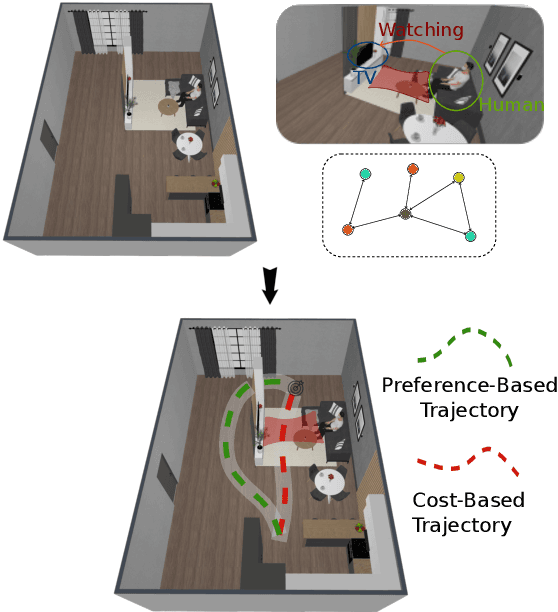
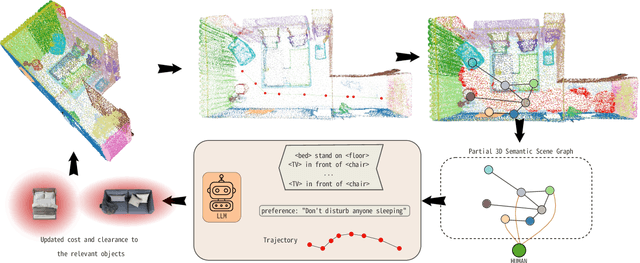
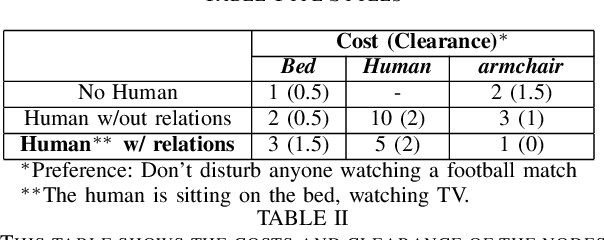
Long-term planning for robots operating in domestic environments poses unique challenges due to the interactions between humans, objects, and spaces. Recent advancements in trajectory planning have leveraged vision-language models (VLMs) to extract contextual information for robots operating in real-world environments. While these methods achieve satisfying performance, they do not explicitly model human activities. Such activities influence surrounding objects and reshape spatial constraints. This paper presents a novel approach to trajectory planning that integrates human preferences, activities, and spatial context through an enriched 3D scene graph (3DSG) representation. By incorporating activity-based relationships, our method captures the spatial impact of human actions, leading to more context-sensitive trajectory adaptation. Preliminary results demonstrate that our approach effectively assigns costs to spaces influenced by human activities, ensuring that the robot trajectory remains contextually appropriate and sensitive to the ongoing environment. This balance between task efficiency and social appropriateness enhances context-aware human-robot interactions in domestic settings. Future work includes implementing a full planning pipeline and conducting user studies to evaluate trajectory acceptability.
FunGraph: Functionality Aware 3D Scene Graphs for Language-Prompted Scene Interaction
Mar 10, 2025The concept of 3D scene graphs is increasingly recognized as a powerful semantic and hierarchical representation of the environment. Current approaches often address this at a coarse, object-level resolution. In contrast, our goal is to develop a representation that enables robots to directly interact with their environment by identifying both the location of functional interactive elements and how these can be used. To achieve this, we focus on detecting and storing objects at a finer resolution, focusing on affordance-relevant parts. The primary challenge lies in the scarcity of data that extends beyond instance-level detection and the inherent difficulty of capturing detailed object features using robotic sensors. We leverage currently available 3D resources to generate 2D data and train a detector, which is then used to augment the standard 3D scene graph generation pipeline. Through our experiments, we demonstrate that our approach achieves functional element segmentation comparable to state-of-the-art 3D models and that our augmentation enables task-driven affordance grounding with higher accuracy than the current solutions.