 Add to Chrome
 Add to Firefox
 Add to Edge
TinyLLaVA-Video-R1: Towards Smaller LMMs for Video Reasoning
Apr 13, 2025
Recently, improving the reasoning ability of large multimodal models (LMMs) through reinforcement learning has made great progress. However, most existing works are based on highly reasoning-intensive datasets such as mathematics and code, and researchers generally choose large-scale models as the foundation. We argue that exploring small-scale models' reasoning capabilities remains valuable for researchers with limited computational resources. Moreover, enabling models to explain their reasoning processes on general question-answering datasets is equally meaningful. Therefore, we present the small-scale video reasoning model TinyLLaVA-Video-R1. Based on TinyLLaVA-Video, a traceably trained video understanding model with no more than 4B parameters, it not only demonstrates significantly improved reasoning and thinking capabilities after using reinforcement learning on general Video-QA datasets, but also exhibits the emergent characteristic of "aha moments". Furthermore, we share a series of experimental findings, aiming to provide practical insights for future exploration of video reasoning (thinking) abilities in small-scale models. It is available at https://github.com/ZhangXJ199/TinyLLaVA-Video-R1.

From Hypothesis to Publication: A Comprehensive Survey of AI-Driven Research Support Systems
Mar 03, 2025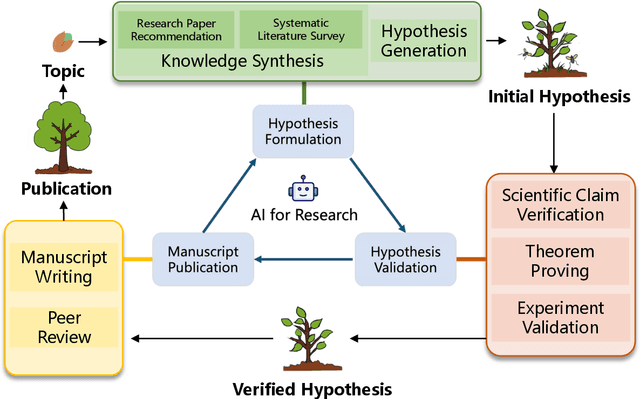
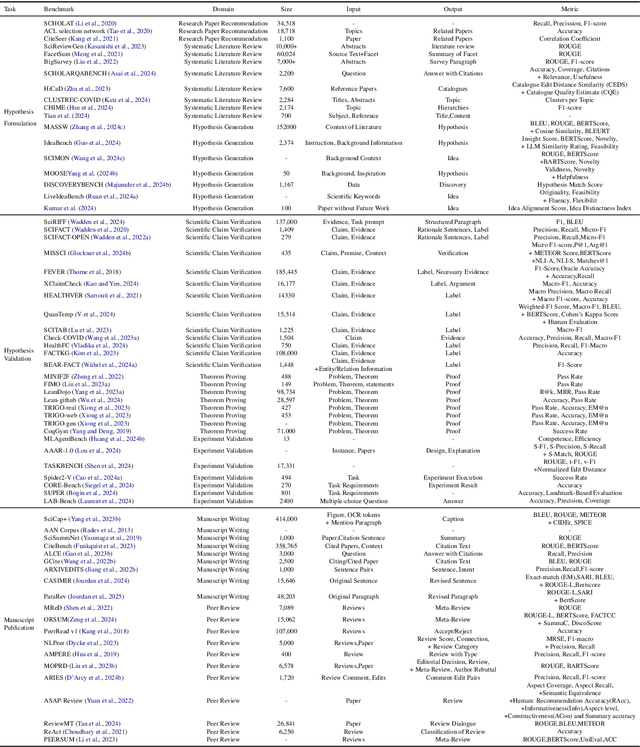
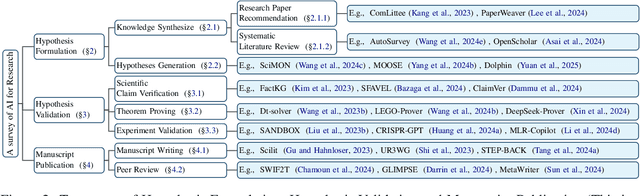
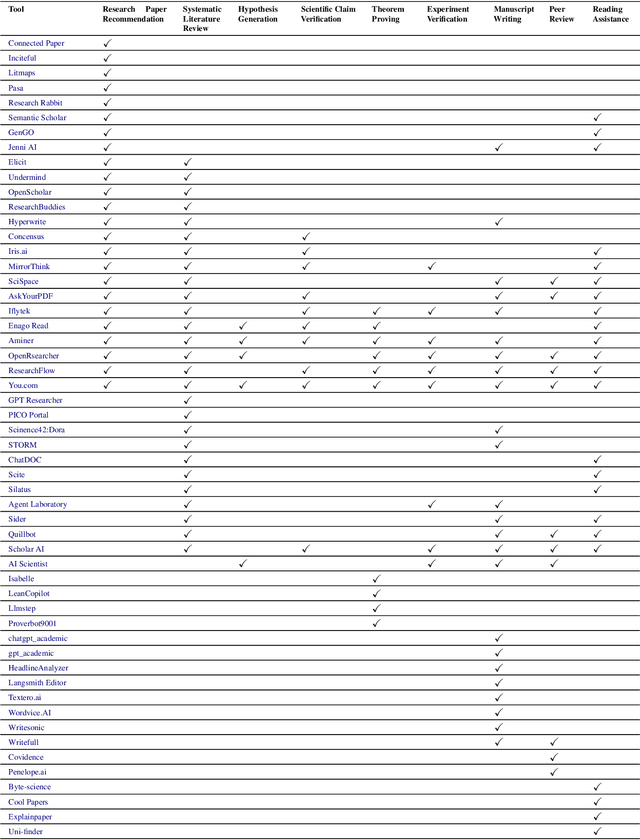
Research is a fundamental process driving the advancement of human civilization, yet it demands substantial time and effort from researchers. In recent years, the rapid development of artificial intelligence (AI) technologies has inspired researchers to explore how AI can accelerate and enhance research. To monitor relevant advancements, this paper presents a systematic review of the progress in this domain. Specifically, we organize the relevant studies into three main categories: hypothesis formulation, hypothesis validation, and manuscript publication. Hypothesis formulation involves knowledge synthesis and hypothesis generation. Hypothesis validation includes the verification of scientific claims, theorem proving, and experiment validation. Manuscript publication encompasses manuscript writing and the peer review process. Furthermore, we identify and discuss the current challenges faced in these areas, as well as potential future directions for research. Finally, we also offer a comprehensive overview of existing benchmarks and tools across various domains that support the integration of AI into the research process. We hope this paper serves as an introduction for beginners and fosters future research. Resources have been made publicly available at https://github.com/zkzhou126/AI-for-Research.
Verification of Bit-Flip Attacks against Quantized Neural Networks
Feb 22, 2025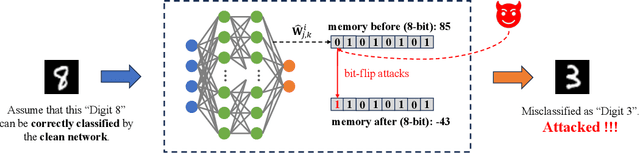
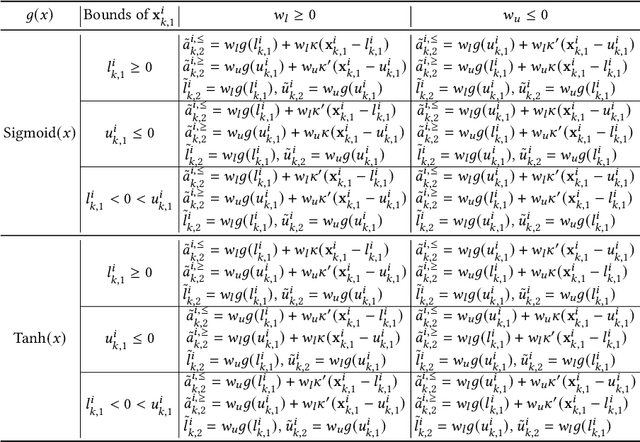
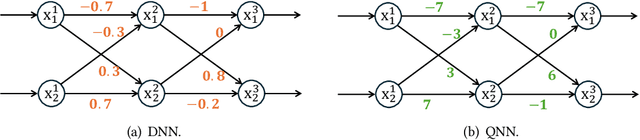
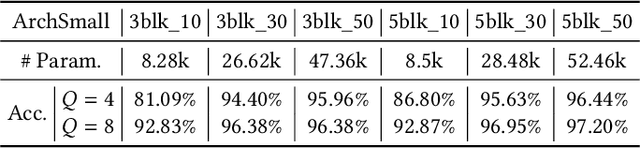
In the rapidly evolving landscape of neural network security, the resilience of neural networks against bit-flip attacks (i.e., an attacker maliciously flips an extremely small amount of bits within its parameter storage memory system to induce harmful behavior), has emerged as a relevant area of research. Existing studies suggest that quantization may serve as a viable defense against such attacks. Recognizing the documented susceptibility of real-valued neural networks to such attacks and the comparative robustness of quantized neural networks (QNNs), in this work, we introduce BFAVerifier, the first verification framework designed to formally verify the absence of bit-flip attacks or to identify all vulnerable parameters in a sound and rigorous manner. BFAVerifier comprises two integral components: an abstraction-based method and an MILP-based method. Specifically, we first conduct a reachability analysis with respect to symbolic parameters that represent the potential bit-flip attacks, based on a novel abstract domain with a sound guarantee. If the reachability analysis fails to prove the resilience of such attacks, then we encode this verification problem into an equivalent MILP problem which can be solved by off-the-shelf solvers. Therefore, BFAVerifier is sound, complete, and reasonably efficient. We conduct extensive experiments, which demonstrate its effectiveness and efficiency across various network architectures, quantization bit-widths, and adversary capabilities.
Clustering Properties of Self-Supervised Learning
Jan 30, 2025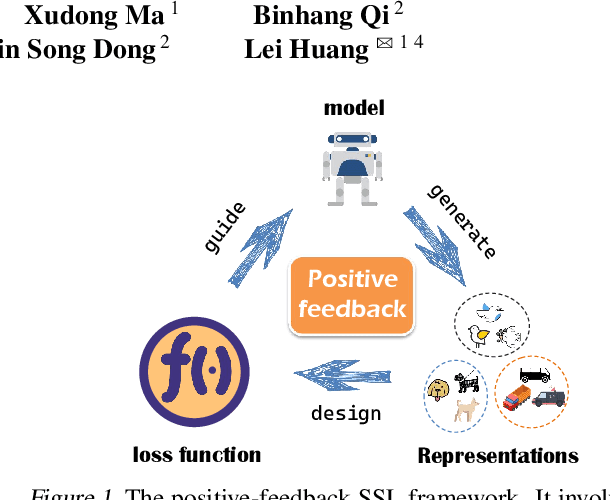
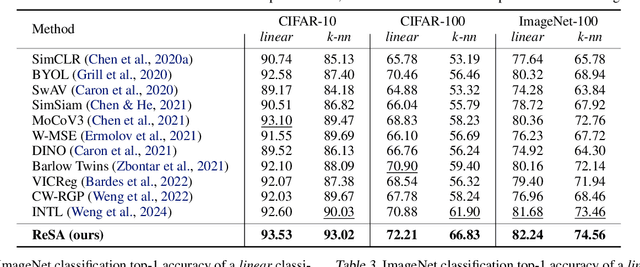
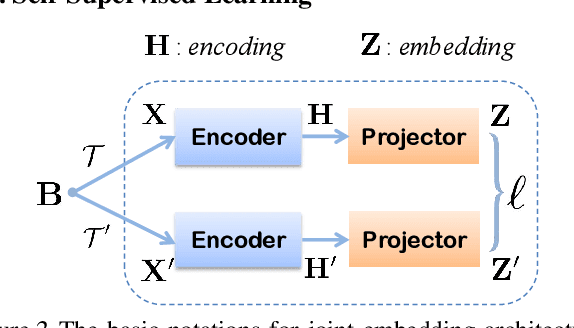
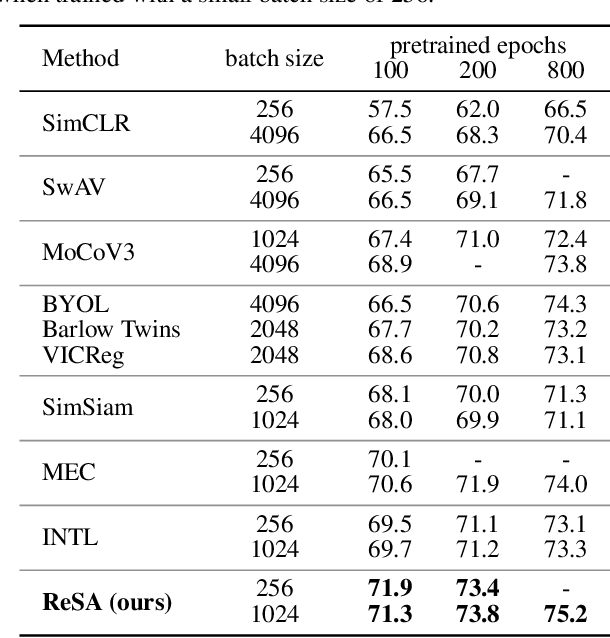
Self-supervised learning (SSL) methods via joint embedding architectures have proven remarkably effective at capturing semantically rich representations with strong clustering properties, magically in the absence of label supervision. Despite this, few of them have explored leveraging these untapped properties to improve themselves. In this paper, we provide an evidence through various metrics that the encoder's output $encoding$ exhibits superior and more stable clustering properties compared to other components. Building on this insight, we propose a novel positive-feedback SSL method, termed Representation Soft Assignment (ReSA), which leverages the model's clustering properties to promote learning in a self-guided manner. Extensive experiments on standard SSL benchmarks reveal that models pretrained with ReSA outperform other state-of-the-art SSL methods by a significant margin. Finally, we analyze how ReSA facilitates better clustering properties, demonstrating that it effectively enhances clustering performance at both fine-grained and coarse-grained levels, shaping representations that are inherently more structured and semantically meaningful.
TinyLLaVA-Video: A Simple Framework of Small-scale Large Multimodal Models for Video Understanding
Jan 26, 2025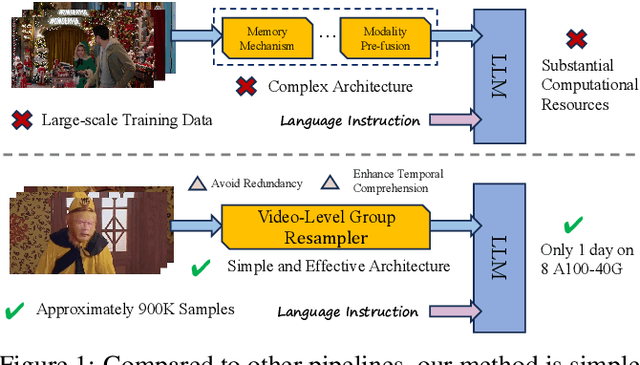

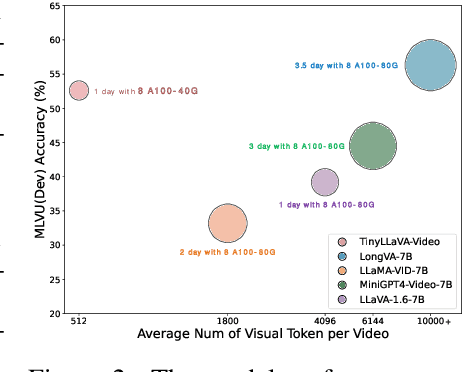
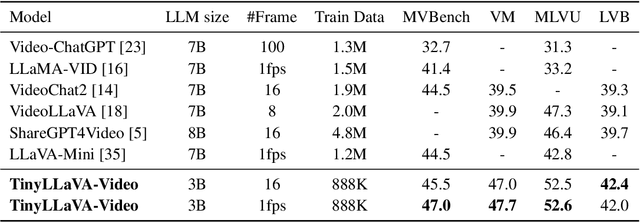
We present the TinyLLaVA-Video, a video understanding model with parameters not exceeding 4B that processes video sequences in a simple manner, without the need for complex architectures, supporting both fps sampling and uniform frame sampling. Our model is characterized by modularity and scalability, allowing training and inference with limited computational resources and enabling users to replace components based on their needs. We validate the effectiveness of this framework through experiments, the best model achieving performance comparable to certain existing 7B models on multiple video understanding benchmarks. The code and training recipes are fully open source, with all components and training data publicly available. We hope this work can serve as a baseline for practitioners exploring small-scale multimodal models for video understanding. It is available at \url{https://github.com/ZhangXJ199/TinyLLaVA-Video}.
Joint Antenna Selection and Beamforming Design for Active RIS-aided ISAC Systems
Jan 16, 2025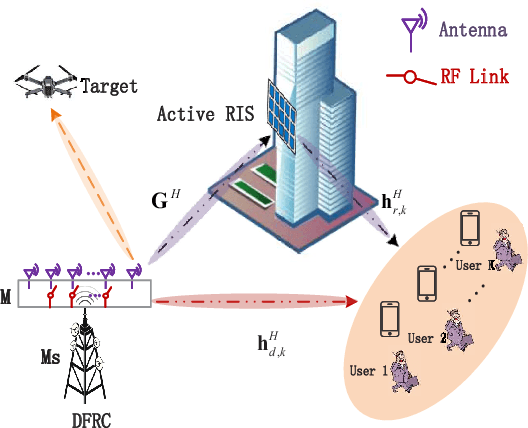

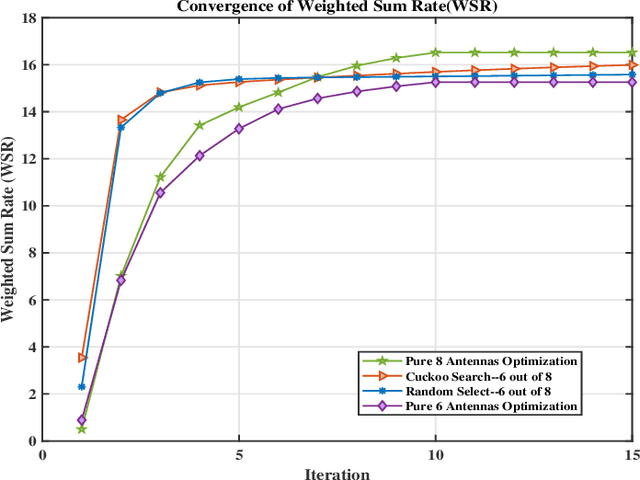
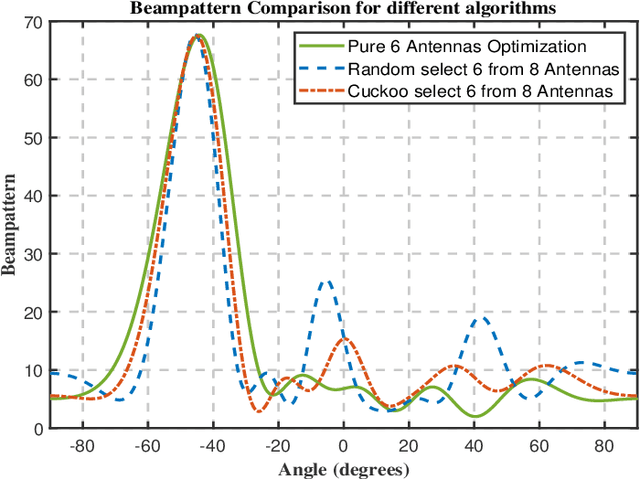
Active reconfigurable intelligent surface (A-RIS) aided integrated sensing and communications (ISAC) system has been considered as a promising paradigm to improve spectrum efficiency. However, massive energy-hungry radio frequency (RF) chains hinder its large-scale deployment. To address this issue, an A-RIS-aided ISAC system with antenna selection (AS) is proposed in this work, where a target is sensed while multiple communication users are served with specifically selected antennas. Specifically, a cuckoo search-based scheme is first utilized to select the antennas associated with high-gain channels. Subsequently, with the properly selected antennas, the weighted sum-rate (WSR) of the system is optimized under the condition of radar probing power level, power budget for the A-RIS and transmitter. To solve the highly non-convex optimization problem, we develop an efficient algorithm based on weighted minimum mean square error (WMMSE) and fractional programming (FP). Simulation results show that the proposed AS scheme and the algorithm are effective, which reduce the number of RF chains without significant performance degradation.
SLAM: Towards Efficient Multilingual Reasoning via Selective Language Alignment
Jan 07, 2025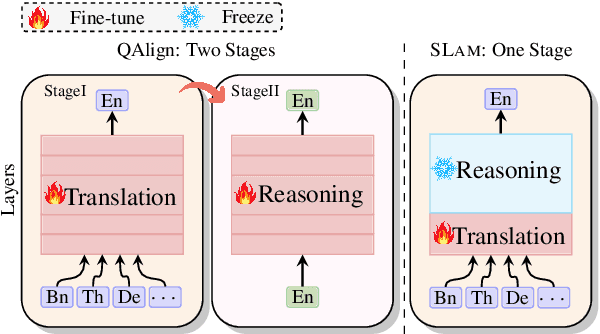
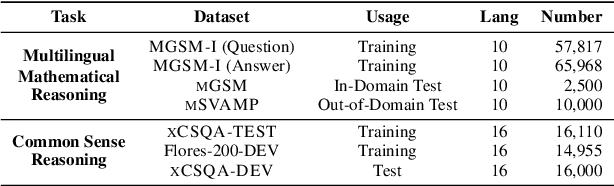
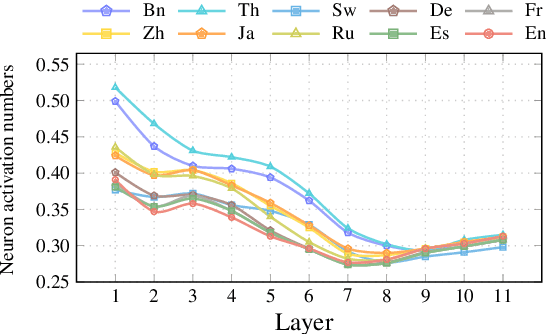
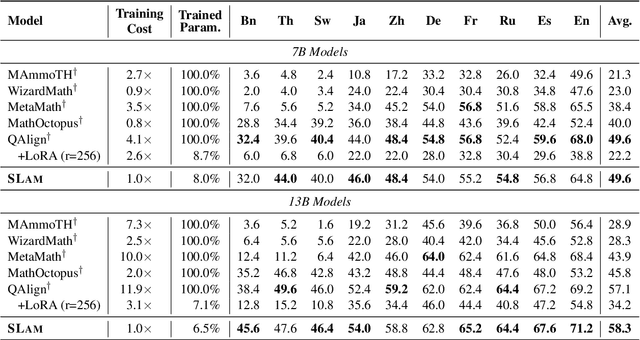
Despite the significant improvements achieved by large language models (LLMs) in English reasoning tasks, these models continue to struggle with multilingual reasoning. Recent studies leverage a full-parameter and two-stage training paradigm to teach models to first understand non-English questions and then reason. However, this method suffers from both substantial computational resource computing and catastrophic forgetting. The fundamental cause is that, with the primary goal of enhancing multilingual comprehension, an excessive number of irrelevant layers and parameters are tuned during the first stage. Given our findings that the representation learning of languages is merely conducted in lower-level layers, we propose an efficient multilingual reasoning alignment approach that precisely identifies and fine-tunes the layers responsible for handling multilingualism. Experimental results show that our method, SLAM, only tunes 6 layers' feed-forward sub-layers including 6.5-8% of all parameters within 7B and 13B LLMs, achieving superior average performance than all strong baselines across 10 languages. Meanwhile, SLAM only involves one training stage, reducing training time by 4.1-11.9 compared to the two-stage method.
Length Controlled Generation for Black-box LLMs
Dec 19, 2024


Large language models (LLMs) have demonstrated impressive instruction following capabilities, while still struggling to accurately manage the length of the generated text, which is a fundamental requirement in many real-world applications. Existing length control methods involve fine-tuning the parameters of LLMs, which is inefficient and suboptimal for practical use. In this paper, we propose a novel iterative sampling framework for text length control, integrating the Metropolis-Hastings algorithm with an importance sampling acceleration strategy. This framework efficiently and reliably regulates LLMs to generate length-constrained text without modifying the underlying parameters, thereby preserving the original capabilities of LLMs. Experimental results demonstrate that our framework achieves almost 100\% success rates of length control on Llama3.1 for tasks such as length-controlled abstractive summarization and length-constrained instruction following, with minimal additional computational overhead. This also highlights the significant potential of our method for precise length control across a broader range of applications, without compromising the versatility of LLMs.
XTransplant: A Probe into the Upper Bound Performance of Multilingual Capability and Culture Adaptability in LLMs via Mutual Cross-lingual Feed-forward Transplantation
Dec 17, 2024Current large language models (LLMs) often exhibit imbalances in multilingual capabilities and cultural adaptability, largely due to their English-centric pretraining data. To address this imbalance, we propose a probing method named XTransplant that explores cross-lingual latent interactions via cross-lingual feed-forward transplantation during inference stage, with the hope of enabling the model to leverage the strengths of both English and non-English languages. Through extensive pilot experiments, we empirically prove that both the multilingual capabilities and cultural adaptability of LLMs hold the potential to be significantly improved by XTransplant, respectively from En -> non-En and non-En -> En, highlighting the underutilization of current LLMs' multilingual potential. And the patterns observed in these pilot experiments further motivate an offline scaling inference strategy, which demonstrates consistent performance improvements in multilingual and culture-aware tasks, sometimes even surpassing multilingual supervised fine-tuning. And we do hope our further analysis and discussion could help gain deeper insights into XTransplant mechanism.
Bench-CoE: a Framework for Collaboration of Experts from Benchmark
Dec 05, 2024Large Language Models (LLMs) are key technologies driving intelligent systems to handle multiple tasks. To meet the demands of various tasks, an increasing number of LLMs-driven experts with diverse capabilities have been developed, accompanied by corresponding benchmarks to evaluate their performance. This paper proposes the Bench-CoE framework, which enables Collaboration of Experts (CoE) by effectively leveraging benchmark evaluations to achieve optimal performance across various tasks. Bench-CoE includes a set of expert models, a router for assigning tasks to corresponding experts, and a benchmark dataset for training the router. Moreover, we formulate Query-Level and Subject-Level approaches based on our framework, and analyze the merits and drawbacks of these two approaches. Finally, we conduct a series of experiments with vary data distributions on both language and multimodal tasks to validate that our proposed Bench-CoE outperforms any single model in terms of overall performance. We hope this method serves as a baseline for further research in this area. The code is available at \url{https://github.com/ZhangXJ199/Bench-CoE}.