 Add to Chrome
 Add to Firefox
 Add to Edge
IEA: Amateur-Friendly Conversational Image Editing Agent via Three Stages of Multitask Alignment
Jun 06, 2026
Current image editing software often hinges on fixed filters or expert tuning, leaving a gap between amateur users' intent and outcomes. Creations by generative models may contain artifacts, implausible details, or stylistic drift away from photorealism and offer little insight into why an edit was made. We propose IEA, a conversational Image Editing Agent that learns to operate parameterized tools in an explicit, interpretable action space. IEA is trained via a three-stage multitask pipeline: (1) SFT on distilled expert edits, (2) GRPO with rewards for likeness improvement, tool usefulness, and intent summarization, and (3) large-scale synthetic fine-tuning to jointly master image editing, refinement, and user intent summarization. By manipulating 16 editing tools step by step, IEA produces transparent edit traces that can be inspected and debugged. In quantitative experiments, it attains a lower pixel distance on the edit task and a higher ROUGE-L on the summary task than strong baselines. In user studies, it ranks best among tool-calling methods for instruction following while surpassing generative methods in overall perceptual quality. Our results validate interpretable, tool-centric VLMs as a reliable path to human instruction-guided image retouching.

SSR: Can Simulated Patients Learn to Stigmatize Themselves? Modeling Self-Stigma through Internal Monologue
Jun 06, 2026Simulating patients with large language models (LLMs) is a promising tool for mental health training, but existing approaches fail to capture a key clinical reality: self-stigma. Patients experiencing self-stigma, the internalization of negative stereotypes, often exhibit context-sensitive resistance, such as avoidance, denial, or self-blame, which current models render as static or uniformly compliant behavior. To address this, we introduce a novel simulation framework grounded in the psychological 3A1H model of self-stigmatization. Our core innovation is the creation of a \textbf{Stigmatized Self-Reflection} (\textbf{SSR}) dataset, where we augment mental health dialogues with internal monologues that reflect stigma-aware reasoning. By fine-tuning LLMs with this data using a chain-of-thought approach, we train patient agents to dynamically adjust their level and expression of stigma based on conversational triggers. Evaluations demonstrate that our approach significantly outperforms specialized baselines, generating more authentic and situationally appropriate patient responses. This work provides a crucial step towards realistic stigma simulation for clinical training and empathetic dialogue systems.
Synthetic or Authentic? Building Mental Patient Simulators from Longitudinal Evidence
Mar 24, 2026Patient simulation is essential for developing and evaluating mental health dialogue systems. As most existing approaches rely on snapshot-style prompts with limited profile information, homogeneous behaviors and incoherent disease progression in multi-turn interactions have become key chellenges. In this work, we propose DEPROFILE, a data-grounded patient simulation framework that constructs unified, multi-source patient profiles by integrating demographic attributes, standardized clinical symptoms, counseling dialogues, and longitudinal life-event histories from real-world data. We further introduce a Chain-of-Change agent to transform noisy longitudinal records into structured, temporally grounded memory representations for simulation. Experiments across multiple large language model (LLM) backbones show that with more comprehensive profile constructed by DEPROFILE, the dialogue realism, behavioral diversity, and event richness have consistently improved and exceed state-of-the-art baselines, highlighting the importance of grounding patient simulation in verifiable longitudinal evidence.
Delusions of Large Language Models
Mar 09, 2025Large Language Models often generate factually incorrect but plausible outputs, known as hallucinations. We identify a more insidious phenomenon, LLM delusion, defined as high belief hallucinations, incorrect outputs with abnormally high confidence, making them harder to detect and mitigate. Unlike ordinary hallucinations, delusions persist with low uncertainty, posing significant challenges to model reliability. Through empirical analysis across different model families and sizes on several Question Answering tasks, we show that delusions are prevalent and distinct from hallucinations. LLMs exhibit lower honesty with delusions, which are harder to override via finetuning or self reflection. We link delusion formation with training dynamics and dataset noise and explore mitigation strategies such as retrieval augmented generation and multi agent debating to mitigate delusions. By systematically investigating the nature, prevalence, and mitigation of LLM delusions, our study provides insights into the underlying causes of this phenomenon and outlines future directions for improving model reliability.
AdaEAGLE: Optimizing Speculative Decoding via Explicit Modeling of Adaptive Draft Structures
Dec 25, 2024


Speculative Decoding (SD) is a popular lossless technique for accelerating the inference of Large Language Models (LLMs). We show that the decoding speed of SD frameworks with static draft structures can be significantly improved by incorporating context-aware adaptive draft structures. However, current studies on adaptive draft structures are limited by their performance, modeling approaches, and applicability. In this paper, we introduce AdaEAGLE, the first SD framework that explicitly models adaptive draft structures. AdaEAGLE leverages the Lightweight Draft Length Predictor (LDLP) module to explicitly predict the optimal number of draft tokens during inference to guide the draft model. It achieves comparable speedup results without manual thresholds and allows for deeper, more specialized optimizations. Moreover, together with threshold-based strategies, AdaEAGLE achieves a $1.62\times$ speedup over the vanilla AR decoding and outperforms fixed-length SotA baseline while maintaining output quality.
MobA: A Two-Level Agent System for Efficient Mobile Task Automation
Oct 17, 2024
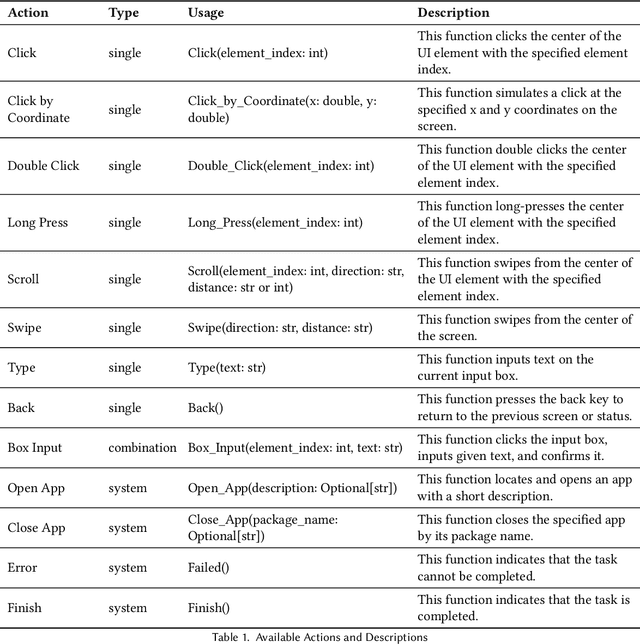
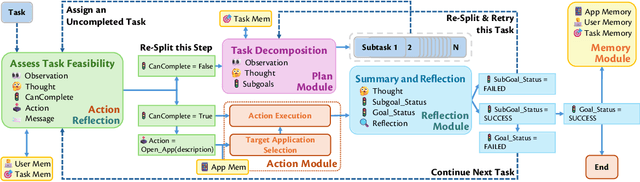
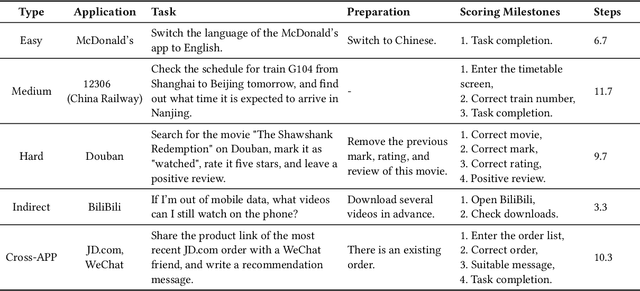
Current mobile assistants are limited by dependence on system APIs or struggle with complex user instructions and diverse interfaces due to restricted comprehension and decision-making abilities. To address these challenges, we propose MobA, a novel Mobile phone Agent powered by multimodal large language models that enhances comprehension and planning capabilities through a sophisticated two-level agent architecture. The high-level Global Agent (GA) is responsible for understanding user commands, tracking history memories, and planning tasks. The low-level Local Agent (LA) predicts detailed actions in the form of function calls, guided by sub-tasks and memory from the GA. Integrating a Reflection Module allows for efficient task completion and enables the system to handle previously unseen complex tasks. MobA demonstrates significant improvements in task execution efficiency and completion rate in real-life evaluations, underscoring the potential of MLLM-empowered mobile assistants.
Towards Reliable and Empathetic Depression-Diagnosis-Oriented Chats
Apr 07, 2024Chatbots can serve as a viable tool for preliminary depression diagnosis via interactive conversations with potential patients. Nevertheless, the blend of task-oriented and chit-chat in diagnosis-related dialogues necessitates professional expertise and empathy. Such unique requirements challenge traditional dialogue frameworks geared towards single optimization goals. To address this, we propose an innovative ontology definition and generation framework tailored explicitly for depression diagnosis dialogues, combining the reliability of task-oriented conversations with the appeal of empathy-related chit-chat. We further apply the framework to D$^4$, the only existing public dialogue dataset on depression diagnosis-oriented chats. Exhaustive experimental results indicate significant improvements in task completion and emotional support generation in depression diagnosis, fostering a more comprehensive approach to task-oriented chat dialogue system development and its applications in digital mental health.
LLM-empowered Chatbots for Psychiatrist and Patient Simulation: Application and Evaluation
May 23, 2023Empowering chatbots in the field of mental health is receiving increasing amount of attention, while there still lacks exploration in developing and evaluating chatbots in psychiatric outpatient scenarios. In this work, we focus on exploring the potential of ChatGPT in powering chatbots for psychiatrist and patient simulation. We collaborate with psychiatrists to identify objectives and iteratively develop the dialogue system to closely align with real-world scenarios. In the evaluation experiments, we recruit real psychiatrists and patients to engage in diagnostic conversations with the chatbots, collecting their ratings for assessment. Our findings demonstrate the feasibility of using ChatGPT-powered chatbots in psychiatric scenarios and explore the impact of prompt designs on chatbot behavior and user experience.