 Add to Chrome
 Add to Firefox
 Add to Edge
Yesterday's Shield, Today's Spear: A Self-Evolving Safety Guardrail in Production
Aug 09, 2026
Deployed LLM safety guardrails are predominantly static: trained once and frozen at release, while new jailbreak techniques and previously un-addressed harmful categories emerge within days, leaving the defense perpetually a step behind. We present SESG (Self-Evolving Safety Guardrails), a multi-agent system running in production. SESG monitors the live traffic behind a deployed guardrail and surfaces two classes of failure: jailbreaks novel in form and harmful categories novel in content. Once a failure is confirmed, a generation agent synthesizes paired training data targeted at it; a validation agent rebalances the batch toward the direction in which the deployed model errs, so that the model's own mistakes steer its training set; and a routing agent matches the training action to the diagnosed gap and returns the next version to production. Over six rounds of live evolution (V0 to V6), a 1.7B guardrail adapts to a new threat in 16-24 hours, with about 2 hours of human effort, versus the 40-90 hours of the manual process it replaces. On six emerging threats, it outperforms static guardrails from 0.6B to 9B and an adaptive baseline while preserving its general screening competence. Since April 2026, SESG has been the primary update pipeline of Sangfor's guardrail, autonomously closing 14 of 15 new threat scenarios in two months. We release 9 test sets for the 6 new threats at https://github.com/Trams1017/SESG. Warning: This paper contains examples that may be harmful or offensive.

NameBERT: Scaling Name-Based Nationality Classification with LLM-Augmented Open Academic Data
Apr 12, 2026Inferring nationality from personal names is a critical capability for equity and bias monitoring, personalization, and a valuable tool in biomedical and sociological research. However, existing name-based nationality classifiers are typically trained on relatively small or source-specific labeled datasets, which can introduce coverage gaps and limit performance for underrepresented countries. While large language models (LLMs) demonstrate strong zero-shot performance for name-based nationality prediction, their computational cost and latency make them impractical for real-time, large-scale deployment. In this work, we created a large-scale name-nationality dataset from the Open Academic Graph (OAG) and introduce a framework that leverages LLMs as dataset enrichers rather than inference engines. We augment low-resource countries with LLM-generated names and evaluate on real and synthetic-tail test sets. We find that augmentation produces large gains when evaluation includes synthetic tail names and still offers a modest lift on tail-country metrics otherwise. Overall, NameBERT models achieve significantly higher accuracy than state-of-the-art baselines across both in- and out-of-domain tasks, while remaining efficient for large-scale inference compared to LLMs.
* 12 pages, 3 figures, 8 tables; accepted at the 39th Canadian Conference on Artificial Intelligence (Canadian AI 2026)
Mixed Chain-of-Psychotherapies for Emotional Support Chatbot
Sep 29, 2024
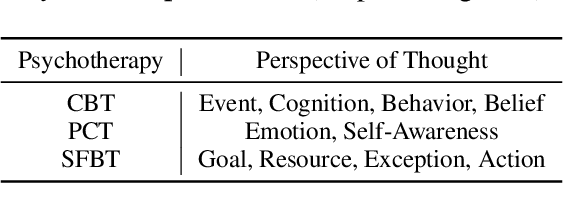
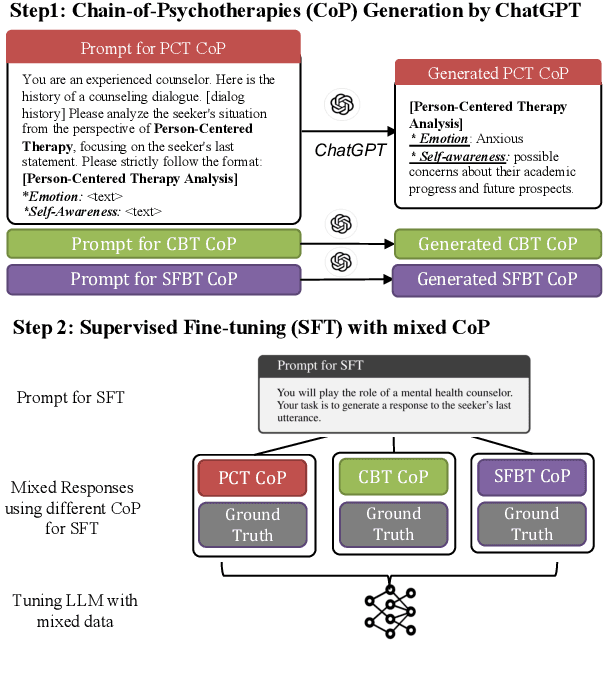
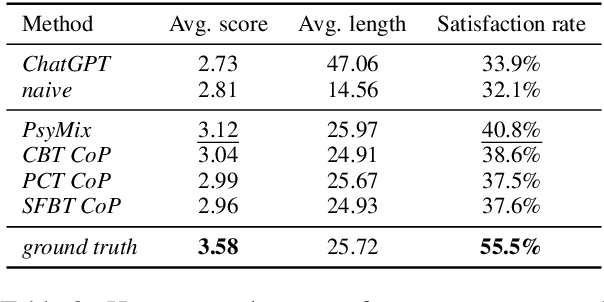
In the realm of mental health support chatbots, it is vital to show empathy and encourage self-exploration to provide tailored solutions. However, current approaches tend to provide general insights or solutions without fully understanding the help-seeker's situation. Therefore, we propose PsyMix, a chatbot that integrates the analyses of the seeker's state from the perspective of a psychotherapy approach (Chain-of-Psychotherapies, CoP) before generating the response, and learns to incorporate the strength of various psychotherapies by fine-tuning on a mixture of CoPs. Through comprehensive evaluation, we found that PsyMix can outperform the ChatGPT baseline, and demonstrate a comparable level of empathy in its responses to that of human counselors.
Towards Reliable and Empathetic Depression-Diagnosis-Oriented Chats
Apr 07, 2024Chatbots can serve as a viable tool for preliminary depression diagnosis via interactive conversations with potential patients. Nevertheless, the blend of task-oriented and chit-chat in diagnosis-related dialogues necessitates professional expertise and empathy. Such unique requirements challenge traditional dialogue frameworks geared towards single optimization goals. To address this, we propose an innovative ontology definition and generation framework tailored explicitly for depression diagnosis dialogues, combining the reliability of task-oriented conversations with the appeal of empathy-related chit-chat. We further apply the framework to D$^4$, the only existing public dialogue dataset on depression diagnosis-oriented chats. Exhaustive experimental results indicate significant improvements in task completion and emotional support generation in depression diagnosis, fostering a more comprehensive approach to task-oriented chat dialogue system development and its applications in digital mental health.