 Add to Chrome
 Add to Firefox
 Add to Edge
USAD: Uncertainty-aware Statistical Adversarial Detection
Jun 26, 2026
Statistical adversarial detection (SAD) treats detection as a two-sample test. Given a reference set of clean examples (CEs) and a batch of queries, potentially containing an unknown mixture of CEs and adversarial examples (AEs), SAD decides whether the query distribution drifts away from the CE distribution while controlling the false-alarm rate. Existing SAD-based methods mainly use maximum mean discrepancy (MMD) to measure the distributional discrepancy. However, MMD's distributional properties limit its ability to capture characteristic uncertainty patterns of AEs that are crucial for detection: AEs typically exhibit abnormal feature spread (i.e., global uncertainty) and instability under perturbations (i.e., local uncertainty). To close the gap, we propose Uncertainty-aware Statistical Adversarial Detection (USAD), which explicitly captures these uncertainty patterns with two new statistics: (1) Variance Discrepancy (VD), which measures the difference in feature spread between AEs and CEs to capture global uncertainty differences. (2) Perturbation-based Covariance Discrepancy (PCD), which compares feature covariance under Gaussian perturbations to capture local uncertainty differences. By aggregating VD and PCD, USAD achieves superior detection performances over baseline methods against various adversarial attacks, highlighting the importance of considering characteristic behaviors of AEs for effective SAD. Our code is available at: https://anonymous.4open.science/r/USAD.

SVoT: State-aware Visualization-of-Thought for Spatial Reasoning via Reinforcement Learning
Jun 10, 2026Spatial reasoning remains a challenge for Multimodal Large Language Models (MLLMs), as it requires reliable multi-hop inference over both intermediate states and state transitions. Current studies often leave intermediate states unverified and treat state transitions as implicit processes, which limits reliability in multi-hop spatial reasoning. To address this, we propose State-aware Visualization-of-Thought (SVoT), a reinforcement learning framework that generates interleaved, verifiable intermediate states and visualizations. SVoT integrates transition reasoning chains into the generation processes, enabling the model to verify action preconditions and effects through interleaved textual and visual reasoning. We train SVoT via Group Relative Policy Optimization (GRPO), instantiating verification through reward design and evaluating the efficacy of different fine-grained rewards. As existing benchmarks reduce state transitions to single-variable updates, substantially simplifying the problems, we establish five domains by extending classical environments and introducing two novel domains, Pacman and Gather, that require multi-object interactions and numerical reasoning. These domains support systematic evaluation of multi-hop spatial reasoning with quantitative verification of generated intermediate states and transition reasoning. SVoT with transition-aware supervision achieves state-of-the-art performance across the introduced domains, yielding up to a 65% absolute accuracy gain on out-of-distribution test sets.
LOTTERY: Learning from Reference-Only Samples in Two-Sample Testing under Size Asymmetry
Jun 07, 2026Data-adaptive two-sample testing assesses if two samples come from the same distribution, using a discrepancy learned from the data (e.g., via kernel-based feature representations). Such methods typically rely on data splitting to decouple learning from testing and control type I error. However, this paradigm is ill-suited to few-shot settings with severe sample-size imbalance: abundant reference samples are available, while only a handful of query samples arrive. In this paper, we show how this imbalance can be leveraged constructively. Using abundant reference data, we learn reference-dependent representations that summarize salient structure of the reference distribution and provide informative signals for detecting departures. We incorporate a collection of representation families that capture both global and local structure, and adaptively weight them using only reference samples via an uncertainty-guided principle. Theoretically, we establish permutation-based type I error control and show consistency of the aggregated test: as the sample sizes grow, the test power converges to one whenever the representation set contains at least one consistent representation. Empirically, our aggregation achieves strong performance across a range of benchmarks while retaining type I error control.
* 16 pages, 1 figure
Revisit Non-parametric Two-sample Testing as a Semi-supervised Learning Problem
Nov 30, 2024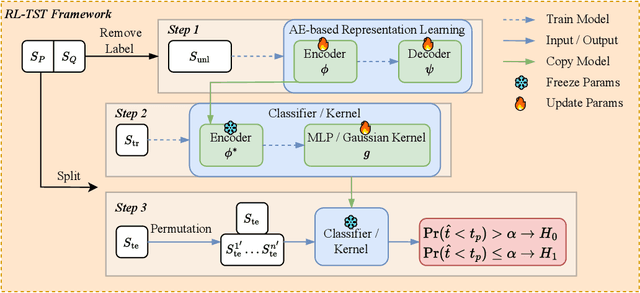
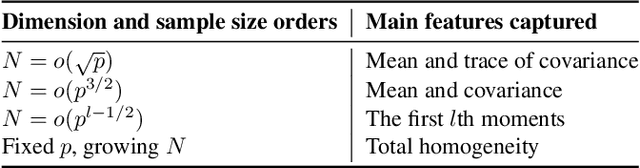
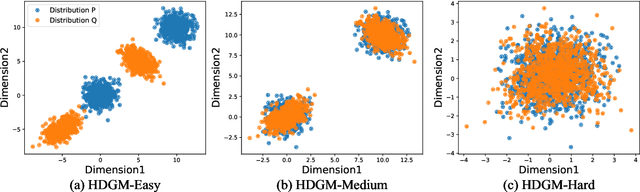
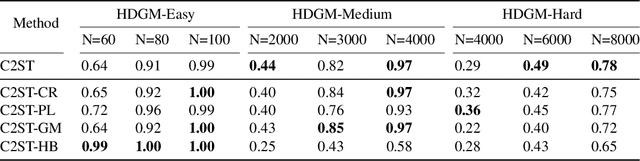
Learning effective data representations is crucial in answering if two samples X and Y are from the same distribution (a.k.a. the non-parametric two-sample testing problem), which can be categorized into: i) learning discriminative representations (DRs) that distinguish between two samples in a supervised-learning paradigm, and ii) learning inherent representations (IRs) focusing on data's inherent features in an unsupervised-learning paradigm. However, both paradigms have issues: learning DRs reduces the data points available for the two-sample testing phase, and learning purely IRs misses discriminative cues. To mitigate both issues, we propose a novel perspective to consider non-parametric two-sample testing as a semi-supervised learning (SSL) problem, introducing the SSL-based Classifier Two-Sample Test (SSL-C2ST) framework. While a straightforward implementation of SSL-C2ST might directly use existing state-of-the-art (SOTA) SSL methods to train a classifier with labeled data (with sample indexes X or Y) and unlabeled data (the remaining ones in the two samples), conventional two-sample testing data often exhibits substantial overlap between samples and violates SSL methods' assumptions, resulting in low test power. Therefore, we propose a two-step approach: first, learn IRs using all data, then fine-tune IRs with only labelled data to learn DRs, which can both utilize information from whole dataset and adapt the discriminative power to the given data. Extensive experiments and theoretical analysis demonstrate that SSL-C2ST outperforms traditional C2ST by effectively leveraging unlabeled data. We also offer a stronger empirically designed test achieving the SOTA performance in many two-sample testing datasets.