 Add to Chrome
 Add to Firefox
 Add to Edge
SR-Agent: An Experience-Driven Agentic Framework for Post-Ranking Strategy Refinement in E-Commerce Recommendation
Jul 21, 2026
User experience is a first-class objective in industrial e-commerce recommender systems (RS). Post-ranking strategies, which govern diversity, similarity, and exposure over a ranked list, are widely deployed in industrial RS for their simplicity and low serving cost. However, as the online recommendation environment evolves continuously, these statically configured strategies gradually become stale, thereby degrading the user experience. Refining them typically relies on manual inspection, diagnosis, and updates, making it slow, costly, and difficult to scale or reuse. Although recent LLM-based agents (e.g., RecUserSim, SimUSER, and Self-EvolveRec) offer promising directions, none of them close the full loop of automated, self-evolving strategy refinement. To bridge this gap, we introduce SR-Agent, which, to the best of our knowledge, is the first agentic framework deployed to refine post-ranking strategies in industrial RS. SR-Agent unifies three components: (i) a UserSim agent that applies inspection skills to surface user-perceived bad cases; (ii) an Analysis agent that consolidates recurring bad cases into structured, reusable diagnoses; and (iii) a constrained Strategy Refinement Harness that maps diagnoses to typed and bounded actions, gated by a four-stage reward pipeline with reversible rollback. Deployed on the Kuaishou e-commerce platform, SR-Agent continuously runs this refinement loop and, in a one-month online A/B test, increases order volume by 0.71%, browsing depth by 0.34%, and clicked-category diversity by 0.48%, while markedly shortening the refinement cycle and lowering operational cost.

QARM V2: Quantitative Alignment Multi-Modal Recommendation for Reasoning User Sequence Modeling
Feb 09, 2026With the evolution of large language models (LLMs), there is growing interest in leveraging their rich semantic understanding to enhance industrial recommendation systems (RecSys). Traditional RecSys relies on ID-based embeddings for user sequence modeling in the General Search Unit (GSU) and Exact Search Unit (ESU) paradigm, which suffers from low information density, knowledge isolation, and weak generalization ability. While LLMs offer complementary strengths with dense semantic representations and strong generalization, directly applying LLM embeddings to RecSys faces critical challenges: representation unmatch with business objectives and representation unlearning end-to-end with downstream tasks. In this paper, we present QARM V2, a unified framework that bridges LLM semantic understanding with RecSys business requirements for user sequence modeling.
Towards Generalizable Graph Contrastive Learning: An Information Theory Perspective
Nov 20, 2022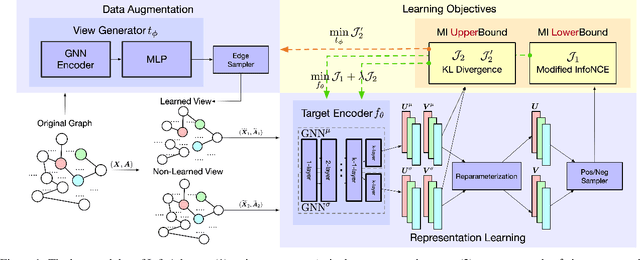
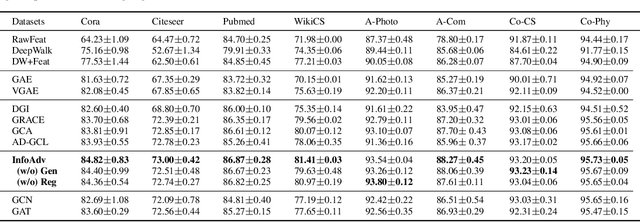
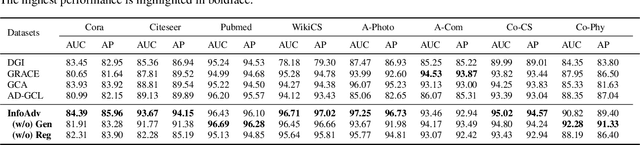
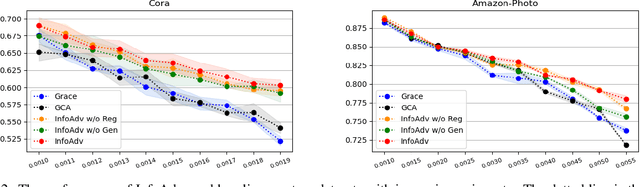
Graph contrastive learning (GCL) emerges as the most representative approach for graph representation learning, which leverages the principle of maximizing mutual information (InfoMax) to learn node representations applied in downstream tasks. To explore better generalization from GCL to downstream tasks, previous methods heuristically define data augmentation or pretext tasks. However, the generalization ability of GCL and its theoretical principle are still less reported. In this paper, we first propose a metric named GCL-GE for GCL generalization ability. Considering the intractability of the metric due to the agnostic downstream task, we theoretically prove a mutual information upper bound for it from an information-theoretic perspective. Guided by the bound, we design a GCL framework named InfoAdv with enhanced generalization ability, which jointly optimizes the generalization metric and InfoMax to strike the right balance between pretext task fitting and the generalization ability on downstream tasks. We empirically validate our theoretical findings on a number of representative benchmarks, and experimental results demonstrate that our model achieves state-of-the-art performance.
Graph Convolutional Networks using Heat Kernel for Semi-supervised Learning
Jul 27, 2020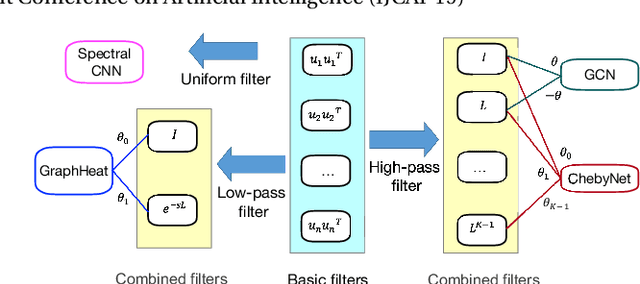
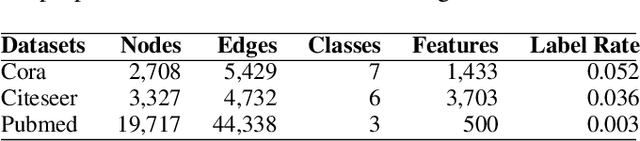
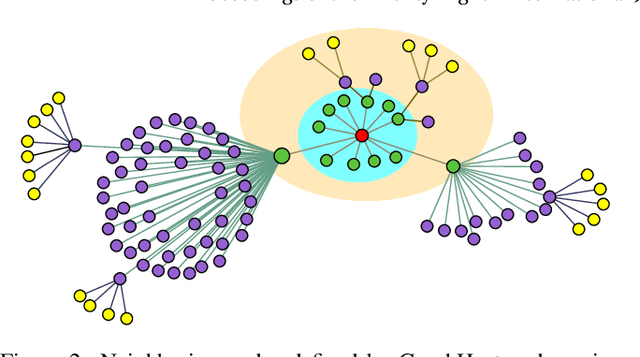
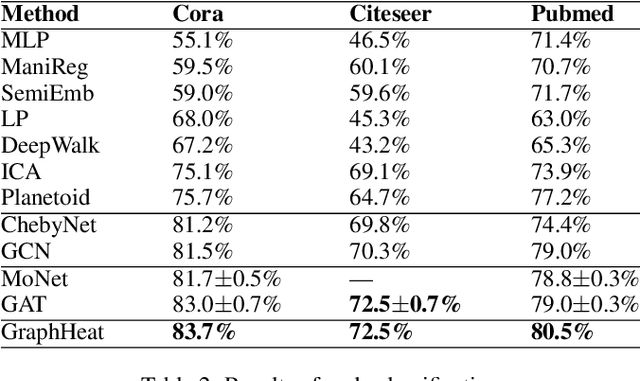
Graph convolutional networks gain remarkable success in semi-supervised learning on graph structured data. The key to graph-based semisupervised learning is capturing the smoothness of labels or features over nodes exerted by graph structure. Previous methods, spectral methods and spatial methods, devote to defining graph convolution as a weighted average over neighboring nodes, and then learn graph convolution kernels to leverage the smoothness to improve the performance of graph-based semi-supervised learning. One open challenge is how to determine appropriate neighborhood that reflects relevant information of smoothness manifested in graph structure. In this paper, we propose GraphHeat, leveraging heat kernel to enhance low-frequency filters and enforce smoothness in the signal variation on the graph. GraphHeat leverages the local structure of target node under heat diffusion to determine its neighboring nodes flexibly, without the constraint of order suffered by previous methods. GraphHeat achieves state-of-the-art results in the task of graph-based semi-supervised classification across three benchmark datasets: Cora, Citeseer and Pubmed.
A Graph Auto-Encoder for Attributed Network Embedding
Jun 20, 2019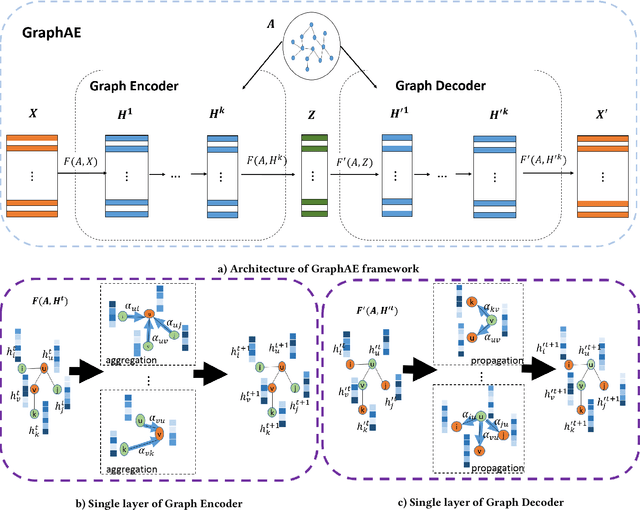
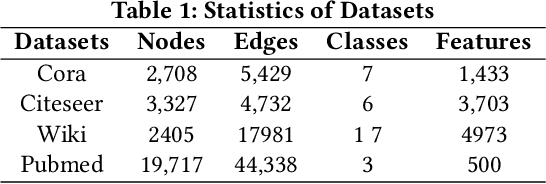
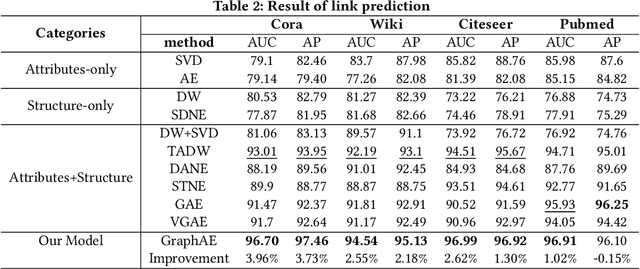
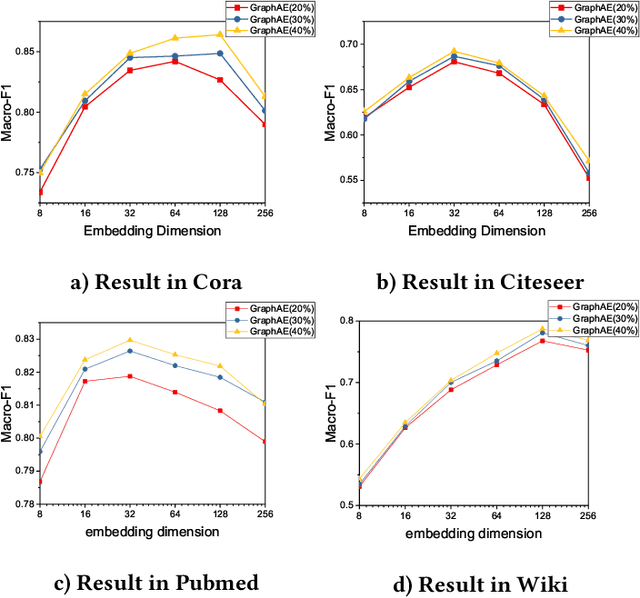
Attributed network embedding aims to learn low-dimensional node representations from both network structure and node attributes. Existing methods can be categorized into two groups: (1) the first group learns two separated node representations from network structure and node attribute respectively and concatenating them together; (2) the other group obtains node representations by translating node attributes into network structure or vice versa. However, both groups have their drawbacks. The first group neglects the correlation between these two types of information, while the second group assumes strong dependence between network structure and node attributes. In this paper, we address attributed network embedding from a novel perspective, i.e., learning representation of a target node via modeling its attributed local subgraph. To achieve this goal, we propose a novel graph auto-encoder framework, namely GraphAE. For a target node, GraphAE first aggregates the attribute information from its attributed local subgrah, obtaining its low-dimensional representation. Next, GraphAE diffuses its representation to nodes in its local subgraph to reconstruct their attribute information. Our proposed perspective transfroms the problem of learning node representations into the problem of modeling the context information manifested in both network structure and node attributes, thus having high capacity to learn good node representations for attributed network. Extensive experimental results on real-world datasets demonstrate that the proposed framework outperforms the state-of-the-art network approaches at the tasks of link prediction and node classification.