 Add to Chrome
 Add to Firefox
 Add to Edge
PBE-UNet: A light weight Progressive Boundary-Enhanced U-Net with Scale-Aware Aggregation for Ultrasound Image Segmentation
Apr 15, 2026
Accurate lesion segmentation in ultrasound images is essential for preventive screening and clinical diagnosis, yet remains challenging due to low contrast, blurry boundaries, and significant scale variations. Although existing deep learning-based methods have achieved remarkable performance, these methods still struggle with scale variations and indistinct tumor boundaries. To address these challenges, we propose a progressive boundary enhanced U-Net (PBE-UNet). Specially, we first introduce a scale-aware aggregation module (SAAM) that dynamically adjusts its receptive field to capture robust multi-scale contextual information. Then, we propose a boundary-guided feature enhancement (BGFE) module to enhance the feature representations. We find that there are large gaps between the narrow boundary and the wide segmentation error areas. Unlike existing methods that treat boundaries as static masks, the BGFE module progressively expands the narrow boundary prediction into broader spatial attention maps. Thus, broader spatial attention maps could effectively cover the wider segmentation error regions and enhance the model's focus on these challenging areas. We conduct expensive experiments on four benchmark ultrasound datasets, BUSI, Dataset B, TN3K, and BP. The experimental results how that our proposed PBE-UNet outperforms state-of-the-art ultrasound image segmentation methods. The code is at https://github.com/cruelMouth/PBE-UNet.

Scaling Video Pretraining for Surgical Foundation Models
Apr 02, 2026Surgical video understanding is essential for computer-assisted interventions, yet existing surgical foundation models remain constrained by limited data scale, procedural diversity, and inconsistent evaluation, often lacking a reproducible training pipeline. We propose SurgRec, a scalable and reproducible pretraining recipe for surgical video understanding, instantiated with two variants: SurgRec-MAE and SurgRec-JEPA. We curate a large multi-source corpus of 10,535 videos and 214.5M frames spanning endoscopy, laparoscopy, cataract, and robotic surgery. Building on this corpus, we develop a unified pretraining pipeline with balanced sampling and standardize a reproducible benchmark across 16 downstream datasets and four clinical domains with consistent data splits. Across extensive comparisons against SSL baselines and vision-language models, SurgRec consistently achieves superior performance across downstream datasets. In contrast, VLMs prove unreliable for fine-grained temporal recognition, exhibiting both performance gaps and sensitivity to prompt phrasing. Our work provides a reproducible, scalable foundation for the community to build more general surgical video models. All code, models, and data will be publicly released.
A Novel Hybrid Parameter-Efficient Fine-Tuning Approach for Hippocampus Segmentation and Alzheimer's Disease Diagnosis
Sep 02, 2024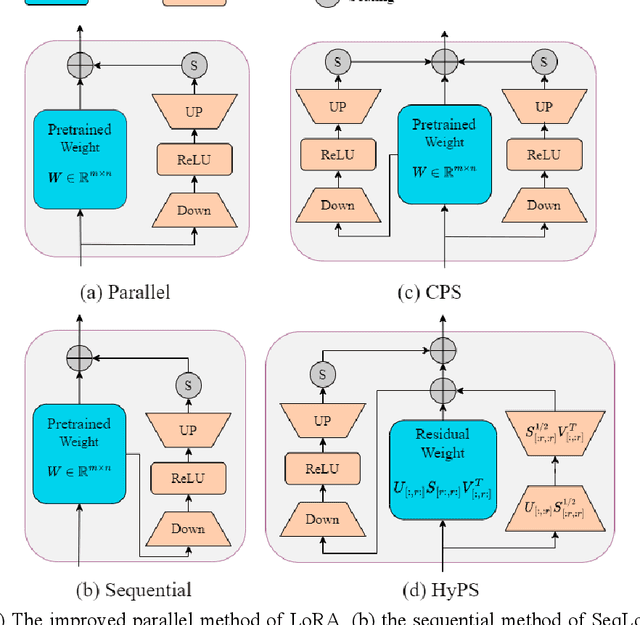
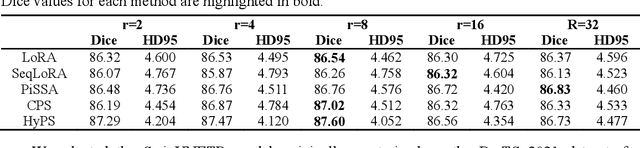
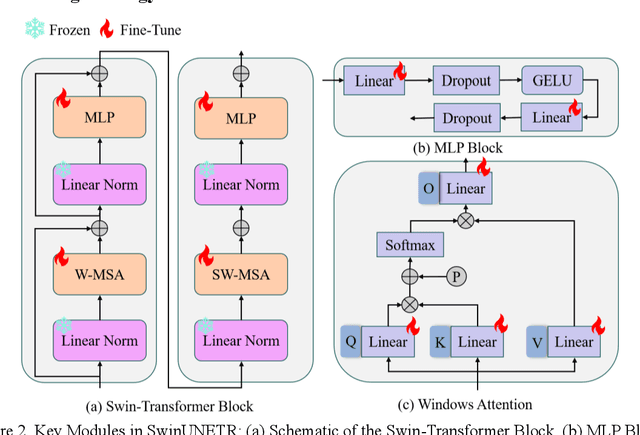
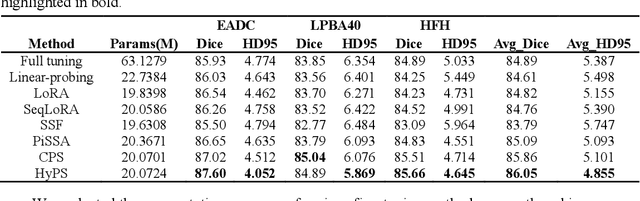
Deep learning methods have significantly advanced medical image segmentation, yet their success hinges on large volumes of manually annotated data, which require specialized expertise for accurate labeling. Additionally, these methods often demand substantial computational resources, particularly for three-dimensional medical imaging tasks. Consequently, applying deep learning techniques for medical image segmentation with limited annotated data and computational resources remains a critical challenge. In this paper, we propose a novel parameter-efficient fine-tuning strategy, termed HyPS, which employs a hybrid parallel and serial architecture. HyPS updates a minimal subset of model parameters, thereby retaining the pre-trained model's original knowledge tructure while enhancing its ability to learn specific features relevant to downstream tasks. We apply this strategy to the state-of-the-art SwinUNETR model for medical image segmentation. Initially, the model is pre-trained on the BraTs2021 dataset, after which the HyPS method is employed to transfer it to three distinct hippocampus datasets.Extensive experiments demonstrate that HyPS outperforms baseline methods, especially in scenarios with limited training samples. Furthermore, based on the segmentation results, we calculated the hippocampal volumes of subjects from the ADNI dataset and combined these with metadata to classify disease types. In distinguishing Alzheimer's disease (AD) from cognitively normal (CN) individuals, as well as early mild cognitive impairment (EMCI) from late mild cognitive impairment (LMCI), HyPS achieved classification accuracies of 83.78% and 64.29%, respectively. These findings indicate that the HyPS method not only facilitates effective hippocampal segmentation using pre-trained models but also holds potential for aiding Alzheimer's disease detection. Our code is publicly available.