 Add to Chrome
 Add to Firefox
 Add to Edge
ImputeECG: Deep Learning Reconstruction of Complete 12-Lead Electrocardiograms from Incomplete Recordings for Cardiac Assessment
Jul 06, 2026
Complete digital 12-lead electrocardiograms (ECGs) are essential for AI-enabled cardiovascular assessment, yet many clinical ECG records, particularly those digitized from ECG images, remain incomplete because of short display formats, incomplete waveform digitization, lead loss, or signal corruption. We developed ImputeECG, a mask-conditioned one-dimensional Transformer autoencoder that completes 12-lead, 10-s ECGs while retaining all observed samples. The model was trained on PTB-XL and evaluated on PTB-XL and CPSC2018 under simulated incomplete settings, with additional real-world validation in a 43,633-record Kailuan clinical cohort after ECG image digitization. Metrics were computed over originally missing regions, with analyses of morphology and downstream diagnostic utility. On PTB-XL, ImputeECG reduced missing-region MAE by 41.7-51.0% and MSE by 54.0-63.7% versus the strongest baseline, with lower errors in R-peak timing, RR interval, QRS duration, QT interval, and P-wave, QRS-complex, and T-wave reconstruction. On CPSC2018, ImputeECG reduced MAE by 49.7-51.9%, supporting external generalization. In downstream multi-label classification, ImputeECG restored performance to 92.28% AUROC and 33.88% AUPRC in the most incomplete PTB-XL setting, approaching complete-ECG performance. On CPSC2018, completed ECGs achieved 94.75-95.89% AUROC and 78.83-81.86% AUPRC across settings. In Kailuan, ECG completion improved zero-shot sex prediction AUROC from 82.6% to 85.8% and reduced age prediction MAE from 10.72 to 9.87 years after image-based ECG digitization. These findings support ECG completion as a practical strategy for converting incomplete ECG records into AI-ready 12-lead, 10-s digital signals and extending the usable scope of ECG archives for digital cardiac assessment.

CAP: Towards PPG Universal Representation Learning with Patient-level Supervision
Jun 13, 2026Photoplethysmography (PPG) plays a central role in wearable health monitoring and clinical decision support. Yet existing approaches to universal PPG representation learning largely focus on signal-level objectives and often overlook patient-level health context, which limits generalization to complex clinical tasks and heterogeneous cohorts. To address this gap, we construct a large-scale paired PPG-EHR multimodal dataset by distilling fragmented medical histories and clinical records into cohesive, patient-level electronic health records (EHR). Building on this resource, we propose Clinical Anchored Pretraining for PPG (CAP). During pretraining, CAP performs cross-modal contrastive alignment that anchors PPG representations to patient-level clinical semantics, guiding the encoder beyond waveform fitting toward modeling consistency in a patient's overall physiological state. During downstream adaptation, the pretrained PPG encoder provides clinically grounded representations that strengthen inductive bias and improve robustness and transferability. Experiments demonstrate that CAP consistently outperforms strong baselines on four diverse downstream tasks. CAP achieves a particularly large gain on respiratory rate prediction (up to +87.6% relative improvement over the state-of-the-art baseline) and delivers an average relative +26.7% across all tasks. We further enhance the interpretability of our approach through comprehensive analyses, including ablations and multiple complementary visualizations of the learned representations. The code for our experiments is available at: https://github.com/gody123gody/CAP .
Wearable Single-Lead ECG Detects Fine-Grained Structural Heart Disease Through Echo-Report Supervision
Jun 08, 2026Structural heart disease (SHD) is a primary driver of heart failure and cardiovascular mortality, yet early detection remains constrained by the limited accessibility of echocardiography. While single-lead electrocardiogram (ECG) is ubiquitous through wearables, existing AI screening models often depend on 12-lead inputs, generalize poorly across institutions, or require massive, condition-specific labeled datasets. Recent work has demonstrated the feasibility of contrastive pre-training between single-lead ECGs and echocardiography reports within a single health system. Here, we present AnyECG-Echo, a framework that advance this paradigm toward clinical translation through three key developments: (1) evaluation in a geographically independent external cohort (n = 16,621); (2) diagnostic coverage of 13 fine-grained SHD subtypes spanning myocardial, chamber, valvular, and great-vessel pathologies; and (3) dual-axis mechanistic interpretability combining electrophysiology-grounded Shapley attribution with emergent correlations to quantitative measurements. Across validation cohorts totaling n = 25,222, the model demonstrated high AUROC for high-impact subtypes, including reduced left ventricular systolic function (AUROC 0.866-0.924), global heart enlargement (0.877-0.931), and mitral stenosis (0.836-0.906). Furthermore, we successfully validated the alignment of model outputs with established medical physiological traits, thereby enhancing interpretability. Notably, we discovered that AnyECG-Echo's outputs function as physiologically grounded digital biomarkers that accurately track objective metrics such as LVEF and myocardial wall thickness. These findings prove that wearable single-lead ECGs can effectively detect fine-grained structural heart disease, offering a practical solution for population-scale screening.
Artificial intelligence-enabled single-lead ECG for non-invasive hyperkalemia detection: development, multicenter validation, and proof-of-concept deployment
Mar 17, 2026Hyperkalemia is a life-threatening electrolyte disorder that is common in patients with chronic kidney disease and heart failure, yet frequent monitoring remains difficult outside hospital settings. We developed and validated Pocket-K, a single-lead AI-ECG system initialized from the ECGFounder foundation model for non-invasive hyperkalemia screening and handheld deployment. In this multicentre observational study using routinely collected clinical ECG and laboratory data, 34,439 patients contributed 62,290 ECG--potassium pairs. Lead I data were used to fine-tune the model. Data from Peking University People's Hospital were divided into development and temporal validation sets, and data from The Second Hospital of Tianjin Medical University served as an independent external validation set. Hyperkalemia was defined as venous serum potassium > 5.5 mmol/L. Pocket-K achieved AUROCs of 0.936 in internal testing, 0.858 in temporal validation, and 0.808 in external validation. For KDIGO-defined moderate-to-severe hyperkalemia (serum potassium >= 6.0 mmol/L), AUROCs increased to 0.940 and 0.861 in the temporal and external sets, respectively. External negative predictive value exceeded 99.3%. Model-predicted high risk below the hyperkalemia threshold was more common in patients with chronic kidney disease and heart failure. A handheld prototype enabled near-real-time inference, supporting future prospective evaluation in native handheld and wearable settings.
ECGFlowCMR: Pretraining with ECG-Generated Cine CMR Improves Cardiac Disease Classification and Phenotype Prediction
Jan 28, 2026Cardiac Magnetic Resonance (CMR) imaging provides a comprehensive assessment of cardiac structure and function but remains constrained by high acquisition costs and reliance on expert annotations, limiting the availability of large-scale labeled datasets. In contrast, electrocardiograms (ECGs) are inexpensive, widely accessible, and offer a promising modality for conditioning the generative synthesis of cine CMR. To this end, we propose ECGFlowCMR, a novel ECG-to-CMR generative framework that integrates a Phase-Aware Masked Autoencoder (PA-MAE) and an Anatomy-Motion Disentangled Flow (AMDF) to address two fundamental challenges: (1) the cross-modal temporal mismatch between multi-beat ECG recordings and single-cycle CMR sequences, and (2) the anatomical observability gap due to the limited structural information inherent in ECGs. Extensive experiments on the UK Biobank and a proprietary clinical dataset demonstrate that ECGFlowCMR can generate realistic cine CMR sequences from ECG inputs, enabling scalable pretraining and improving performance on downstream cardiac disease classification and phenotype prediction tasks.
Contrastive Learning with Spectrum Information Augmentation in Abnormal Sound Detection
Sep 19, 2025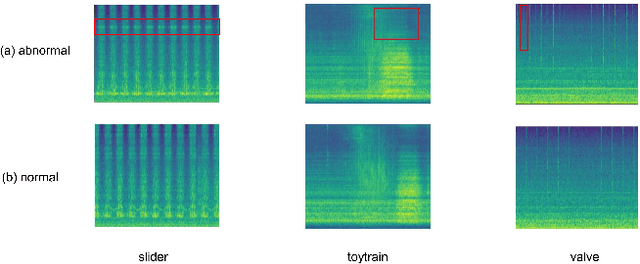

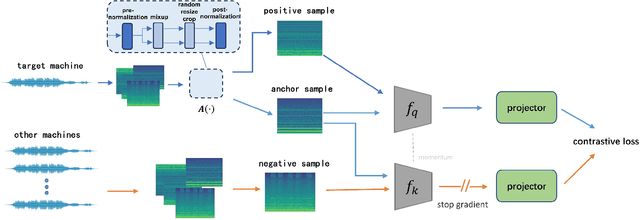

The outlier exposure method is an effective approach to address the unsupervised anomaly sound detection problem. The key focus of this method is how to make the model learn the distribution space of normal data. Based on biological perception and data analysis, it is found that anomalous audio and noise often have higher frequencies. Therefore, we propose a data augmentation method for high-frequency information in contrastive learning. This enables the model to pay more attention to the low-frequency information of the audio, which represents the normal operational mode of the machine. We evaluated the proposed method on the DCASE 2020 Task 2. The results showed that our method outperformed other contrastive learning methods used on this dataset. We also evaluated the generalizability of our method on the DCASE 2022 Task 2 dataset.
Noise Supervised Contrastive Learning and Feature-Perturbed for Anomalous Sound Detection
Sep 18, 2025Unsupervised anomalous sound detection aims to detect unknown anomalous sounds by training a model using only normal audio data. Despite advancements in self-supervised methods, the issue of frequent false alarms when handling samples of the same type from different machines remains unresolved. This paper introduces a novel training technique called one-stage supervised contrastive learning (OS-SCL), which significantly addresses this problem by perturbing features in the embedding space and employing a one-stage noisy supervised contrastive learning approach. On the DCASE 2020 Challenge Task 2, it achieved 94.64\% AUC, 88.42\% pAUC, and 89.24\% mAUC using only Log-Mel features. Additionally, a time-frequency feature named TFgram is proposed, which is extracted from raw audio. This feature effectively captures critical information for anomalous sound detection, ultimately achieving 95.71\% AUC, 90.23\% pAUC, and 91.23\% mAUC. The source code is available at: \underline{www.github.com/huangswt/OS-SCL}.