 Add to Chrome
 Add to Firefox
 Add to Edge
Text Simplification of College Admissions Instructions: A Professionally Simplified and Verified Corpus
Sep 09, 2022
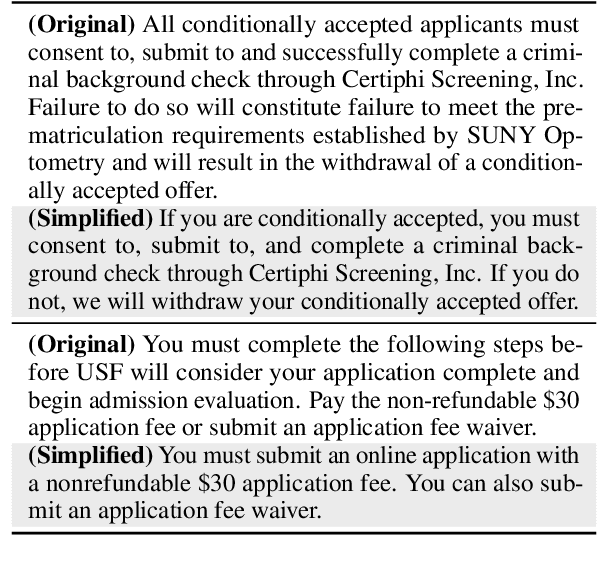
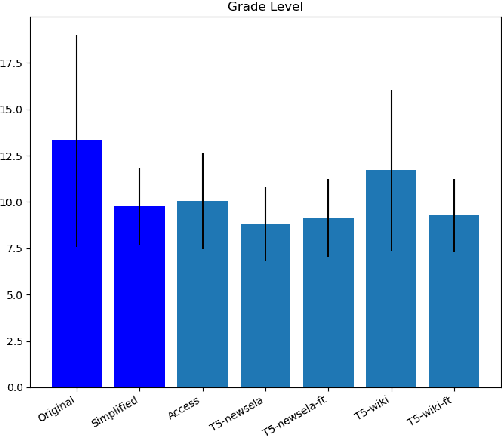
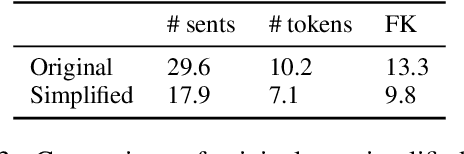
Access to higher education is critical for minority populations and emergent bilingual students. However, the language used by higher education institutions to communicate with prospective students is often too complex; concretely, many institutions in the US publish admissions application instructions far above the average reading level of a typical high school graduate, often near the 13th or 14th grade level. This leads to an unnecessary barrier between students and access to higher education. This work aims to tackle this challenge via text simplification. We present PSAT (Professionally Simplified Admissions Texts), a dataset with 112 admissions instructions randomly selected from higher education institutions across the US. These texts are then professionally simplified, and verified and accepted by subject-matter experts who are full-time employees in admissions offices at various institutions. Additionally, PSAT comes with manual alignments of 1,883 original-simplified sentence pairs. The result is a first-of-its-kind corpus for the evaluation and fine-tuning of text simplification systems in a high-stakes genre distinct from existing simplification resources.

CoditT5: Pretraining for Source Code and Natural Language Editing
Aug 10, 2022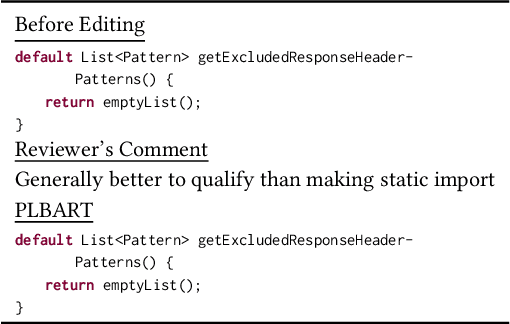
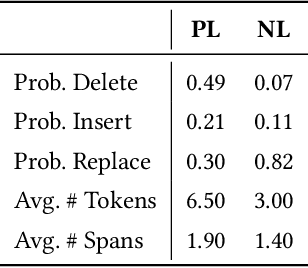
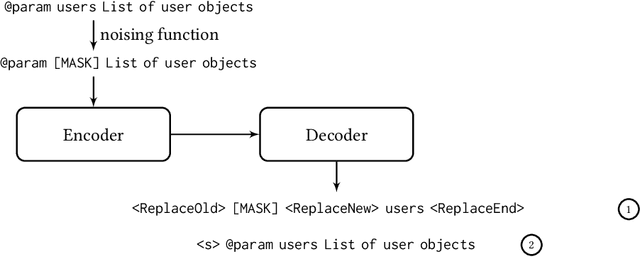
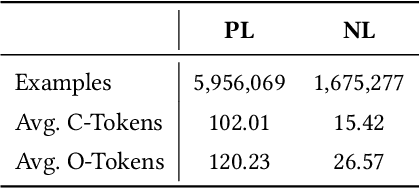
Pretrained language models have been shown to be effective in many software-related generation tasks; however, they are not well-suited for editing tasks as they are not designed to reason about edits. To address this, we propose a novel pretraining objective which explicitly models edits and use it to build CoditT5, a large language model for software-related editing tasks that is pretrained on large amounts of source code and natural language comments. We fine-tune it on various downstream editing tasks, including comment updating, bug fixing, and automated code review. By outperforming pure generation-based models, we demonstrate the generalizability of our approach and its suitability for editing tasks. We also show how a pure generation model and our edit-based model can complement one another through simple reranking strategies, with which we achieve state-of-the-art performance for the three downstream editing tasks.
longhorns at DADC 2022: How many linguists does it take to fool a Question Answering model? A systematic approach to adversarial attacks
Jun 29, 2022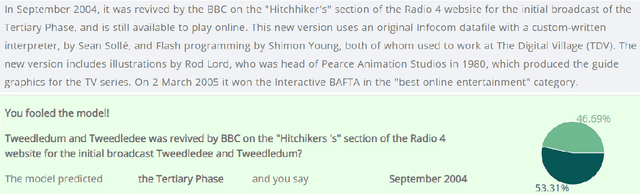
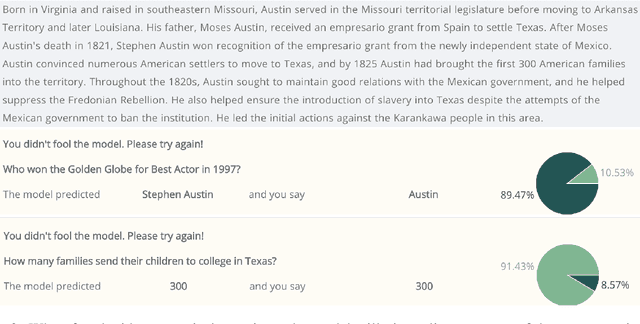
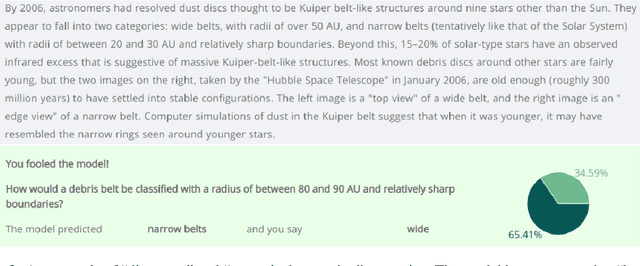
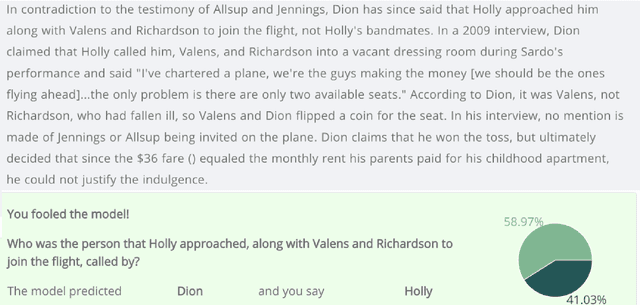
Developing methods to adversarially challenge NLP systems is a promising avenue for improving both model performance and interpretability. Here, we describe the approach of the team "longhorns" on Task 1 of the The First Workshop on Dynamic Adversarial Data Collection (DADC), which asked teams to manually fool a model on an Extractive Question Answering task. Our team finished first, with a model error rate of 62%. We advocate for a systematic, linguistically informed approach to formulating adversarial questions, and we describe the results of our pilot experiments, as well as our official submission.
SNaC: Coherence Error Detection for Narrative Summarization
May 19, 2022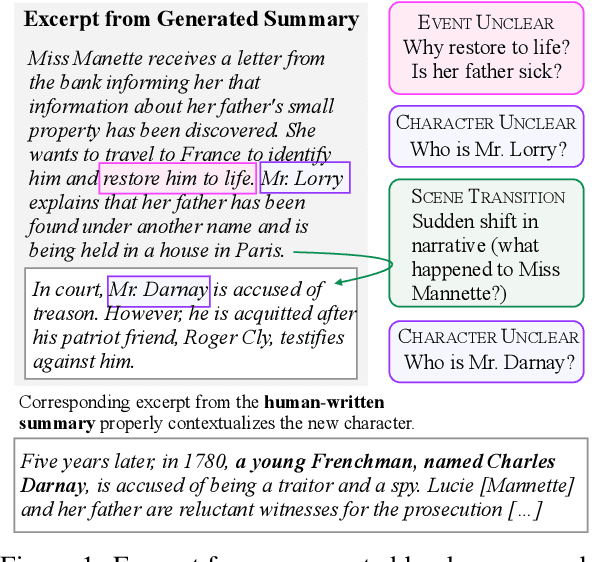
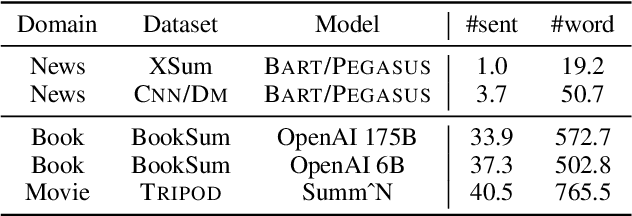
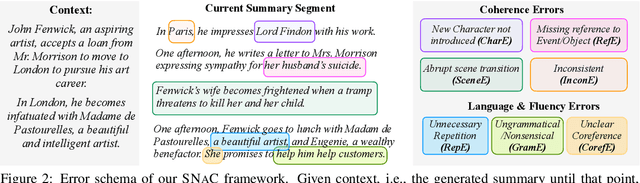
Progress in summarizing long texts is inhibited by the lack of appropriate evaluation frameworks. When a long summary must be produced to appropriately cover the facets of that text, that summary needs to present a coherent narrative to be understandable by a reader, but current automatic and human evaluation methods fail to identify gaps in coherence. In this work, we introduce SNaC, a narrative coherence evaluation framework rooted in fine-grained annotations for long summaries. We develop a taxonomy of coherence errors in generated narrative summaries and collect span-level annotations for 6.6k sentences across 150 book and movie screenplay summaries. Our work provides the first characterization of coherence errors generated by state-of-the-art summarization models and a protocol for eliciting coherence judgments from crowd annotators. Furthermore, we show that the collected annotations allow us to train a strong classifier for automatically localizing coherence errors in generated summaries as well as benchmarking past work in coherence modeling. Finally, our SNaC framework can support future work in long document summarization and coherence evaluation, including improved summarization modeling and post-hoc summary correction.
Evaluating Factuality in Text Simplification
Apr 15, 2022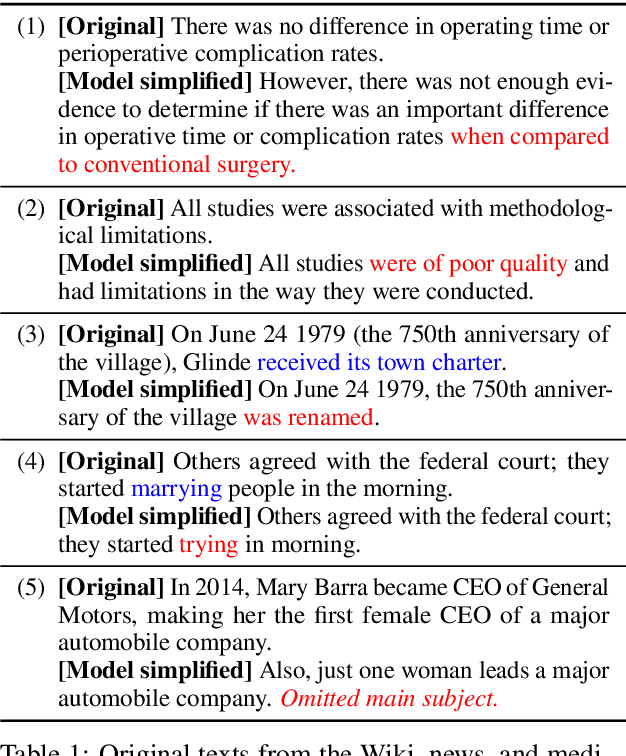

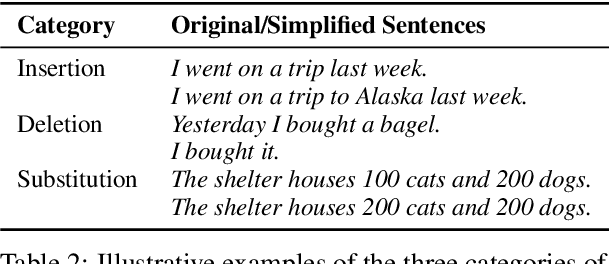
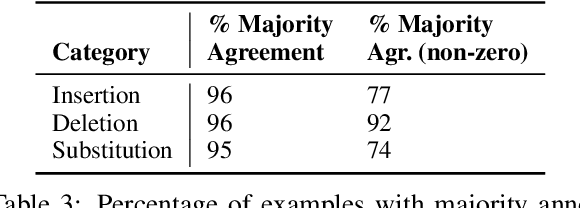
Automated simplification models aim to make input texts more readable. Such methods have the potential to make complex information accessible to a wider audience, e.g., providing access to recent medical literature which might otherwise be impenetrable for a lay reader. However, such models risk introducing errors into automatically simplified texts, for instance by inserting statements unsupported by the corresponding original text, or by omitting key information. Providing more readable but inaccurate versions of texts may in many cases be worse than providing no such access at all. The problem of factual accuracy (and the lack thereof) has received heightened attention in the context of summarization models, but the factuality of automatically simplified texts has not been investigated. We introduce a taxonomy of errors that we use to analyze both references drawn from standard simplification datasets and state-of-the-art model outputs. We find that errors often appear in both that are not captured by existing evaluation metrics, motivating a need for research into ensuring the factual accuracy of automated simplification models.
ProtoTEx: Explaining Model Decisions with Prototype Tensors
Apr 11, 2022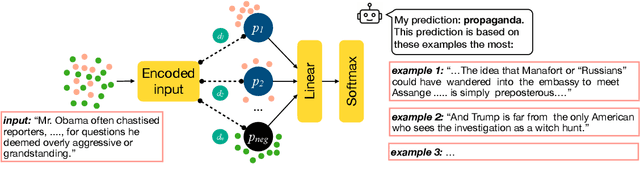
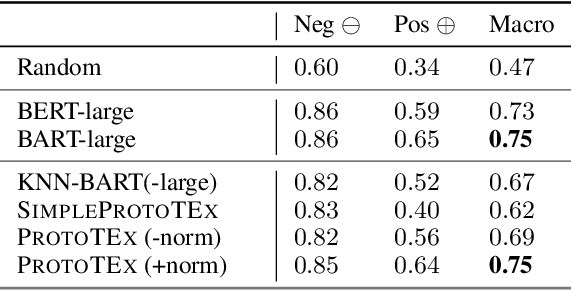
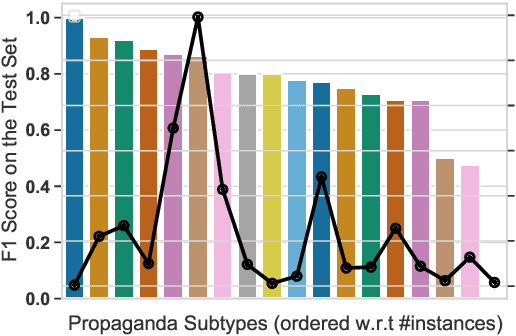
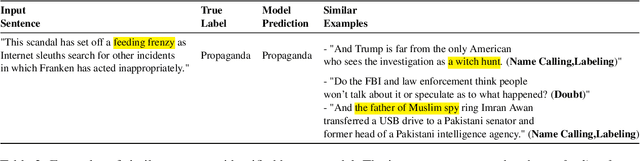
We present ProtoTEx, a novel white-box NLP classification architecture based on prototype networks. ProtoTEx faithfully explains model decisions based on prototype tensors that encode latent clusters of training examples. At inference time, classification decisions are based on the distances between the input text and the prototype tensors, explained via the training examples most similar to the most influential prototypes. We also describe a novel interleaved training algorithm that effectively handles classes characterized by the absence of indicative features. On a propaganda detection task, ProtoTEx accuracy matches BART-large and exceeds BERT-large with the added benefit of providing faithful explanations. A user study also shows that prototype-based explanations help non-experts to better recognize propaganda in online news.
How Do We Answer Complex Questions: Discourse Structure of Long-form Answers
Mar 21, 2022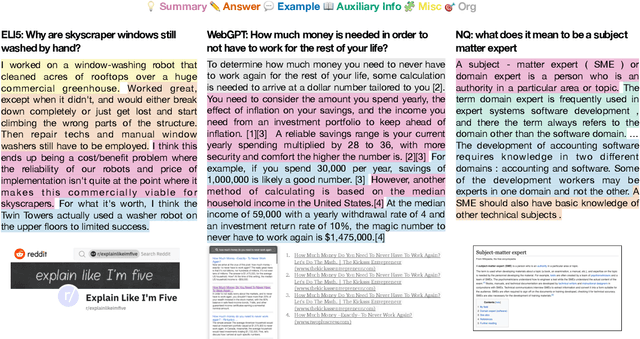
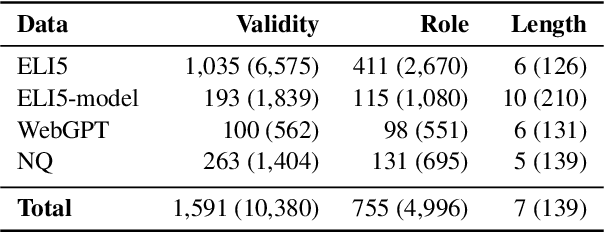
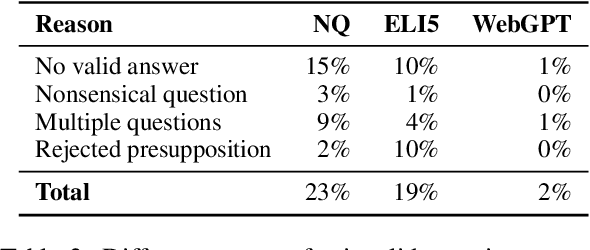
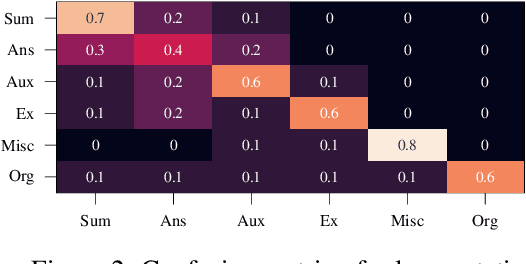
Long-form answers, consisting of multiple sentences, can provide nuanced and comprehensive answers to a broader set of questions. To better understand this complex and understudied task, we study the functional structure of long-form answers collected from three datasets, ELI5, WebGPT and Natural Questions. Our main goal is to understand how humans organize information to craft complex answers. We develop an ontology of six sentence-level functional roles for long-form answers, and annotate 3.9k sentences in 640 answer paragraphs. Different answer collection methods manifest in different discourse structures. We further analyze model-generated answers -- finding that annotators agree less with each other when annotating model-generated answers compared to annotating human-written answers. Our annotated data enables training a strong classifier that can be used for automatic analysis. We hope our work can inspire future research on discourse-level modeling and evaluation of long-form QA systems.
Discourse Comprehension: A Question Answering Framework to Represent Sentence Connections
Nov 01, 2021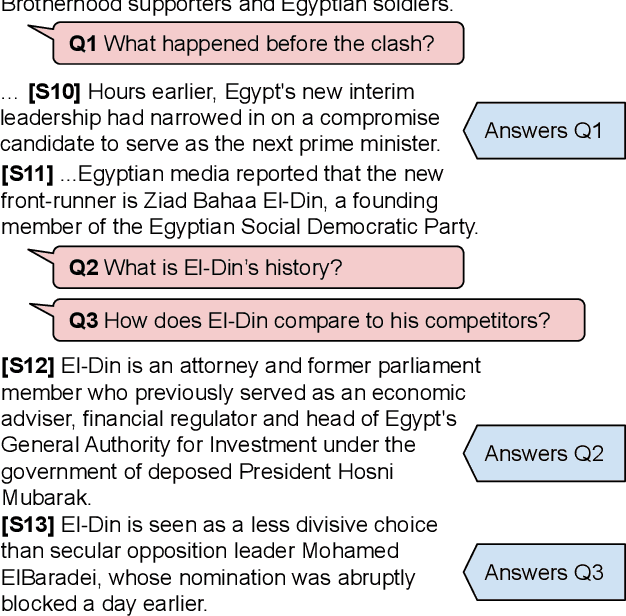
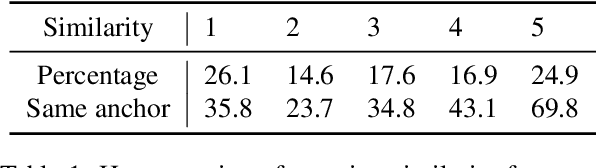
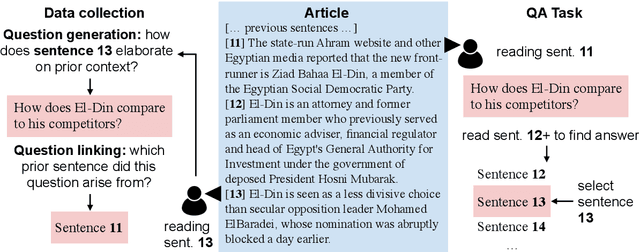
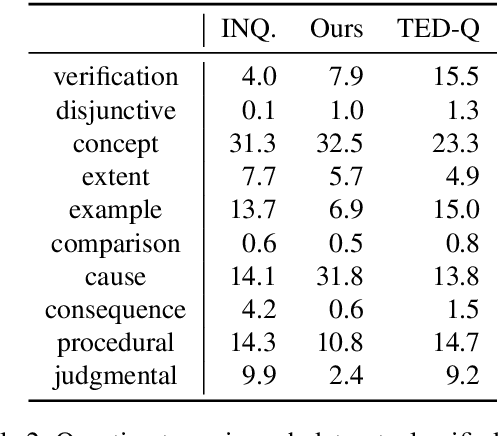
While there has been substantial progress in text comprehension through simple factoid question answering, more holistic comprehension of a discourse still presents a major challenge. Someone critically reflecting on a text as they read it will pose curiosity-driven, often open-ended questions, which reflect deep understanding of the content and require complex reasoning to answer. A key challenge in building and evaluating models for this type of discourse comprehension is the lack of annotated data, especially since finding answers to such questions (which may not be answered at all) requires high cognitive load for annotators over long documents. This paper presents a novel paradigm that enables scalable data collection targeting the comprehension of news documents, viewing these questions through the lens of discourse. The resulting corpus, DCQA (Discourse Comprehension by Question Answering), consists of 22,430 question-answer pairs across 607 English documents. DCQA captures both discourse and semantic links between sentences in the form of free-form, open-ended questions. On an evaluation set that we annotated on questions from the INQUISITIVE dataset, we show that DCQA provides valuable supervision for answering open-ended questions. We additionally design pre-training methods utilizing existing question-answering resources, and use synthetic data to accommodate unanswerable questions.
Training Dynamics for Text Summarization Models
Oct 15, 2021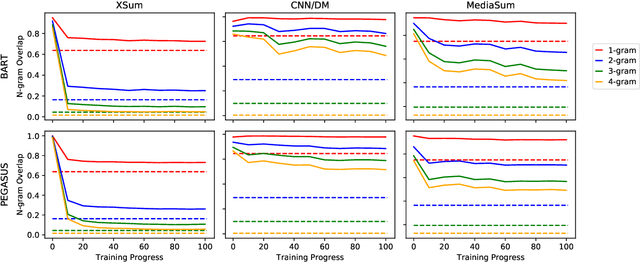
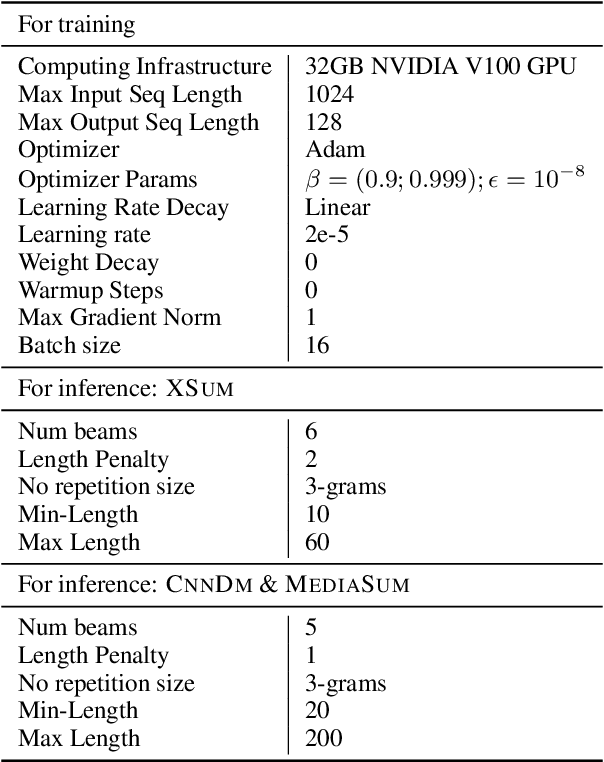
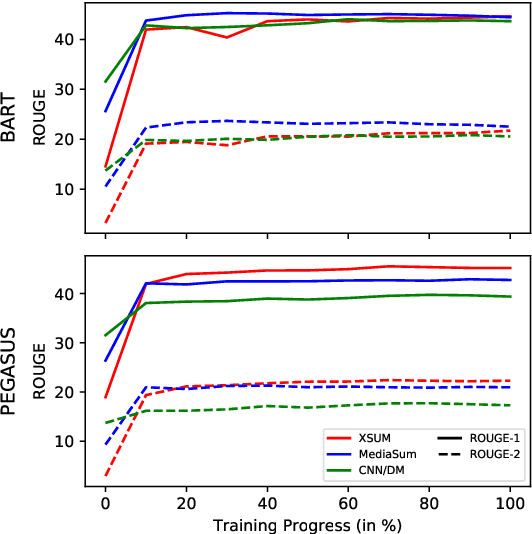
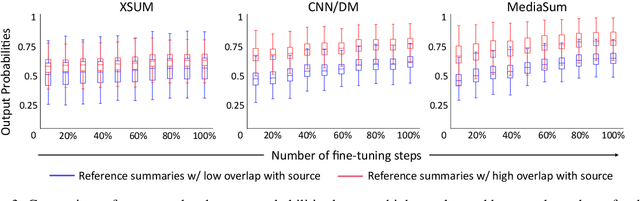
Pre-trained language models (e.g. BART) have shown impressive results when fine-tuned on large summarization datasets. However, little is understood about this fine-tuning process, including what knowledge is retained from pre-training models or how content selection and generation strategies are learnt across iterations. In this work, we analyze the training dynamics for generation models, focusing on news summarization. Across different datasets (CNN/DM, XSum, MediaSum) and summary properties, such as abstractiveness and hallucination, we study what the model learns at different stages of its fine-tuning process. We find that properties such as copy behavior are learnt earlier in the training process and these observations are robust across domains. On the other hand, factual errors, such as hallucination of unsupported facts, are learnt in the later stages, and this behavior is more varied across domains. Based on these observations, we explore complementary approaches for modifying training: first, disregarding high-loss tokens that are challenging to learn and second, disregarding low-loss tokens that are learnt very quickly. This simple training modification allows us to configure our model to achieve different goals, such as improving factuality or improving abstractiveness.
AES Systems Are Both Overstable And Oversensitive: Explaining Why And Proposing Defenses
Oct 14, 2021
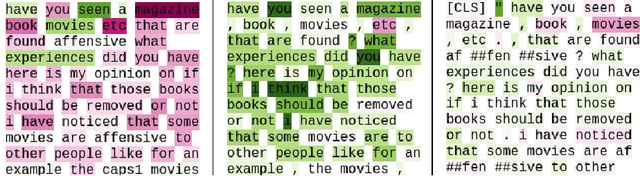
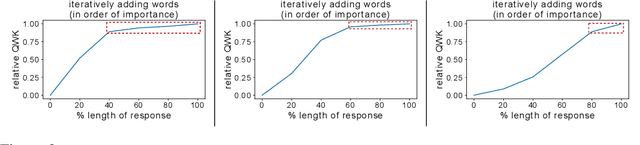
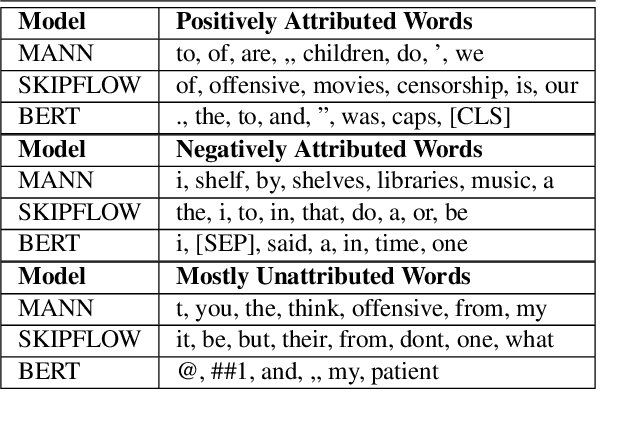
Deep-learning based Automatic Essay Scoring (AES) systems are being actively used by states and language testing agencies alike to evaluate millions of candidates for life-changing decisions ranging from college applications to visa approvals. However, little research has been put to understand and interpret the black-box nature of deep-learning based scoring algorithms. Previous studies indicate that scoring models can be easily fooled. In this paper, we explore the reason behind their surprising adversarial brittleness. We utilize recent advances in interpretability to find the extent to which features such as coherence, content, vocabulary, and relevance are important for automated scoring mechanisms. We use this to investigate the oversensitivity i.e., large change in output score with a little change in input essay content) and overstability i.e., little change in output scores with large changes in input essay content) of AES. Our results indicate that autoscoring models, despite getting trained as "end-to-end" models with rich contextual embeddings such as BERT, behave like bag-of-words models. A few words determine the essay score without the requirement of any context making the model largely overstable. This is in stark contrast to recent probing studies on pre-trained representation learning models, which show that rich linguistic features such as parts-of-speech and morphology are encoded by them. Further, we also find that the models have learnt dataset biases, making them oversensitive. To deal with these issues, we propose detection-based protection models that can detect oversensitivity and overstability causing samples with high accuracies. We find that our proposed models are able to detect unusual attribution patterns and flag adversarial samples successfully.