 Add to Chrome
 Add to Firefox
 Add to Edge
Stochastic Saddle Avoidance Beyond Unit Excitation and Smoothness: A Pathwise Lyapunov-Perron Framework
Aug 06, 2026
Unit excitation (UE) is a common assumption in stochastic saddle avoidance: the stochastic error must have a uniformly positive component along every direction, in expectation. This condition gives a direct way to rule out convergence to strict saddles, but it also oversimplifies the actual noise structure, and does not match many stochastic optimization regimes. In overparameterized or interpolation models, the noise may vanish near stationarity. In finite-sum problems, the stochastic gradient noise may lie in a low-dimensional, data-dependent subspace. In these (common) scenarios, UE is naturally not satisfied. In this paper, we prove an abstract almost sure avoidance theorem for stochastic recursions without UE. The theorem replaces UE-type requirements by verifiable pathwise conditions. In applications, these conditions follow, e.g., from local smoothness and finite-moment assumptions under standard i.i.d. sampling, or from the finite-sum structure under without-replacement sampling. Since the stochastically sampled maps generally do not share a fixed point, the celebrated center-stable manifold argument used in deterministic analyses is not directly applicable. Instead, we use a path-dependent change of variables together with a pathwise Lyapunov--Perron-based proof strategy. As applications, we obtain strict saddle avoidance for stochastic mirror descent (including SGD) and for random reshuffling. For nonsmooth composite objectives, we prove avoidance results for a proximal-type stochastic gradient method. Combining these insights with suitable iterate convergence guarantees, this allows establishing convergence to local minimizers of the original objective function.

FlexiSLM: A Dynamic and Controllable Frame Rate Spoken Language Model
Jun 30, 2026Spoken language models (SLMs) extend LLMs to speech input and output. Existing SLMs represent speech at fixed frame rates (e.g., 25 or 12.5 Hz), ignoring the time-varying information density of speech and offering no flexibility to trade off quality for speed at inference time. Recent audio tokenizer research has proposed dynamic frame rate speech coding, which exploits this non-uniformity and enables two new capabilities: very low average frame rates and frame rate controllability. However, this technique has not yet been applied to SLMs. We introduce Flexible Spoken Language Model (FlexiSLM), the first SLM that supports dynamic and controllable frame rates on both speech input and output. Using dynamic frame rate representations, FlexiSLM outperforms fixed-frame-rate 7B models including Qwen2.5-Omni and Kimi-Audio at its high-quality operating points. We further verify that FlexiSLM can be accurately steered down to 4.0 Hz; at 6.25 Hz, it roughly halves inference time relative to 12.5 Hz while retaining strong speech-to-speech quality. Audio samples are available at https://flexislm.github.io .
Shuffling the Stochastic Mirror Descent via Dual Lipschitz Continuity and Kernel Conditioning
Mar 17, 2026The global Lipschitz smoothness condition underlies most convergence and complexity analyses via two key consequences: the descent lemma and the gradient Lipschitz continuity. How to study the performance of optimization algorithms in the absence of Lipschitz smoothness remains an active area. The relative smoothness framework from Bauschke-Bolte-Teboulle (2017) and Lu-Freund-Nesterov (2018) provides an extended descent lemma, ensuring convergence of Bregman-based proximal gradient methods and their vanilla stochastic counterparts. However, many widely used techniques (e.g., momentum schemes, random reshuffling, and variance reduction) additionally require the Lipschitz-type bound for gradient deviations, leaving their analysis under relative smoothness an open area. To resolve this issue, we introduce the dual kernel conditioning (DKC) regularity condition to regulate the local relative curvature of the kernel functions. Combined with the relative smoothness, DKC provides a dual Lipschitz continuity for gradients: even though the gradient mapping is not Lipschitz in the primal space, it preserves Lipschitz continuity in the dual space induced by a mirror map. We verify that DKC is widely satisfied by popular kernels and is closed under affine composition and conic combination. With these novel tools, we establish the first complexity bounds as well as the iterate convergence of random reshuffling mirror descent for constrained nonconvex relative smooth problems.
A New Kernel Regularity Condition for Distributed Mirror Descent: Broader Coverage and Simpler Analysis
Mar 13, 2026Existing convergence of distributed optimization methods in non-Euclidean geometries typically rely on kernel assumptions: (i) global Lipschitz smoothness and (ii) bi-convexity of the associated Bregman divergence function. Unfortunately, these conditions are violated by nearly all kernels used in practice, leaving a huge theory-practice gap. This work closes this gap by developing a unified analytical tool that guarantees convergence under mild conditions. Specifically, we introduce Hessian relative uniform continuity (HRUC), a regularity satisfied by nearly all standard kernels. Importantly, HRUC is closed under concatenation, positive scaling, composition, and various kernel combinations. Leveraging the geometric structure induced by HRUC, we derive convergence guarantees for mirror descent-based gradient tracking without imposing any restrictive assumptions. More broadly, our analysis techniques extend seamlessly to other decentralized optimization methods in genuinely non-Euclidean and non-Lipschitz settings.
A Generalized Version of Chung's Lemma and its Applications
Jun 09, 2024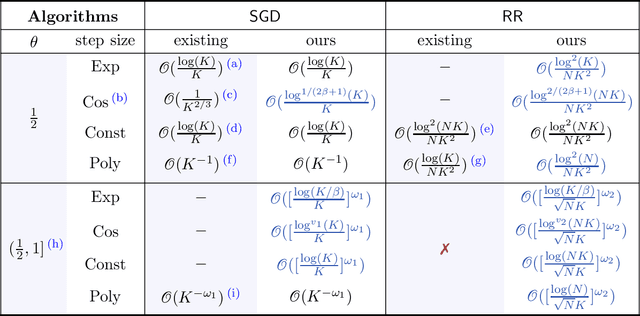
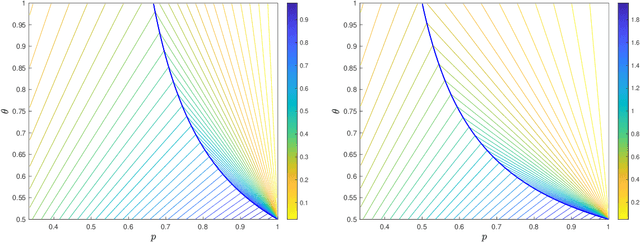
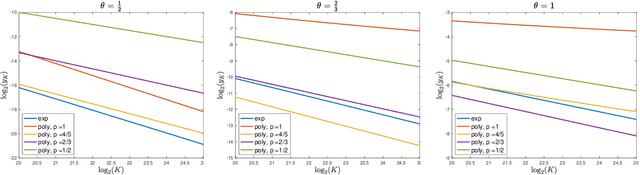
Chung's lemma is a classical tool for establishing asymptotic convergence rates of (stochastic) optimization methods under strong convexity-type assumptions and appropriate polynomial diminishing step sizes. In this work, we develop a generalized version of Chung's lemma, which provides a simple non-asymptotic convergence framework for a more general family of step size rules. We demonstrate broad applicability of the proposed generalized Chung's lemma by deriving tight non-asymptotic convergence rates for a large variety of stochastic methods. In particular, we obtain partially new non-asymptotic complexity results for stochastic optimization methods, such as stochastic gradient descent and random reshuffling, under a general $(\theta,\mu)$-Polyak-Lojasiewicz (PL) condition and for various step sizes strategies, including polynomial, constant, exponential, and cosine step sizes rules. Notably, as a by-product of our analysis, we observe that exponential step sizes can adapt to the objective function's geometry, achieving the optimal convergence rate without requiring exact knowledge of the underlying landscape. Our results demonstrate that the developed variant of Chung's lemma offers a versatile, systematic, and streamlined approach to establish non-asymptotic convergence rates under general step size rules.
A KL-based Analysis Framework with Applications to Non-Descent Optimization Methods
Jun 04, 2024We propose a novel analysis framework for non-descent-type optimization methodologies in nonconvex scenarios based on the Kurdyka-Lojasiewicz property. Our framework allows covering a broad class of algorithms, including those commonly employed in stochastic and distributed optimization. Specifically, it enables the analysis of first-order methods that lack a sufficient descent property and do not require access to full (deterministic) gradient information. We leverage this framework to establish, for the first time, iterate convergence and the corresponding rates for the decentralized gradient method and federated averaging under mild assumptions. Furthermore, based on the new analysis techniques, we show the convergence of the random reshuffling and stochastic gradient descent method without necessitating typical a priori bounded iterates assumptions.
Convergence of SGD with momentum in the nonconvex case: A novel time window-based analysis
May 27, 2024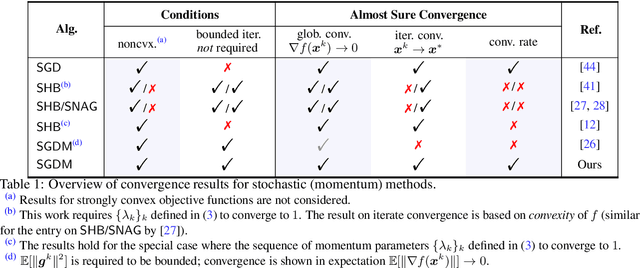

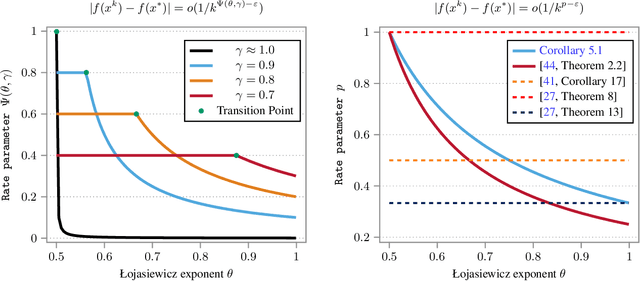
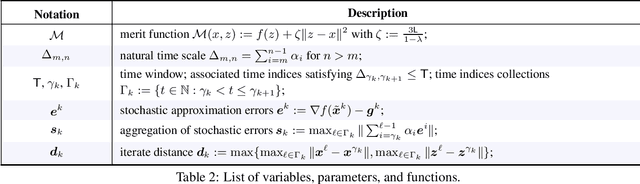
We propose a novel time window-based analysis technique to investigate the convergence behavior of the stochastic gradient descent method with momentum (SGDM) in nonconvex settings. Despite its popularity, the convergence behavior of SGDM remains less understood in nonconvex scenarios. This is primarily due to the absence of a sufficient descent property and challenges in controlling stochastic errors in an almost sure sense. To address these challenges, we study the behavior of SGDM over specific time windows, rather than examining the descent of consecutive iterates as in traditional analyses. This time window-based approach simplifies the convergence analysis and enables us to establish the first iterate convergence result for SGDM under the Kurdyka-Lojasiewicz (KL) property. Based on the underlying KL exponent and the utilized step size scheme, we further characterize local convergence rates of SGDM.
A New Random Reshuffling Method for Nonsmooth Nonconvex Finite-sum Optimization
Dec 02, 2023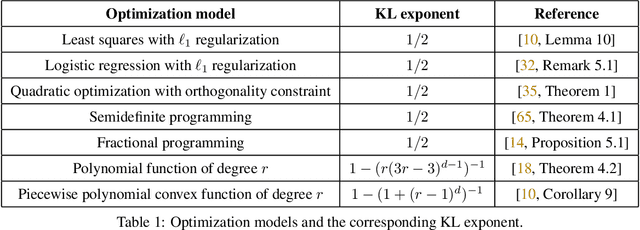
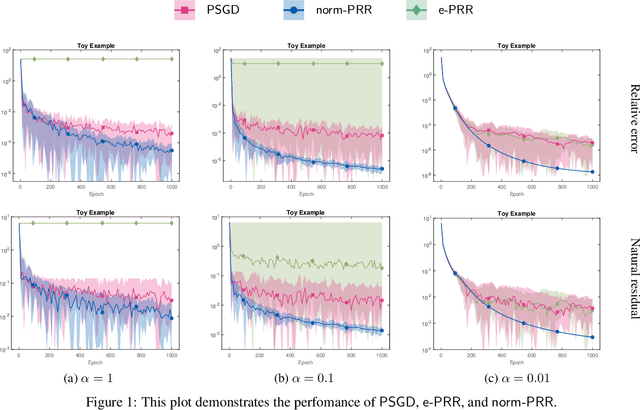
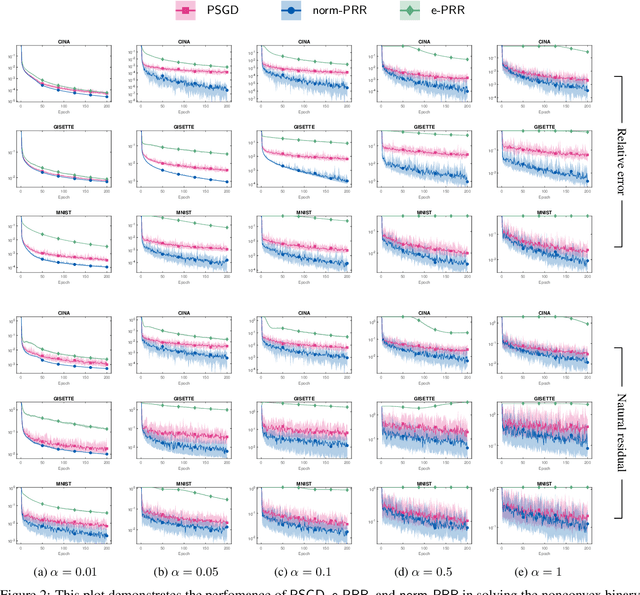
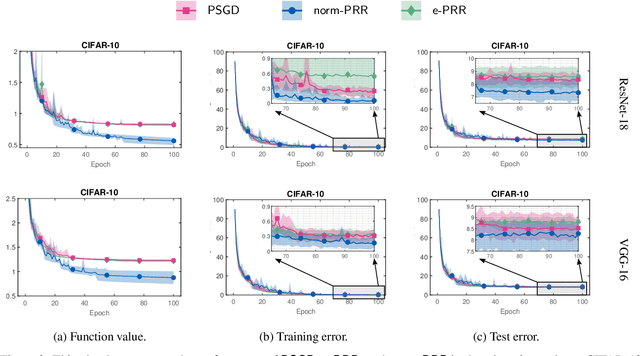
In this work, we propose and study a novel stochastic optimization algorithm, termed the normal map-based proximal random reshuffling (norm-PRR) method, for nonsmooth nonconvex finite-sum problems. Random reshuffling techniques are prevalent and widely utilized in large-scale applications, e.g., in the training of neural networks. While the convergence behavior and advantageous acceleration effects of random reshuffling methods are fairly well understood in the smooth setting, much less seems to be known in the nonsmooth case and only few proximal-type random reshuffling approaches with provable guarantees exist. We establish the iteration complexity ${\cal O}(n^{-1/3}T^{-2/3})$ for norm-PRR, where $n$ is the number of component functions and $T$ counts the total number of iteration. We also provide novel asymptotic convergence results for norm-PRR. Specifically, under the Kurdyka-{\L}ojasiewicz (KL) inequality, we establish strong limit-point convergence, i.e., the iterates generated by norm-PRR converge to a single stationary point. Moreover, we derive last iterate convergence rates of the form ${\cal O}(k^{-p})$; here, $p \in [0, 1]$ depends on the KL exponent $\theta \in [0,1)$ and step size dynamics. Finally, we present preliminary numerical results on machine learning problems that demonstrate the efficiency of the proposed method.
Convergence of a Normal Map-based Prox-SGD Method under the KL Inequality
May 10, 2023In this paper, we present a novel stochastic normal map-based algorithm ($\mathsf{norM}\text{-}\mathsf{SGD}$) for nonconvex composite-type optimization problems and discuss its convergence properties. Using a time window-based strategy, we first analyze the global convergence behavior of $\mathsf{norM}\text{-}\mathsf{SGD}$ and it is shown that every accumulation point of the generated sequence of iterates $\{\boldsymbol{x}^k\}_k$ corresponds to a stationary point almost surely and in an expectation sense. The obtained results hold under standard assumptions and extend the more limited convergence guarantees of the basic proximal stochastic gradient method. In addition, based on the well-known Kurdyka-{\L}ojasiewicz (KL) analysis framework, we provide novel point-wise convergence results for the iterates $\{\boldsymbol{x}^k\}_k$ and derive convergence rates that depend on the underlying KL exponent $\boldsymbol{\theta}$ and the step size dynamics $\{\alpha_k\}_k$. Specifically, for the popular step size scheme $\alpha_k=\mathcal{O}(1/k^\gamma)$, $\gamma \in (\frac23,1]$, (almost sure) rates of the form $\|\boldsymbol{x}^k-\boldsymbol{x}^*\| = \mathcal{O}(1/k^p)$, $p \in (0,\frac12)$, can be established. The obtained rates are faster than related and existing convergence rates for $\mathsf{SGD}$ and improve on the non-asymptotic complexity bounds for $\mathsf{norM}\text{-}\mathsf{SGD}$.
Distributed Random Reshuffling over Networks
Jan 09, 2022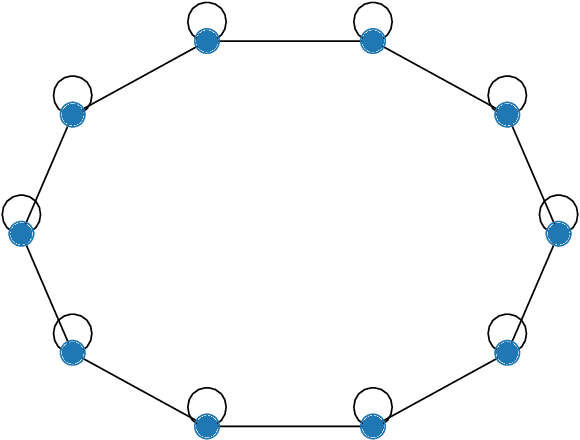
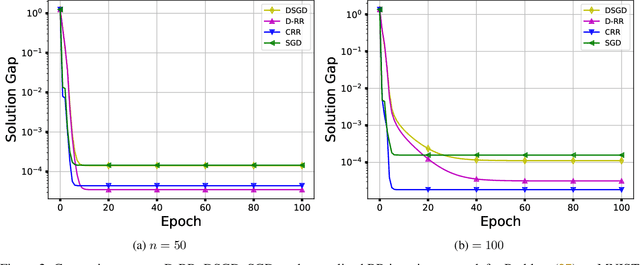
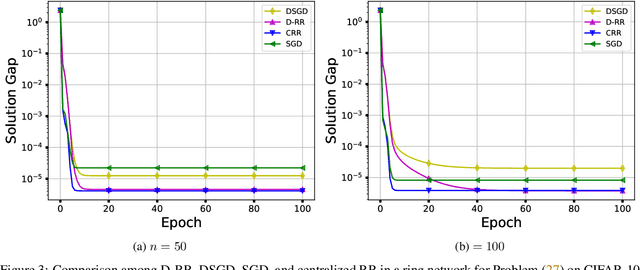
In this paper, we consider the distributed optimization problem where $n$ agents, each possessing a local cost function, collaboratively minimize the average of the local cost functions over a connected network. To solve the problem, we propose a distributed random reshuffling (D-RR) algorithm that combines the classical distributed gradient descent (DGD) method and Random Reshuffling (RR). We show that D-RR inherits the superiority of RR for both smooth strongly convex and smooth nonconvex objective functions. In particular, for smooth strongly convex objective functions, D-RR achieves $\mathcal{O}(1/T^2)$ rate of convergence (here, $T$ counts the total number of iterations) in terms of the squared distance between the iterate and the unique minimizer. When the objective function is assumed to be smooth nonconvex and has Lipschitz continuous component functions, we show that D-RR drives the squared norm of gradient to $0$ at a rate of $\mathcal{O}(1/T^{2/3})$. These convergence results match those of centralized RR (up to constant factors).