 Add to Chrome
 Add to Firefox
 Add to Edge
Stochastic Saddle Avoidance Beyond Unit Excitation and Smoothness: A Pathwise Lyapunov-Perron Framework
Aug 06, 2026
Unit excitation (UE) is a common assumption in stochastic saddle avoidance: the stochastic error must have a uniformly positive component along every direction, in expectation. This condition gives a direct way to rule out convergence to strict saddles, but it also oversimplifies the actual noise structure, and does not match many stochastic optimization regimes. In overparameterized or interpolation models, the noise may vanish near stationarity. In finite-sum problems, the stochastic gradient noise may lie in a low-dimensional, data-dependent subspace. In these (common) scenarios, UE is naturally not satisfied. In this paper, we prove an abstract almost sure avoidance theorem for stochastic recursions without UE. The theorem replaces UE-type requirements by verifiable pathwise conditions. In applications, these conditions follow, e.g., from local smoothness and finite-moment assumptions under standard i.i.d. sampling, or from the finite-sum structure under without-replacement sampling. Since the stochastically sampled maps generally do not share a fixed point, the celebrated center-stable manifold argument used in deterministic analyses is not directly applicable. Instead, we use a path-dependent change of variables together with a pathwise Lyapunov--Perron-based proof strategy. As applications, we obtain strict saddle avoidance for stochastic mirror descent (including SGD) and for random reshuffling. For nonsmooth composite objectives, we prove avoidance results for a proximal-type stochastic gradient method. Combining these insights with suitable iterate convergence guarantees, this allows establishing convergence to local minimizers of the original objective function.

Schattor: Schatten-family methods for deep learning optimization
Jun 14, 2026Modern deep learning optimization features heterogeneous parameter structures, noisy gradients, and highly nonconvex landscapes, posing significant challenges for both algorithm design and theoretical analysis. Motivated by the limitations of SGD and the success of adaptive optimizers, we propose {\it Schattor}, a family of adaptive first-order methods based on Schatten norms. Schattor unifies SGD and the recently proposed matrix-variate adaptive optimizer Muon within a single Schatten-norm-based framework. We establish dimension-free stationarity guarantees for methods in the Schattor family for stochastic matrix optimization problems via a novel matrix martingale moment bound. We also develop multi-block extensions that adaptively balance block-wise optimization progress and prove dimension-free stationarity guarantees in this more general setting.
A KL-based Analysis Framework with Applications to Non-Descent Optimization Methods
Jun 04, 2024We propose a novel analysis framework for non-descent-type optimization methodologies in nonconvex scenarios based on the Kurdyka-Lojasiewicz property. Our framework allows covering a broad class of algorithms, including those commonly employed in stochastic and distributed optimization. Specifically, it enables the analysis of first-order methods that lack a sufficient descent property and do not require access to full (deterministic) gradient information. We leverage this framework to establish, for the first time, iterate convergence and the corresponding rates for the decentralized gradient method and federated averaging under mild assumptions. Furthermore, based on the new analysis techniques, we show the convergence of the random reshuffling and stochastic gradient descent method without necessitating typical a priori bounded iterates assumptions.
Convergence of SGD with momentum in the nonconvex case: A novel time window-based analysis
May 27, 2024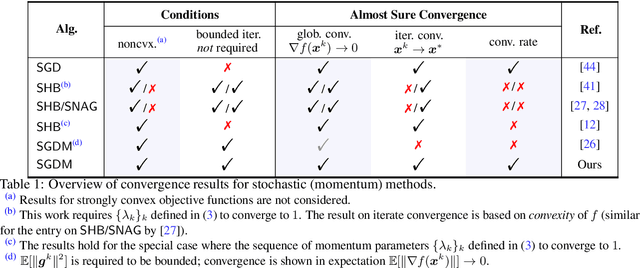

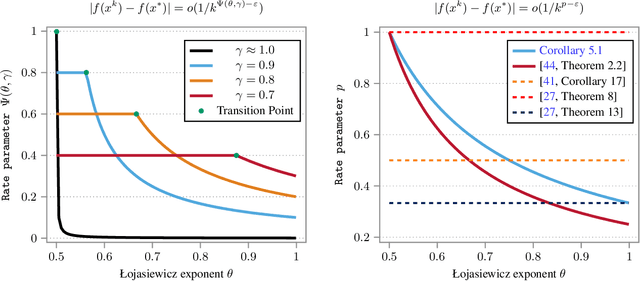
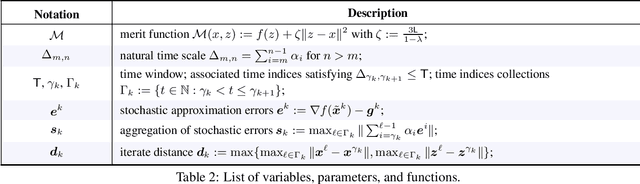
We propose a novel time window-based analysis technique to investigate the convergence behavior of the stochastic gradient descent method with momentum (SGDM) in nonconvex settings. Despite its popularity, the convergence behavior of SGDM remains less understood in nonconvex scenarios. This is primarily due to the absence of a sufficient descent property and challenges in controlling stochastic errors in an almost sure sense. To address these challenges, we study the behavior of SGDM over specific time windows, rather than examining the descent of consecutive iterates as in traditional analyses. This time window-based approach simplifies the convergence analysis and enables us to establish the first iterate convergence result for SGDM under the Kurdyka-Lojasiewicz (KL) property. Based on the underlying KL exponent and the utilized step size scheme, we further characterize local convergence rates of SGDM.