 Add to Chrome
 Add to Firefox
 Add to Edge
CoNav-UAV: Cooperative Dual-Altitude Aerial Navigation via Stackelberg Learning
Aug 03, 2026
Target-oriented vision-and-language navigation (VLN) on aerial platforms is attracting growing attention for missions such as disaster rescue, infrastructure inspection, and security patrol. In this task, an unmanned aerial vehicle (UAV) needs to locate targets given only a concise description of their appearance and surroundings. This requires global exploration and grounding as well as collision-free close-range approach, two interleaved processes difficult to reconcile within a single agent. Most existing methods transfer the ground VLN paradigm to a low-altitude UAV and compensate for its inefficient exploration with external assistance. A recent attempt deploys two UAVs at complementary altitudes yet still relies on privileged information and trains its two agents independently, precluding any mutual adaptation essential for cooperation. Here we propose CoNav-UAV, which explicitly models the task as a Stackelberg game between a high-altitude leader and a low-altitude follower, with the system operating on onboard visual and linguistic inputs alone. To solve this game, we introduce Iterative Stackelberg Learning. The leader's high-level vision-language reasoning is refined via memory-based in-context learning, while the follower's precise motion control is updated via DAgger-style expert distillation. The alternation drives both agents toward a Stackelberg equilibrium. CoNav-UAV consistently outperforms single- and dual-agent baselines across three high-fidelity urban scenes from the AerialVLN benchmark. Success rate improves by up to 30.8 points on the learning scene, and 9.0 points under cross-scene transfer while using about 3x less adaptation data. Further analyses validate the complementary gains of the leader and follower updates and reveal robust gains yet distinct learning dynamics across VLM backbones.

Consensus-Based Dynamic Task Allocation for Multi-Robot System Considering Payloads Consumption
Dec 13, 2024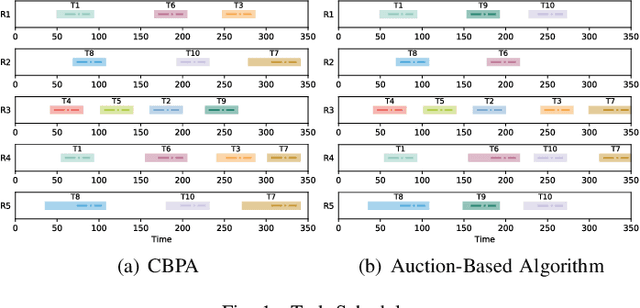
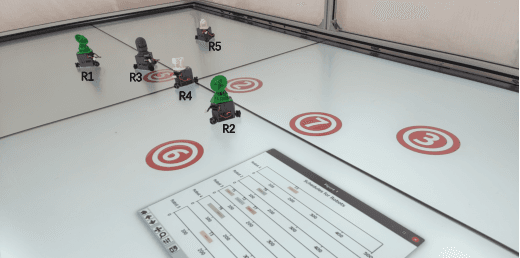
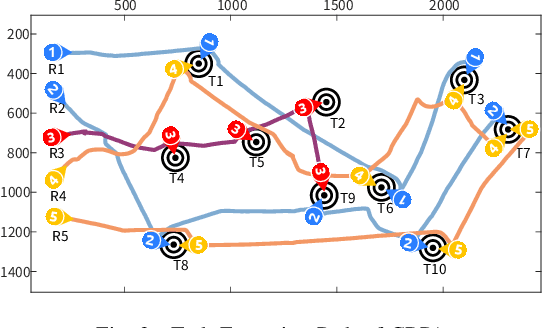
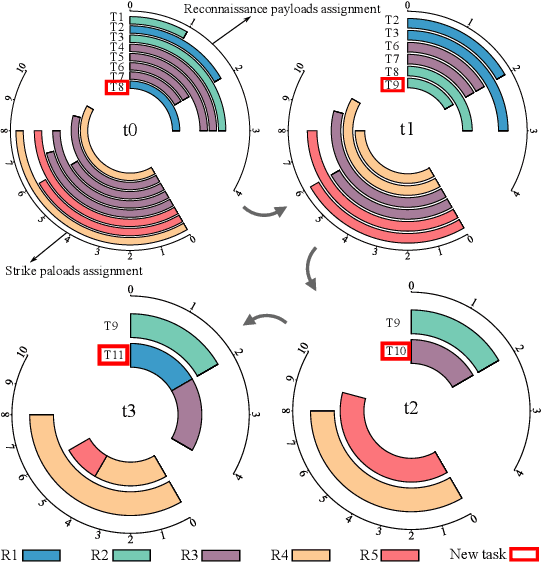
This paper presents a consensus-based payload algorithm (CBPA) to deal with the condition of robots' capability decrease for multi-robot task allocation. During the execution of complex tasks, robots' capabilities could decrease with the consumption of payloads, which causes a problem that the robot coalition would not meet the tasks' requirements in real time. The proposed CBPA is an enhanced version of the consensus-based bundle algorithm (CBBA) and comprises two primary core phases: the payload bundle construction and consensus phases. In the payload bundle construction phase, CBPA introduces a payload assignment matrix to track the payloads carried by the robots and the demands of multi-robot tasks in real time. Then, robots share their respective payload assignment matrix in the consensus phase. These two phases are iterated to dynamically adjust the number of robots performing multi-robot tasks and the number of tasks each robot performs and obtain conflict-free results to ensure that the robot coalition meets the demand and completes all tasks as quickly as possible. Physical experiment shows that CBPA is appropriate in complex and dynamic scenarios where robots need to collaborate and task requirements are tightly coupled to the robots' payloads. Numerical experiments show that CBPA has higher total task gains than CBBA.
SPF-EMPC Planner: A real-time multi-robot trajectory planner for complex environments with uncertainties
Oct 17, 2024
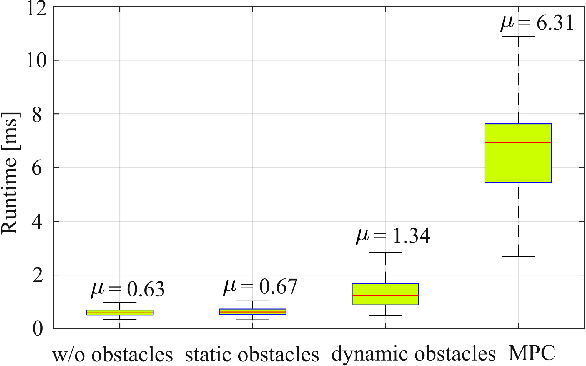
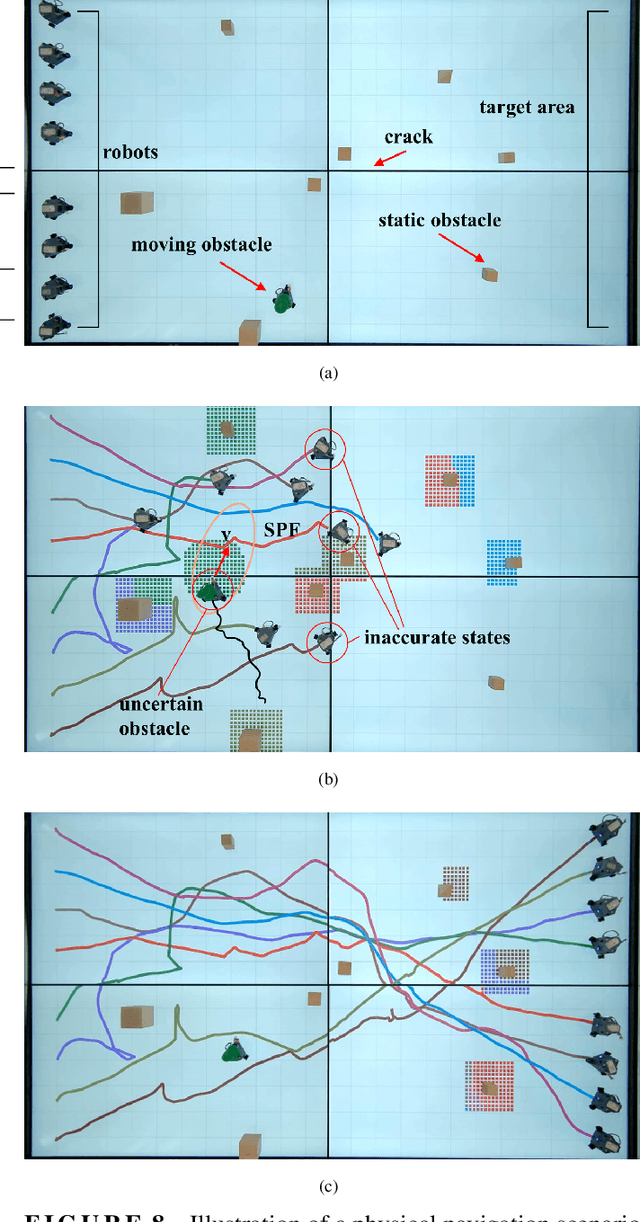
In practical applications, the unpredictable movement of obstacles and the imprecise state observation of robots introduce significant uncertainties for the swarm of robots, especially in cluster environments. However, existing methods are difficult to realize safe navigation, considering uncertainties, complex environmental structures, and robot swarms. This paper introduces an extended state model predictive control planner with a safe probability field to address the multi-robot navigation problem in complex, dynamic, and uncertain environments. Initially, the safe probability field offers an innovative approach to model the uncertainty of external dynamic obstacles, combining it with an unconstrained optimization method to generate safe trajectories for multi-robot online. Subsequently, the extended state model predictive controller can accurately track these generated trajectories while considering the robots' inherent model constraints and state uncertainty, thus ensuring the practical feasibility of the planned trajectories. Simulation experiments show a success rate four times higher than that of state-of-the-art algorithms. Physical experiments demonstrate the method's ability to operate in real-time, enabling safe navigation for multi-robot in uncertain environments.