 Add to Chrome
 Add to Firefox
 Add to Edge
Scaling the Horizon, Not the Parameters: Reaching Trillion-Parameter Performance with a 35B Agent
Jun 29, 2026
We introduce Agents-A1, a 35B Mixture-of-Experts Agentic Model that reaches trillion-parameter-level performance by scaling the agent horizon. We investigate agent-horizon scaling from two perspectives: scaling long-horizon trajectories and scaling heterogeneous agent abilities. To support this goal, we build a long-horizon knowledge-action infrastructure that connects external knowledge, actions, observations, and verifier outcomes, producing agentic trajectories with an average length of 45K tokens. Based on this, we train Agents-A1 with a three-stage recipe. First, we perform full-domain supervised fine-tuning to align the base model with broad agentic behaviors. Second, we train domain-level teacher models to capture specialized expertise in each domain. Third, we propose a multi-teacher domain-routed on-policy distillation with salient vocabulary alignment to improve knowledge transfer efficiency across different domains, unifying six heterogeneous domains into one deployable student model. Agents-A1 achieves strong and broad performance for long-horizon agent benchmarks. Compared with 1T-parameter model such as Kimi-K2.6 and DeepSeek-V4-pro, Agents-A1 achieves leading results on SEAL-0 (56.4), IFBench (80.6), HiPhO (46.4), FrontierScience-Olympiad (79.0), and MolBench-Bind (56.8), and remains highly competitive on SciCode (44.3), HLE (47.6) and BrowseComp (75.5). We hope this work provides the community with a practical path for scaling the horizon using a 35B agent that can reach or match the performance of 1T models on long-horizon tasks.

Certified Signed Graph Unlearning
Nov 18, 2025Signed graphs model complex relationships through positive and negative edges, with widespread real-world applications. Given the sensitive nature of such data, selective removal mechanisms have become essential for privacy protection. While graph unlearning enables the removal of specific data influences from Graph Neural Networks (GNNs), existing methods are designed for conventional GNNs and overlook the unique heterogeneous properties of signed graphs. When applied to Signed Graph Neural Networks (SGNNs), these methods lose critical sign information, degrading both model utility and unlearning effectiveness. To address these challenges, we propose Certified Signed Graph Unlearning (CSGU), which provides provable privacy guarantees while preserving the sociological principles underlying SGNNs. CSGU employs a three-stage method: (1) efficiently identifying minimal influenced neighborhoods via triangular structures, (2) applying sociological theories to quantify node importance for optimal privacy budget allocation, and (3) performing importance-weighted parameter updates to achieve certified modifications with minimal utility degradation. Extensive experiments demonstrate that CSGU outperforms existing methods, achieving superior performance in both utility preservation and unlearning effectiveness on SGNNs.
Learning to Fast Unrank in Collaborative Filtering Recommendation
Nov 10, 2025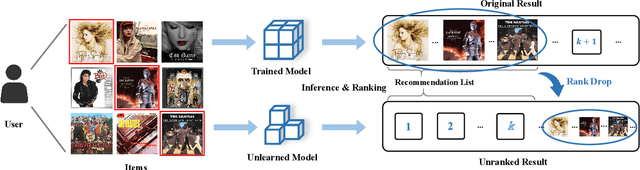
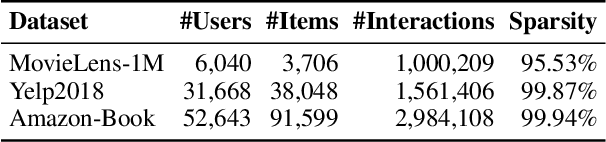
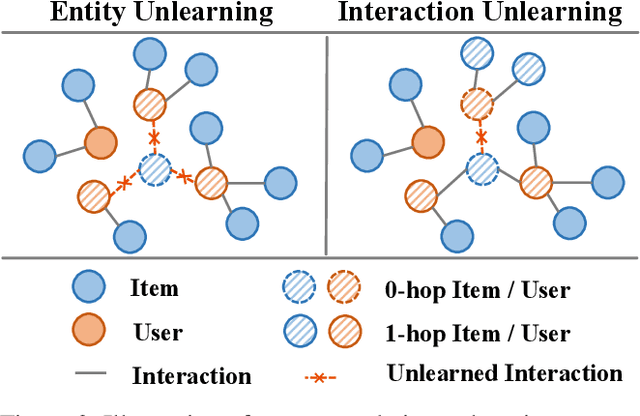
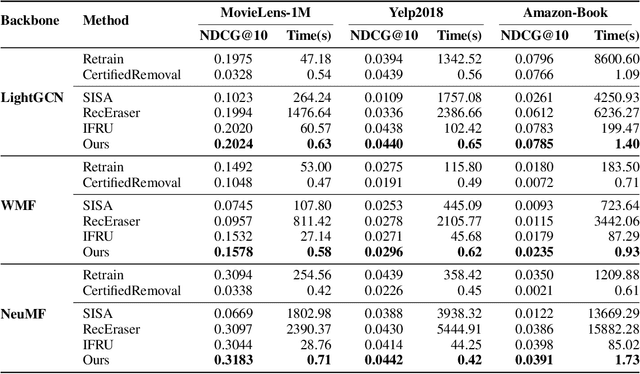
Modern data-driven recommendation systems risk memorizing sensitive user behavioral patterns, raising privacy concerns. Existing recommendation unlearning methods, while capable of removing target data influence, suffer from inefficient unlearning speed and degraded performance, failing to meet real-time unlearning demands. Considering the ranking-oriented nature of recommendation systems, we present unranking, the process of reducing the ranking positions of target items while ensuring the formal guarantees of recommendation unlearning. To achieve efficient unranking, we propose Learning to Fast Unrank in Collaborative Filtering Recommendation (L2UnRank), which operates through three key stages: (a) identifying the influenced scope via interaction-based p-hop propagation, (b) computing structural and semantic influences for entities within this scope, and (c) performing efficient, ranking-aware parameter updates guided by influence information. Extensive experiments across multiple datasets and backbone models demonstrate L2UnRank's model-agnostic nature, achieving state-of-the-art unranking effectiveness and maintaining recommendation quality comparable to retraining, while also delivering a 50x speedup over existing methods. Codes are available at https://github.com/Juniper42/L2UnRank.