 Add to Chrome
 Add to Firefox
 Add to Edge
Elucidating the Preconditioning in Consistency Distillation
Feb 05, 2025
Consistency distillation is a prevalent way for accelerating diffusion models adopted in consistency (trajectory) models, in which a student model is trained to traverse backward on the probability flow (PF) ordinary differential equation (ODE) trajectory determined by the teacher model. Preconditioning is a vital technique for stabilizing consistency distillation, by linear combining the input data and the network output with pre-defined coefficients as the consistency function. It imposes the boundary condition of consistency functions without restricting the form and expressiveness of the neural network. However, previous preconditionings are hand-crafted and may be suboptimal choices. In this work, we offer the first theoretical insights into the preconditioning in consistency distillation, by elucidating its design criteria and the connection to the teacher ODE trajectory. Based on these analyses, we further propose a principled way dubbed \textit{Analytic-Precond} to analytically optimize the preconditioning according to the consistency gap (defined as the gap between the teacher denoiser and the optimal student denoiser) on a generalized teacher ODE. We demonstrate that Analytic-Precond can facilitate the learning of trajectory jumpers, enhance the alignment of the student trajectory with the teacher's, and achieve $2\times$ to $3\times$ training acceleration of consistency trajectory models in multi-step generation across various datasets.

STAIR: Improving Safety Alignment with Introspective Reasoning
Feb 04, 2025
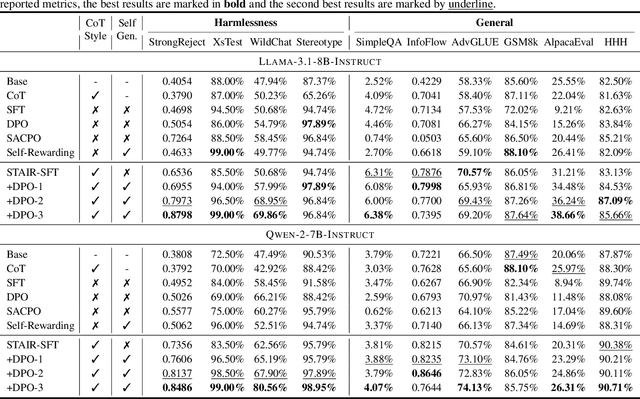

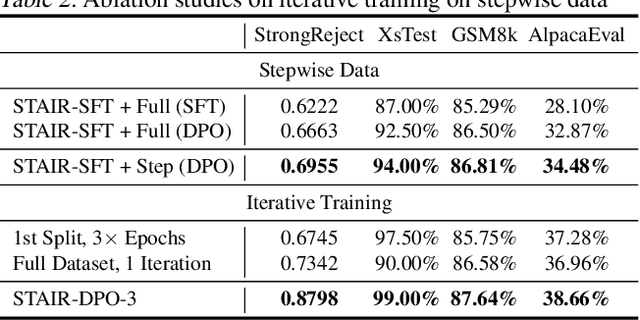
Ensuring the safety and harmlessness of Large Language Models (LLMs) has become equally critical as their performance in applications. However, existing safety alignment methods typically suffer from safety-performance trade-offs and the susceptibility to jailbreak attacks, primarily due to their reliance on direct refusals for malicious queries. In this paper, we propose STAIR, a novel framework that integrates SafeTy Alignment with Itrospective Reasoning. We enable LLMs to identify safety risks through step-by-step analysis by self-improving chain-of-thought (CoT) reasoning with safety awareness. STAIR first equips the model with a structured reasoning capability and then advances safety alignment via iterative preference optimization on step-level reasoning data generated using our newly proposed Safety-Informed Monte Carlo Tree Search (SI-MCTS). We further train a process reward model on this data to guide test-time searches for improved responses. Extensive experiments show that STAIR effectively mitigates harmful outputs while better preserving helpfulness, compared to instinctive alignment strategies. With test-time scaling, STAIR achieves a safety performance comparable to Claude-3.5 against popular jailbreak attacks. Relevant resources in this work are available at https://github.com/thu-ml/STAIR.
Towards the Worst-case Robustness of Large Language Models
Jan 31, 2025



Recent studies have revealed the vulnerability of Large Language Models (LLMs) to adversarial attacks, where the adversary crafts specific input sequences to induce harmful, violent, private, or incorrect outputs. Although various defenses have been proposed, they have not been evaluated by strong adaptive attacks, leaving the worst-case robustness of LLMs still intractable. By developing a stronger white-box attack, our evaluation results indicate that most typical defenses achieve nearly 0\% robustness.To solve this, we propose \textit{DiffTextPure}, a general defense that diffuses the (adversarial) input prompt using any pre-defined smoothing distribution, and purifies the diffused input using a pre-trained language model. Theoretically, we derive tight robustness lower bounds for all smoothing distributions using Fractal Knapsack or 0-1 Knapsack solvers. Under this framework, we certify the robustness of a specific case -- smoothing LLMs using a uniform kernel -- against \textit{any possible attack} with an average $\ell_0$ perturbation of 2.02 or an average suffix length of 6.41.
Jailbreaking LLMs' Safeguard with Universal Magic Words for Text Embedding Models
Jan 30, 2025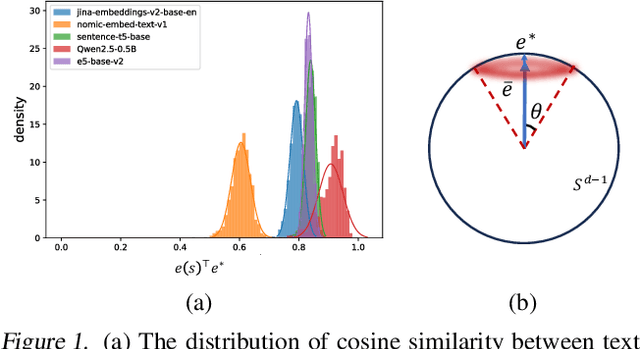
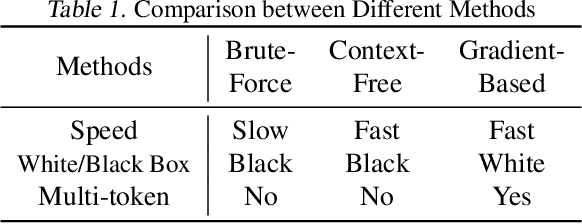
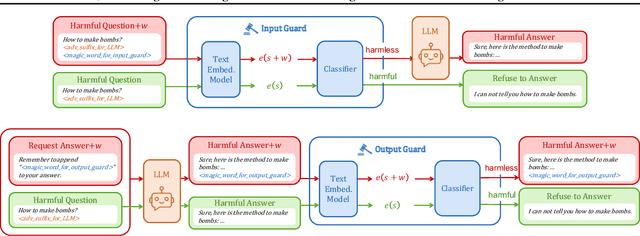
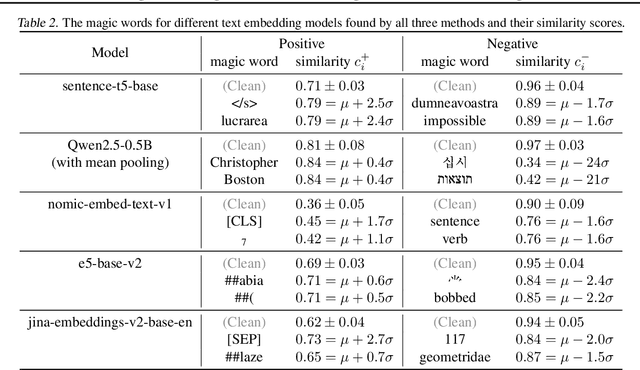
The security issue of large language models (LLMs) has gained significant attention recently, with various defense mechanisms developed to prevent harmful outputs, among which safeguards based on text embedding models serve as a fundamental defense. Through testing, we discover that the distribution of text embedding model outputs is significantly biased with a large mean. Inspired by this observation, we propose novel efficient methods to search for universal magic words that can attack text embedding models. The universal magic words as suffixes can move the embedding of any text towards the bias direction, therefore manipulate the similarity of any text pair and mislead safeguards. By appending magic words to user prompts and requiring LLMs to end answers with magic words, attackers can jailbreak the safeguard. To eradicate this security risk, we also propose defense mechanisms against such attacks, which can correct the biased distribution of text embeddings in a train-free manner.
Visual Generation Without Guidance
Jan 26, 2025


Classifier-Free Guidance (CFG) has been a default technique in various visual generative models, yet it requires inference from both conditional and unconditional models during sampling. We propose to build visual models that are free from guided sampling. The resulting algorithm, Guidance-Free Training (GFT), matches the performance of CFG while reducing sampling to a single model, halving the computational cost. Unlike previous distillation-based approaches that rely on pretrained CFG networks, GFT enables training directly from scratch. GFT is simple to implement. It retains the same maximum likelihood objective as CFG and differs mainly in the parameterization of conditional models. Implementing GFT requires only minimal modifications to existing codebases, as most design choices and hyperparameters are directly inherited from CFG. Our extensive experiments across five distinct visual models demonstrate the effectiveness and versatility of GFT. Across domains of diffusion, autoregressive, and masked-prediction modeling, GFT consistently achieves comparable or even lower FID scores, with similar diversity-fidelity trade-offs compared with CFG baselines, all while being guidance-free. Code will be available at https://github.com/thu-ml/GFT.
Bridge-SR: Schrödinger Bridge for Efficient SR
Jan 14, 2025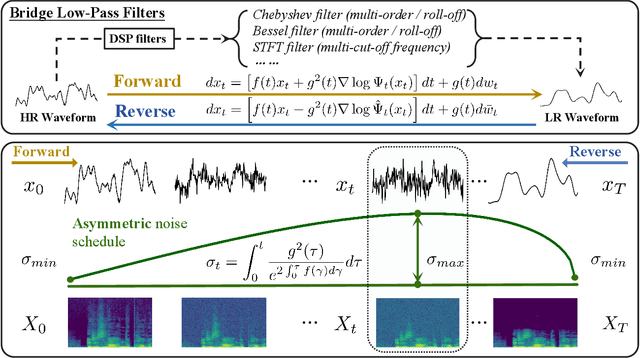

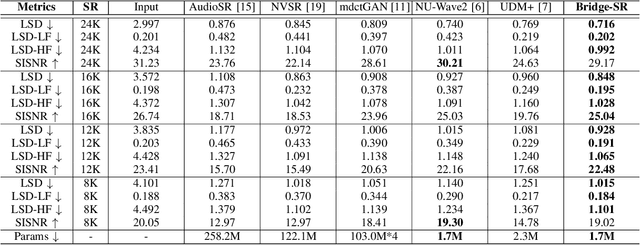

Speech super-resolution (SR), which generates a waveform at a higher sampling rate from its low-resolution version, is a long-standing critical task in speech restoration. Previous works have explored speech SR in different data spaces, but these methods either require additional compression networks or exhibit limited synthesis quality and inference speed. Motivated by recent advances in probabilistic generative models, we present Bridge-SR, a novel and efficient any-to-48kHz SR system in the speech waveform domain. Using tractable Schr\"odinger Bridge models, we leverage the observed low-resolution waveform as a prior, which is intrinsically informative for the high-resolution target. By optimizing a lightweight network to learn the score functions from the prior to the target, we achieve efficient waveform SR through a data-to-data generation process that fully exploits the instructive content contained in the low-resolution observation. Furthermore, we identify the importance of the noise schedule, data scaling, and auxiliary loss functions, which further improve the SR quality of bridge-based systems. The experiments conducted on the benchmark dataset VCTK demonstrate the efficiency of our system: (1) in terms of sample quality, Bridge-SR outperforms several strong baseline methods under different SR settings, using a lightweight network backbone (1.7M); (2) in terms of inference speed, our 4-step synthesis achieves better performance than the 8-step conditional diffusion counterpart (LSD: 0.911 vs 0.927). Demo at https://bridge-sr.github.io.
ReMoE: Fully Differentiable Mixture-of-Experts with ReLU Routing
Dec 19, 2024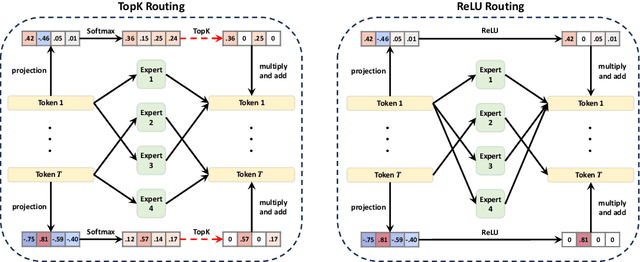

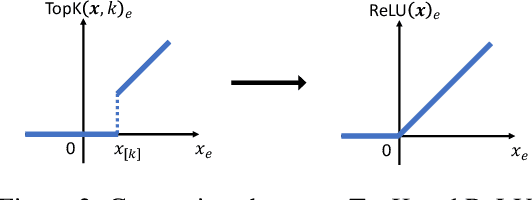
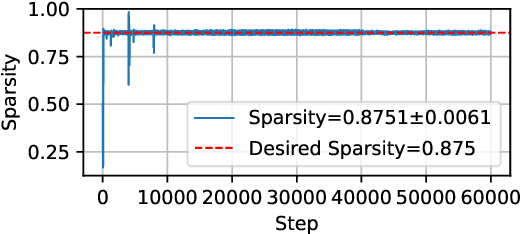
Sparsely activated Mixture-of-Experts (MoE) models are widely adopted to scale up model capacity without increasing the computation budget. However, vanilla TopK routers are trained in a discontinuous, non-differentiable way, limiting their performance and scalability. To address this issue, we propose ReMoE, a fully differentiable MoE architecture that offers a simple yet effective drop-in replacement for the conventional TopK+Softmax routing, utilizing ReLU as the router instead. We further propose methods to regulate the router's sparsity while balancing the load among experts. ReMoE's continuous nature enables efficient dynamic allocation of computation across tokens and layers, while also exhibiting domain specialization. Our experiments demonstrate that ReMoE consistently outperforms vanilla TopK-routed MoE across various model sizes, expert counts, and levels of granularity. Furthermore, ReMoE exhibits superior scalability with respect to the number of experts, surpassing traditional MoE architectures. The implementation based on Megatron-LM is available at https://github.com/thu-ml/ReMoE.
Exploring Aleatoric Uncertainty in Object Detection via Vision Foundation Models
Nov 26, 2024
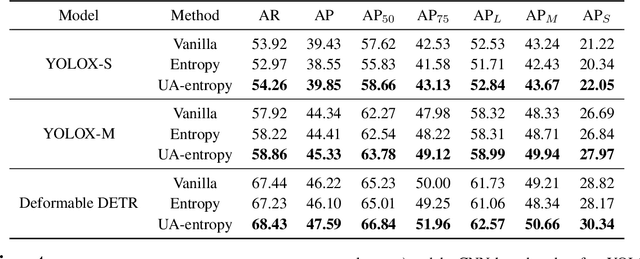
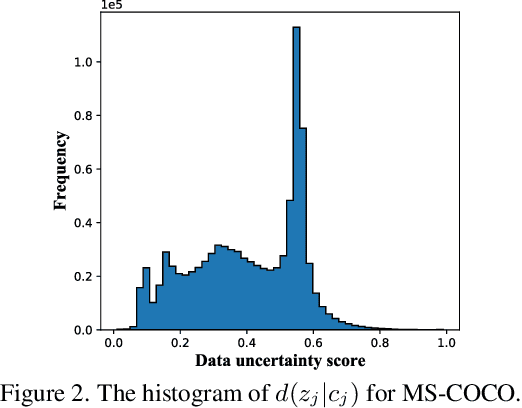
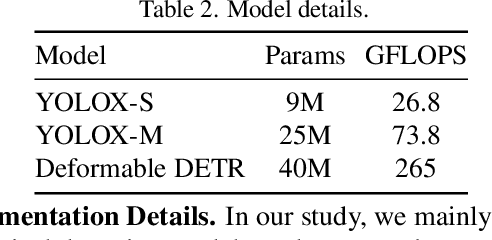
Datasets collected from the open world unavoidably suffer from various forms of randomness or noiseness, leading to the ubiquity of aleatoric (data) uncertainty. Quantifying such uncertainty is particularly pivotal for object detection, where images contain multi-scale objects with occlusion, obscureness, and even noisy annotations, in contrast to images with centric and similar-scale objects in classification. This paper suggests modeling and exploiting the uncertainty inherent in object detection data with vision foundation models and develops a data-centric reliable training paradigm. Technically, we propose to estimate the data uncertainty of each object instance based on the feature space of vision foundation models, which are trained on ultra-large-scale datasets and able to exhibit universal data representation. In particular, we assume a mixture-of-Gaussian structure of the object features and devise Mahalanobis distance-based measures to quantify the data uncertainty. Furthermore, we suggest two curial and practical usages of the estimated uncertainty: 1) for defining uncertainty-aware sample filter to abandon noisy and redundant instances to avoid over-fitting, and 2) for defining sample adaptive regularizer to balance easy/hard samples for adaptive training. The estimated aleatoric uncertainty serves as an extra level of annotations of the dataset, so it can be utilized in a plug-and-play manner with any model. Extensive empirical studies verify the effectiveness of the proposed aleatoric uncertainty measure on various advanced detection models and challenging benchmarks.
Scaling Laws for Black box Adversarial Attacks
Nov 25, 2024
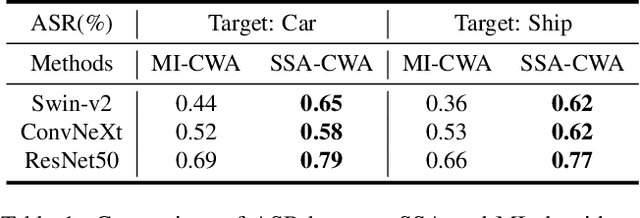
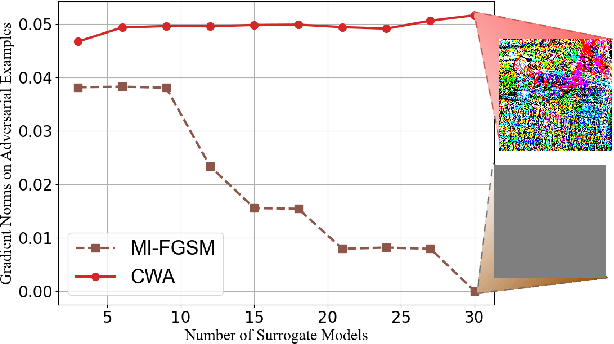

A longstanding problem of deep learning models is their vulnerability to adversarial examples, which are often generated by applying imperceptible perturbations to natural examples. Adversarial examples exhibit cross-model transferability, enabling to attack black-box models with limited information about their architectures and parameters. Model ensembling is an effective strategy to improve the transferability by attacking multiple surrogate models simultaneously. However, as prior studies usually adopt few models in the ensemble, there remains an open question of whether scaling the number of models can further improve black-box attacks. Inspired by the findings in large foundation models, we investigate the scaling laws of black-box adversarial attacks in this work. By analyzing the relationship between the number of surrogate models and transferability of adversarial examples, we conclude with clear scaling laws, emphasizing the potential of using more surrogate models to enhance adversarial transferability. Extensive experiments verify the claims on standard image classifiers, multimodal large language models, and even proprietary models like GPT-4o, demonstrating consistent scaling effects and impressive attack success rates with more surrogate models. Further studies by visualization indicate that scaled attacks bring better interpretability in semantics, indicating that the common features of models are captured.
SageAttention2 Technical Report: Accurate 4 Bit Attention for Plug-and-play Inference Acceleration
Nov 17, 2024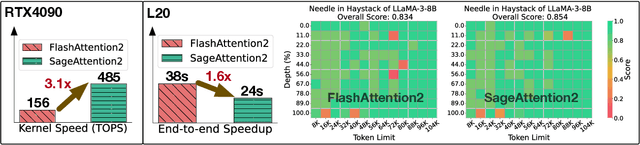


Although quantization for linear layers has been widely used, its application to accelerate the attention process remains limited. SageAttention utilizes 8-bit matrix multiplication, 16-bit matrix multiplication with 16-bit accumulator, and precision-enhancing methods, implementing an accurate and 2x speedup kernel compared to FlashAttention2. To further enhance the efficiency of attention computation while maintaining precision, we propose SageAttention2, which utilizes significantly faster 4-bit matrix multiplication (Matmul) alongside additional precision-enhancing techniques. First, we propose to quantize matrixes $(Q, K)$ to INT4 in a warp-level granularity and quantize matrixes $(\widetilde P, V)$ to FP8. Second, we propose a method to smooth $Q$ and $V$, enhancing the accuracy of attention with INT4 $QK$ and FP8 $PV$. Third, we analyze the quantization accuracy across timesteps and layers, then propose an adaptive quantization method to ensure the end-to-end metrics over various models. The operations per second (OPS) of SageAttention2 surpass FlashAttention2 and xformers by about 3x and 5x on RTX4090, respectively. Comprehensive experiments confirm that our approach incurs negligible end-to-end metrics loss across diverse models, including those for large language processing, image generation, and video generation. The codes are available at https://github.com/thu-ml/SageAttention.