 Add to Chrome
 Add to Firefox
 Add to Edge
Tripody: An Overconstrained 3-SPR-like Parallel Robot for High-Reach Construction Tasks
Jul 28, 2026
Many ceiling construction tasks still rely on heavy serial manipulators that are difficult to deploy in cluttered interiors, motivating lightweight, field-ready alternatives that reach ceiling height while maintaining millimeter-level accuracy and the stiffness demanded by overhead tool loads. We introduce Tripody, a wheeled 3-DoF parallel robot for high-reach tasks that replaces the base spherical joints of a classical 3-SPR (3 legs; S: base spherical joint; P: actuated prismatic joint; R: end-effector revolute joint) morphology with universal joints, intentionally overconstraining the mechanism; small, distributed elastic deflections absorb the resulting incompatibilities, preserving predominantly translational motion. The 33kg system extends from 1.7m to 3.4m in height, supports a continuous 32kg payload, and offers a modular end-effector interface for ceiling operations. We detail the mechanical design - including custom linear actuators and a kinematic-compatibility analysis - and a control stack for accurate positioning that combines SE(3) state estimation, forward kinematics, and task-space control. In experiments, Tripody exhibits similar in-plane stiffness to a spherical-base variant but substantially higher torsional stiffness - an increase of 67% at 1.7m, 196% at 2.6m, and 454% at 3.4m - while maintaining negligible cross-axis coupling. Closed-loop positioning with a total station converges below 0.6mm across the entire workspace; pure model extrapolation achieves a 95th-percentile error of 2.7mm (max 3.6mm). Finally, we demonstrate task-level ceiling-drilling feasibility in an open-loop study by drilling a 15-hole pattern with 4.5mm maximum relative hole-position error after rigid alignment. These results support overconstrained, compliance-absorbing 3-SPR-like architectures as a practical path to lightweight, high- reach, millimeter-accurate construction robots.
* 8 pages, 11 figures, Accepted in July 2026 at IEEE Robotics and Automation Letters (RA-L)

Hilti-Trimble-Oxford Dataset: 360 Visual-Inertial Benchmark with Floor Plan Priors for SLAM and Localization
Jul 07, 2026Automated progress monitoring on construction sites is an active area of research and development. Robot and human-carried mapping systems have been developed to build 3D maps of building and infrastructure projects. While LiDAR-based mapping systems achieve high accuracy, the cost of LiDAR can be prohibitive. Consumer-grade cameras with wide field of view ("360 cameras") combined with embedded inertial measurement units (IMUs) provide a cost-effective alternative. To support change detection and progress monitoring, highly accurate visual Simultaneous Localization and Mapping (SLAM) and floor plan-referenced localization systems are required. In this paper we present a high-quality dataset collected at an active construction site, which captures realistic challenges such as variable lighting conditions, moving workers, fast motions, and repetitive structures. The dataset offers thirty visual-inertial sequences recorded across seven floors over an eight-month period of the construction project. Ground truth trajectories were collected using a high quality LiDAR-inertial SLAM system rigidly attached to the 360 camera. Additionally, we report the results of an open research challenge evaluating the best visual SLAM and localization systems from around the world. The Challenge attracted substantially higher participation in SLAM, with 62 teams compared to 22 in floor-plan-referenced localization, reflecting the broader maturity of SLAM methods. The higher errors in localization further highlight the difficulty of this task in construction and point to the need for continued research, which this dataset is intended to support. The dataset and the benchmark are publicly available at: https://hilti-trimble-challenge.com/dataset-2026.
Enhancing Robotic Precision in Construction: A Modular Factor Graph-Based Framework to Deflection and Backlash Compensation Using High-Accuracy Accelerometers
Jan 24, 2025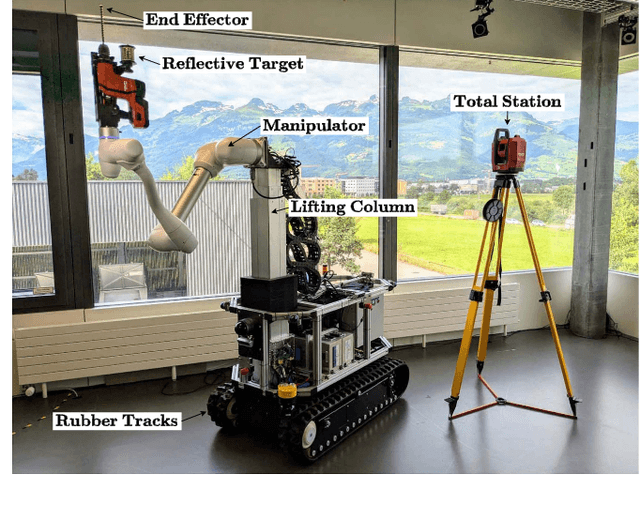
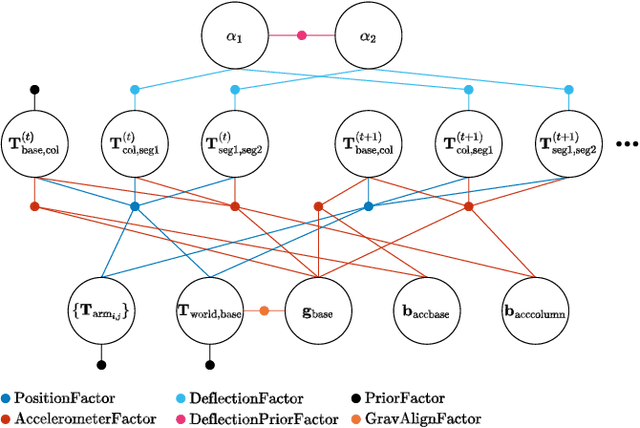
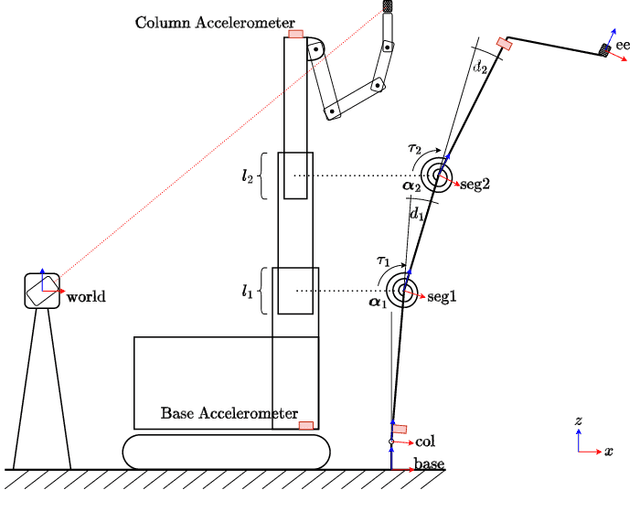
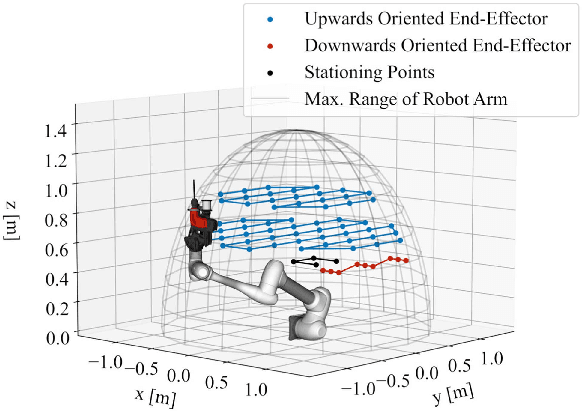
Accurate positioning is crucial in the construction industry, where labor shortages highlight the need for automation. Robotic systems with long kinematic chains are required to reach complex workspaces, including floors, walls, and ceilings. These requirements significantly impact positioning accuracy due to effects such as deflection and backlash in various parts along the kinematic chain. In this work, we introduce a novel approach that integrates deflection and backlash compensation models with high-accuracy accelerometers, significantly enhancing position accuracy. Our method employs a modular framework based on a factor graph formulation to estimate the state of the kinematic chain, leveraging acceleration measurements to inform the model. Extensive testing on publicly released datasets, reflecting real-world construction disturbances, demonstrates the advantages of our approach. The proposed method reduces the $95\%$ error threshold in the xy-plane by $50\%$ compared to the state-of-the-art Virtual Joint Method, and by $31\%$ when incorporating base tilt compensation.
* 8 pages, 7 figures, Accepted on November 2024 at IEEE Robotics and Automation Letters
Hilti SLAM Challenge 2023: Benchmarking Single + Multi-session SLAM across Sensor Constellations in Construction
Apr 15, 2024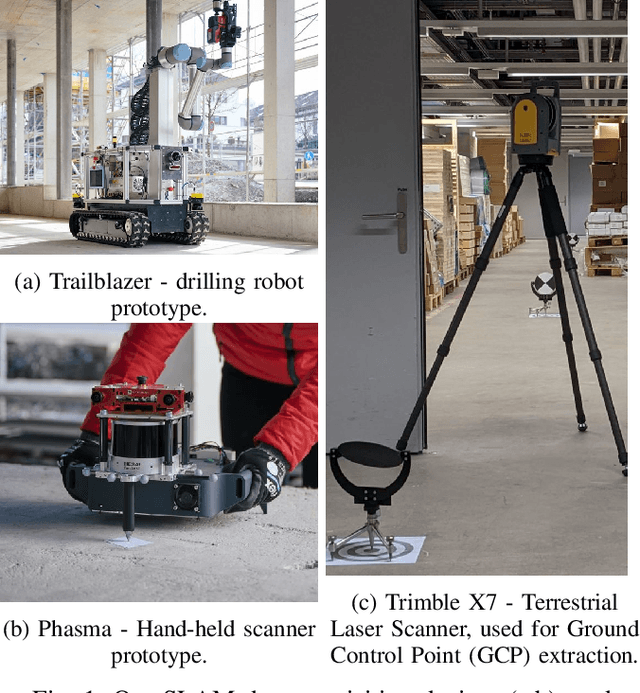
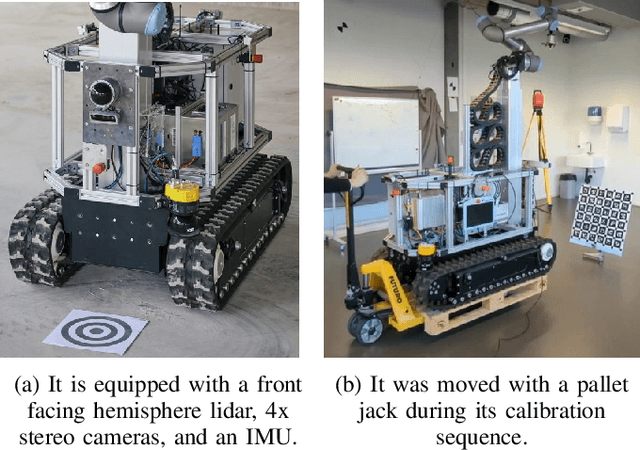
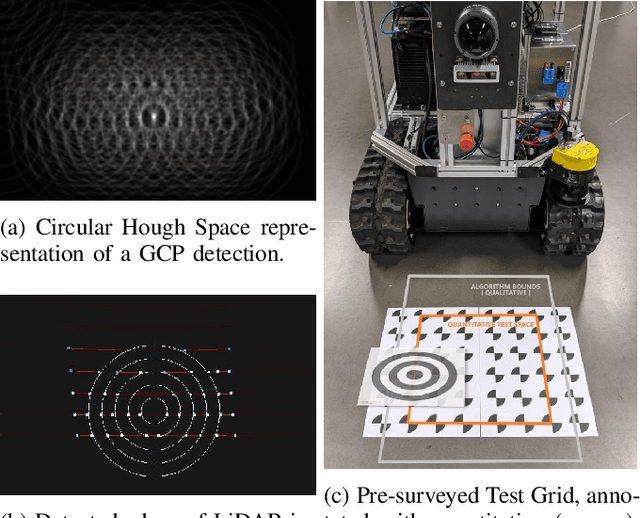
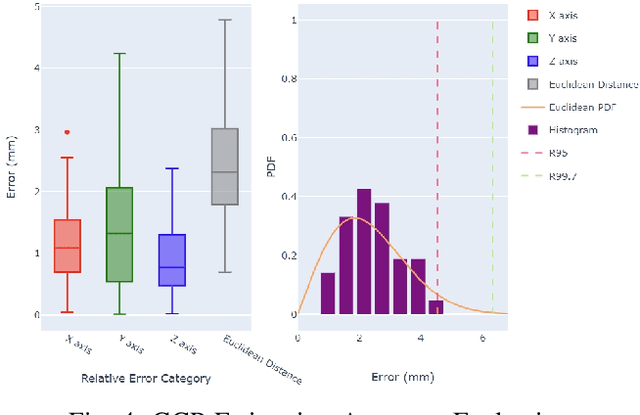
Simultaneous Localization and Mapping systems are a key enabler for positioning in both handheld and robotic applications. The Hilti SLAM Challenges organized over the past years have been successful at benchmarking some of the world's best SLAM Systems with high accuracy. However, more capabilities of these systems are yet to be explored, such as platform agnosticism across varying sensor suites and multi-session SLAM. These factors indirectly serve as an indicator of robustness and ease of deployment in real-world applications. There exists no dataset plus benchmark combination publicly available, which considers these factors combined. The Hilti SLAM Challenge 2023 Dataset and Benchmark addresses this issue. Additionally, we propose a novel fiducial marker design for a pre-surveyed point on the ground to be observable from an off-the-shelf LiDAR mounted on a robot, and an algorithm to estimate its position at mm-level accuracy. Results from the challenge show an increase in overall participation, single-session SLAM systems getting increasingly accurate, successfully operating across varying sensor suites, but relatively few participants performing multi-session SLAM.
Whole-Body Control of a Mobile Manipulator using End-to-End Reinforcement Learning
Feb 25, 2020
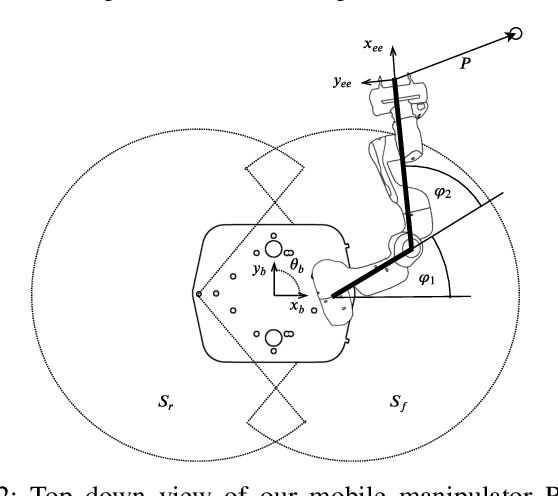
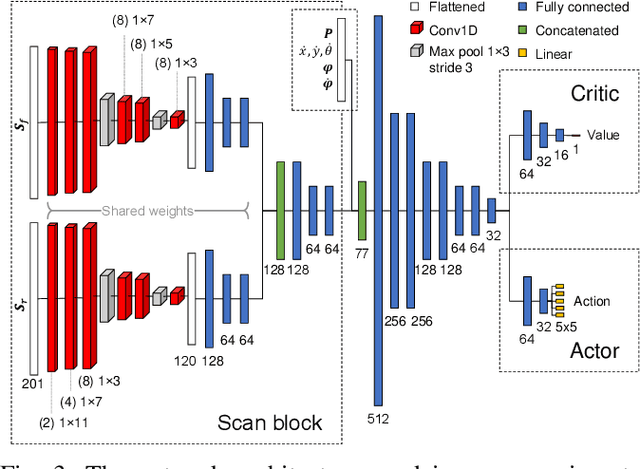
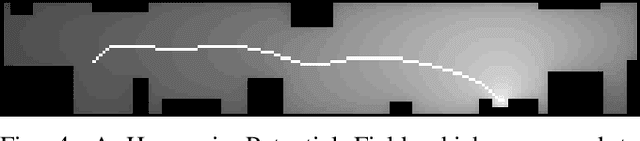
Mobile manipulation is usually achieved by sequentially executing base and manipulator movements. This simplification, however, leads to a loss in efficiency and in some cases a reduction of workspace size. Even though different methods have been proposed to solve Whole-Body Control (WBC) online, they are either limited by a kinematic model or do not allow for reactive, online obstacle avoidance. In order to overcome these drawbacks, in this work, we propose an end-to-end Reinforcement Learning (RL) approach to WBC. We compared our learned controller against a state-of-the-art sampling-based method in simulation and achieved faster overall mission times. In addition, we validated the learned policy on our mobile manipulator RoyalPanda in challenging narrow corridor environments.