 Add to Chrome
 Add to Firefox
 Add to Edge
Tripody: An Overconstrained 3-SPR-like Parallel Robot for High-Reach Construction Tasks
Jul 28, 2026
Many ceiling construction tasks still rely on heavy serial manipulators that are difficult to deploy in cluttered interiors, motivating lightweight, field-ready alternatives that reach ceiling height while maintaining millimeter-level accuracy and the stiffness demanded by overhead tool loads. We introduce Tripody, a wheeled 3-DoF parallel robot for high-reach tasks that replaces the base spherical joints of a classical 3-SPR (3 legs; S: base spherical joint; P: actuated prismatic joint; R: end-effector revolute joint) morphology with universal joints, intentionally overconstraining the mechanism; small, distributed elastic deflections absorb the resulting incompatibilities, preserving predominantly translational motion. The 33kg system extends from 1.7m to 3.4m in height, supports a continuous 32kg payload, and offers a modular end-effector interface for ceiling operations. We detail the mechanical design - including custom linear actuators and a kinematic-compatibility analysis - and a control stack for accurate positioning that combines SE(3) state estimation, forward kinematics, and task-space control. In experiments, Tripody exhibits similar in-plane stiffness to a spherical-base variant but substantially higher torsional stiffness - an increase of 67% at 1.7m, 196% at 2.6m, and 454% at 3.4m - while maintaining negligible cross-axis coupling. Closed-loop positioning with a total station converges below 0.6mm across the entire workspace; pure model extrapolation achieves a 95th-percentile error of 2.7mm (max 3.6mm). Finally, we demonstrate task-level ceiling-drilling feasibility in an open-loop study by drilling a 15-hole pattern with 4.5mm maximum relative hole-position error after rigid alignment. These results support overconstrained, compliance-absorbing 3-SPR-like architectures as a practical path to lightweight, high- reach, millimeter-accurate construction robots.
* 8 pages, 11 figures, Accepted in July 2026 at IEEE Robotics and Automation Letters (RA-L)

Enhancing Robotic Precision in Construction: A Modular Factor Graph-Based Framework to Deflection and Backlash Compensation Using High-Accuracy Accelerometers
Jan 24, 2025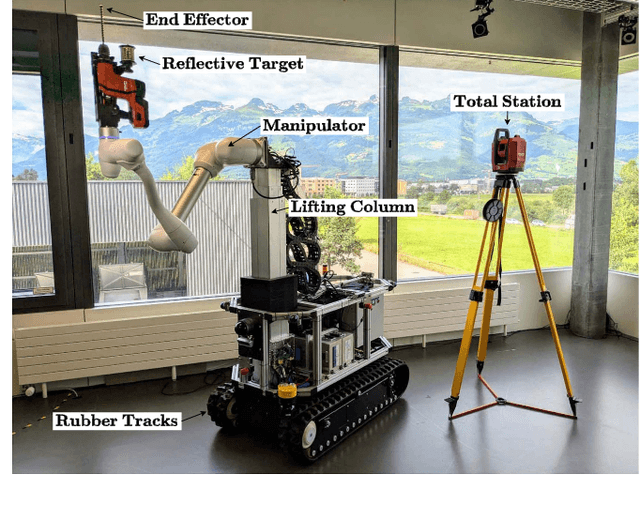
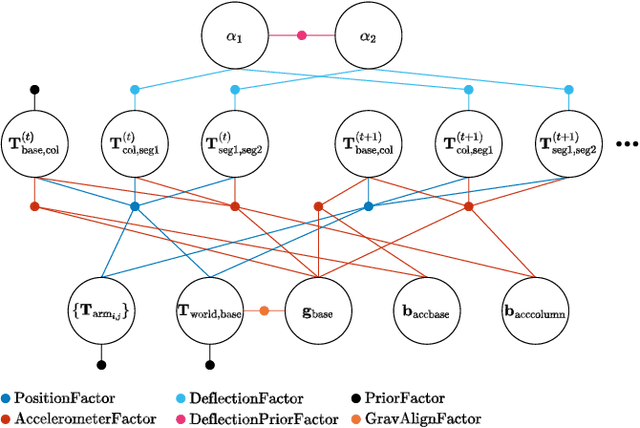
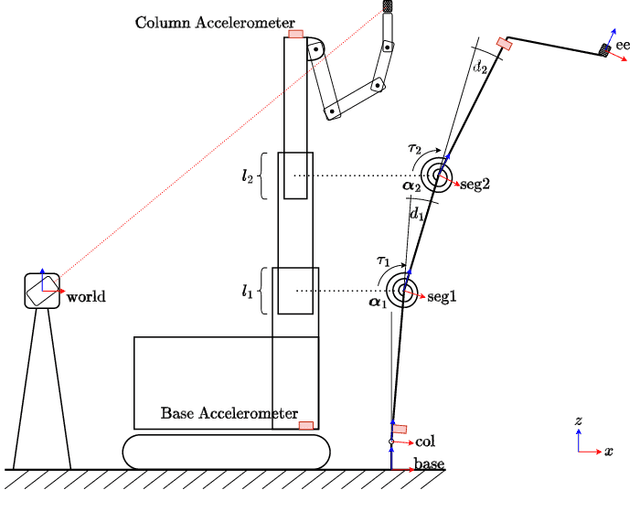
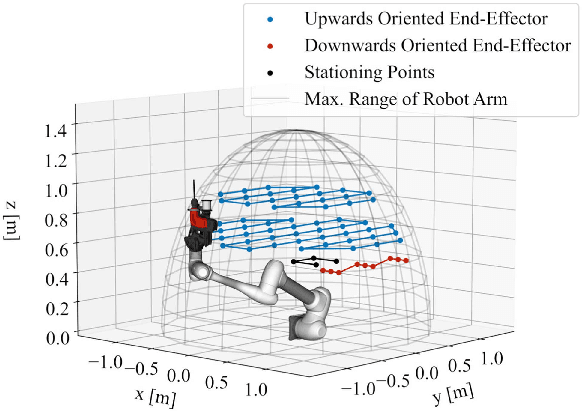
Accurate positioning is crucial in the construction industry, where labor shortages highlight the need for automation. Robotic systems with long kinematic chains are required to reach complex workspaces, including floors, walls, and ceilings. These requirements significantly impact positioning accuracy due to effects such as deflection and backlash in various parts along the kinematic chain. In this work, we introduce a novel approach that integrates deflection and backlash compensation models with high-accuracy accelerometers, significantly enhancing position accuracy. Our method employs a modular framework based on a factor graph formulation to estimate the state of the kinematic chain, leveraging acceleration measurements to inform the model. Extensive testing on publicly released datasets, reflecting real-world construction disturbances, demonstrates the advantages of our approach. The proposed method reduces the $95\%$ error threshold in the xy-plane by $50\%$ compared to the state-of-the-art Virtual Joint Method, and by $31\%$ when incorporating base tilt compensation.
* 8 pages, 7 figures, Accepted on November 2024 at IEEE Robotics and Automation Letters