 Add to Chrome
 Add to Firefox
 Add to Edge
A Framework for Individual Tree Growth Reconstruction Using Multi-Platform Laser Scanning
Jul 24, 2026
Accurate tree-level forest monitoring using laser scanning data requires reliable tree delineation, consistent tree correspondence across multitemporal point clouds, and accurate estimation of tree attributes and their change. Reconstructing tree growth in boreal forests is challenging due to the scarcity of historical stem-level data, propagation of errors from older sensors into change estimation, and growth rates with a magnitude of measurement uncertainty. This study investigates a framework for estimating individual tree diameter at breast height (DBH) and stem volume growth using 136 point clouds acquired between 2014--2025 with 11 scanners on airborne (ALS), mobile (MLS), and terrestrial laser scanning (TLS) platforms across boreal forest test sites. Trees were delineated from an MLS point cloud using deep learning-based segmentation which was transferred to the remaining point clouds, resulting in reliable multitemporal tree correspondence. Stem curves were derived from MLS/TLS data, with ALS data used for height estimation, enabling DBH and volume estimation and time series. A height growth-based scaling model was used to reconstruct stem attributes across time and estimate growth. Results showed that modeled growth achieved higher agreement with manual growth estimates than differencing independently estimated attributes from point clouds. The modeled-manual 5- and 10-year growth RMSEs were 55--111\% and 26--67\% for DBH, and 31--87\% and 21--67\% for volume, respectively, depending on plot difficulty. The scaling model was temporally robust, with errors remaining stable or stabilizing after 5--6 years, reaching maximum RMSEs of 8--12\% for DBH and 12--23\% for volume after 12 years. Combining MLS/TLS-derived stem measurements with multitemporal ALS-derived heights provided a robust framework for individual tree growth estimation without requiring multiple under-canopy scans.

3D LULC classification using multispectral LiDAR and deep learning: current and prospective schemes
May 21, 2026Land Use Land Cover (LULC) classification is essential for national 3D mapping, geospatial analysis, and sustainable planning. Multispectral (MS) LiDAR provides synchronized spatial-spectral information, and deep learning (DL) enables 3D point cloud semantic segmentation; however, adoption is limited by the lack of publicly available urban and suburban MS LiDAR datasets aligned with National Mapping and Cadastral Agencies (NMCAs) classification schemes. This study addresses these gaps by introducing L1 and L2 NMCA-aligned LULC classification schemes and a new benchmark MS LiDAR dataset. We evaluate seven state-of-the-art DL models and perform spectral ablation studies at both levels of detail. Results show that Point Transformer V3 achieves the best performance, with mIoU of 79.4% (L1, 8 classes) and 58.9% (L2, 20 classes) using a dual-wavelength LiDAR system (532 nm and 1064 nm). Ablation results show that multispectral information improves performance over geometry-only inputs, with gains of 1.1 percentage points at L1 and 7.8 points at L2. These results highlight the value of LiDAR reflectance for fine-grained material discrimination and support the evolution of NMCA LULC schemes toward higher semantic detail. The Loosdorf-MSL dataset contributes a new benchmark for consistent national and international LULC mapping.
Multispectral airborne laser scanning dataset for tree species classification: MS-ALS-SPECIES
Apr 27, 2026The shift from stand-level to individual-tree-level forest assessments supports improved biodiversity mapping, particularly in boreal ecosystems where tree species like aspen (Populus tremula L.) play a keystone role. While airborne laser scanning (ALS) is the standard for such inventories, a major limitation is the small number of publicly available ALS datasets containing high-quality, field-validated reference data. Furthermore, open multispectral ALS datasets with high-quality field reference data are completely lacking despite the potential of multispectral ALS data for tree species classification. This paper presents and details an open multispectral ALS dataset used in a recent international benchmarking study of machine learning and deep learning methods for tree species classification by Taher et al. (2026). The dataset comprises 6326 segment-level point clouds of individual trees representing nine species in Southern Finland. The point cloud data has been acquired using two multispectral laser scanning systems each operating at three laser wavelengths: a helicopter-borne system (HeliALS) with a point density exceeding 1000 points/m$^2$ and an Optech Titan system with approximately 35 points/m$^2$. We provide a detailed description of field data collection techniques developed in the study to facilitate the collection of high-quality ground truth data in an efficient and scalable manner. Additionally, our article presents new analyses on species classification using multispectral data building upon the initial findings of Taher et al. (2026). Furthermore, we study the relation between classification accuracy and tree height to highlight the versatility of the open dataset and to demonstrate the advantage of the point transformer model for small trees and minority species.
Multispectral LiDAR data for extracting tree points in urban and suburban areas
Aug 27, 2025Monitoring urban tree dynamics is vital for supporting greening policies and reducing risks to electrical infrastructure. Airborne laser scanning has advanced large-scale tree management, but challenges remain due to complex urban environments and tree variability. Multispectral (MS) light detection and ranging (LiDAR) improves this by capturing both 3D spatial and spectral data, enabling detailed mapping. This study explores tree point extraction using MS-LiDAR and deep learning (DL) models. Three state-of-the-art models are evaluated: Superpoint Transformer (SPT), Point Transformer V3 (PTv3), and Point Transformer V1 (PTv1). Results show the notable time efficiency and accuracy of SPT, with a mean intersection over union (mIoU) of 85.28%. The highest detection accuracy is achieved by incorporating pseudo normalized difference vegetation index (pNDVI) with spatial data, reducing error rate by 10.61 percentage points (pp) compared to using spatial information alone. These findings highlight the potential of MS-LiDAR and DL to improve tree extraction and further tree inventories.
Multispectral airborne laser scanning for tree species classification: a benchmark of machine learning and deep learning algorithms
Apr 19, 2025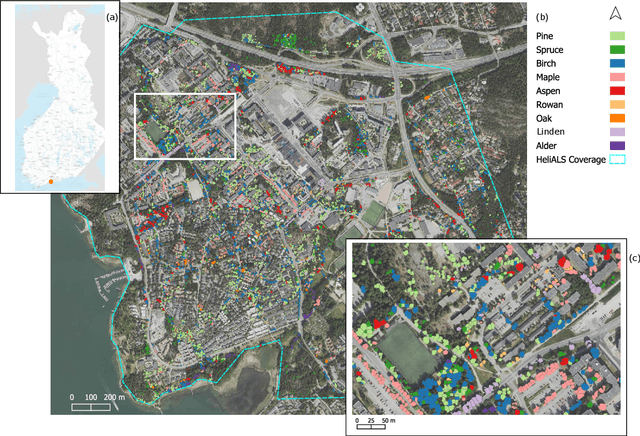
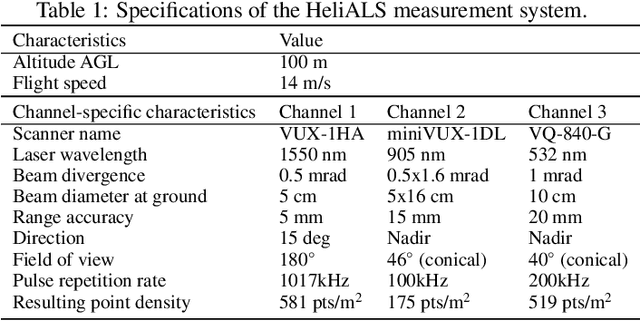

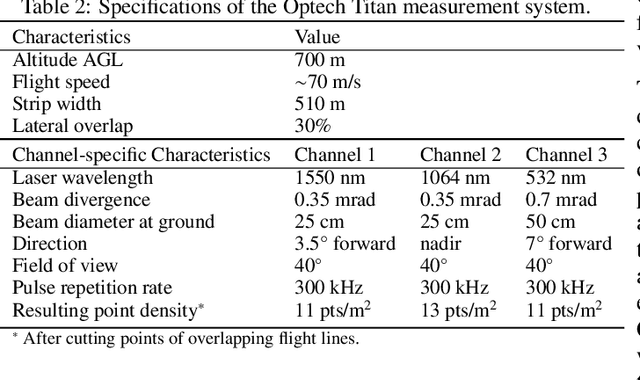
Climate-smart and biodiversity-preserving forestry demands precise information on forest resources, extending to the individual tree level. Multispectral airborne laser scanning (ALS) has shown promise in automated point cloud processing and tree segmentation, but challenges remain in identifying rare tree species and leveraging deep learning techniques. This study addresses these gaps by conducting a comprehensive benchmark of machine learning and deep learning methods for tree species classification. For the study, we collected high-density multispectral ALS data (>1000 pts/m$^2$) at three wavelengths using the FGI-developed HeliALS system, complemented by existing Optech Titan data (35 pts/m$^2$), to evaluate the species classification accuracy of various algorithms in a test site located in Southern Finland. Based on 5261 test segments, our findings demonstrate that point-based deep learning methods, particularly a point transformer model, outperformed traditional machine learning and image-based deep learning approaches on high-density multispectral point clouds. For the high-density ALS dataset, a point transformer model provided the best performance reaching an overall (macro-average) accuracy of 87.9% (74.5%) with a training set of 1065 segments and 92.0% (85.1%) with 5000 training segments. The best image-based deep learning method, DetailView, reached an overall (macro-average) accuracy of 84.3% (63.9%), whereas a random forest (RF) classifier achieved an overall (macro-average) accuracy of 83.2% (61.3%). Importantly, the overall classification accuracy of the point transformer model on the HeliALS data increased from 73.0% with no spectral information to 84.7% with single-channel reflectance, and to 87.9% with spectral information of all the three channels.
Road Grip Uncertainty Estimation Through Surface State Segmentation
Apr 11, 2025Slippery road conditions pose significant challenges for autonomous driving. Beyond predicting road grip, it is crucial to estimate its uncertainty reliably to ensure safe vehicle control. In this work, we benchmark several uncertainty prediction methods to assess their effectiveness for grip uncertainty estimation. Additionally, we propose a novel approach that leverages road surface state segmentation to predict grip uncertainty. Our method estimates a pixel-wise grip probability distribution based on inferred road surface conditions. Experimental results indicate that the proposed approach enhances the robustness of grip uncertainty prediction.
Unsupervised deep learning for semantic segmentation of multispectral LiDAR forest point clouds
Feb 10, 2025Point clouds captured with laser scanning systems from forest environments can be utilized in a wide variety of applications within forestry and plant ecology, such as the estimation of tree stem attributes, leaf angle distribution, and above-ground biomass. However, effectively utilizing the data in such tasks requires the semantic segmentation of the data into wood and foliage points, also known as leaf-wood separation. The traditional approach to leaf-wood separation has been geometry- and radiometry-based unsupervised algorithms, which tend to perform poorly on data captured with airborne laser scanning (ALS) systems, even with a high point density. While recent machine and deep learning approaches achieve great results even on sparse point clouds, they require manually labeled training data, which is often extremely laborious to produce. Multispectral (MS) information has been demonstrated to have potential for improving the accuracy of leaf-wood separation, but quantitative assessment of its effects has been lacking. This study proposes a fully unsupervised deep learning method, GrowSP-ForMS, which is specifically designed for leaf-wood separation of high-density MS ALS point clouds and based on the GrowSP architecture. GrowSP-ForMS achieved a mean accuracy of 84.3% and a mean intersection over union (mIoU) of 69.6% on our MS test set, outperforming the unsupervised reference methods by a significant margin. When compared to supervised deep learning methods, our model performed similarly to the slightly older PointNet architecture but was outclassed by more recent approaches. Finally, two ablation studies were conducted, which demonstrated that our proposed changes increased the test set mIoU of GrowSP-ForMS by 29.4 percentage points (pp) in comparison to the original GrowSP model and that utilizing MS data improved the mIoU by 5.6 pp from the monospectral case.
Unsupervised semantic segmentation of urban high-density multispectral point clouds
Oct 24, 2024
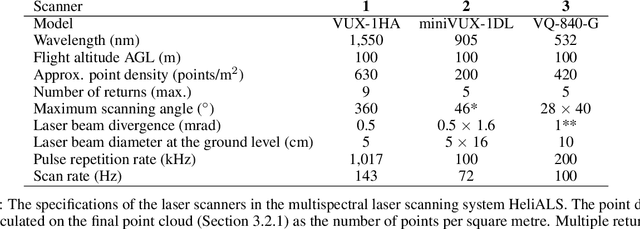


The availability of highly accurate urban airborne laser scanning (ALS) data will increase rapidly in the future, especially as acquisition costs decrease, for example through the use of drones. Current challenges in data processing are related to the limited spectral information and low point density of most ALS datasets. Another challenge will be the growing need for annotated training data, frequently produced by manual processes, to enable semantic interpretation of point clouds. This study proposes to semantically segment new high-density (1200 points per square metre on average) multispectral ALS data with an unsupervised ground-aware deep clustering method GroupSP inspired by the unsupervised GrowSP algorithm. GroupSP divides the scene into superpoints as a preprocessing step. The neural network is trained iteratively by grouping the superpoints and using the grouping assignments as pseudo-labels. The predictions for the unseen data are given by over-segmenting the test set and mapping the predicted classes into ground truth classes manually or with automated majority voting. GroupSP obtained an overall accuracy (oAcc) of 97% and a mean intersection over union (mIoU) of 80%. When compared to other unsupervised semantic segmentation methods, GroupSP outperformed GrowSP and non-deep K-means. However, a supervised random forest classifier outperformed GroupSP. The labelling efforts in GroupSP can be minimal; it was shown, that the GroupSP can semantically segment seven urban classes (building, high vegetation, low vegetation, asphalt, rock, football field, and gravel) with oAcc of 95% and mIoU of 75% using only 0.004% of the available annotated points in the mapping assignment. Finally, the multispectral information was examined; adding each new spectral channel improved the mIoU. Additionally, echo deviation was valuable, especially when distinguishing ground-level classes.
Dense Road Surface Grip Map Prediction from Multimodal Image Data
Apr 26, 2024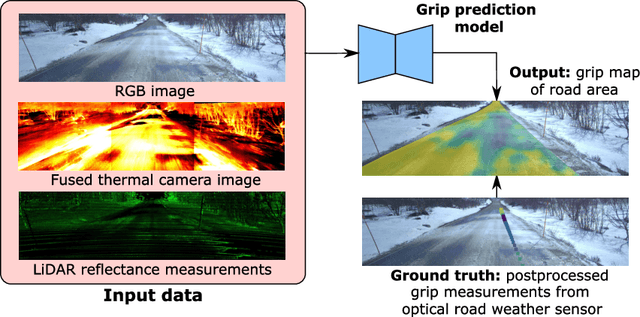
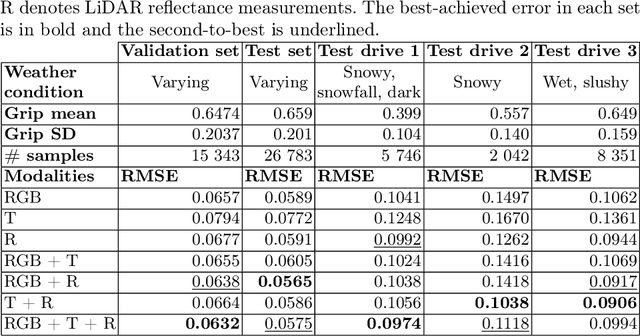
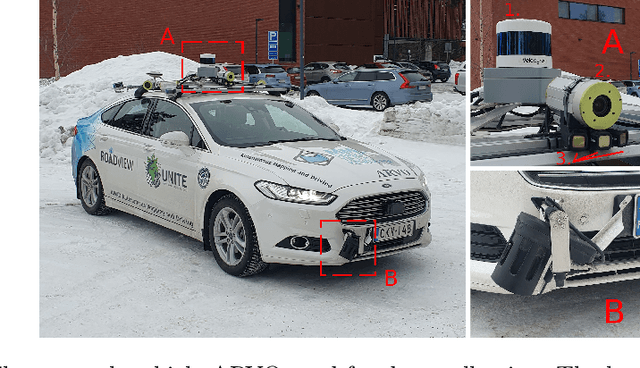
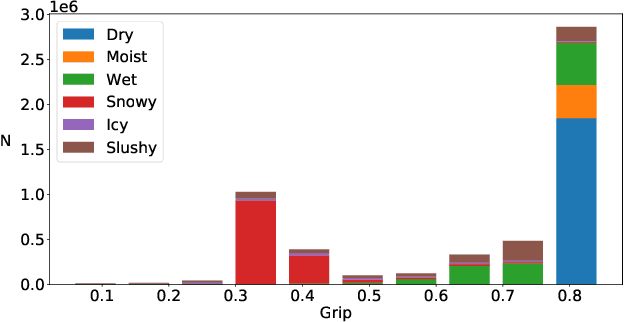
Slippery road weather conditions are prevalent in many regions and cause a regular risk for traffic. Still, there has been less research on how autonomous vehicles could detect slippery driving conditions on the road to drive safely. In this work, we propose a method to predict a dense grip map from the area in front of the car, based on postprocessed multimodal sensor data. We trained a convolutional neural network to predict pixelwise grip values from fused RGB camera, thermal camera, and LiDAR reflectance images, based on weakly supervised ground truth from an optical road weather sensor. The experiments show that it is possible to predict dense grip values with good accuracy from the used data modalities as the produced grip map follows both ground truth measurements and local weather conditions, such as snowy areas on the road. The model using only the RGB camera or LiDAR reflectance modality provided good baseline results for grip prediction accuracy while using models fusing the RGB camera, thermal camera, and LiDAR modalities improved the grip predictions significantly.
Towards High-Definition Maps: a Framework Leveraging Semantic Segmentation to Improve NDT Map Compression and Descriptivity
Jan 10, 2023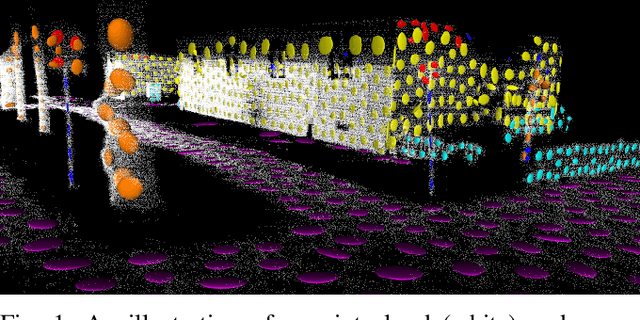
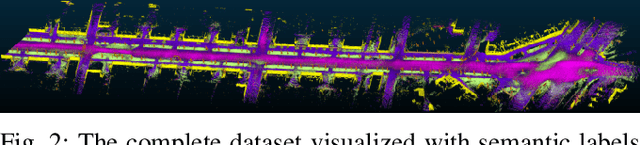
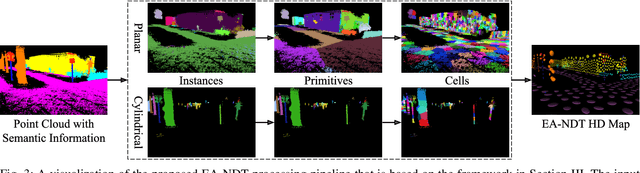
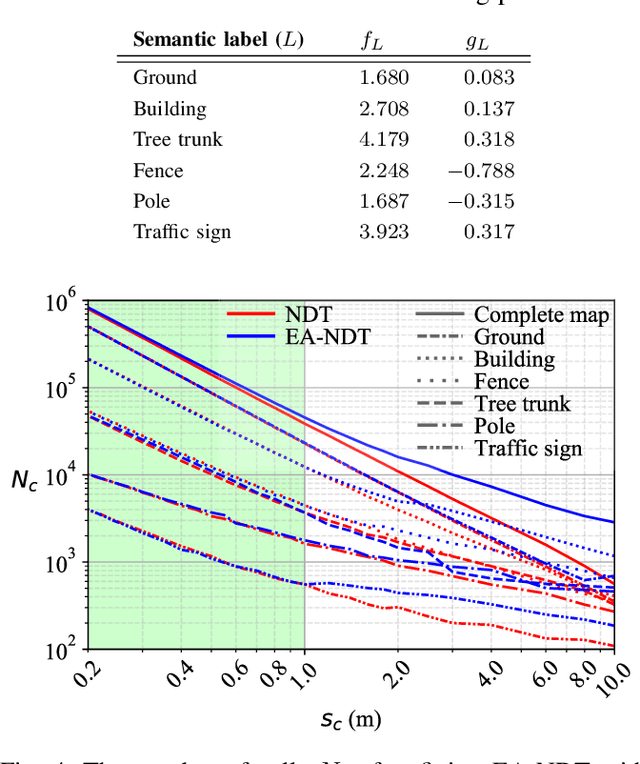
High-Definition (HD) maps are needed for robust navigation of autonomous vehicles, limited by the on-board storage capacity. To solve this, we propose a novel framework, Environment-Aware Normal Distributions Transform (EA-NDT), that significantly improves compression of standard NDT map representation. The compressed representation of EA-NDT is based on semantic-aided clustering of point clouds resulting in more optimal cells compared to grid cells of standard NDT. To evaluate EA-NDT, we present an open-source implementation that extracts planar and cylindrical primitive features from a point cloud and further divides them into smaller cells to represent the data as an EA-NDT HD map. We collected an open suburban environment dataset and evaluated EA-NDT HD map representation against the standard NDT representation. Compared to the standard NDT, EA-NDT achieved consistently at least 1.5x higher map compression while maintaining the same descriptive capability. Moreover, we showed that EA-NDT is capable of producing maps with significantly higher descriptivity score when using the same number of cells than the standard NDT.