 Add to Chrome
 Add to Firefox
 Add to Edge
Riverine Land Cover Mapping through Semantic Segmentation of Multispectral Point Clouds
Mar 23, 2026
Accurate land cover mapping in riverine environments is essential for effective river management, ecological understanding, and geomorphic change monitoring. This study explores the use of Point Transformer v2 (PTv2), an advanced deep neural network architecture designed for point cloud data, for land cover mapping through semantic segmentation of multispectral LiDAR data in real-world riverine environments. We utilize the geometric and spectral information from the 3-channel LiDAR point cloud to map land cover classes, including sand, gravel, low vegetation, high vegetation, forest floor, and water. The PTv2 model was trained and evaluated on point cloud data from the Oulanka river in northern Finland using both geometry and spectral features. To improve the model's generalization in new riverine environments, we additionally investigate multi-dataset training that adds sparsely annotated data from an additional river dataset. Results demonstrated that using the full-feature configuration resulted in performance with a mean Intersection over Union (mIoU) of 0.950, significantly outperforming the geometry baseline. Other ablation studies revealed that intensity and reflectance features were the key for accurate land cover mapping. The multi-dataset training experiment showed improved generalization performance, suggesting potential for developing more robust models despite limited high-quality annotated data. Our work demonstrates the potential of applying transformer-based architectures to multispectral point clouds in riverine environments. The approach offers new capabilities for monitoring sediment transport and other river management applications.

Multispectral airborne laser scanning for tree species classification: a benchmark of machine learning and deep learning algorithms
Apr 19, 2025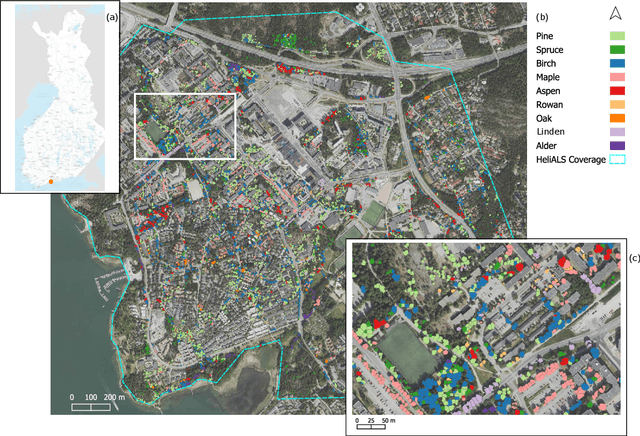
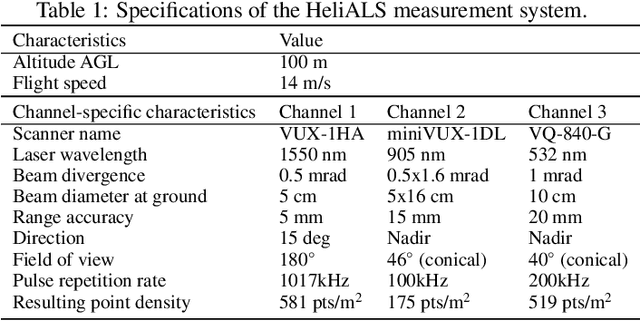
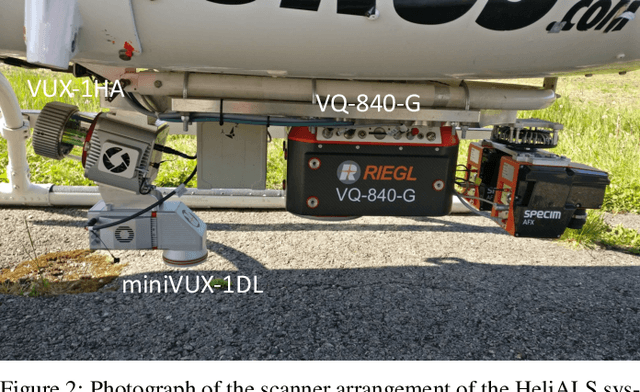
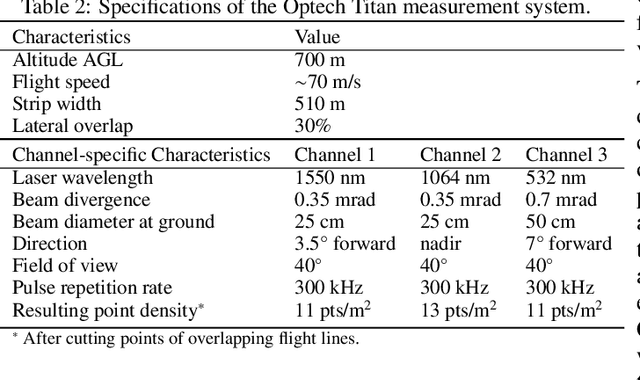
Climate-smart and biodiversity-preserving forestry demands precise information on forest resources, extending to the individual tree level. Multispectral airborne laser scanning (ALS) has shown promise in automated point cloud processing and tree segmentation, but challenges remain in identifying rare tree species and leveraging deep learning techniques. This study addresses these gaps by conducting a comprehensive benchmark of machine learning and deep learning methods for tree species classification. For the study, we collected high-density multispectral ALS data (>1000 pts/m$^2$) at three wavelengths using the FGI-developed HeliALS system, complemented by existing Optech Titan data (35 pts/m$^2$), to evaluate the species classification accuracy of various algorithms in a test site located in Southern Finland. Based on 5261 test segments, our findings demonstrate that point-based deep learning methods, particularly a point transformer model, outperformed traditional machine learning and image-based deep learning approaches on high-density multispectral point clouds. For the high-density ALS dataset, a point transformer model provided the best performance reaching an overall (macro-average) accuracy of 87.9% (74.5%) with a training set of 1065 segments and 92.0% (85.1%) with 5000 training segments. The best image-based deep learning method, DetailView, reached an overall (macro-average) accuracy of 84.3% (63.9%), whereas a random forest (RF) classifier achieved an overall (macro-average) accuracy of 83.2% (61.3%). Importantly, the overall classification accuracy of the point transformer model on the HeliALS data increased from 73.0% with no spectral information to 84.7% with single-channel reflectance, and to 87.9% with spectral information of all the three channels.