 Add to Chrome
 Add to Firefox
 Add to Edge
Distilled Reinforcement Learning for LLM Post-training
Jul 19, 2026
Large language model (LLM) post-training is essential for improving reasoning, adaptation, and alignment. Existing methods mainly follow two paradigms: reinforcement learning (RL) and on-policy distillation (OPD). However, RL relies on coarse-grained outcome supervision, resulting in difficult credit assignment and limited capability to acquire new knowledge. OPD, meanwhile, unconditionally matches teacher logits through KL divergence, which creates a dilemma: similar teachers provide little new knowledge, while substantially different teachers often yield ineffective guidance, largely restricting OPD to within-family distillation. We propose Distilled Reinforcement Learning (Distilled RL), which integrates teacher supervision into the RL objective to provide fine-grained guidance, selectively transfer new knowledge and avoid unconditional imitation. Distilled RL contains three components: reverse importance sampling with clipping, negative sample reset, and sequence-level geometric normalization. Through a concise and interpretable case study, we demonstrate that Distilled RL can effectively transfer previously unavailable knowledge from a teacher model to a student model. Extensive experiments across both within-family and cross-family distillation settings show that Distilled RL substantially outperforms standard RL and OPD in terms of both pass@1 and pass@k. Our code is available at https://github.com/597358816/Distilled-RL.

Attend to Evidence: Evidence-Anchored Spatial Attention Supervision for Multimodal RLVR
May 29, 2026Reinforcement learning with verifiable rewards (RLVR) improves vision-language models (VLMs) by optimizing outcome rewards derived from final answers. However, such outcome-only rewards do not tell the model which image regions justify an answer. For questions that require visual grounding, these rewards cannot distinguish responses supported by relevant visual evidence from those produced by language-prior shortcuts or lucky guesses. We introduce EASE (Evidence-Anchored Spatial Attention), which augments multimodal RLVR with visual-evidence process supervision. EASE converts annotated evidence regions into a smoothed visual-token target and uses it to guide response-to-image attention during RL training, but only on high-reward trajectories. The annotations are used solely as privileged training labels, while inference requires only the original image and question. Across Qwen2.5-VL-7B, Qwen3-VL-4B, and Qwen3-VL-8B, EASE raises average scores over DAPO by 2.5 to 3.1 points on perception, hallucination, visual math, and multimodal reasoning benchmarks. Diagnostics and ablations show that EASE better aligns visual attention with annotated evidence regions.
Distribution-Centric Policy Optimization Dominates Exploration-Exploitation Trade-off
Jan 19, 2026The exploration-exploitation (EE) trade-off is a central challenge in reinforcement learning (RL) for large language models (LLMs). With Group Relative Policy Optimization (GRPO), training tends to be exploitation driven: entropy decreases monotonically, samples convergence, and exploration fades. Most existing fixes are \textbf{sample-centric}: they seek or bonus rare samples, assuming exploration comes from novel trajectories and tokens. These heuristics depend on the "luck" of informative samples, lack principled control of the policy, and often yield limited or inconsistent gains. In this work, we are the first to introduce a \textbf{distribution-centric} perspective for RL, in which exploration is always guided by a "better" target distribution, and reveal that a policy's ability to resist entropy collapse is governed by the distribution itself rather than individual samples. Building on this insight, we propose Distribution-Centric Policy Optimization (DCPO), which reformulates entropy regulation as distribution-level regularization. DCPO achieves controllable entropy fully on-policy without sampling from external distributions, enabling efficient exploration while maintaining training stability. Across multiple models and seven benchmarks, DCPO improves over GRPO by about 20\% on average. Overall, DCPO replaces sample-level heuristics with distribution-level principles, offering a theoretically grounded and flexible framework for controllable exploration and a stronger EE trade-off. The code is available in https://github.com/597358816/DCPO.
Speech-to-Speech Translation with Discrete-Unit-Based Style Transfer
Sep 14, 2023
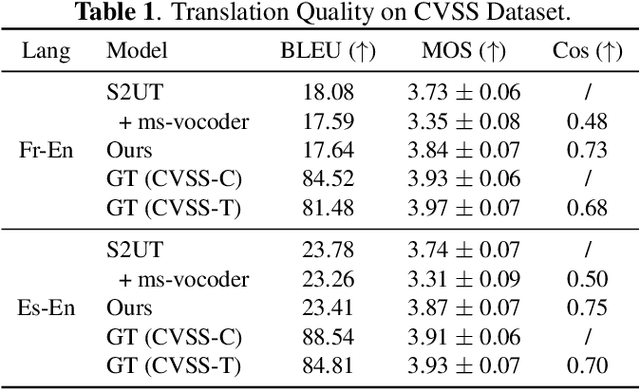
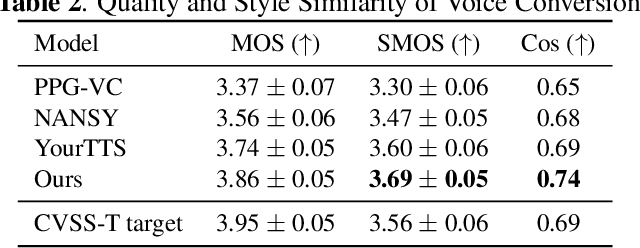
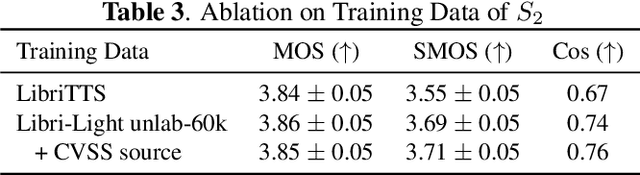
Direct speech-to-speech translation (S2ST) with discrete self-supervised representations has achieved remarkable accuracy, but is unable to preserve the speaker timbre of the source speech during translation. Meanwhile, the scarcity of high-quality speaker-parallel data poses a challenge for learning style transfer between source and target speech. We propose an S2ST framework with an acoustic language model based on discrete units from a self-supervised model and a neural codec for style transfer. The acoustic language model leverages self-supervised in-context learning, acquiring the ability for style transfer without relying on any speaker-parallel data, thereby overcoming the issue of data scarcity. By using extensive training data, our model achieves zero-shot cross-lingual style transfer on previously unseen source languages. Experiments show that our model generates translated speeches with high fidelity and style similarity. Audio samples are available at http://stylelm.github.io/ .