 Add to Chrome
 Add to Firefox
 Add to Edge
DVM: A Bytecode Virtual Machine Approach for Dynamic Tensor Computation
Apr 02, 2026
Dynamism is common in AI computation, e.g., the dynamic tensor shapes and the dynamic control flows in models. Due to the long compilation time, existing runtime compilation damages the model efficiency, while the offline compilers either suffer from the long compilation time and device memory footprint to cover all the possible execution instances of a dynamic model, or sacrifice optimization opportunities for usability. In this paper, we rethink the feasibility of runtime compilation for dynamic models and identify that the key for it to work is to speed up the compilation or hide the compilation overhead. To do this, we propose a real-time compiler, DVM. In DVM, we design a runtime operator compiler based on a bytecode virtual machine to perform effective and efficient compilation for each dynamic operator instance given its input. Specifically, instead of compiling programs into machine code, we encode the operator program into bytecode on the CPU and decode the bytecode into virtual instructions for direct execution on the NPU. Based on the runtime operator compiler, we further propose an operator fuser, which performs symbol-deduction-based fusion on static graphs and runtime fusion on dynamic graphs. Both pattern- and stacking-based fusion are supported to increase fusion opportunities. Evaluation on operators, subgraphs, and models shows that, compared with TorchInductor, PyTorch-eager and MindSpore-graph-O0, we are up to 11.77$\times$ better in terms of the operator/model efficiency and up to 5 orders of magnitude faster in terms of the maximum compilation time.

DVM: Real-Time Kernel Generation for Dynamic AI Models
Mar 25, 2026Dynamism is common in AI computation, e.g., the dynamic tensor shapes and the dynamic control flows in models. Due to the long compilation time, existing runtime compilation damages the model efficiency, while the offline compilers either suffer from the long compilation time and device memory footprint to cover all the possible execution instances of a dynamic model, or sacrifice optimization opportunities for usability. In this paper, we rethink the feasibility of runtime compilation for dynamic models and identify that the key for it to work is to speed up the compilation or hide the compilation overhead. To do this, we propose a real-time compiler, DVM. In DVM, we design a runtime operator compiler based on a bytecode virtual machine to perform effective and efficient compilation for each dynamic operator instance given its input. Specifically, instead of compiling programs into machine code, we encode the operator program into bytecode on the CPU and decode the bytecode into virtual instructions for direct execution on the NPU. Based on the runtime operator compiler, we further propose an operator fuser, which performs symbol-deduction-based fusion on static graphs and runtime fusion on dynamic graphs. Both pattern- and stacking-based fusion are supported to increase fusion opportunities. Evaluation on operators, subgraphs, and models shows that, compared with TorchInductor, PyTorch-eager and MindSpore-graph-O0, we are up to 11.77$\times$ better in terms of the operator/model efficiency and up to 5 orders of magnitude faster in terms of the maximum compilation time.
ErrorRadar: Benchmarking Complex Mathematical Reasoning of Multimodal Large Language Models Via Error Detection
Oct 06, 2024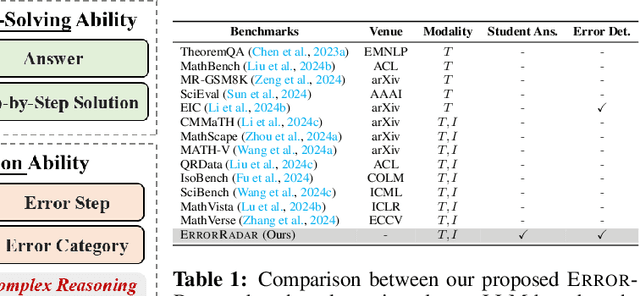
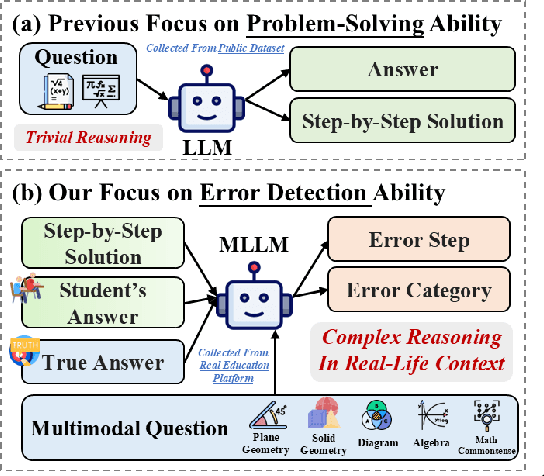
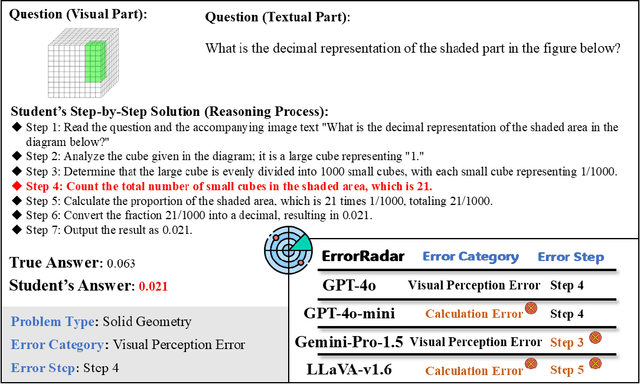
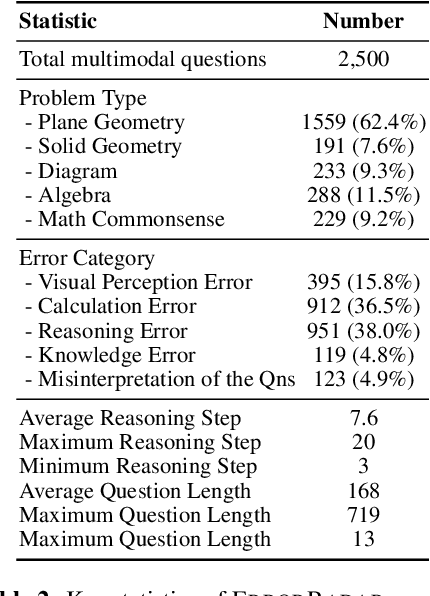
As the field of Multimodal Large Language Models (MLLMs) continues to evolve, their potential to revolutionize artificial intelligence is particularly promising, especially in addressing mathematical reasoning tasks. Current mathematical benchmarks predominantly focus on evaluating MLLMs' problem-solving ability, yet there is a crucial gap in addressing more complex scenarios such as error detection, for enhancing reasoning capability in complicated settings. To fill this gap, we formally formulate the new task: multimodal error detection, and introduce ErrorRadar, the first benchmark designed to assess MLLMs' capabilities in such a task. ErrorRadar evaluates two sub-tasks: error step identification and error categorization, providing a comprehensive framework for evaluating MLLMs' complex mathematical reasoning ability. It consists of 2,500 high-quality multimodal K-12 mathematical problems, collected from real-world student interactions in an educational organization, with rigorous annotation and rich metadata such as problem type and error category. Through extensive experiments, we evaluated both open-source and closed-source representative MLLMs, benchmarking their performance against educational expert evaluators. Results indicate significant challenges still remain, as GPT-4o with best performance is still around 10% behind human evaluation. The dataset will be available upon acceptance.