 Add to Chrome
 Add to Firefox
 Add to Edge
DVM: A Bytecode Virtual Machine Approach for Dynamic Tensor Computation
Apr 02, 2026
Dynamism is common in AI computation, e.g., the dynamic tensor shapes and the dynamic control flows in models. Due to the long compilation time, existing runtime compilation damages the model efficiency, while the offline compilers either suffer from the long compilation time and device memory footprint to cover all the possible execution instances of a dynamic model, or sacrifice optimization opportunities for usability. In this paper, we rethink the feasibility of runtime compilation for dynamic models and identify that the key for it to work is to speed up the compilation or hide the compilation overhead. To do this, we propose a real-time compiler, DVM. In DVM, we design a runtime operator compiler based on a bytecode virtual machine to perform effective and efficient compilation for each dynamic operator instance given its input. Specifically, instead of compiling programs into machine code, we encode the operator program into bytecode on the CPU and decode the bytecode into virtual instructions for direct execution on the NPU. Based on the runtime operator compiler, we further propose an operator fuser, which performs symbol-deduction-based fusion on static graphs and runtime fusion on dynamic graphs. Both pattern- and stacking-based fusion are supported to increase fusion opportunities. Evaluation on operators, subgraphs, and models shows that, compared with TorchInductor, PyTorch-eager and MindSpore-graph-O0, we are up to 11.77$\times$ better in terms of the operator/model efficiency and up to 5 orders of magnitude faster in terms of the maximum compilation time.

DVM: Real-Time Kernel Generation for Dynamic AI Models
Mar 25, 2026Dynamism is common in AI computation, e.g., the dynamic tensor shapes and the dynamic control flows in models. Due to the long compilation time, existing runtime compilation damages the model efficiency, while the offline compilers either suffer from the long compilation time and device memory footprint to cover all the possible execution instances of a dynamic model, or sacrifice optimization opportunities for usability. In this paper, we rethink the feasibility of runtime compilation for dynamic models and identify that the key for it to work is to speed up the compilation or hide the compilation overhead. To do this, we propose a real-time compiler, DVM. In DVM, we design a runtime operator compiler based on a bytecode virtual machine to perform effective and efficient compilation for each dynamic operator instance given its input. Specifically, instead of compiling programs into machine code, we encode the operator program into bytecode on the CPU and decode the bytecode into virtual instructions for direct execution on the NPU. Based on the runtime operator compiler, we further propose an operator fuser, which performs symbol-deduction-based fusion on static graphs and runtime fusion on dynamic graphs. Both pattern- and stacking-based fusion are supported to increase fusion opportunities. Evaluation on operators, subgraphs, and models shows that, compared with TorchInductor, PyTorch-eager and MindSpore-graph-O0, we are up to 11.77$\times$ better in terms of the operator/model efficiency and up to 5 orders of magnitude faster in terms of the maximum compilation time.
AKG kernel Agent: A Multi-Agent Framework for Cross-Platform Kernel Synthesis
Dec 29, 2025Modern AI models demand high-performance computation kernels. The growing complexity of LLMs, multimodal architectures, and recommendation systems, combined with techniques like sparsity and quantization, creates significant computational challenges. Moreover, frequent hardware updates and diverse chip architectures further complicate this landscape, requiring tailored kernel implementations for each platform. However, manual optimization cannot keep pace with these demands, creating a critical bottleneck in AI system development. Recent advances in LLM code generation capabilities have opened new possibilities for automating kernel development. In this work, we propose AKG kernel agent (AI-driven Kernel Generator), a multi-agent system that automates kernel generation, migration, and performance tuning. AKG kernel agent is designed to support multiple domain-specific languages (DSLs), including Triton, TileLang, CPP, and CUDA-C, enabling it to target different hardware backends while maintaining correctness and portability. The system's modular design allows rapid integration of new DSLs and hardware targets. When evaluated on KernelBench using Triton DSL across GPU and NPU backends, AKG kernel agent achieves an average speedup of 1.46$\times$ over PyTorch Eager baselines implementations, demonstrating its effectiveness in accelerating kernel development for modern AI workloads.
PolyTOPS: Reconfigurable and Flexible Polyhedral Scheduler
Jan 12, 2024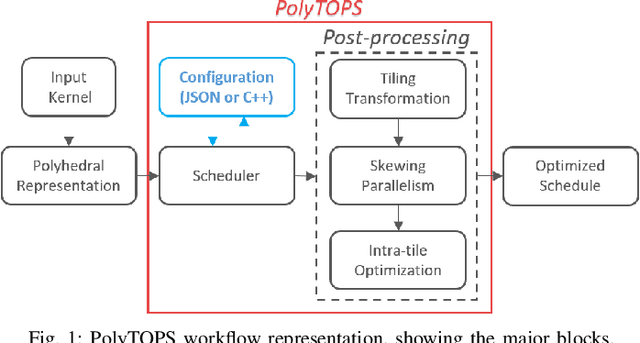
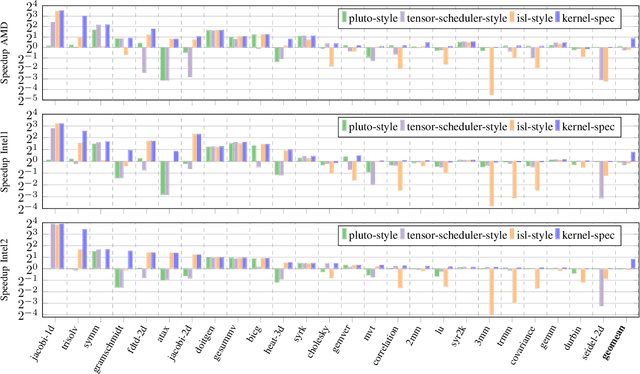
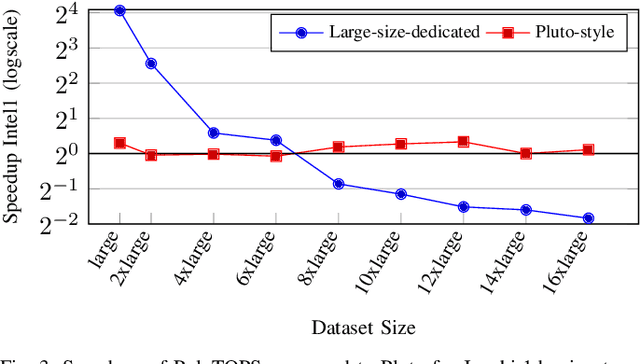
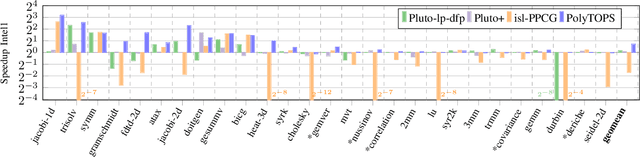
Polyhedral techniques have been widely used for automatic code optimization in low-level compilers and higher-level processes. Loop optimization is central to this technique, and several polyhedral schedulers like Feautrier, Pluto, isl and Tensor Scheduler have been proposed, each of them targeting a different architecture, parallelism model, or application scenario. The need for scenario-specific optimization is growing due to the heterogeneity of architectures. One of the most critical cases is represented by NPUs (Neural Processing Units) used for AI, which may require loop optimization with different objectives. Another factor to be considered is the framework or compiler in which polyhedral optimization takes place. Different scenarios, depending on the target architecture, compilation environment, and application domain, may require different kinds of optimization to best exploit the architecture feature set. We introduce a new configurable polyhedral scheduler, PolyTOPS, that can be adjusted to various scenarios with straightforward, high-level configurations. This scheduler allows the creation of diverse scheduling strategies that can be both scenario-specific (like state-of-the-art schedulers) and kernel-specific, breaking the concept of a one-size-fits-all scheduler approach. PolyTOPS has been used with isl and CLooG as code generators and has been integrated in MindSpore AKG deep learning compiler. Experimental results in different scenarios show good performance: a geomean speedup of 7.66x on MindSpore (for the NPU Ascend architecture) hybrid custom operators over isl scheduling, a geomean speedup up to 1.80x on PolyBench on different multicore architectures over Pluto scheduling. Finally, some comparisons with different state-of-the-art tools are presented in the PolyMage scenario.