 Add to Chrome
 Add to Firefox
 Add to Edge
Learning Trajectory-Aware Multimodal Large Language Models for Video Reasoning Segmentation
Mar 23, 2026
The prosperity of Multimodal Large Language Models (MLLMs) has stimulated the demand for video reasoning segmentation, which aims to segment video objects based on human instructions. Previous studies rely on unidirectional and implicit text-trajectory alignment, which struggles with trajectory perception when faced with severe video dynamics. In this work, we propose TrajSeg, a simple and unified framework built upon MLLMs. Concretely, we introduce bidirectional text-trajectory alignment, where MLLMs accept grounding-intended (text-to-trajectory) and captioning-intended (trajectory-to-text) instructions. This way, MLLMs can benefit from enhanced correspondence and better perceive object trajectories in videos. The mask generation from trajectories is achieved via a frame-level content integration (FCI) module and a unified mask decoder. The former adapts the MLLM-parsed trajectory-level token to frame-specific information. The latter unifies segmentation for all frames into a single structure, enabling the proposed framework to be simplified and end-to-end trainable. Extensive experiments on referring and reasoning video segmentation datasets demonstrate the effectiveness of TrajSeg, which outperforms all video reasoning segmentation methods on all metrics. The code will be publicly available at https://github.com/haodi19/TrajSeg.

Show Me When and Where: Towards Referring Video Object Segmentation in the Wild
Mar 15, 2026Referring video object segmentation (RVOS) has recently generated great popularity in computer vision due to its widespread applications. Existing RVOS setting contains elaborately trimmed videos, with text-referred objects always appearing in all frames, which however fail to fully reflect the realistic challenges of this task. This simplified setting requires RVOS methods to only predict where objects, with no need to show when the objects appear. In this work, we introduce a new setting towards in-the-wild RVOS. To this end, we collect a new benchmark dataset using Youtube Untrimmed videos for RVOS - YoURVOS, which contains 1,120 in-the-wild videos with 7 times more duration and scenes than existing datasets. Our new benchmark challenges RVOS methods to show not only where but also when objects appear in videos. To set a baseline, we propose Object-level Multimodal TransFormers (OMFormer) to tackle the challenges, which are characterized by encoding object-level multimodal interactions for efficient and global spatial-temporal localisation. We demonstrate that previous VOS methods struggle on our YoURVOS benchmark, especially with the increase of target-absent frames, while our OMFormer consistently performs well. Our YoURVOS dataset offers an imperative benchmark, which will push forward the advancement of RVOS methods for practical applications.
PVUW 2024 Challenge on Complex Video Understanding: Methods and Results
Jun 24, 2024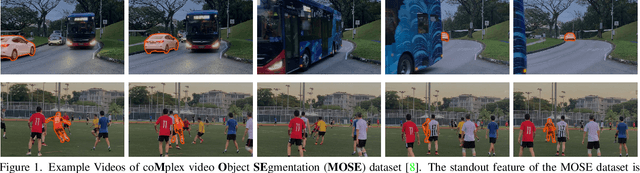
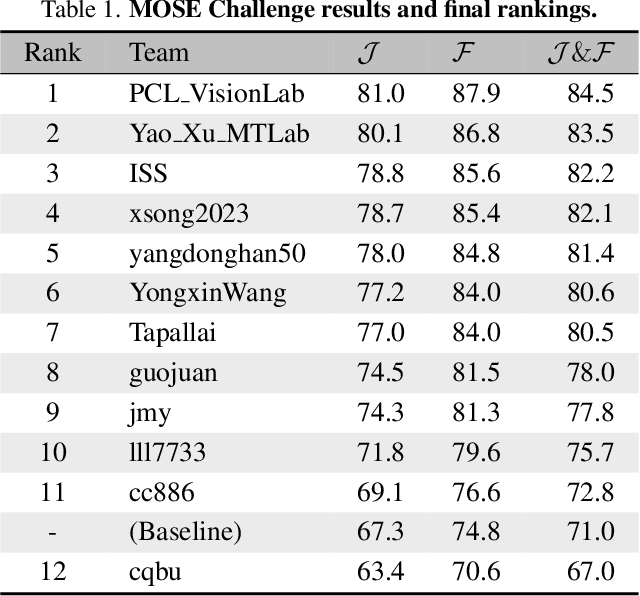

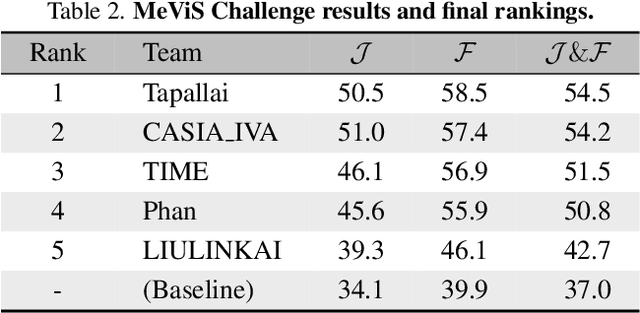
Pixel-level Video Understanding in the Wild Challenge (PVUW) focus on complex video understanding. In this CVPR 2024 workshop, we add two new tracks, Complex Video Object Segmentation Track based on MOSE dataset and Motion Expression guided Video Segmentation track based on MeViS dataset. In the two new tracks, we provide additional videos and annotations that feature challenging elements, such as the disappearance and reappearance of objects, inconspicuous small objects, heavy occlusions, and crowded environments in MOSE. Moreover, we provide a new motion expression guided video segmentation dataset MeViS to study the natural language-guided video understanding in complex environments. These new videos, sentences, and annotations enable us to foster the development of a more comprehensive and robust pixel-level understanding of video scenes in complex environments and realistic scenarios. The MOSE challenge had 140 registered teams in total, 65 teams participated the validation phase and 12 teams made valid submissions in the final challenge phase. The MeViS challenge had 225 registered teams in total, 50 teams participated the validation phase and 5 teams made valid submissions in the final challenge phase.
1st Place Solution for MeViS Track in CVPR 2024 PVUW Workshop: Motion Expression guided Video Segmentation
Jun 11, 2024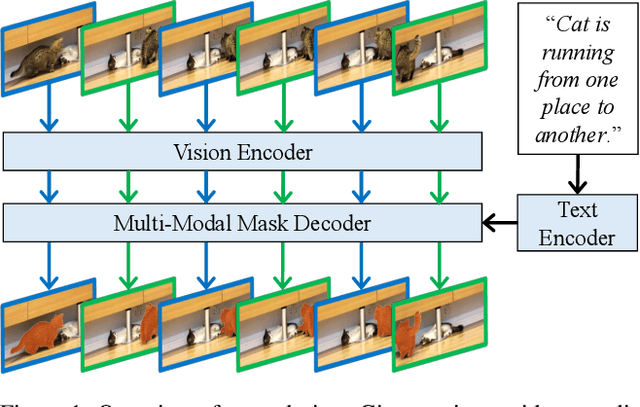
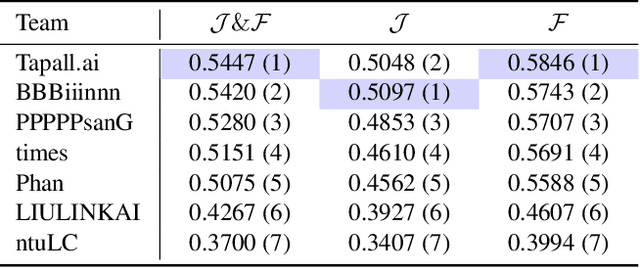
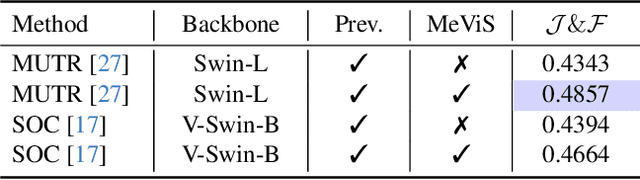
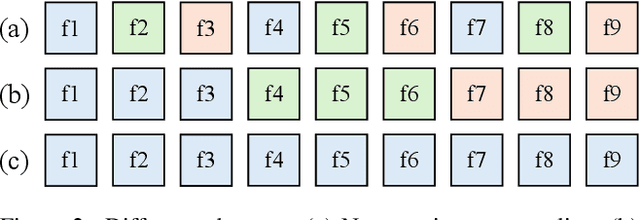
Motion Expression guided Video Segmentation (MeViS), as an emerging task, poses many new challenges to the field of referring video object segmentation (RVOS). In this technical report, we investigated and validated the effectiveness of static-dominant data and frame sampling on this challenging setting. Our solution achieves a J&F score of 0.5447 in the competition phase and ranks 1st in the MeViS track of the PVUW Challenge. The code is available at: https://github.com/Tapall-AI/MeViS_Track_Solution_2024.