 Add to Chrome
 Add to Firefox
 Add to Edge
LEIQ-Assessor: Multi-dimensional Quality Assessment of Low-light Enhanced Images via Multi-task Learning
Jun 29, 2026
Low-light image enhancement algorithms (LIEAs) aim to improve the visibility of images captured under poor illumination. However, the enhancement process often introduces artifacts such as noise amplification, color shift, structural damage, and over-exposure, which degrade the perceptual quality of the enhanced images. Therefore, a reliable image quality assessment (IQA) metric for evaluating enhancement effects is of great importance for both the development of LIEAs and their practical applications. In this paper, we present \textbf{LEIQ-Assessor}, a multi-dimensional quality assessment model for low-light image enhancement based on multi-task learning, developed for the QoMEX 2026 Grand Challenge on Low-light Enhanced Image Quality Assessment. Specifically, our method leverages a pre-trained SigLIP2 Vision Transformer as the backbone and simultaneously predicts the overall Mean Opinion Score (MOS) together with six perceptual sub-attributes: lightness, color fidelity, noise level, exposure quality, naturalness, and content recovery. By jointly optimizing these correlated objectives via the PLCC loss, the shared representation captures richer quality-aware features than its single-task counterpart. Experiments on the MLE benchmark demonstrate that LEIQ-Assessor significantly outperforms existing no-reference IQA models and hand-crafted quality descriptors. Our method achieved second place in the QoMEX 2026 Grand Challenge on Low-light Enhanced Image Quality Assessment. The code is available at https://github.com/sunwei925/LEIQ-Assessor.

NTIRE 2026 The 3rd Restore Any Image Model (RAIM) Challenge: Professional Image Quality Assessment (Track 1)
Apr 14, 2026In this paper, we present an overview of the NTIRE 2026 challenge on the 3rd Restore Any Image Model in the Wild, specifically focusing on Track 1: Professional Image Quality Assessment. Conventional Image Quality Assessment (IQA) typically relies on scalar scores. By compressing complex visual characteristics into a single number, these methods fundamentally struggle to distinguish subtle differences among uniformly high-quality images. Furthermore, they fail to articulate why one image is superior, lacking the reasoning capabilities required to provide guidance for vision tasks. To bridge this gap, recent advancements in Multimodal Large Language Models (MLLMs) offer a promising paradigm. Inspired by this potential, our challenge establishes a novel benchmark exploring the ability of MLLMs to mimic human expert cognition in evaluating high-quality image pairs. Participants were tasked with overcoming critical bottlenecks in professional scenarios, centering on two primary objectives: (1) Comparative Quality Selection: reliably identifying the visually superior image within a high-quality pair; and (2) Interpretative Reasoning: generating grounded, expert-level explanations that detail the rationale behind the selection. In total, the challenge attracted nearly 200 registrations and over 2,500 submissions. The top-performing methods significantly advanced the state of the art in professional IQA. The challenge dataset is available at https://github.com/narthchin/RAIM-PIQA, and the official homepage is accessible at https://www.codabench.org/competitions/12789/.
DTactive: A Vision-Based Tactile Sensor with Active Surface
Oct 10, 2024The development of vision-based tactile sensors has significantly enhanced robots' perception and manipulation capabilities, especially for tasks requiring contact-rich interactions with objects. In this work, we present DTactive, a novel vision-based tactile sensor with active surfaces. DTactive inherits and modifies the tactile 3D shape reconstruction method of DTact while integrating a mechanical transmission mechanism that facilitates the mobility of its surface. Thanks to this design, the sensor is capable of simultaneously performing tactile perception and in-hand manipulation with surface movement. Leveraging the high-resolution tactile images from the sensor and the magnetic encoder data from the transmission mechanism, we propose a learning-based method to enable precise angular trajectory control during in-hand manipulation. In our experiments, we successfully achieved accurate rolling manipulation within the range of [ -180{\deg},180{\deg} ] on various objects, with the root mean square error between the desired and actual angular trajectories being less than 12{\deg} on nine trained objects and less than 19{\deg} on three novel objects. The results demonstrate the potential of DTactive for in-hand object manipulation in terms of effectiveness, robustness and precision.
9DTact: A Compact Vision-Based Tactile Sensor for Accurate 3D Shape Reconstruction and Generalizable 6D Force Estimation
Aug 28, 2023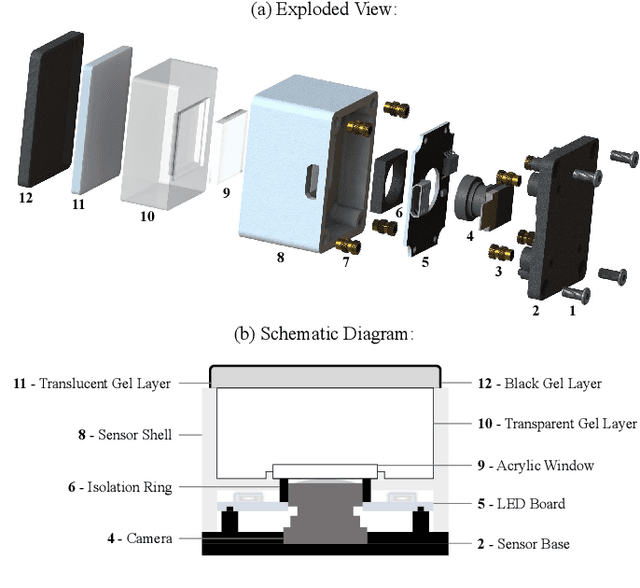

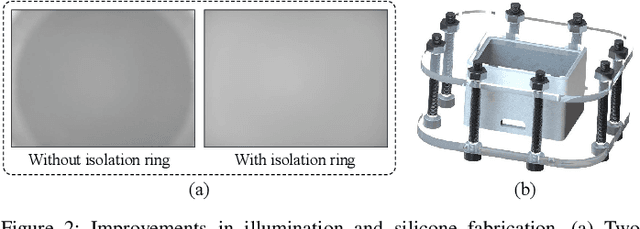
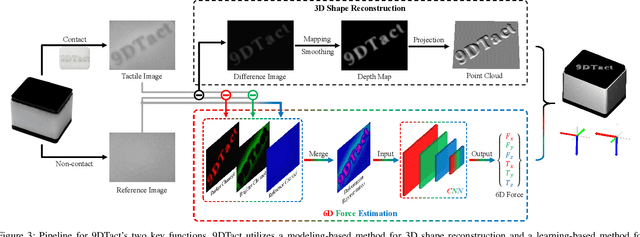
The advancements in vision-based tactile sensors have boosted the aptitude of robots to perform contact-rich manipulation, particularly when precise positioning and contact state of the manipulated objects are crucial for successful execution. In this work, we present 9DTact, a straightforward yet versatile tactile sensor that offers 3D shape reconstruction and 6D force estimation capabilities. Conceptually, 9DTact is designed to be highly compact, robust, and adaptable to various robotic platforms. Moreover, it is low-cost and DIY-friendly, requiring minimal assembly skills. Functionally, 9DTact builds upon the optical principles of DTact and is optimized to achieve 3D shape reconstruction with enhanced accuracy and efficiency. Remarkably, we leverage the optical and deformable properties of the translucent gel so that 9DTact can perform 6D force estimation without the participation of auxiliary markers or patterns on the gel surface. More specifically, we collect a dataset consisting of approximately 100,000 image-force pairs from 175 complex objects and train a neural network to regress the 6D force, which can generalize to unseen objects. To promote the development and applications of vision-based tactile sensors, we open-source both the hardware and software of 9DTact as well as present a 1-hour video tutorial.