 Add to Chrome
 Add to Firefox
 Add to Edge
What's in a Name? Beyond Class Indices for Image Recognition
Apr 05, 2023
Existing machine learning models demonstrate excellent performance in image object recognition after training on a large-scale dataset under full supervision. However, these models only learn to map an image to a predefined class index, without revealing the actual semantic meaning of the object in the image. In contrast, vision-language models like CLIP are able to assign semantic class names to unseen objects in a `zero-shot' manner, although they still rely on a predefined set of candidate names at test time. In this paper, we reconsider the recognition problem and task a vision-language model to assign class names to images given only a large and essentially unconstrained vocabulary of categories as prior information. We use non-parametric methods to establish relationships between images which allow the model to automatically narrow down the set of possible candidate names. Specifically, we propose iteratively clustering the data and voting on class names within them, showing that this enables a roughly 50\% improvement over the baseline on ImageNet. Furthermore, we tackle this problem both in unsupervised and partially supervised settings, as well as with a coarse-grained and fine-grained search space as the unconstrained dictionary.

MRCN: A Novel Modality Restitution and Compensation Network for Visible-Infrared Person Re-identification
Mar 26, 2023Visible-infrared person re-identification (VI-ReID), which aims to search identities across different spectra, is a challenging task due to large cross-modality discrepancy between visible and infrared images. The key to reduce the discrepancy is to filter out identity-irrelevant interference and effectively learn modality-invariant person representations. In this paper, we propose a novel Modality Restitution and Compensation Network (MRCN) to narrow the gap between the two modalities. Specifically, we first reduce the modality discrepancy by using two Instance Normalization (IN) layers. Next, to reduce the influence of IN layers on removing discriminative information and to reduce modality differences, we propose a Modality Restitution Module (MRM) and a Modality Compensation Module (MCM) to respectively distill modality-irrelevant and modality-relevant features from the removed information. Then, the modality-irrelevant features are used to restitute to the normalized visible and infrared features, while the modality-relevant features are used to compensate for the features of the other modality. Furthermore, to better disentangle the modality-relevant features and the modality-irrelevant features, we propose a novel Center-Quadruplet Causal (CQC) loss to encourage the network to effectively learn the modality-relevant features and the modality-irrelevant features. Extensive experiments are conducted to validate the superiority of our method on the challenging SYSU-MM01 and RegDB datasets. More remarkably, our method achieves 95.1% in terms of Rank-1 and 89.2% in terms of mAP on the RegDB dataset.
Integrated Design of Cooperative Area Coverage and Target Tracking with Multi-UAV System
Mar 16, 2023This paper systematically studies the cooperative area coverage and target tracking problem of multiple-unmanned aerial vehicles (multi-UAVs). The problem is solved by decomposing into three sub-problems: information fusion, task assignment, and multi-UAV behavior decision-making. Specifically, in the information fusion process, we use the maximum consistency protocol to update the joint estimation states of multi-targets (JESMT) and the area detection information. The area detection information is represented by the equivalent visiting time map (EVTM), which is built based on the detection probability and the actual visiting time of the area. Then, we model the task assignment problem of multi-UAV searching and tracking multi-targets as a network flow model with upper and lower flow bounds. An algorithm named task assignment minimum-cost maximum-flow (TAMM) is proposed. Cooperative behavior decision-making uses Fisher information as the mission reward to obtain the optimal tracking action of the UAV. Furthermore, a coverage behavior decision-making algorithm based on the anti-flocking method is designed for those UAVs assigned the coverage task. Finally, a distributed multi-UAV cooperative area coverage and target tracking algorithm is designed, which integrates information fusion, task assignment, and behavioral decision-making. Numerical and hardware-in-the-loop simulation results show that the proposed method can achieve persistent area coverage and cooperative target tracking.
Adaptive incentive for cross-silo federated learning: A multi-agent reinforcement learning approach
Feb 15, 2023


Cross-silo federated learning (FL) is a typical FL that enables organizations(e.g., financial or medical entities) to train global models on isolated data. Reasonable incentive is key to encouraging organizations to contribute data. However, existing works on incentivizing cross-silo FL lack consideration of the environmental dynamics (e.g., precision of the trained global model and data owned by uncertain clients during the training processes). Moreover, most of them assume that organizations share private information, which is unrealistic. To overcome these limitations, we propose a novel adaptive mechanism for cross-silo FL, towards incentivizing organizations to contribute data to maximize their long-term payoffs in a real dynamic training environment. The mechanism is based on multi-agent reinforcement learning, which learns near-optimal data contribution strategy from the history of potential games without organizations' private information. Experiments demonstrate that our mechanism achieves adaptive incentive and effectively improves the long-term payoffs for organizations.
Standing Between Past and Future: Spatio-Temporal Modeling for Multi-Camera 3D Multi-Object Tracking
Feb 07, 2023This work proposes an end-to-end multi-camera 3D multi-object tracking (MOT) framework. It emphasizes spatio-temporal continuity and integrates both past and future reasoning for tracked objects. Thus, we name it "Past-and-Future reasoning for Tracking" (PF-Track). Specifically, our method adapts the "tracking by attention" framework and represents tracked instances coherently over time with object queries. To explicitly use historical cues, our "Past Reasoning" module learns to refine the tracks and enhance the object features by cross-attending to queries from previous frames and other objects. The "Future Reasoning" module digests historical information and predicts robust future trajectories. In the case of long-term occlusions, our method maintains the object positions and enables re-association by integrating motion predictions. On the nuScenes dataset, our method improves AMOTA by a large margin and remarkably reduces ID-Switches by 90% compared to prior approaches, which is an order of magnitude less. The code and models are made available at https://github.com/TRI-ML/PF-Track.
Predicting Molecule-Target Interaction by Learning Biomedical Network and Molecule Representations
Feb 06, 2023The study of molecule-target interaction is quite important for drug discovery in terms of target identification, hit identification, pathway study, drug-drug interaction, etc. Most existing methodologies utilize either biomedical network information or molecule structural features to predict potential interaction link. However, the biomedical network information based methods usually suffer from cold start problem, while structure based methods often give limited performance due to the structure/interaction assumption and data quality. To address these issues, we propose a pseudo-siamese Graph Neural Network method, namely MTINet+, which learns both biomedical network topological and molecule structural/chemical information as representations to predict potential interaction of given molecule and target pair. In MTINet+, 1-hop subgraphs of given molecule and target pair are extracted from known interaction of biomedical network as topological information, meanwhile the molecule structural and chemical attributes are processed as molecule information. MTINet+ learns these two types of information as embedding features for predicting the pair link. In the experiments of different molecule-target interaction tasks, MTINet+ significantly outperforms over the state-of-the-art baselines. In addition, in our designed network sparsity experiments , MTINet+ shows strong robustness against different sparse biomedical networks.
Multi-scale multi-modal micro-expression recognition algorithm based on transformer
Jan 11, 2023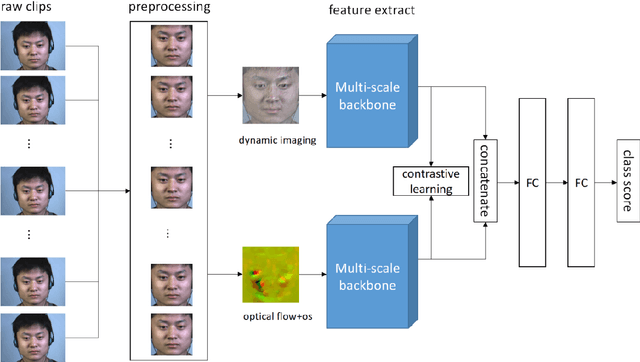


A micro-expression is a spontaneous unconscious facial muscle movement that can reveal the true emotions people attempt to hide. Although manual methods have made good progress and deep learning is gaining prominence. Due to the short duration of micro-expression and different scales of expressed in facial regions, existing algorithms cannot extract multi-modal multi-scale facial region features while taking into account contextual information to learn underlying features. Therefore, in order to solve the above problems, a multi-modal multi-scale algorithm based on transformer network is proposed in this paper, aiming to fully learn local multi-grained features of micro-expressions through two modal features of micro-expressions - motion features and texture features. To obtain local area features of the face at different scales, we learned patch features at different scales for both modalities, and then fused multi-layer multi-headed attention weights to obtain effective features by weighting the patch features, and combined cross-modal contrastive learning for model optimization. We conducted comprehensive experiments on three spontaneous datasets, and the results show the accuracy of the proposed algorithm in single measurement SMIC database is up to 78.73% and the F1 value on CASMEII of the combined database is up to 0.9071, which is at the leading level.
Breaking the "Object" in Video Object Segmentation
Dec 12, 2022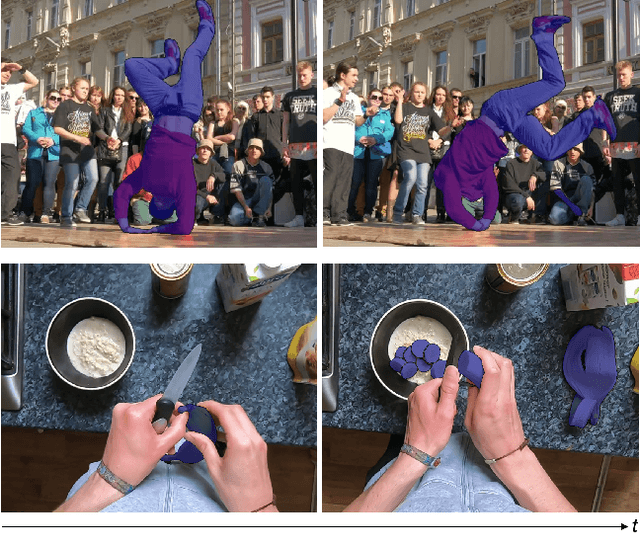

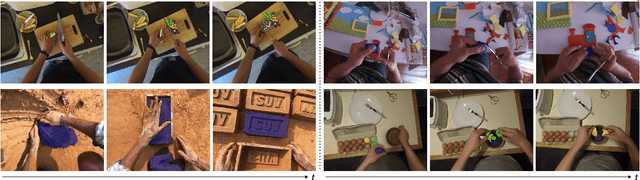
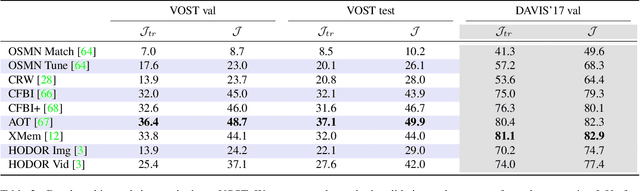
The appearance of an object can be fleeting when it transforms. As eggs are broken or paper is torn, their color, shape and texture can change dramatically, preserving virtually nothing of the original except for the identity itself. Yet, this important phenomenon is largely absent from existing video object segmentation (VOS) benchmarks. In this work, we close the gap by collecting a new dataset for Video Object Segmentation under Transformations (VOST). It consists of more than 700 high-resolution videos, captured in diverse environments, which are 20 seconds long on average and densely labeled with instance masks. A careful, multi-step approach is adopted to ensure that these videos focus on complex object transformations, capturing their full temporal extent. We then extensively evaluate state-of-the-art VOS methods and make a number of important discoveries. In particular, we show that existing methods struggle when applied to this novel task and that their main limitation lies in over-reliance on static appearance cues. This motivates us to propose a few modifications for the top-performing baseline that improve its capabilities by better modeling spatio-temporal information. But more broadly, the hope is to stimulate discussion on learning more robust video object representations.
ShaSTA: Modeling Shape and Spatio-Temporal Affinities for 3D Multi-Object Tracking
Nov 08, 2022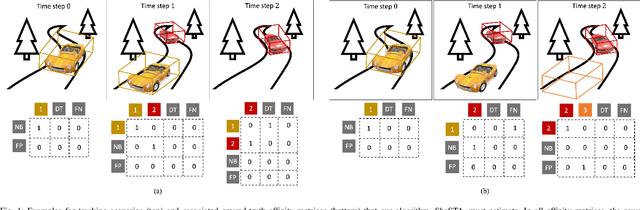
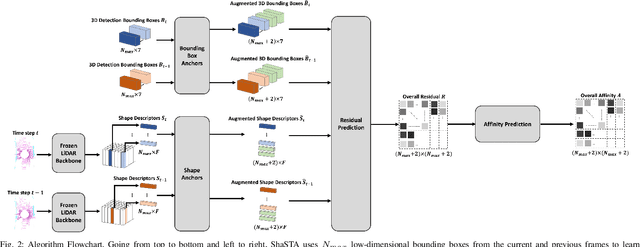
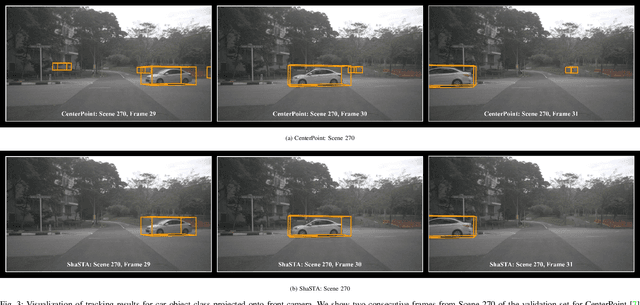
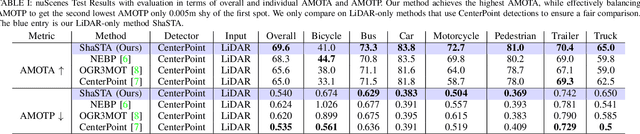
Multi-object tracking is a cornerstone capability of any robotic system. Most approaches follow a tracking-by-detection paradigm. However, within this framework, detectors function in a low precision-high recall regime, ensuring a low number of false-negatives while producing a high rate of false-positives. This can negatively affect the tracking component by making data association and track lifecycle management more challenging. Additionally, false-negative detections due to difficult scenarios like occlusions can negatively affect tracking performance. Thus, we propose a method that learns shape and spatio-temporal affinities between consecutive frames to better distinguish between true-positive and false-positive detections and tracks, while compensating for false-negative detections. Our method provides a probabilistic matching of detections that leads to robust data association and track lifecycle management. We quantitatively evaluate our method through ablative experiments and on the nuScenes tracking benchmark where we achieve state-of-the-art results. Our method not only estimates accurate, high-quality tracks but also decreases the overall number of false-positive and false-negative tracks. Please see our project website for source code and demo videos: sites.google.com/view/shasta-3d-mot/home.
Automatic Change-Point Detection in Time Series via Deep Learning
Nov 07, 2022Detecting change-points in data is challenging because of the range of possible types of change and types of behaviour of data when there is no change. Statistically efficient methods for detecting a change will depend on both of these features, and it can be difficult for a practitioner to develop an appropriate detection method for their application of interest. We show how to automatically generate new detection methods based on training a neural network. Our approach is motivated by many existing tests for the presence of a change-point being able to be represented by a simple neural network, and thus a neural network trained with sufficient data should have performance at least as good as these methods. We present theory that quantifies the error rate for such an approach, and how it depends on the amount of training data. Empirical results show that, even with limited training data, its performance is competitive with the standard CUSUM test for detecting a change in mean when the noise is independent and Gaussian, and can substantially outperform it in the presence of auto-correlated or heavy-tailed noise. Our method also shows strong results in detecting and localising changes in activity based on accelerometer data.