 Add to Chrome
 Add to Firefox
 Add to Edge
Frequency-Controlled Diffusion Model for Versatile Text-Guided Image-to-Image Translation
Jul 03, 2024
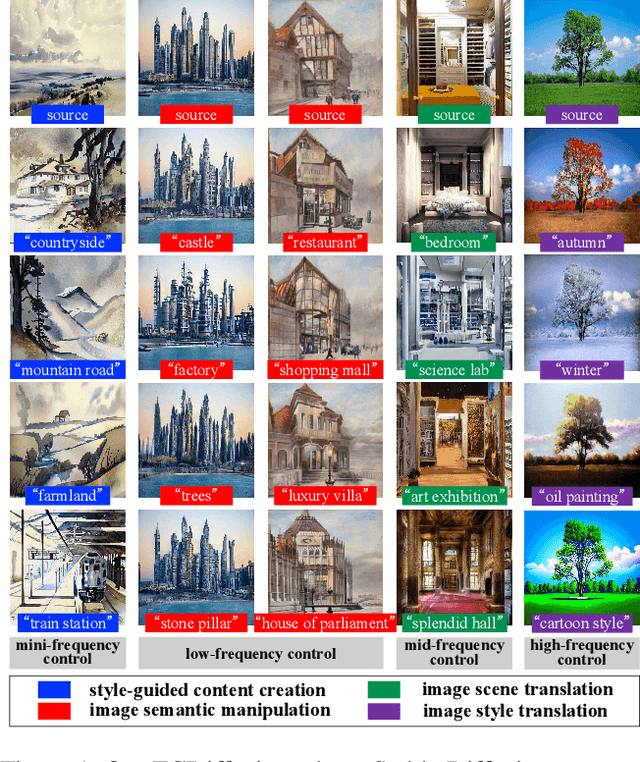
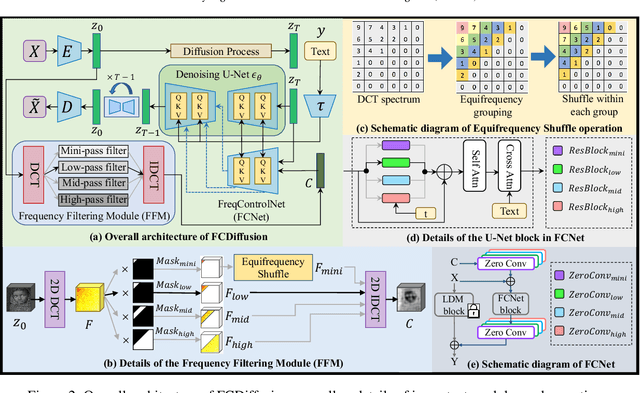
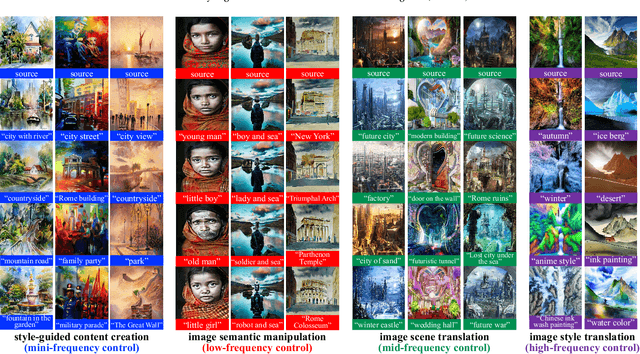

Recently, large-scale text-to-image (T2I) diffusion models have emerged as a powerful tool for image-to-image translation (I2I), allowing open-domain image translation via user-provided text prompts. This paper proposes frequency-controlled diffusion model (FCDiffusion), an end-to-end diffusion-based framework that contributes a novel solution to text-guided I2I from a frequency-domain perspective. At the heart of our framework is a feature-space frequency-domain filtering module based on Discrete Cosine Transform, which filters the latent features of the source image in the DCT domain, yielding filtered image features bearing different DCT spectral bands as different control signals to the pre-trained Latent Diffusion Model. We reveal that control signals of different DCT spectral bands bridge the source image and the T2I generated image in different correlations (e.g., style, structure, layout, contour, etc.), and thus enable versatile I2I applications emphasizing different I2I correlations, including style-guided content creation, image semantic manipulation, image scene translation, and image style translation. Different from related approaches, FCDiffusion establishes a unified text-guided I2I framework suitable for diverse image translation tasks simply by switching among different frequency control branches at inference time. The effectiveness and superiority of our method for text-guided I2I are demonstrated with extensive experiments both qualitatively and quantitatively. The code is publicly available at: https://github.com/XiangGao1102/FCDiffusion.
* Proceedings of the 38th AAAI Conference on Artificial Intelligence (AAAI 2024)

Coding for Intelligence from the Perspective of Category
Jul 02, 2024


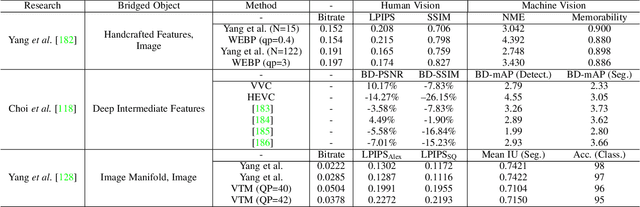
Coding, which targets compressing and reconstructing data, and intelligence, often regarded at an abstract computational level as being centered around model learning and prediction, interweave recently to give birth to a series of significant progress. The recent trends demonstrate the potential homogeneity of these two fields, especially when deep-learning models aid these two categories for better probability modeling. For better understanding and describing from a unified perspective, inspired by the basic generally recognized principles in cognitive psychology, we formulate a novel problem of Coding for Intelligence from the category theory view. Based on the three axioms: existence of ideal coding, existence of practical coding, and compactness promoting generalization, we derive a general framework to understand existing methodologies, namely that, coding captures the intrinsic relationships of objects as much as possible, while ignoring information irrelevant to downstream tasks. This framework helps identify the challenges and essential elements in solving the specific derived Minimal Description Length (MDL) optimization problem from a broader range, providing opportunities to build a more intelligent system for handling multiple tasks/applications with coding ideas/tools. Centering on those elements, we systematically review recent processes of towards optimizing the MDL problem in more comprehensive ways from data, model, and task perspectives, and reveal their impacts on the potential CfI technical routes. After that, we also present new technique paths to fulfill CfI and provide potential solutions with preliminary experimental evidence. Last, further directions and remaining issues are discussed as well. The discussion shows our theory can reveal many phenomena and insights about large foundation models, which mutually corroborate with recent practices in feature learning.
Using Large Language Models to Assist Video Content Analysis: An Exploratory Study of Short Videos on Depression
Jun 27, 2024


Despite the growing interest in leveraging Large Language Models (LLMs) for content analysis, current studies have primarily focused on text-based content. In the present work, we explored the potential of LLMs in assisting video content analysis by conducting a case study that followed a new workflow of LLM-assisted multimodal content analysis. The workflow encompasses codebook design, prompt engineering, LLM processing, and human evaluation. We strategically crafted annotation prompts to get LLM Annotations in structured form and explanation prompts to generate LLM Explanations for a better understanding of LLM reasoning and transparency. To test LLM's video annotation capabilities, we analyzed 203 keyframes extracted from 25 YouTube short videos about depression. We compared the LLM Annotations with those of two human coders and found that LLM has higher accuracy in object and activity Annotations than emotion and genre Annotations. Moreover, we identified the potential and limitations of LLM's capabilities in annotating videos. Based on the findings, we explore opportunities and challenges for future research and improvements to the workflow. We also discuss ethical concerns surrounding future studies based on LLM-assisted video analysis.
Self-Supervised Skeleton Action Representation Learning: A Benchmark and Beyond
Jun 05, 2024Self-supervised learning (SSL), which aims to learn meaningful prior representations from unlabeled data, has been proven effective for label-efficient skeleton-based action understanding. Different from the image domain, skeleton data possesses sparser spatial structures and diverse representation forms, with the absence of background clues and the additional temporal dimension. This presents the new challenges for the pretext task design of spatial-temporal motion representation learning. Recently, many endeavors have been made for skeleton-based SSL and remarkable progress has been achieved. However, a systematic and thorough review is still lacking. In this paper, we conduct, for the first time, a comprehensive survey on self-supervised skeleton-based action representation learning, where various literature is organized according to their pre-training pretext task methodologies. Following the taxonomy of context-based, generative learning, and contrastive learning approaches, we make a thorough review and benchmark of existing works and shed light on the future possible directions. Our investigation demonstrates that most SSL works rely on the single paradigm, learning representations of a single level, and are evaluated on the action recognition task solely, which leaves the generalization power of skeleton SSL models under-explored. To this end, a novel and effective SSL method for skeleton is further proposed, which integrates multiple pretext tasks to jointly learn versatile representations of different granularity, substantially boosting the generalization capacity for different downstream tasks. Extensive experiments under three large-scale datasets demonstrate that the proposed method achieves the superior generalization performance on various downstream tasks, including recognition, retrieval, detection, and few-shot learning.
Algorithmic Fairness: A Tolerance Perspective
Apr 26, 2024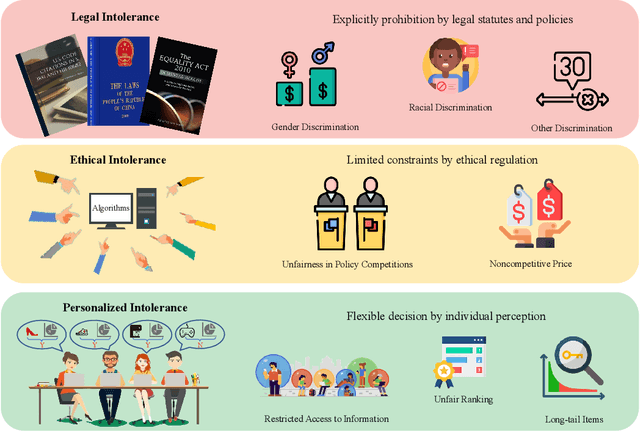


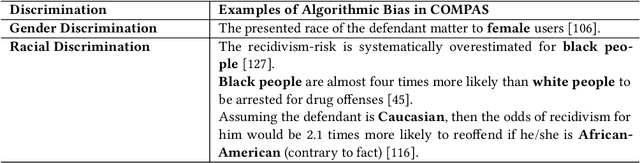
Recent advancements in machine learning and deep learning have brought algorithmic fairness into sharp focus, illuminating concerns over discriminatory decision making that negatively impacts certain individuals or groups. These concerns have manifested in legal, ethical, and societal challenges, including the erosion of trust in intelligent systems. In response, this survey delves into the existing literature on algorithmic fairness, specifically highlighting its multifaceted social consequences. We introduce a novel taxonomy based on 'tolerance', a term we define as the degree to which variations in fairness outcomes are acceptable, providing a structured approach to understanding the subtleties of fairness within algorithmic decisions. Our systematic review covers diverse industries, revealing critical insights into the balance between algorithmic decision making and social equity. By synthesizing these insights, we outline a series of emerging challenges and propose strategic directions for future research and policy making, with the goal of advancing the field towards more equitable algorithmic systems.
Correcting Diffusion-Based Perceptual Image Compression with Privileged End-to-End Decoder
Apr 07, 2024

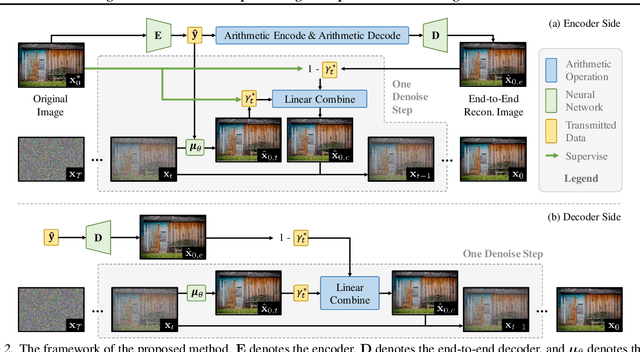
The images produced by diffusion models can attain excellent perceptual quality. However, it is challenging for diffusion models to guarantee distortion, hence the integration of diffusion models and image compression models still needs more comprehensive explorations. This paper presents a diffusion-based image compression method that employs a privileged end-to-end decoder model as correction, which achieves better perceptual quality while guaranteeing the distortion to an extent. We build a diffusion model and design a novel paradigm that combines the diffusion model and an end-to-end decoder, and the latter is responsible for transmitting the privileged information extracted at the encoder side. Specifically, we theoretically analyze the reconstruction process of the diffusion models at the encoder side with the original images being visible. Based on the analysis, we introduce an end-to-end convolutional decoder to provide a better approximation of the score function $\nabla_{\mathbf{x}_t}\log p(\mathbf{x}_t)$ at the encoder side and effectively transmit the combination. Experiments demonstrate the superiority of our method in both distortion and perception compared with previous perceptual compression methods.
Zero-Reference Low-Light Enhancement via Physical Quadruple Priors
Mar 19, 2024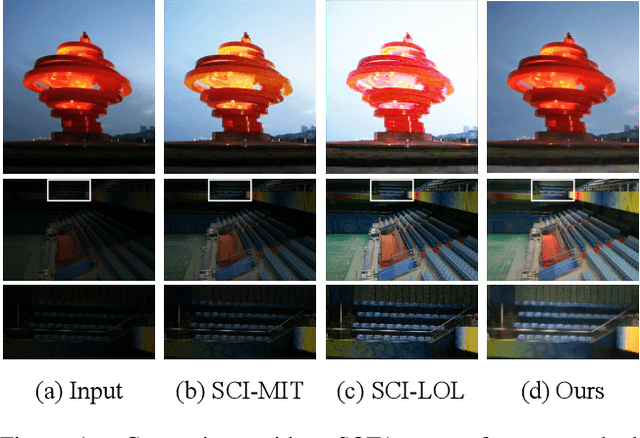


Understanding illumination and reducing the need for supervision pose a significant challenge in low-light enhancement. Current approaches are highly sensitive to data usage during training and illumination-specific hyper-parameters, limiting their ability to handle unseen scenarios. In this paper, we propose a new zero-reference low-light enhancement framework trainable solely with normal light images. To accomplish this, we devise an illumination-invariant prior inspired by the theory of physical light transfer. This prior serves as the bridge between normal and low-light images. Then, we develop a prior-to-image framework trained without low-light data. During testing, this framework is able to restore our illumination-invariant prior back to images, automatically achieving low-light enhancement. Within this framework, we leverage a pretrained generative diffusion model for model ability, introduce a bypass decoder to handle detail distortion, as well as offer a lightweight version for practicality. Extensive experiments demonstrate our framework's superiority in various scenarios as well as good interpretability, robustness, and efficiency. Code is available on our project homepage: http://daooshee.github.io/QuadPrior-Website/
Diffusion Enhancement for Cloud Removal in Ultra-Resolution Remote Sensing Imagery
Jan 25, 2024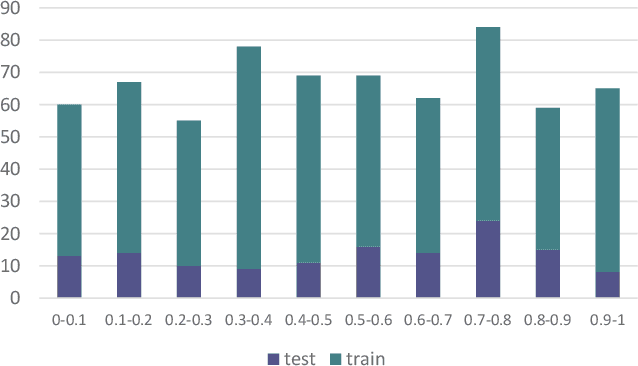
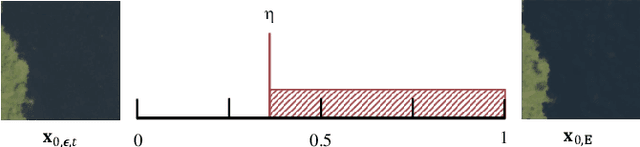
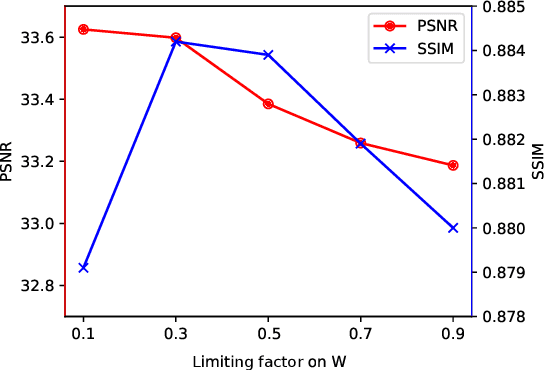
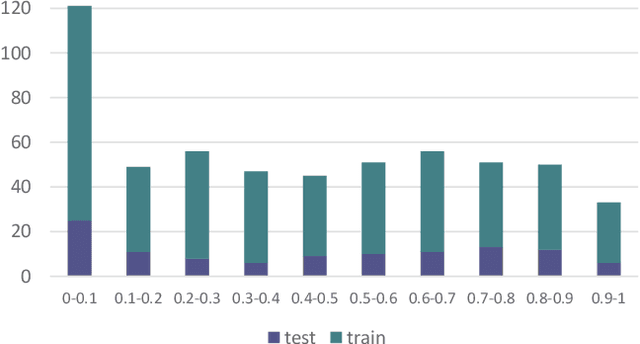
The presence of cloud layers severely compromises the quality and effectiveness of optical remote sensing (RS) images. However, existing deep-learning (DL)-based Cloud Removal (CR) techniques encounter difficulties in accurately reconstructing the original visual authenticity and detailed semantic content of the images. To tackle this challenge, this work proposes to encompass enhancements at the data and methodology fronts. On the data side, an ultra-resolution benchmark named CUHK Cloud Removal (CUHK-CR) of 0.5m spatial resolution is established. This benchmark incorporates rich detailed textures and diverse cloud coverage, serving as a robust foundation for designing and assessing CR models. From the methodology perspective, a novel diffusion-based framework for CR called Diffusion Enhancement (DE) is proposed to perform progressive texture detail recovery, which mitigates the training difficulty with improved inference accuracy. Additionally, a Weight Allocation (WA) network is developed to dynamically adjust the weights for feature fusion, thereby further improving performance, particularly in the context of ultra-resolution image generation. Furthermore, a coarse-to-fine training strategy is applied to effectively expedite training convergence while reducing the computational complexity required to handle ultra-resolution images. Extensive experiments on the newly established CUHK-CR and existing datasets such as RICE confirm that the proposed DE framework outperforms existing DL-based methods in terms of both perceptual quality and signal fidelity.
Prompted Contrast with Masked Motion Modeling: Towards Versatile 3D Action Representation Learning
Aug 08, 2023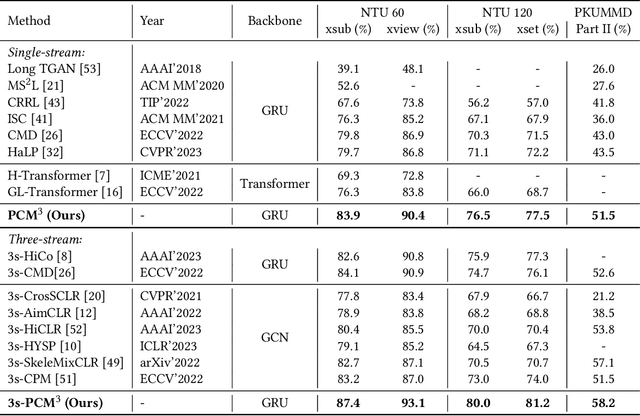
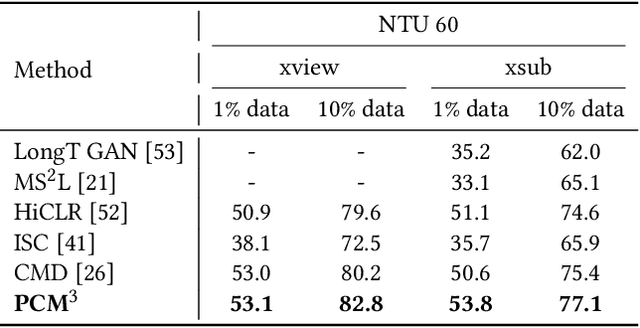
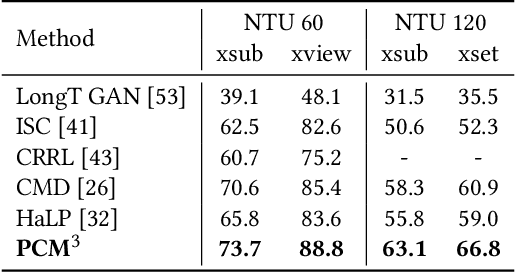
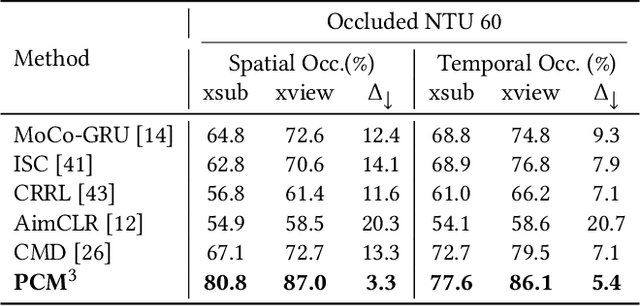
Self-supervised learning has proved effective for skeleton-based human action understanding, which is an important yet challenging topic. Previous works mainly rely on contrastive learning or masked motion modeling paradigm to model the skeleton relations. However, the sequence-level and joint-level representation learning cannot be effectively and simultaneously handled by these methods. As a result, the learned representations fail to generalize to different downstream tasks. Moreover, combining these two paradigms in a naive manner leaves the synergy between them untapped and can lead to interference in training. To address these problems, we propose Prompted Contrast with Masked Motion Modeling, PCM$^{\rm 3}$, for versatile 3D action representation learning. Our method integrates the contrastive learning and masked prediction tasks in a mutually beneficial manner, which substantially boosts the generalization capacity for various downstream tasks. Specifically, masked prediction provides novel training views for contrastive learning, which in turn guides the masked prediction training with high-level semantic information. Moreover, we propose a dual-prompted multi-task pretraining strategy, which further improves model representations by reducing the interference caused by learning the two different pretext tasks. Extensive experiments on five downstream tasks under three large-scale datasets are conducted, demonstrating the superior generalization capacity of PCM$^{\rm 3}$ compared to the state-of-the-art works. Our project is publicly available at: https://jhang2020.github.io/Projects/PCM3/PCM3.html .
Similarity Min-Max: Zero-Shot Day-Night Domain Adaptation
Jul 19, 2023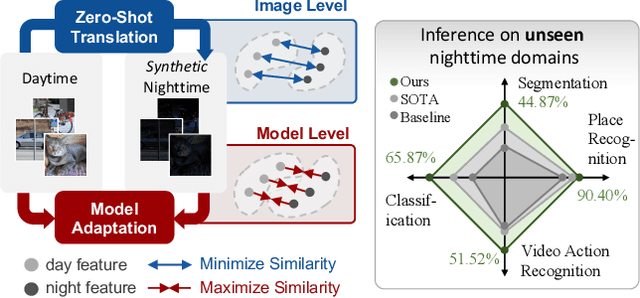
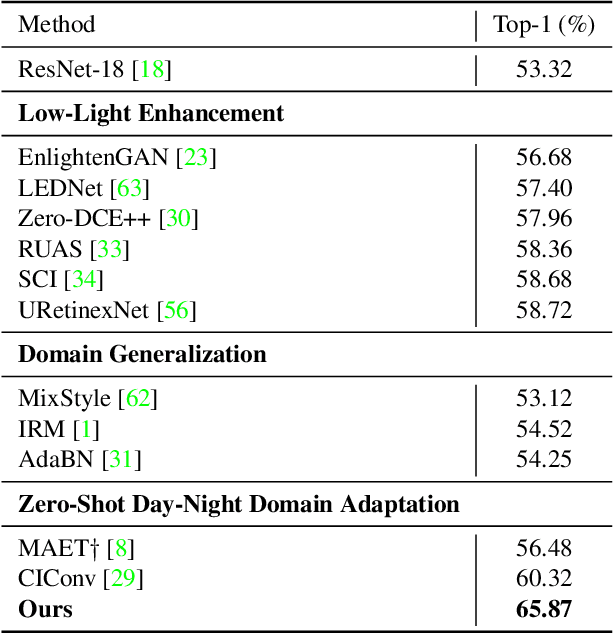
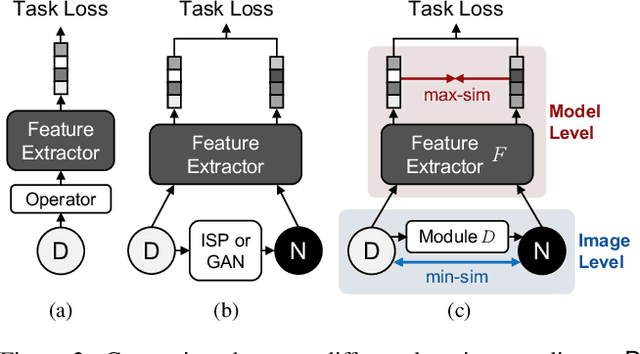

Low-light conditions not only hamper human visual experience but also degrade the model's performance on downstream vision tasks. While existing works make remarkable progress on day-night domain adaptation, they rely heavily on domain knowledge derived from the task-specific nighttime dataset. This paper challenges a more complicated scenario with border applicability, i.e., zero-shot day-night domain adaptation, which eliminates reliance on any nighttime data. Unlike prior zero-shot adaptation approaches emphasizing either image-level translation or model-level adaptation, we propose a similarity min-max paradigm that considers them under a unified framework. On the image level, we darken images towards minimum feature similarity to enlarge the domain gap. Then on the model level, we maximize the feature similarity between the darkened images and their normal-light counterparts for better model adaptation. To the best of our knowledge, this work represents the pioneering effort in jointly optimizing both aspects, resulting in a significant improvement of model generalizability. Extensive experiments demonstrate our method's effectiveness and broad applicability on various nighttime vision tasks, including classification, semantic segmentation, visual place recognition, and video action recognition. Code and pre-trained models are available at https://red-fairy.github.io/ZeroShotDayNightDA-Webpage/.