 Add to Chrome
 Add to Firefox
 Add to Edge
mmRadarTwin: A Measurement-Calibrated Signal-Level Digital Twin Platform for Indoor mmWave Radar
Jul 30, 2026
Indoor mmWave radar perception is difficult to reproduce because measured range-angle responses depend on scene geometry, material response, multipath, hardware conventions, and signal processing. Existing ray-tracing and digital-twin tools often expose rendering, channel, or path-level quantities, while radar sensing requires complex signal products that can be processed and compared in the same domain as real FMCW measurements. We present mmRadarTwin, a signal-level and path-attributed digital-twin platform for indoor mmWave radar. mmRadarTwin links a real radar measurement branch with an Unreal Engine scene-simulation branch through a shared receive-channel and range-angle processing interface. The simulator writes complex multi-channel receive grids and exports per-path contribution records that identify the actor, material tag, propagation event, and output-bin support of each simulated return. We evaluate mmRadarTwin in an office deployment using a commodity monostatic mmWave radar and mobile scene-capture hardware. Across 154 measured poses spanning 22 radar locations, the current physics-only path-basis simulator recalls 70.8% of measurement-active geometry-supported response regions in the central usable field of view while exposing residuals caused by weak or missing path support, shifted responses, unsupported anchors, and missing physical mechanisms. Rather than claiming complete radar-map reconstruction or cross-room generalization, mmRadarTwin establishes a practical systems workflow for constructing, comparing, and diagnosing indoor radar digital twins.

TouchWorld: A Predictive and Reactive Tactile Foundation Model for Dexterous Manipulation
Jul 09, 2026Dexterous manipulation in everyday environments requires both anticipation and reaction: a robot must predict how contact should evolve while rapidly correcting local errors caused by slip, misalignment, unstable grasping, or force mismatch. Vision and language provide semantic and geometric guidance, but they cannot reliably reveal hidden contact states such as force, slip, and contact stability. Although tactile sensing exposes these physical cues, most existing policies treat touch as a low-frequency observation stream within a monolithic action model, coupling slow task reasoning, action generation, and fast contact feedback in a single loop. We introduce TouchWorld, a predictive-and-reactive tactile foundation model for dexterous manipulation. TouchWorld uses a hierarchical policy that separates vision-language subtask planning, tactile world-model prediction, visuo-tactile goal-conditioned action generation, and high-frequency tactile residual refinement. A High-Level Planning Layer produces executable subtasks and predicts tactile subgoals; a Visuo-Tactile Goal-Conditioned Policy generates nominal action chunks; and a Tactile-Conditioned Refinement Policy performs online residual correction using recent tactile and proprioceptive feedback. By using touch as both a predictive contact reference and a fast feedback signal, TouchWorld preserves the semantic generalization of vision-language-action policies while improving local contact adaptation. Across six long-horizon and contact-rich dexterous manipulation tasks, TouchWorld achieves 65.0% success in the clean setting and 53.7% success under human perturbations, outperforming the strongest baseline by 15.7 and 18.5 percentage points, respectively.
TouchAnything: A Dataset and Framework for Bimanual Tactile Estimation from Egocentric Video
May 13, 2026Egocentric human video data, which captures rich human-environment interactions and can be collected at scale, has become a key driver of embodied intelligence research. However, existing egocentric datasets typically lack tactile sensing, a critical modality that provides direct cues about contact, force, and pressure in human-object interaction. Without such signals, models struggle to learn physically grounded representations of real-world interaction dynamics. While tactile sensors provide these cues, deploying high-quality tactile hardware at scale remains expensive and cumbersome. This raises a central question: can tactile feedback be inferred directly from visual observations, enabling scalable tactile supervision for egocentric video data and supporting physically grounded embodied learning? To enable research in this direction, we introduce EgoTouch, a large-scale multi-view egocentric dataset with dense tactile supervision for bimanual hand-object interaction. EgoTouch comprises 208 manipulation tasks spanning 1,891 episodes in diverse indoor and outdoor environments, with synchronized multi-view RGB (head-mounted egocentric and dual wrist-mounted cameras), bimanual 3D hand pose, and continuous pressure maps from wearable tactile sensors. Building on EgoTouch, we introduce TouchAnything, a baseline multi-view vision-to-touch prediction framework that uses the egocentric view as the primary input and flexibly leverages available wrist-mounted views at inference time. Experiments show that incorporating wrist-mounted views generally improves tactile prediction over egocentric-only input, achieving up to 5.0% relative improvement in Contact IoU and 6.1% relative improvement in Volumetric IoU. We will publicly release the dataset, code, and benchmark.
Inject Once Survive Later: Backdooring Vision-Language-Action Models to Persist Through Downstream Fine-tuning
Jan 31, 2026Vision-Language-Action (VLA) models have become foundational to modern embodied AI systems. By integrating visual perception, language understanding, and action planning, they enable general-purpose task execution across diverse environments. Despite their importance, the security of VLA models remains underexplored -- particularly in the context of backdoor attacks, which pose realistic threats in physical-world deployments. While recent methods attempt to inject backdoors into VLA models, these backdoors are easily erased during downstream adaptation, as user-side fine-tuning with clean data significantly alters model parameters, rendering them impractical for real-world applications. To address these challenges, we propose INFUSE (INjection into Fine-tUne-inSensitive modulEs), the first backdoor attack framework for VLA base models that remains effective even with arbitrary user fine-tuning. INFUSE begins by analyzing parameter sensitivity across diverse fine-tuning scenarios to identify modules that remain largely unchanged -- the fine-tune-insensitive modules. It then injects backdoors into these stable modules while freezing the rest, ensuring malicious behavior persists after extensive user fine-tuning. Comprehensive experiments across multiple VLA architectures demonstrate INFUSE's effectiveness. After user-side fine-tuning, INFUSE maintains mean attack success rates of 91.0% on simulation environments and 79.8% on real-world robot tasks, substantially surpassing BadVLA (38.8% and 36.6%, respectively), while preserving clean-task performance comparable to standard models. These results uncover a critical threat: backdoors implanted before distribution can persist through fine-tuning and remain effective at deployment.
ConLA: Contrastive Latent Action Learning from Human Videos for Robotic Manipulation
Jan 31, 2026Vision-Language-Action (VLA) models achieve preliminary generalization through pretraining on large scale robot teleoperation datasets. However, acquiring datasets that comprehensively cover diverse tasks and environments is extremely costly and difficult to scale. In contrast, human demonstration videos offer a rich and scalable source of diverse scenes and manipulation behaviors, yet their lack of explicit action supervision hinders direct utilization. Prior work leverages VQ-VAE based frameworks to learn latent actions from human videos in an unsupervised manner. Nevertheless, since the training objective primarily focuses on reconstructing visual appearances rather than capturing inter-frame dynamics, the learned representations tend to rely on spurious visual cues, leading to shortcut learning and entangled latent representations that hinder transferability. To address this, we propose ConLA, an unsupervised pretraining framework for learning robotic policies from human videos. ConLA introduces a contrastive disentanglement mechanism that leverages action category priors and temporal cues to isolate motion dynamics from visual content, effectively mitigating shortcut learning. Extensive experiments show that ConLA achieves strong performance across diverse benchmarks. Notably, by pretraining solely on human videos, our method for the first time surpasses the performance obtained with real robot trajectory pretraining, highlighting its ability to extract pure and semantically consistent latent action representations for scalable robot learning.
Clarifying Semantics of In-Context Examples for Unit Test Generation
Oct 02, 2025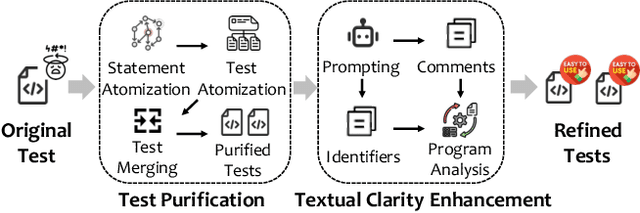
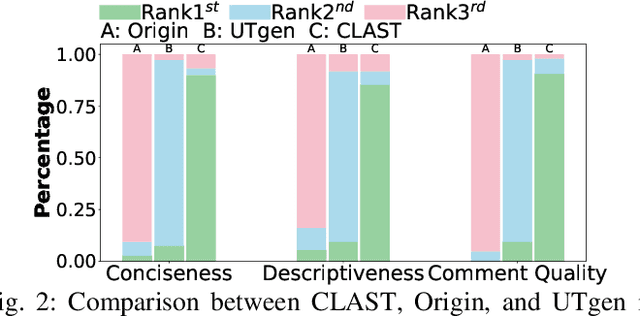
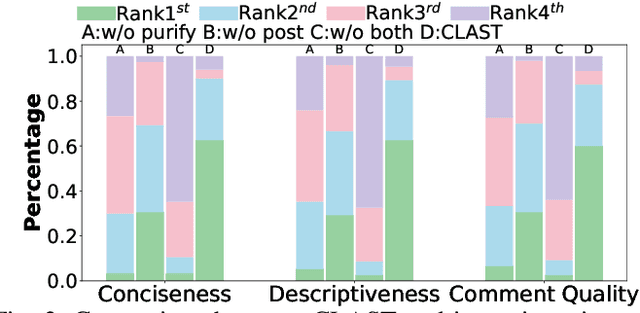

Recent advances in large language models (LLMs) have enabled promising performance in unit test generation through in-context learning (ICL). However, the quality of in-context examples significantly influences the effectiveness of generated tests-poorly structured or semantically unclear test examples often lead to suboptimal outputs. In this paper, we propose CLAST, a novel technique that systematically refines unit tests to improve their semantic clarity, thereby enhancing their utility as in-context examples. The approach decomposes complex tests into logically clearer ones and improves semantic clarity through a combination of program analysis and LLM-based rewriting. We evaluated CLAST on four open-source and three industrial projects. The results demonstrate that CLAST largely outperforms UTgen, the state-of-the-art refinement technique, in both preserving test effectiveness and enhancing semantic clarity. Specifically, CLAST fully retains the original effectiveness of unit tests, while UTgen reduces compilation success rate (CSR), pass rate (PR), test coverage (Cov), and mutation score (MS) by an average of 12.90%, 35.82%, 4.65%, and 5.07%, respectively. Over 85.33% of participants in our user study preferred the semantic clarity of CLAST-refined tests. Notably, incorporating CLAST-refined tests as examples effectively improves ICL-based unit test generation approaches such as RAGGen and TELPA, resulting in an average increase of 25.97% in CSR, 28.22% in PR, and 45.99% in Cov for generated tests, compared to incorporating UTgen-refined tests. The insights from the follow-up user study not only reinforce CLAST's potential impact in software testing practice but also illuminate avenues for future research.