 Add to Chrome
 Add to Firefox
 Add to Edge
GlobalForge: Towards Robust AI-Generated Image Detection
Jul 16, 2026
AI-generated image (AIGI) detectors achieve strong accuracy on clean benchmarks, but their performance drops sharply after images are propagated through real-world channels. We trace this fragility to what these detectors actually learn: they overfit to local artifacts left by generators in small spatial neighborhoods, which are easily destroyed by common propagation degradations such as JPEG compression and blur. Instead, we shift the discriminative cue from fragile local artifacts to more robust global structure. Building on this, we propose GlobalForge, a framework with two complementary modules. The Local Information Bottleneck (LIB) suppresses local components to block shortcut learning, while the Global Structural Reasoning (GSR) module forces every token to gather evidence from distant regions. Both modules are trained jointly under a contrastive structural loss based on degradation that keeps the resulting features stable under degradation. To support fine-grained robustness evaluation, we further introduce RealDeg-Bench, covering 7 common degradation operators and multi-step compound chains. GlobalForge improves average BAcc on 8 in-the-wild benchmark groups by $\mathbf{5.89\%}$ over the previous state-of-the-art, and is clearly ahead of representative baselines on RealDeg-Bench under both single and compound degradations. Code is available at https://anonymous.4open.science/r/GlobalForge-BE0F/.

Rethinking the Readout: Unlocking Video Backbones for AI-Generated Video Detection
Jul 16, 2026AI-generated videos (AIGVs) typically contain subtle temporal artifacts that arise from inter-frame inconsistencies rather than within individual frames. A detector that captures such artifacts should therefore benefit from video pretrained backbones over image only ones. In practice, however, video backbones with standard global readouts often fail to outperform strong image pretrained probes on AIGV benchmarks. We attribute this gap to excessive spatiotemporal aggregation in the readout. Video pretrained backbones tend to compress each frame into a single global descriptor. This compression suppresses local patch level temporal dynamics and discards inter patch relations, which are precisely the cues that AIGV detection most reliably depends on. Based on this, we propose Velocity Gated Patch Velocity Profiling (V-PVP), a lightweight readout that replaces only the aggregation layer with two parallel streams over the patch velocity field, adding only about $0.5$M trainable parameters. V-PVP serves as a general plug-and-play module that consistently improves performance across diverse video backbones under both end-to-end fine-tuning and linear probing settings. Our method reaches \textbf{95.28} AUC on AIGVDBench while keeping the backbone fully frozen. The results show that simply replacing the aggregation layer reactivates the temporal potential of frozen video backbones, restoring their advantage on AIGV detection. Code is available at https://anonymous.4open.science/r/PVP-81B3/.
HD3C: Efficient Medical Data Classification for Embedded Devices
Sep 18, 2025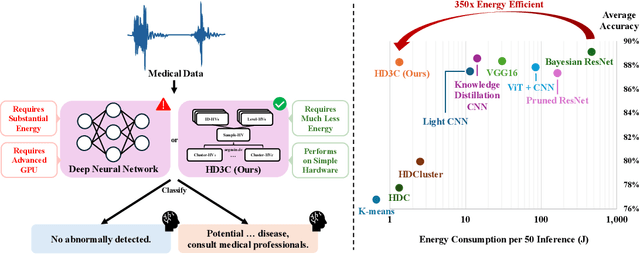
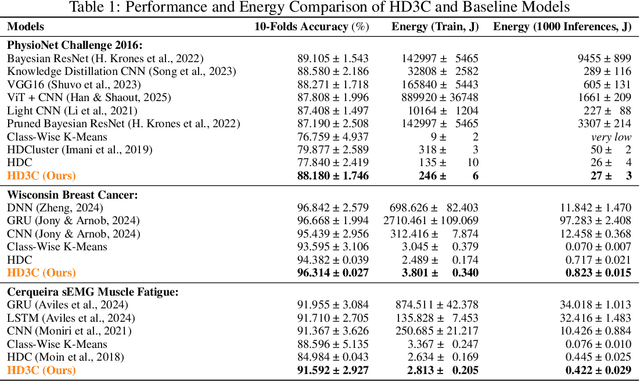
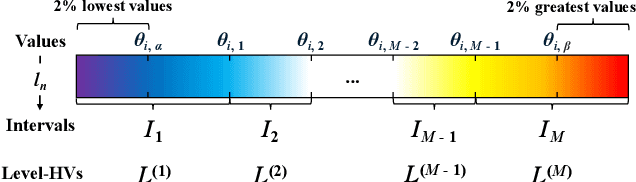
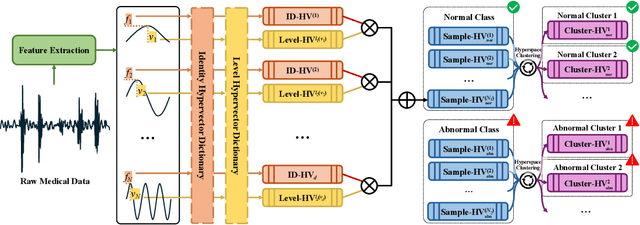
Energy-efficient medical data classification is essential for modern disease screening, particularly in home and field healthcare where embedded devices are prevalent. While deep learning models achieve state-of-the-art accuracy, their substantial energy consumption and reliance on GPUs limit deployment on such platforms. We present Hyperdimensional Computing with Class-Wise Clustering (HD3C), a lightweight classification framework designed for low-power environments. HD3C encodes data into high-dimensional hypervectors, aggregates them into multiple cluster-specific prototypes, and performs classification through similarity search in hyperspace. We evaluate HD3C across three medical classification tasks; on heart sound classification, HD3C is $350\times$ more energy-efficient than Bayesian ResNet with less than 1% accuracy difference. Moreover, HD3C demonstrates exceptional robustness to noise, limited training data, and hardware error, supported by both theoretical analysis and empirical results, highlighting its potential for reliable deployment in real-world settings. Code is available at https://github.com/jianglanwei/HD3C.
Interleave-VLA: Enhancing Robot Manipulation with Interleaved Image-Text Instructions
May 04, 2025Vision-Language-Action (VLA) models have shown great promise for generalist robotic manipulation in the physical world. However, existing models are restricted to robot observations and text-only instructions, lacking the flexibility of interleaved multimodal instructions enabled by recent advances in foundation models in the digital world. In this paper, we present Interleave-VLA, the first framework capable of comprehending interleaved image-text instructions and directly generating continuous action sequences in the physical world. It offers a flexible, model-agnostic paradigm that extends state-of-the-art VLA models with minimal modifications and strong zero-shot generalization. A key challenge in realizing Interleave-VLA is the absence of large-scale interleaved embodied datasets. To bridge this gap, we develop an automatic pipeline that converts text-only instructions from real-world datasets in Open X-Embodiment into interleaved image-text instructions, resulting in the first large-scale real-world interleaved embodied dataset with 210k episodes. Through comprehensive evaluation on simulation benchmarks and real-robot experiments, we demonstrate that Interleave-VLA offers significant benefits: 1) it improves out-of-domain generalization to unseen objects by 2-3x compared to state-of-the-art baselines, 2) supports flexible task interfaces, and 3) handles diverse user-provided image instructions in a zero-shot manner, such as hand-drawn sketches. We further analyze the factors behind Interleave-VLA's strong zero-shot performance, showing that the interleaved paradigm effectively leverages heterogeneous datasets and diverse instruction images, including those from the Internet, which demonstrates strong potential for scaling up. Our model and dataset will be open-sourced.